Superlines Review 2026
Generative Engine Optimization platform that tracks brand visibility in AI search results and provides content recommendations to improve AI citation rates.
Key takeaways
- Superlines tracks brand visibility across 10+ AI search platforms including ChatGPT, Gemini, Perplexity, Claude, Google AI Overviews, DeepSeek, Grok, Copilot, and Mistral
- Uses real front-end interface scraping rather than API calls, which means you see what actual users see -- not a sanitized API response
- Monitoring-focused platform: lacks AI content generation, AI crawler logs, traffic attribution, Reddit/YouTube tracking, and prompt volume scoring that Promptwatch provides
- Starts at €89/month with a 7-day free trial; enterprise and agency tiers available
- Good fit for brands and agencies that want structured GEO reporting and competitive benchmarking; less suited for teams that need to act on visibility gaps with content tooling
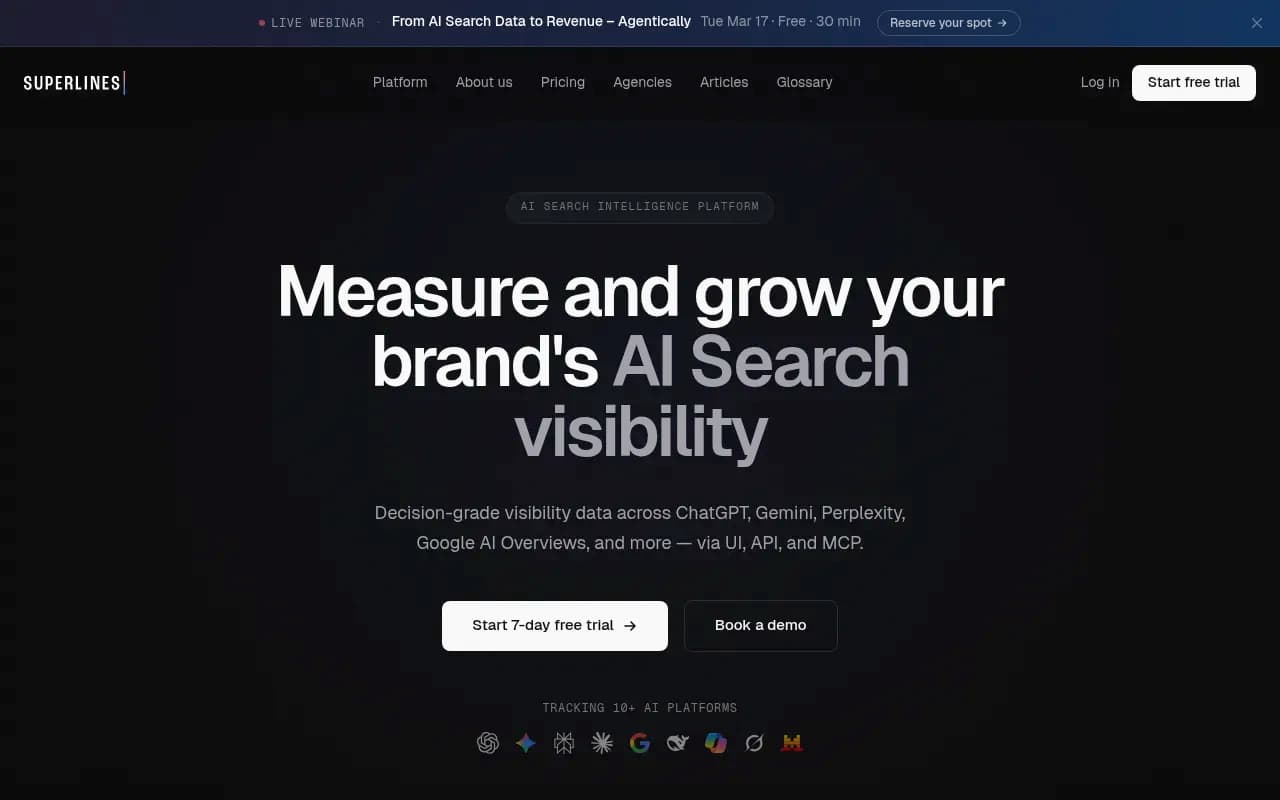
Superlines is a Finnish AI search intelligence platform built for brands and agencies that want to understand how they appear in AI-generated answers. The product positions itself as an "AI Search Console" -- a structured, data-driven way to track citations, brand mentions, sentiment, and share of voice across the major AI engines that are increasingly replacing traditional search for product discovery and brand research.
The company appears to be based in Finland, with customers including Tallink Silja, Supabase, Tietoevry, and Finnlines -- a mix of Nordic enterprises and global tech companies. The platform targets marketing teams, SEO professionals, and digital agencies that are starting to take AI search seriously as a channel, particularly those who need to report on AI visibility to clients or internal stakeholders.
Superlines entered the GEO market at a time when most brands still have no idea how AI models describe them. That's a real problem worth solving. The pitch is straightforward: you can't optimize what you can't measure, and traditional SEO tools like Semrush or Ahrefs don't capture what ChatGPT says about your brand when someone asks for a product recommendation. Superlines fills that gap with a purpose-built monitoring layer.
Key features
Real front-end AI interface monitoring Rather than querying AI model APIs directly, Superlines captures the actual outputs shown in the user-facing interfaces of ChatGPT, Gemini, Perplexity, and others. This is a meaningful distinction. API responses can differ from what users see in practice -- especially for Google AI Overviews and Perplexity, which blend web citations with model-generated text in ways that don't always surface cleanly through an API. Superlines claims this gives "decision-grade" data that reflects real user experience.
Multi-platform coverage across 10+ AI engines The platform monitors ChatGPT, Google Gemini, Perplexity, Claude, Google AI Overviews, Google AI Mode, DeepSeek, Microsoft Copilot, Grok, and Mistral. That's broad coverage for a platform at this price point. Most competitors cover 4-6 engines at comparable tiers. Coverage matters because different AI engines have different citation behaviors -- a brand visible on Perplexity may be invisible on Gemini.
Competitive benchmarking Superlines lets you track how competitors perform across AI search engines side by side. You can see which brands are cited most often, what content earns them visibility, and how share of voice shifts over time. The platform also surfaces new market entrants -- useful for category-level monitoring where the competitive set is changing. Benchmarking is available at market-specific levels, across regions and languages.
AI visibility signals Beyond raw citation counts, Superlines surfaces signals about why competitors are being cited over you. This includes which URLs AI models prefer, how your brand is framed in responses, and sentiment analysis. Understanding framing matters: a brand can be cited frequently but described negatively, which is a different problem than not being cited at all.
Prompt management and tracking You build a governed set of tracked prompts covering your category, use cases, and competitors, then run them continuously across AI models. This is the core workflow. The platform structures prompt management so teams can maintain consistency over time rather than running ad hoc queries. Prompts can be organized by market, language, and persona.
MCP server and API access Superlines offers a Model Context Protocol (MCP) server alongside a standard API. The MCP integration is notable -- it lets you feed real-time visibility data directly into AI agents and custom workflows. For teams building internal AI tooling or wanting to pipe GEO data into their existing analytics stack, this is a practical differentiator. The API supports custom reporting and data export.
Agency multi-client management For agencies, Superlines provides a single platform to manage multiple client accounts, generate exportable reports, and access the underlying data via API. There's a partner program with revenue sharing and agency-specific benefits. The reporting layer is designed to be client-presentable, which matters for agencies trying to add AI search as a billable service.
In-app agent Superlines includes an in-app agent that can help translate visibility findings into prioritized actions -- what to publish, what to update, what to fix technically. This is positioned as a way to bridge the gap between data and execution. That said, it's worth noting this is a guidance layer rather than a full content generation engine.
Who is it for
Superlines fits best for marketing and SEO teams at mid-market to enterprise brands that are starting to treat AI search as a measurable channel. Think a Head of SEO at a Nordic retail brand managing 3-5 markets, or a digital marketing manager at a B2B SaaS company who needs to report AI visibility metrics to a CMO. The platform's emphasis on "decision-grade" data and structured reporting suggests it's aimed at people who need to justify GEO investment internally, not just explore it.
Agencies are a clear target. The multi-client management, exportable reports, and partner program are all built for agency workflows. An SEO agency managing 10-20 client accounts could use Superlines to add AI search reporting as a service line, with the API feeding data into custom client dashboards. The Finnish customer base (Tulos, Hakea, Kumppania) suggests strong traction with Nordic digital agencies specifically.
Superlines is less suited for teams that need to do something with the data beyond monitoring. If your primary need is to identify content gaps and then generate content that gets cited by AI models, the platform's tooling stops short. There's no built-in AI writing agent, no AI crawler log analysis, and no traffic attribution connecting AI visibility to actual revenue. Teams that need the full optimization loop -- find gaps, create content, measure results -- will hit the ceiling of what Superlines offers fairly quickly.
Integrations and ecosystem
API and MCP server: Superlines offers a REST API and a Model Context Protocol server for feeding visibility data into custom workflows and AI agents. This is one of the more developer-friendly aspects of the platform.
UI-based reporting: Exportable reports are available for agency use cases. The format appears to be designed for client presentations.
No native integrations with Google Search Console, Looker Studio, or Slack were found in the scraped content. This is a gap compared to platforms that connect AI visibility data to broader marketing analytics stacks.
GitHub presence: Superlines has a GitHub organization (github.com/Superlines), though the public repositories appear limited based on available information.
No browser extension or mobile app was found in the product documentation.
Pricing and value
Superlines uses usage-based pricing starting at €89/month, with a 7-day free trial and a cancel-anytime policy. The pricing page mentions three tiers, though the exact feature breakdown per tier wasn't fully available in the scraped content. Third-party sources (SaaSworthy) list different price points ($14.92-$49/month), which may reflect outdated data or a different product version -- the current website clearly states €89/month as the starting point.
At €89/month, Superlines is positioned as more affordable than some enterprise-focused competitors. The company's own comparison page notes that AthenaHQ starts at $295/month, making Superlines "less than a third" of that price. For a single brand tracking a moderate number of prompts across multiple AI engines, €89/month is a reasonable entry point.
Enterprise and agency pricing is available on request. The partner program for agencies includes revenue sharing, which suggests custom pricing structures for high-volume agency use.
Compared to Promptwatch, which starts at $99/month for its Essential tier (1 site, 50 prompts, 5 articles), Superlines is in a similar price range at entry level. However, Promptwatch's tiers include AI content generation and crawler logs that Superlines doesn't offer, which affects the value comparison depending on what you need.
Strengths and limitations
What Superlines does well:
- Real front-end interface monitoring is a genuine technical differentiator. Capturing what users actually see, rather than API responses, produces more accurate data for brands trying to understand real-world AI visibility.
- Multi-platform coverage is broad. Ten AI engines at the entry price point is competitive, and the inclusion of Google AI Mode alongside Google AI Overviews shows attention to how Google's AI search is evolving.
- The MCP server integration is forward-thinking. As more teams build internal AI agents, having a GEO data source that plugs directly into those workflows via MCP is a practical capability that most competitors haven't built yet.
- The agency workflow (multi-client management, exportable reports, partner program) is well-considered for the agency market.
Honest limitations:
- No AI content generation: Superlines identifies what to fix but doesn't help you fix it. There's no built-in writing agent to generate content optimized for AI citation. Promptwatch's AI writing agent generates articles grounded in 880M+ citations analyzed -- Superlines has no equivalent.
- No AI crawler logs: Superlines doesn't show you which pages AI crawlers are visiting on your site, how often, or what errors they encounter. Promptwatch's crawler log feature gives teams visibility into how AI engines discover (or fail to discover) their content. This is a meaningful gap for technical SEO teams.
- No traffic attribution: There's no mechanism to connect AI visibility to actual website traffic or revenue. Promptwatch offers traffic attribution via code snippet, Google Search Console integration, or server log analysis. Without this, Superlines users can't close the loop between visibility scores and business outcomes.
- No Reddit or YouTube tracking: AI models frequently cite Reddit threads and YouTube videos in their responses. Superlines doesn't surface these sources. Promptwatch tracks Reddit and YouTube discussions that influence AI recommendations -- a channel Superlines ignores entirely.
- No prompt volume or difficulty scoring: Superlines doesn't appear to offer volume estimates or difficulty scores for tracked prompts, making it harder to prioritize which prompts are worth winning. Promptwatch's Prompt Intelligence feature includes volume estimates, difficulty scores, and query fan-outs.
- No ChatGPT Shopping tracking: For e-commerce brands, ChatGPT's product recommendation carousels are a growing channel. Superlines doesn't track these.
Bottom line
Superlines is a solid monitoring platform for brands and agencies that want structured, multi-engine AI search visibility data without a large upfront investment. The real front-end scraping approach and MCP server integration are genuine technical strengths, and the platform is well-suited for teams that need to report on AI visibility to clients or stakeholders.
The limitation is that it stops at monitoring. Teams that need to act on what they find -- identifying content gaps, generating AI-optimized content, attributing AI traffic to revenue -- will need a more complete platform. For that, Promptwatch covers the full optimization loop that Superlines doesn't reach.
Best use case: a digital agency or mid-market brand that needs clean, multi-engine AI visibility reporting and competitive benchmarking, and has a separate content team to act on the findings.
Frequently asked questions
What is Superlines?
How much does Superlines cost?
Which AI platforms does Superlines monitor?
Does Superlines help create content for AI search?
Is Superlines good for agencies?
How does Superlines differ from Promptwatch?
Similar and alternative tools to Superlines