Key takeaways
- Google AI Mode has crossed 200 million users and now triggers on approximately 48% of tracked search queries, up 58% year-over-year from early 2025.
- Citation patterns are highly concentrated: a small set of authority domains captures the majority of AI citations, meaning most brands are invisible by default.
- Google AI Mode's brand visibility rate (2.14%) is actually higher than Perplexity's (0.64%), but its citation rate (9.09%) is lower -- the two metrics tell very different stories.
- Brands winning in AI Mode are doing three things: building topical authority at scale, getting cited on third-party sources AI models trust, and tracking which pages actually get cited.
- Most traditional SEO tools don't give you the data you need here. You need visibility into how AI models read and cite your content specifically.
What Google AI Mode actually is now
A year ago, AI Mode was an experiment. Now it's infrastructure.
Google's I/O 2026 announcements made the direction unmistakable: VP of Search Elizabeth Reid described the goal as bringing "the best of a search engine with the best of AI" -- and the numbers back that up. Just one year after its debut, AI Mode has over 200 million users. Google AI Overviews (the lighter version of the same technology) now trigger on roughly 48% of all tracked search queries, a 58% year-over-year increase from February 2025, according to data from SQ Magazine.
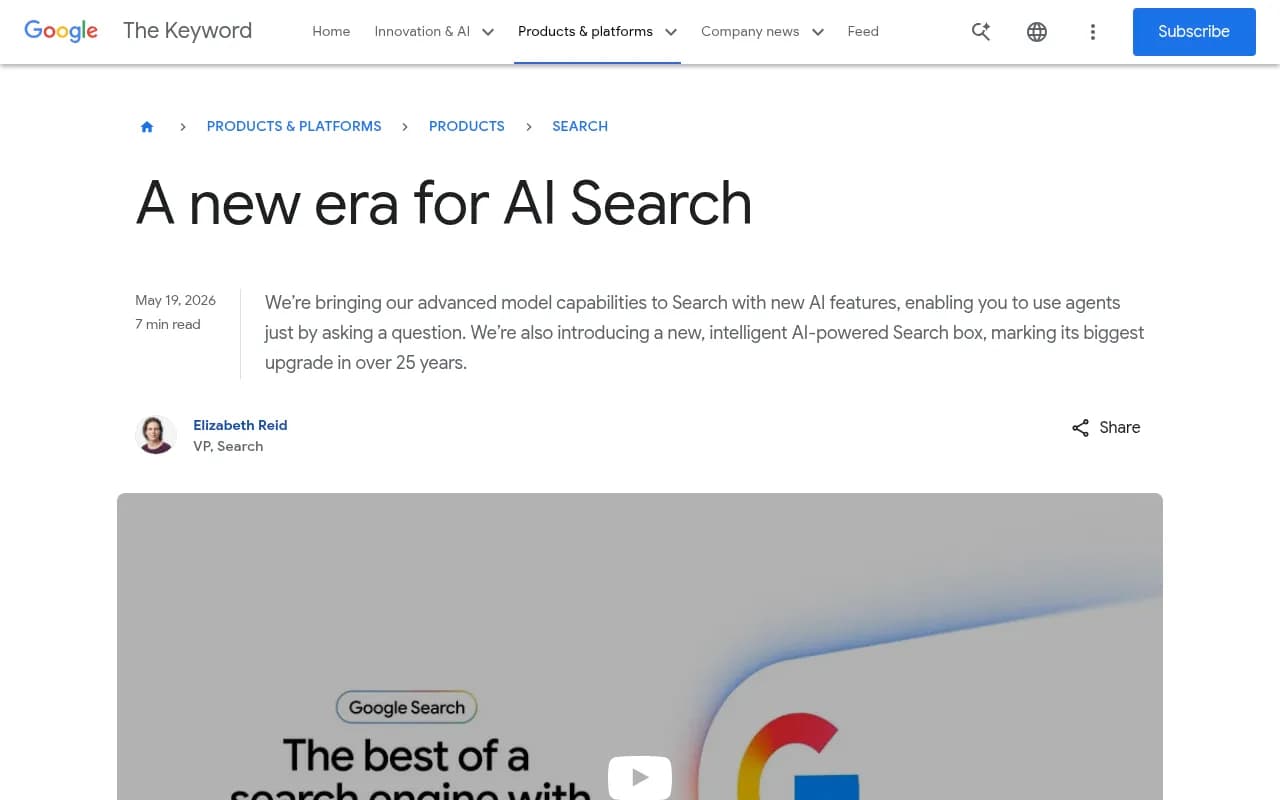
The I/O 2026 updates went further than most expected. Google is now letting users invoke AI agents directly from the search box -- not just getting an answer, but triggering multi-step tasks. The search box itself got its biggest redesign in 25 years. This isn't incremental. The product Google is building looks less like "search with an AI summary" and more like a general-purpose AI interface that happens to have a search index behind it.
For brands, that shift has real consequences. When users get answers from an AI agent rather than clicking through a list of links, the question isn't just "do we rank?" -- it's "does the AI know we exist, and does it trust us enough to cite us?"
The adoption numbers worth knowing
The market share picture in 2026 is genuinely complicated, and the simple headline ("Google still has 80% of search") understates what's happening.
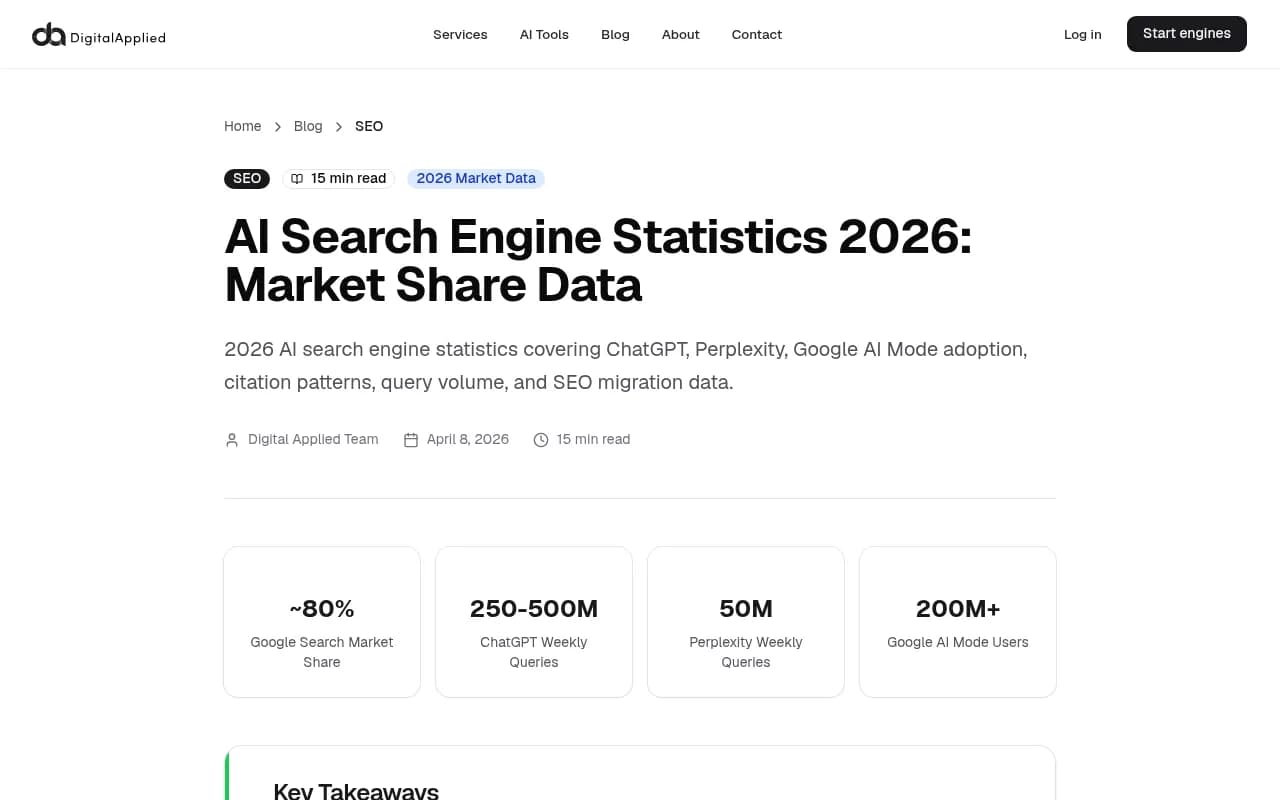
Google does hold roughly 80% of overall search market share. But that figure includes navigational queries (people typing brand names), transactional queries (people looking to buy something), and informational queries (people trying to learn or research something). The disruption is concentrated in that last category.
AI platforms -- ChatGPT Search, Perplexity, Google AI Mode, and Microsoft Copilot -- are capturing an estimated 15-20% of informational query volume. ChatGPT Search alone processes 250-500 million weekly queries. Perplexity handles around 50 million. These aren't rounding errors.
The traffic impact is asymmetric. Non-branded informational query traffic is down 15-30% across content sites. E-commerce and transactional sites are seeing more modest losses of 5-15%. If you run a content-heavy site -- a blog, a knowledge base, a resource library -- you're feeling this more acutely than a product-led site would.
What this means practically: the fight for AI Mode visibility isn't evenly distributed. Informational content is where the battle is happening right now.
Citation patterns: what the data actually shows
This is where things get interesting, and where most brand teams are flying blind.
Data from Superlines' 2026 AI search statistics report breaks down citation and visibility rates across AI platforms:
| Platform | Citation rate | Brand visibility rate |
|---|---|---|
| Perplexity | 13.05% | 0.64% |
| Google AI Mode | 9.09% | 2.14% |
| Gemini | 6.38% | (not specified) |
The counterintuitive finding: Google AI Mode has a lower citation rate than Perplexity (9.09% vs 13.05%), but a higher brand visibility rate (2.14% vs 0.64%). These metrics measure different things. Citation rate reflects how often a platform links to external sources at all. Brand visibility rate reflects how often a specific brand appears in responses.
What this tells you is that Google AI Mode is more selective about when it cites sources, but when it does, brands tend to appear more consistently. Perplexity cites sources more liberally, but those citations are spread across a wider, more fragmented set of domains.
Where citations actually cluster
BrightEdge and Ahrefs data show that roughly 40-55% of ChatGPT Search and Perplexity citations flow to fewer than 1,000 domains. Reddit, Wikipedia, Stack Overflow, and major news outlets dominate. This isn't a surprise -- AI models are trained on and trust sources that have demonstrated authority over time.
The practical implication is uncomfortable: if your brand doesn't appear on the sources AI models already trust, you're not going to get cited just by publishing more content on your own site. You need a presence on the platforms AI models use as reference points.
This is why brands are increasingly investing in:
- Getting featured in established listicles and comparison articles on high-authority domains
- Building a Reddit presence (actual participation, not spam)
- Earning coverage in trade publications and news outlets that AI models consistently cite
- Creating content that directly answers the questions AI models are already being asked
How Google AI Mode selects sources
Understanding the selection mechanism matters if you want to influence it.
Google AI Mode draws on several signals when deciding what to cite and what to surface in AI-generated responses:
Topical authority: The model favors sources that have demonstrated depth on a topic over time, not just pages that rank well for a single keyword. A site with 50 well-structured articles on a specific subject will outperform a site with one strong page on that subject.
Entity recognition: Google's knowledge graph plays a role. Brands that are clearly established as entities -- with consistent NAP data, Wikipedia presence, structured data markup, and cross-web mentions -- get treated differently than anonymous domains.
Freshness and accuracy signals: AI Mode is more likely to cite content that's been recently updated and that aligns with other trusted sources. Contradicting established consensus without strong evidence is a fast way to get deprioritized.
Direct answer density: Content that answers specific questions clearly and early tends to get cited more than content that buries the answer in narrative. This is a structural shift from traditional SEO, where longer content often won.
Third-party validation: If your brand is mentioned positively in sources AI models already trust, that signal carries weight. It's similar to the logic behind traditional link building, but the currency is citations in trusted content rather than backlinks.
What brands are actually doing about it
The response from marketing teams in 2026 falls into a few distinct patterns.
Building topical authority at scale
The brands seeing the best results in AI Mode are treating it like a content infrastructure problem. They're mapping out every question a potential customer might ask in their category, then systematically creating content that answers those questions directly and authoritatively.
This isn't about keyword density. It's about coverage. If a user asks an AI model "what's the best approach to [your category]?" and your brand has written the definitive piece on that topic, you have a shot at being cited. If you haven't, you don't.
Tools like Promptwatch help with this by running Answer Gap Analysis -- showing you which prompts competitors are being cited for that you're not. That kind of prompt-level data is hard to get from traditional SEO tools, which weren't built to track AI citation behavior.

Getting onto the sources AI trusts
Several brands have shifted budget toward what you might call "AI citation PR" -- actively pursuing coverage on the domains AI models reliably cite. This means pitching trade publications, getting listed in comparison articles on high-authority sites, and building genuine presence on Reddit and YouTube (both of which Google AI Mode draws on heavily).
This is different from traditional link building. The goal isn't PageRank -- it's appearing in the training and retrieval data that AI models use when forming responses.
Tracking which pages actually get cited
A growing number of marketing teams are moving beyond rank tracking to citation tracking. Knowing that you "rank #3 for X" tells you less than knowing "our pricing page is being cited in AI Mode responses about [category], but our product comparison page isn't."
Page-level citation data is what lets you make specific decisions: update this page, restructure that one, create a new piece to fill this gap.
Tools like Semrush have added AI Mode tracking features, though their approach uses fixed prompts rather than dynamic prompt monitoring.
For more granular tracking across multiple AI platforms simultaneously, platforms like Profound and AthenaHQ offer enterprise-grade monitoring.
Profound


Structured data and technical optimization
This one is less glamorous but genuinely matters. AI models parse structured data. FAQ schema, HowTo schema, Article schema, and Product schema all give AI models cleaner signals about what your content contains and how to use it.
Brands that have invested in structured data markup are seeing it pay off in AI Mode in ways it didn't always pay off in traditional search. The signal is cleaner and more machine-readable, which is exactly what an AI model wants.
The agent layer: what I/O 2026 changes
The I/O 2026 announcements introduced something that goes beyond AI-generated summaries: agentic search. Users can now ask Google to complete multi-step tasks -- research a topic, compare options, draft a response -- all within the search interface.
This matters for brands because it changes the nature of the interaction. When a user asks an agent to "find me the best [product category] options under $X and compare them," the agent isn't just surfacing a list of links. It's making decisions, synthesizing information, and potentially completing transactions.
Brands that aren't in the agent's consideration set at the research phase won't appear in the comparison phase. And brands that aren't in the comparison phase won't appear in the recommendation.
The funnel is collapsing into a single AI-mediated interaction, and visibility at the top of that interaction is what determines whether you exist in the user's decision-making process at all.
A practical framework for AI Mode visibility
If you're trying to build a systematic approach rather than reacting to each update, here's how to think about it:
Step 1: Audit your current AI visibility. Before you can improve anything, you need to know where you stand. Which prompts is your brand appearing in? Which competitors are being cited when you're not? What's your citation rate across different AI platforms?
Step 2: Map the prompt landscape in your category. What are users actually asking AI models about your industry? These aren't always the same as your target keywords. AI prompts tend to be longer, more conversational, and more specific than traditional search queries.
Step 3: Identify content gaps. Where are competitors being cited for prompts that you should be winning? These gaps represent specific content opportunities -- not generic "write more content" advice, but precise topics and angles that AI models are actively looking for answers to.
Step 4: Create content engineered for AI citation. This means direct answers early in the piece, strong topical depth, clear entity signals, and structured data markup. It also means publishing on the platforms AI models trust, not just your own site.
Step 5: Track citation results at the page level. Monitor which of your pages are being cited, by which AI models, and for which prompts. Use that data to prioritize your next round of updates and new content.
This cycle -- find gaps, create content, track results -- is what separates brands that are growing their AI visibility from those that are watching it erode.
Tools worth knowing about
Beyond the major platforms, a few tools have emerged specifically for AI search visibility work:
Otterly.AI


The market for AI visibility tools is moving fast. Most of the tools that existed 18 months ago have added features, and new entrants appear regularly. The key question to ask of any tool: does it show you what to do, or just what's happening? Monitoring without action is useful for reporting but won't move your numbers.
The honest assessment
Google AI Mode is not going to replace traditional search overnight. The 80% market share figure is real, and navigational and transactional queries are still largely handled by traditional search mechanics.
But informational queries -- the ones that drive awareness, consideration, and research -- are being captured by AI interfaces at a rate that's already material for content-heavy sites. And the I/O 2026 announcements make clear that Google is accelerating this, not slowing down.
The brands that are taking AI Mode seriously now are building citation authority, topical depth, and tracking infrastructure while the competitive landscape is still relatively open. That window won't stay open indefinitely. As more brands invest in AI visibility, the citation clusters will become harder to break into.
The data is clear enough: 48% of queries triggering AI Overviews, 200 million AI Mode users, 15-30% informational traffic declines. The question isn't whether this matters. It's whether you're building the infrastructure to compete in it.