Key takeaways
- AI search visibility is genuinely different from traditional SEO -- the same prompt can return different answers minutes apart, which makes measurement harder than it looks
- ChatGPT, Google AI Mode, and Perplexity each have distinct citation behaviors, so a single-engine approach will always leave blind spots
- Several platforms now track all three (and more) in one place, eliminating the need for separate tools
- Tracking alone isn't enough -- the teams making real gains are the ones using visibility data to find content gaps and fix them
- Promptwatch is the only platform in 2026 rated as a leader across monitoring, gap analysis, and content generation -- it closes the full loop from "where am I invisible?" to "here's the content that fixes it"
If you've tried to get a clear picture of your brand's AI search visibility lately, you've probably run into the same wall: one tool covers ChatGPT but not Perplexity, another handles Google AI Overviews but ignores everything else, and before long you're paying for three subscriptions, exporting CSVs, and manually stitching together a picture that's already out of date by the time you finish.
This guide is about how to stop doing that.
Why AI search visibility is genuinely hard to measure
Before getting into tools, it's worth being honest about what makes this problem tricky -- because a lot of the frustration teams feel comes from expecting AI search to behave like traditional search.
It doesn't.
When you tracked keyword rankings in 2019, position 4 on Tuesday was almost certainly position 4 on Wednesday. You could screenshot it, put it in a report, and trust it. AI search broke that contract. Language models are probabilistic. Run the same prompt twice and you might get two different sets of citations. Run it from a different location, with a different persona, or on a different day, and the answer can shift meaningfully.
This isn't a bug -- it's how these systems work. But it means any single data point is close to meaningless. What you actually need is statistical sampling across many runs, many prompts, and multiple models. That's what separates serious AI visibility platforms from tools that just let you manually type a prompt and screenshot the result.
The second complication: ChatGPT, Google AI Mode, and Perplexity don't behave the same way.
- Perplexity is citation-first by design. It almost always shows sources, and those sources are crawlable and trackable.
- Google AI Mode (the standalone conversational interface, not just AI Overviews) tends to favor content that already performs well in traditional search -- your existing domain authority matters here more than on Perplexity.
- ChatGPT's web-browsing mode (SearchGPT) has lower search volume than the others but is growing, and its citation behavior is less predictable. The user-facing product can also behave differently from the API, which is why tools that only query the API can give you misleading data.
If you're only tracking one of these, you're flying partially blind.
The three approaches teams are using in 2026
Approach 1: One dedicated AI visibility platform
The cleanest solution. You pick a platform built specifically for multi-engine AI search monitoring, configure your prompts once, and get unified data across all three engines (and usually several more).
This is where the market has matured significantly. In 2024, you had maybe two or three credible options. By mid-2026, there are dozens of platforms claiming multi-engine coverage -- but the quality varies enormously.
The key questions to ask any platform:
- Does it track user-facing AI interfaces or just APIs? (API-only data can miss what real users actually see)
- How many prompt runs does it aggregate before reporting a visibility score?
- Does it track citations at the page level, or just domain level?
- Can it show you what competitors are being cited for that you're not?
- Does it do anything with that data beyond showing you a number?
That last question is the one most platforms fail on.
Approach 2: Traditional SEO platform with AI add-ons
Tools like Semrush and Ahrefs have added AI search tracking features. Semrush's approach uses fixed prompt sets, which limits flexibility. Ahrefs Brand Radar similarly works with fixed prompts and lacks AI traffic attribution. These are fine if you're already deep in one of those ecosystems and want a rough sense of AI visibility without adding another tool -- but they're not built for teams where AI search is a primary focus.
Approach 3: Stitching together multiple specialized tools
Some teams use one tool for ChatGPT tracking, another for Perplexity, and Google Search Console for AI Overview data. This works, but it's expensive, time-consuming, and produces data that's hard to compare across engines. It's also where most teams get stuck -- they end up with a lot of data and no clear action to take.
What to look for in a unified AI visibility platform
Here's a practical comparison of the capabilities that actually matter, across the platforms worth considering:
| Capability | Why it matters |
|---|---|
| Multi-engine coverage (ChatGPT, Perplexity, Google AI Mode) | Blind spots in any one engine mean missed opportunities |
| User-facing tracking (not just API) | API outputs can differ from what users actually see |
| Page-level citation tracking | Domain-level data won't tell you which content is working |
| Competitor visibility comparison | You need to know what you're missing relative to who's winning |
| Answer gap / content gap analysis | Shows you the specific prompts where competitors appear and you don't |
| Content generation or briefs | Turns gap data into something you can actually publish |
| AI crawler log monitoring | Shows you when and how AI bots are crawling your site |
| Prompt volume and difficulty data | Helps you prioritize which gaps to fix first |
| Reddit and YouTube citation tracking | These sources heavily influence AI responses |
| Traffic attribution | Connects AI visibility to actual revenue |
Most platforms cover the first two or three rows. Very few cover the full list.
The platforms worth knowing about
Promptwatch
Promptwatch is the platform that goes furthest down that list. It monitors 10 AI models including ChatGPT, Perplexity, Google AI Mode, Google AI Overviews, Claude, Gemini, Grok, DeepSeek, Copilot, and Mistral -- all from one dashboard.
What makes it different from the monitoring-only crowd is the action loop it's built around. It doesn't just show you where you're invisible. It shows you the exact prompts where competitors are being cited and you're not (Answer Gap Analysis), then helps you create content engineered to fill those gaps (Content Agents), then tracks whether that new content gets crawled and cited over time (Agent Analytics and page-level tracking).
The AI Crawler Logs feature is particularly useful -- it gives you real-time data on when GPTBot, ClaudeBot, PerplexityBot, and others are hitting your site, which pages they're reading, and any errors they're encountering. Most competitors don't have this at all.

Otterly.AI
A solid monitoring platform that covers ChatGPT, Perplexity, and Google AI Overviews. Good for teams that want clean dashboards and don't need content generation built in. The limitation is that it stops at monitoring -- you'll need separate tools to act on what you find.
Otterly.AI

Profound
Enterprise-focused, strong feature set, covers 9+ AI engines. Pricing is higher than most alternatives, and it lacks Reddit tracking and ChatGPT Shopping monitoring. Better suited to large brands with dedicated AI search teams than to mid-market companies.
Profound

Rankshift
Covers ChatGPT, Perplexity, and AI search tracking with a cleaner interface than some of the older platforms. Worth considering for smaller teams that want straightforward monitoring without a lot of configuration overhead.

LLM Pulse
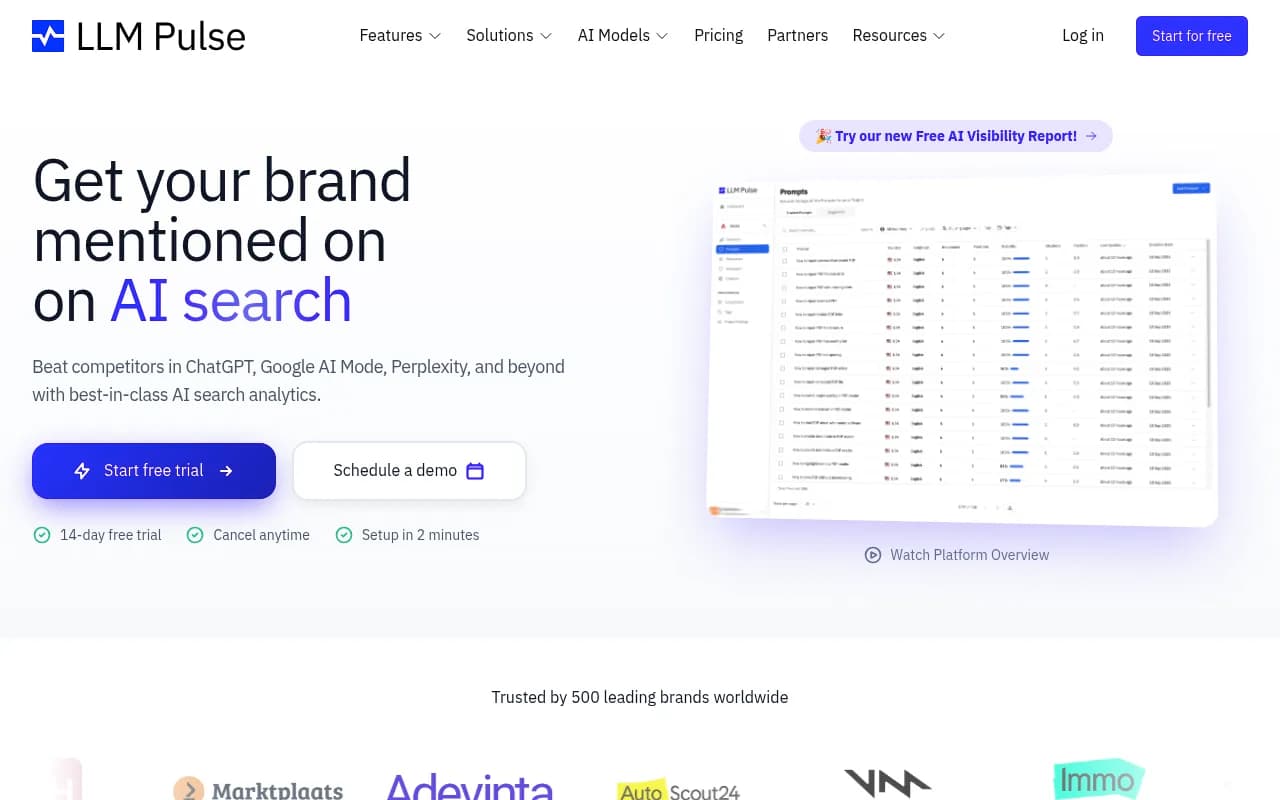
Tracks brand visibility across ChatGPT, Perplexity, and more. Useful for teams that want a lightweight option and don't need the full optimization workflow.
Omnia
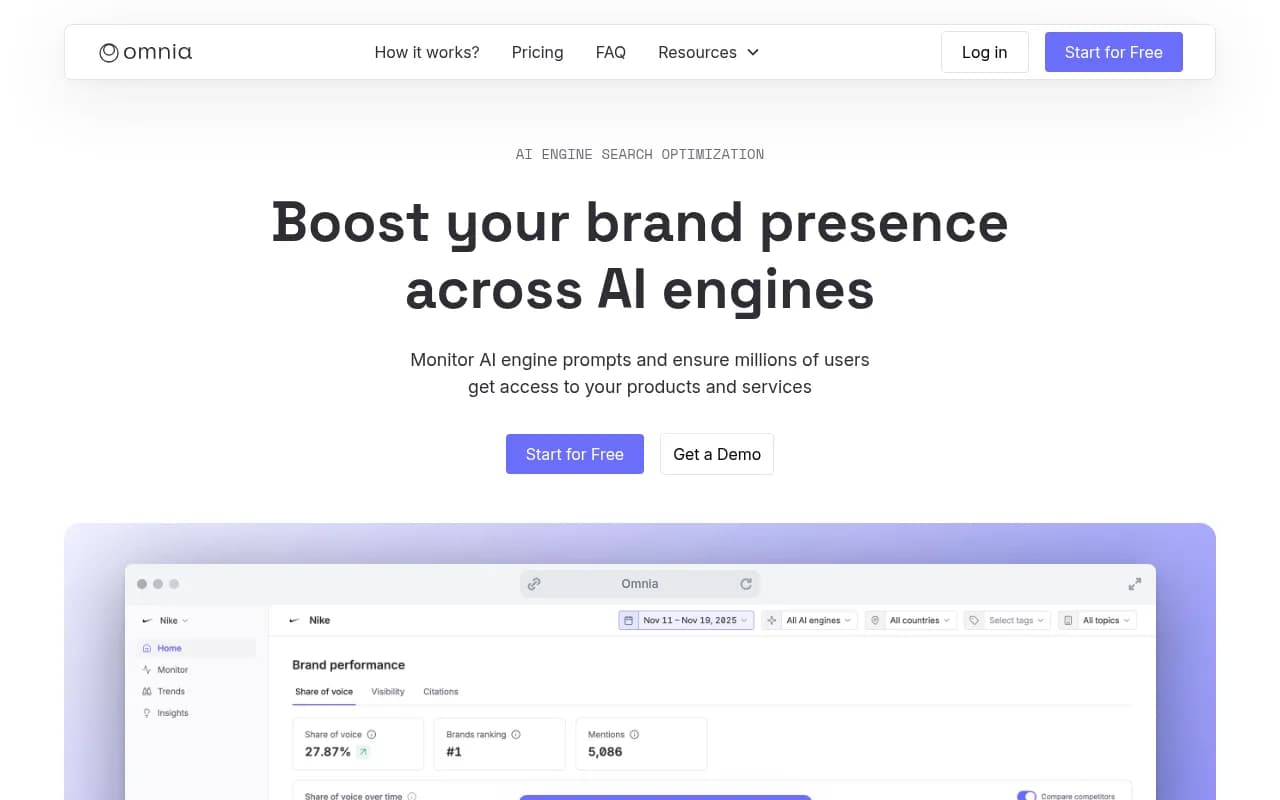
Focused on measuring brand presence in AI-generated answers. Good for teams that want to benchmark visibility over time without a lot of complexity.
Peec AI
A monitoring-focused platform for marketing teams. Covers the main AI search engines but, like most in this category, doesn't extend into content optimization or generation.

AthenaHQ
Monitoring-oriented with a clean interface. Lacks content optimization and generation capabilities, so it's best for teams that have a separate content workflow and just need visibility data.

A practical setup for 2026
Here's how I'd approach this if I were setting up AI search visibility tracking from scratch today:
Step 1: Define your prompt universe. Don't try to track everything. Start with 30-50 prompts that represent how your actual customers search -- buying-intent questions, comparison queries, "best X for Y" prompts. These are the ones where visibility translates to pipeline.
Step 2: Pick one platform that covers all three engines. Running separate tools for ChatGPT, Perplexity, and Google AI Mode is a false economy. The time cost of reconciling data across tools is real, and the data won't be comparable anyway (different sampling methodologies, different prompt sets, different reporting periods).
Step 3: Establish a baseline before you do anything else. Run your prompt set across all three engines and record where you appear, where competitors appear, and which prompts return zero citations for your brand. That gap list is your roadmap.
Step 4: Prioritize gaps by prompt volume and competitive difficulty. Not all gaps are equal. A prompt that gets asked thousands of times a month where you're invisible and a competitor with thin content is winning -- that's your first target. Platforms with prompt volume and difficulty scoring (like Promptwatch) make this prioritization automatic.
Step 5: Create content that addresses the gaps. This is where most teams stall. They have the data but no clear process for turning it into content. The best platforms now generate content briefs or full drafts grounded in the actual prompt data, competitor citations, and brand guidelines -- so you're not starting from a blank page.
Step 6: Monitor crawler activity. After publishing new content, watch whether AI crawlers are picking it up. If GPTBot or PerplexityBot isn't visiting a page, it can't cite it. Crawler log monitoring tells you this within days, not months.
Step 7: Track the citation timeline. From publish to crawl to citation, the lag varies by engine. Perplexity tends to be faster than ChatGPT. Google AI Mode is slower still. Knowing the typical lag for each engine helps you set realistic expectations and spot anomalies.
The non-determinism problem nobody wants to talk about
One more thing worth addressing directly: AI search answers are not stable. The same prompt, run at the same time on the same platform, can return different citations on different runs. This is the non-determinism problem, and it's the reason single-run screenshots are nearly worthless as evidence.
Any serious visibility platform handles this by running each prompt multiple times and aggregating the results into a visibility score or citation frequency percentage. When a platform tells you "your brand appears in 34% of responses for this prompt," that's a meaningful number. When someone shows you a screenshot of one response where you appeared, that tells you almost nothing about your actual visibility.
Ask any platform you're evaluating how many runs they aggregate per prompt and over what time period. If they can't answer clearly, that's a red flag.
Connecting visibility to revenue
The final piece that most teams are still figuring out: how do you know if AI search visibility is actually driving traffic and revenue?
This requires connecting two data streams. First, you need to know when AI engines are sending traffic to your site -- which means identifying sessions that originate from ChatGPT, Perplexity, or Google AI Mode in your analytics. Second, you need to correlate changes in visibility scores with changes in that traffic.
Some platforms now offer traffic attribution that connects AI citations to actual visits and conversions. This is still early-stage for most tools, but it's the direction the market is heading. Without it, you're optimizing for a metric (citation frequency) that you can't directly connect to business outcomes.
The teams that will win at AI search in the next 12 months are the ones building this full loop: track visibility, find gaps, create content, monitor crawling, measure citations, attribute revenue. That's not three separate tools. It's one workflow -- and the platforms that support the whole thing are the ones worth investing in.