Key takeaways
- Otterly.AI is a solid monitoring tool, but it stops at showing you data — it doesn't help you act on it
- The most common frustration is the "implementation gap": you can see you're missing from AI responses, but the tool won't tell you why or what to change
- The alternatives below range from full GEO platforms with built-in content generation to budget-friendly trackers with stronger actionability
- If content generation and optimization are your priority, Promptwatch and Search Atlas are the strongest options in 2026
- Pricing across the category varies wildly — from $50/month for basic tracking to $500+ for enterprise platforms
Otterly.AI helped a lot of teams realize that AI search visibility was something worth tracking. That's genuinely valuable. But if you've been using it for more than a month, you've probably hit the same wall everyone else does: the dashboard tells you that competitors are appearing in ChatGPT responses you're not, and then... nothing. No explanation. No fix. Just a number that makes you feel bad.
That's not a knock on Otterly specifically — it's a category-wide problem. Most AI visibility tools were built to monitor, not to optimize. The ones worth switching to in 2026 are the ones that close that gap.
This guide focuses specifically on alternatives that include some form of content generation, content gap analysis, or optimization guidance. Pure monitoring tools that just show you a different dashboard aren't worth the migration cost.
Why teams are leaving Otterly.AI
The pricing structure is one issue. Otterly starts at $29/month for 10 prompts, which is barely enough to test the tool. Getting to 100 prompts costs $189/month — a 550% jump. The Pro tier hits $989/month. For what is essentially a monitoring dashboard, that's a hard sell to any finance team.
The bigger issue is actionability. As one user put it on Reddit: "It tracks the source, but gives zero actionable strategy on how to restructure content to get cited." You can see you appeared in 3 out of 10 ChatGPT responses — but you don't know why you're missing from the other 7, and the tool won't help you figure it out.
Other common complaints:
- Claude and Gemini coverage often requires add-ons in base plans
- No sentiment analysis to understand how AI characterizes your brand
- No content optimization guidance
- Weekly update cycles that can't keep pace with how fast AI search results shift
- Reporting that doesn't hold up in executive presentations
If your goal is to actively improve how AI models talk about your brand — not just watch it happen — you need something different.
How to evaluate alternatives
When comparing tools, focus on five things:
- Does it tell you what to change, not just what's happening?
- Does it generate or suggest content based on real gap data?
- Does it track the right AI engines for your audience?
- Does the pricing scale reasonably as your prompt set grows?
- Does it connect visibility to actual traffic or revenue?
With that in mind, here are the seven alternatives worth considering.
1. Promptwatch — best overall for GEO optimization with content generation
Promptwatch is the most complete option on this list if your goal is to actually improve AI visibility, not just measure it. The core difference from Otterly is that Promptwatch is built around an action loop: find gaps, create content, track results.

The Answer Gap Analysis feature shows you exactly which prompts competitors are visible for that you're not — and more importantly, it shows you the specific content your site is missing. Not just "you're not ranking for this prompt" but "here's what AI models want to answer this question that your site doesn't have."
From there, Content Agents generate articles, listicles, comparisons, and briefs grounded in real prompt data, citation volumes, persona targeting, and competitor analysis. This isn't generic AI writing — it's content built specifically to fill the gaps AI models are already exposing.
The platform also includes AI Crawler Logs, which show you in real time which pages AI crawlers are hitting, what errors they encounter, and when pages move from crawl to citation. Most competitors don't have this at all. Add in prompt volume estimates, difficulty scoring, query fan-outs, ChatGPT Shopping tracking, Reddit and YouTube citation analysis, and page-level tracking — and you have a tool that genuinely earns the "optimization platform" label rather than just "tracker."
Promptwatch monitors 10 AI models: ChatGPT, Perplexity, Google AI Overviews, Google AI Mode, Claude, Gemini, Meta/Llama, DeepSeek, Grok, Mistral, and Copilot.
Pricing starts at $99/month (Essential: 1 site, 50 prompts, 5 articles), $249/month (Professional: 2 sites, 150 prompts, 15 articles, crawler logs), and $579/month (Business: 5 sites, 350 prompts, 30 articles). A free trial is available.
2. Search Atlas — best for teams that want SEO + GEO in one place
Search Atlas has quietly become one of the more capable platforms in this space. It combines traditional SEO tools with AI search tracking and, crucially, includes content generation built into the workflow. You can identify gaps in your AI visibility and generate optimized content without switching tools.

What makes it stand out is the depth of the SEO side. If your team is already doing keyword research, backlink analysis, and site audits, Search Atlas lets you fold AI visibility into the same workflow rather than managing two separate platforms. The content generation is tied to actual SERP and AI response data, so the output is more targeted than generic AI writing tools.
It's a strong choice for SEO teams that are expanding into GEO and don't want to rebuild their entire stack.
3. AirOps — best for content engineering at scale
AirOps takes a different approach. Rather than being primarily a monitoring tool with content generation bolted on, it's built as a content engineering platform that happens to be designed for AI search visibility.
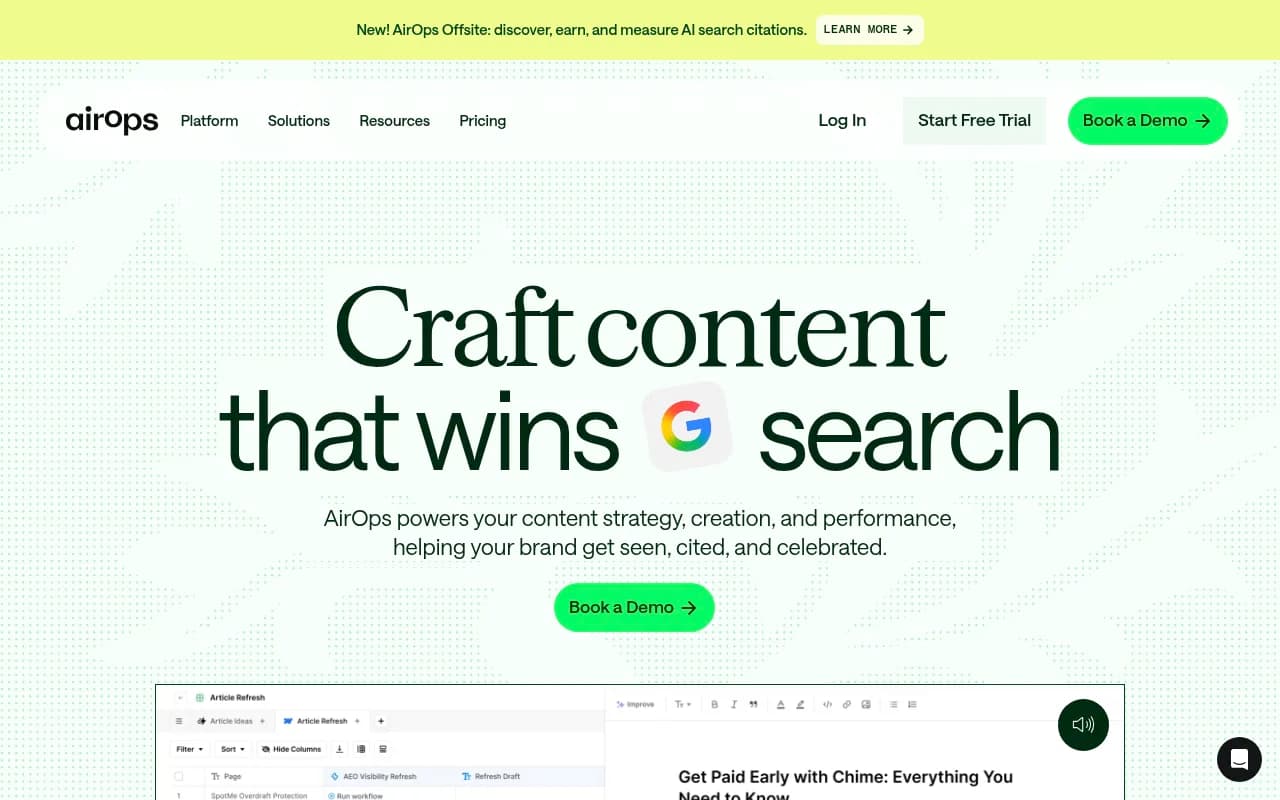
The platform lets you build content workflows that pull from real prompt data and citation analysis, then generate and publish content at scale. For teams producing high volumes of content — think agencies or brands with large content operations — this is more efficient than tools that generate one article at a time.
The trade-off is that AirOps is less of a "track your brand" tool and more of a "build content that ranks in AI" tool. If you need both in one place, you'll want to pair it with something else. But if content production is your bottleneck, it's worth a close look.
4. Scrunch AI — best for enterprise teams with complex AI journeys
Scrunch AI is built for larger organizations that need more than a simple dashboard. It includes GA4 integration, SOC 2 compliance, and what it calls AXP (AI Experience) layer tracking — mapping how AI models represent your brand across complex, multi-step customer journeys.
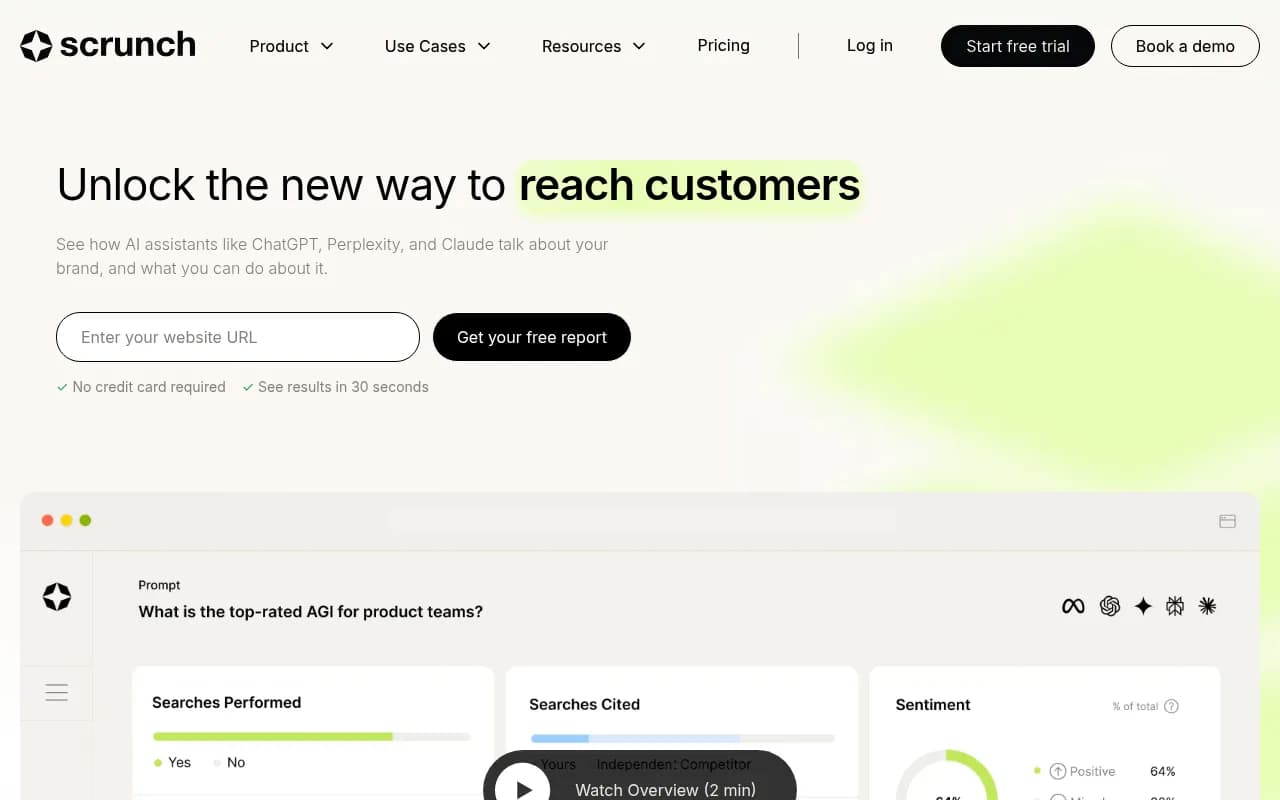
The content optimization features aren't as deep as Promptwatch or Search Atlas, but Scrunch does provide structured recommendations based on its analysis. For enterprise teams where compliance and data integration matter as much as the GEO features themselves, it's one of the few options that checks those boxes.
Pricing is on the higher end, and it's worth getting a demo before committing — the feature set is genuinely complex, and the value depends heavily on your use case.
5. SE Ranking — best for teams already in an SEO suite
SE Ranking added AI visibility tracking to its existing SEO platform, which means if you're already a customer, you get GEO monitoring without switching tools. The AI Visibility module tracks brand mentions across major AI engines and provides some content optimization guidance through its existing content tools.
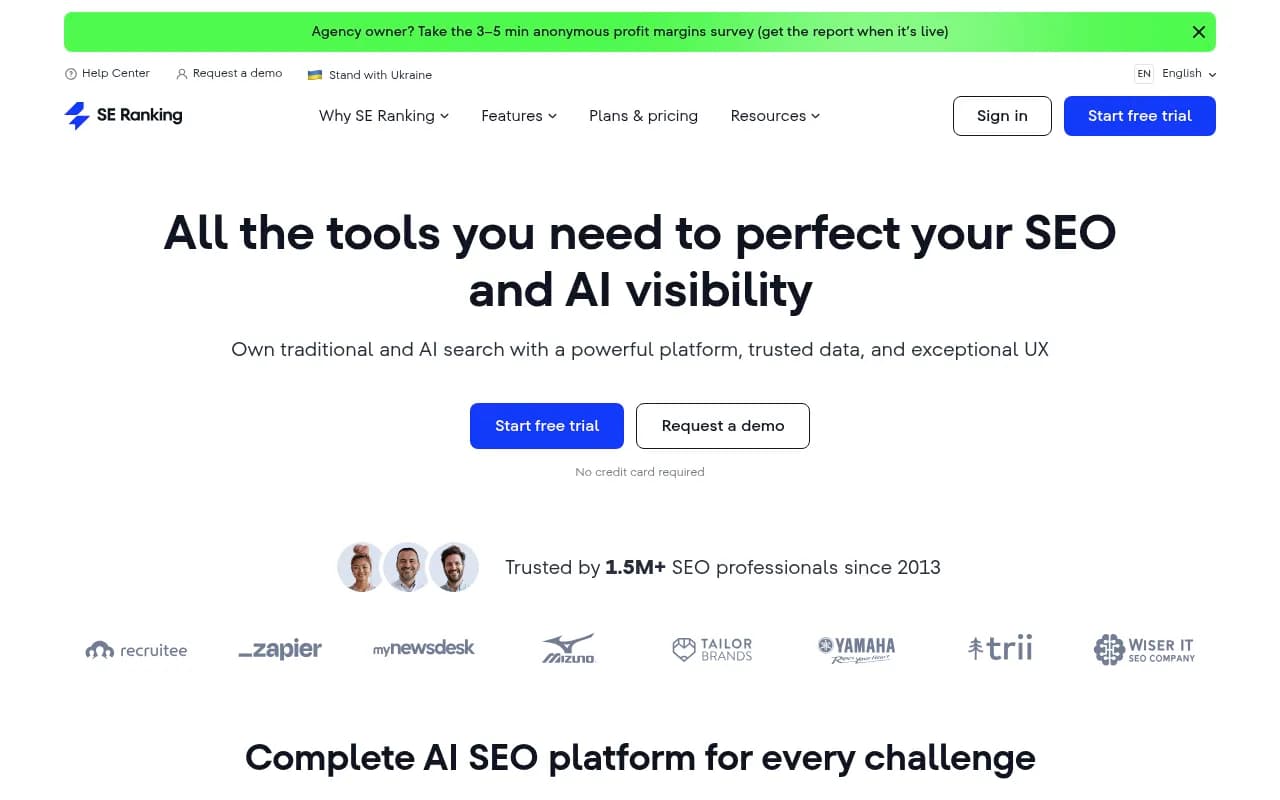
The honest assessment: SE Ranking's AI visibility features aren't as deep as dedicated GEO platforms. But if you're paying for SE Ranking anyway, the incremental cost to add AI tracking is low, and the integration with keyword data, rank tracking, and site audits is genuinely useful. You get a more complete picture of visibility across both traditional and AI search.
For teams that aren't ready to invest in a dedicated GEO platform, this is a reasonable starting point.
6. Writesonic — best for content-first teams that want GEO monitoring included
Writesonic is primarily known as an AI content platform, but it's added GEO tracking features that make it a legitimate alternative for teams where content production is the primary workflow and monitoring is secondary.

The GEO features track brand visibility across major AI engines and surface content recommendations. The content generation side is mature — Writesonic has been in the AI writing space long enough to have refined its output quality significantly. The combination makes sense for content teams that want to publish more AI-optimized content without learning a new monitoring tool from scratch.
The limitation is that the GEO tracking isn't as granular as dedicated platforms. You won't get crawler logs, prompt difficulty scoring, or deep citation analysis. But for a content-first workflow, it's a practical option.
7. Rankability — best for agencies managing multiple clients
Rankability is built with agencies in mind. It combines AI search tracking with content optimization tools and is designed to handle multiple clients without the workflow friction that single-brand tools create.
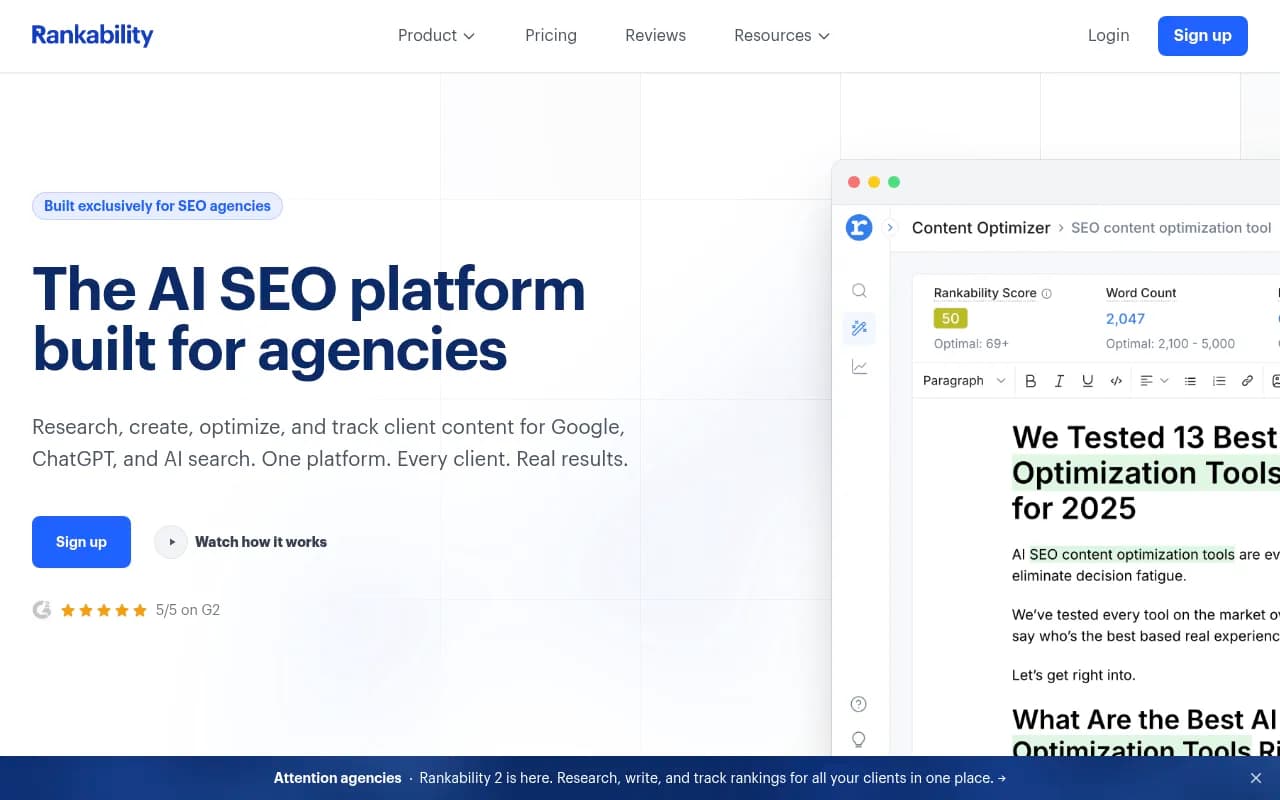
The content brief generation is solid — it pulls from AI response data to create briefs that are specifically designed to help content rank in AI search. For agencies that need to produce content recommendations at scale across different clients and industries, this is more practical than tools built for single brands.
The reporting is also agency-friendly, with white-label options and client-facing dashboards that are cleaner than most.
Quick comparison
| Tool | Content generation | AI engines tracked | Best for | Starting price |
|---|---|---|---|---|
| Promptwatch | Yes (Content Agents) | 10 (ChatGPT, Perplexity, Claude, Gemini, Grok, DeepSeek, Copilot, Meta AI, Mistral, AI Overviews) | Full GEO optimization + content | $99/mo |
| Search Atlas | Yes | Major engines | SEO + GEO teams | Custom |
| AirOps | Yes (workflow-based) | Varies | Content engineering at scale | Custom |
| Scrunch AI | Recommendations | Major engines | Enterprise / compliance-heavy | Custom |
| SE Ranking | Via content tools | Major engines | Existing SE Ranking customers | ~$65/mo |
| Writesonic | Yes (primary feature) | Major engines | Content-first teams | $199/mo |
| Rankability | Brief generation | Major engines | Agencies | Custom |
What to look for beyond content generation
Content generation is the most obvious gap between Otterly and these alternatives, but it's not the only thing worth evaluating. A few other capabilities that separate good GEO tools from great ones:
Crawler logs. Knowing that an AI model cited your page is useful. Knowing that the crawler visited your page 14 times before citing it — and what errors it encountered — is more useful. Very few tools have this.
Prompt volume and difficulty data. Not all prompts are worth tracking. Tools that show you which prompts have high search volume and which are actually winnable help you prioritize instead of guessing.
Reddit and YouTube tracking. AI models frequently cite Reddit threads and YouTube videos in their responses. If your competitors are winning citations through third-party content and you're only optimizing your own site, you're missing a significant channel.
Traffic attribution. Visibility scores are interesting. Revenue impact is what gets budget approved. Tools that connect AI citations to actual site traffic and conversions are significantly more defensible in internal conversations.
The bottom line
Otterly.AI is a reasonable entry point for AI visibility monitoring. But "monitoring" is the ceiling — it won't help you improve. If you've been using it for a few months and you're still asking "now what?" after every dashboard refresh, that's the signal to look at something else.
The tools on this list all go further in at least one meaningful way. For most teams, Promptwatch is the most complete option — the combination of gap analysis, content generation, crawler logs, and traffic attribution covers the full workflow. For teams with specific needs (agency scale, enterprise compliance, existing SEO stack integration), Search Atlas, Rankability, and SE Ranking are worth evaluating seriously.
The category is maturing fast. A year ago, most of these tools barely existed. The gap between monitoring-only tools and optimization platforms is only going to widen.