Key takeaways
- Google AI Mode crossed 1 billion monthly active users in May 2026, making AI citation eligibility a primary SEO concern -- not a nice-to-have.
- Traditional rank tracking is no longer sufficient: only 17-54% of AI Overview citations now come from top-10 organic results, down from 76% in mid-2025.
- This 12-point audit covers technical requirements, content structure, E-E-A-T signals, and schema -- the factors Google's own documentation identifies as relevant to AI feature eligibility.
- Most content fails on a handful of predictable issues: missing structured data, thin E-E-A-T signals, poor heading structure, and slow page speed.
- Tracking your AI visibility after fixing these issues is just as important as the audit itself.
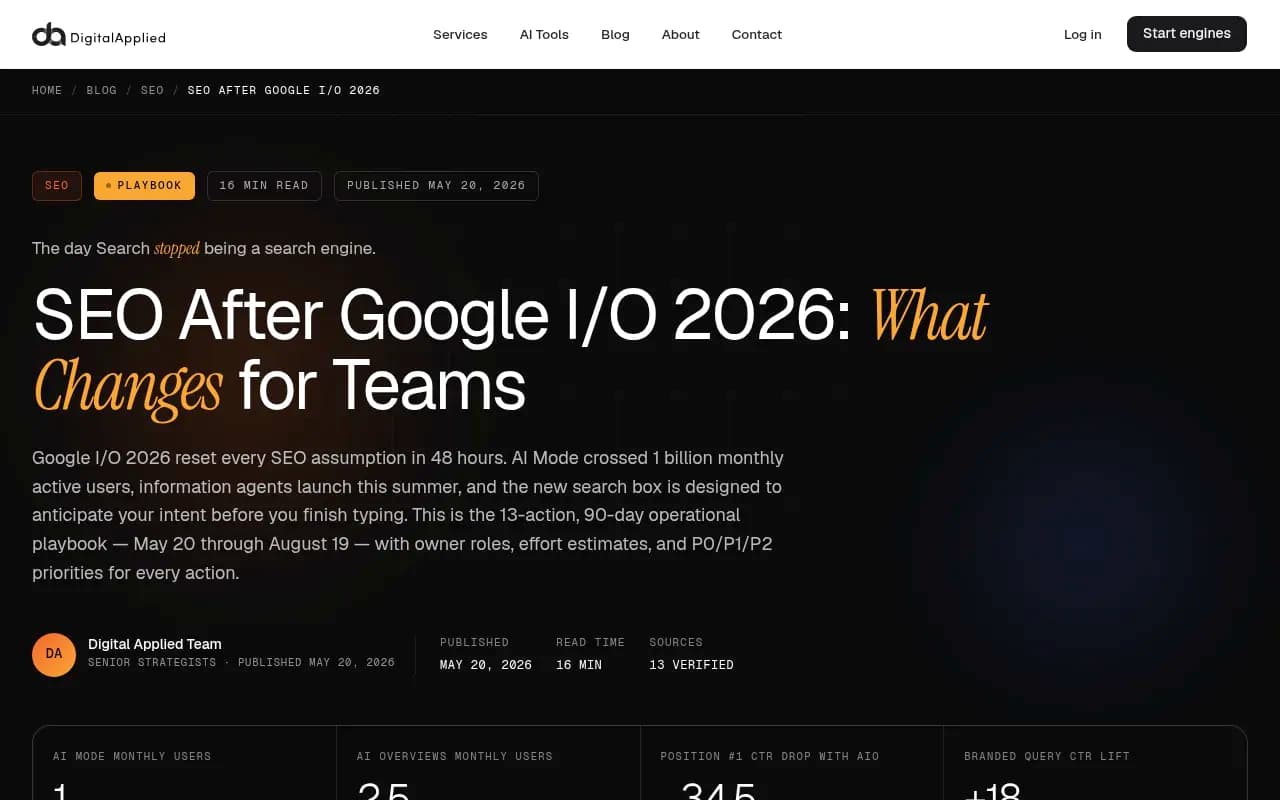
Something shifted at Google I/O 2026 that a lot of SEO teams are still catching up to. AI Mode -- Google's conversational, multi-step search experience -- crossed 1 billion monthly active users in May 2026. That's roughly 10x growth in 12 months. And Ahrefs research suggests that when AI Overviews appear on a SERP, position #1 organic CTR drops by around 34.5%.
The uncomfortable reality: ranking well no longer guarantees you appear in the AI answer. The citation pool for AI features is different from the organic top-10. So the question isn't just "do we rank?" anymore. It's "is our content even eligible to be cited?"
This checklist walks through 12 specific things to check on your existing content. Some are technical. Some are structural. Some are about credibility signals. All of them are things Google has either explicitly documented or that show up consistently in citation analysis.
Before you start: what "eligibility" actually means
Google hasn't published a definitive list of criteria for AI Mode citations. What it has done is document the technical requirements for appearing in AI features (in Google Search Central), and the pattern from citation research is fairly consistent: pages that get cited tend to be crawlable, fast, structured clearly, and written with genuine expertise signals.
"Eligibility" in this guide means: your content has no obvious blockers, and it's structured in a way that makes it easy for AI systems to extract and attribute a clear, accurate answer.
The 12-point audit checklist
1. Check your crawlability and indexing status
This sounds basic, but it's where a surprising number of audits uncover problems. If Googlebot can't crawl a page, or if the page is accidentally noindexed, it simply won't appear in AI features -- full stop.
What to check:
- Open Google Search Console and look for crawl errors, especially for your most important content pages
- Use the URL Inspection tool on your highest-value pages to confirm they're indexed
- Check your
robots.txtfor any overly broad disallow rules that might be blocking content sections - Look for
noindexmeta tags on pages that should be indexed
Also worth checking: whether your site has a Googlebot-specific crawl budget issue. Large sites with lots of thin or duplicate pages can see important content deprioritized. A crawler like Screaming Frog can surface these quickly.
2. Verify that AI crawlers aren't blocked
This is distinct from Googlebot access. Google's AI features use specific crawlers (like Google-Extended), and some sites have blocked them -- sometimes intentionally, sometimes accidentally through blanket bot-blocking rules.
Check your robots.txt for rules that might block Google-Extended or other AI-related user agents. Google's Search Central documentation explicitly notes that sites can control their content in AI features through these settings, but if you want to appear in AI Mode, you need to allow access.
If you've implemented a CDN-level bot management solution (Cloudflare, Fastly, etc.), check whether AI crawlers are being rate-limited or blocked at that layer too.
3. Audit page speed and Core Web Vitals
Google has been consistent: page experience signals matter for AI feature eligibility. Slow pages are less likely to be cited, and pages with poor Core Web Vitals scores send a quality signal that works against you.
Run your key content pages through Google PageSpeed Insights. Focus on:
- Largest Contentful Paint (LCP): aim for under 2.5 seconds
- Cumulative Layout Shift (CLS): aim for under 0.1
- Interaction to Next Paint (INP): aim for under 200ms
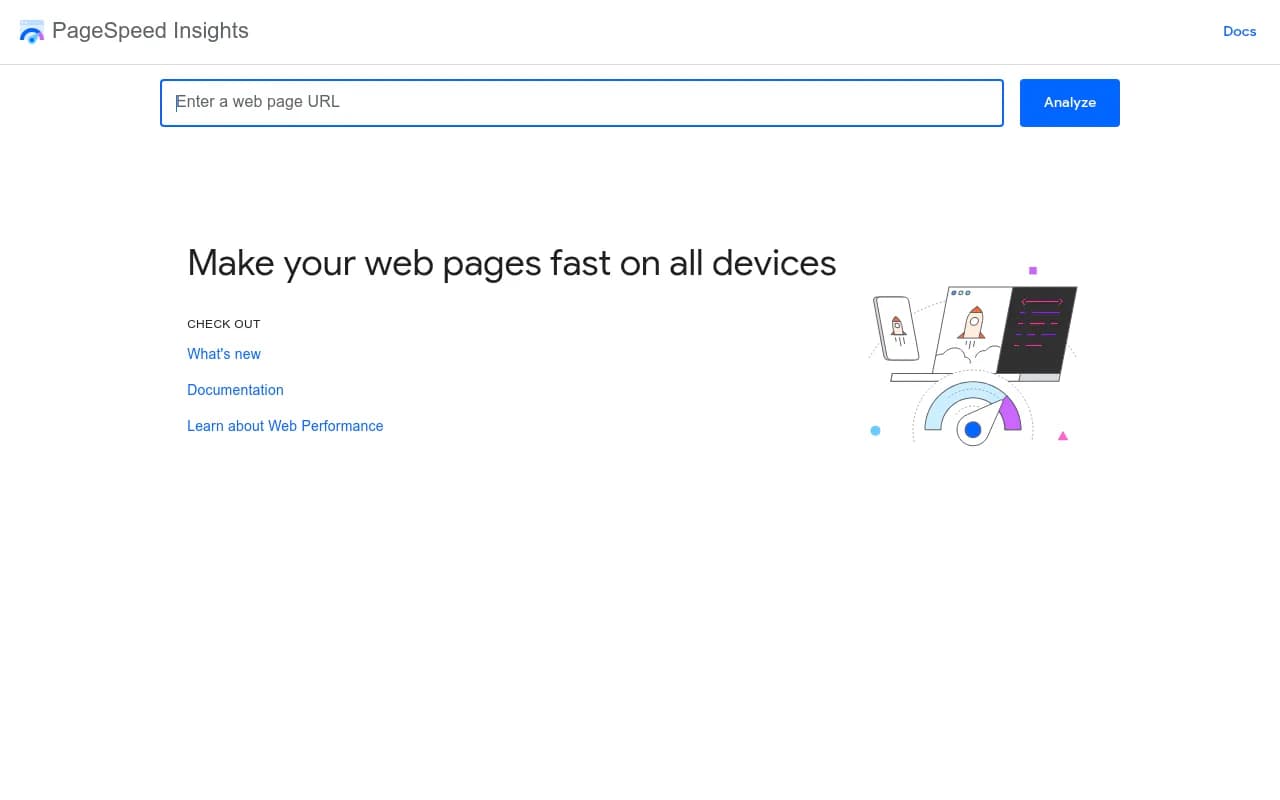
Pages that fail Core Web Vitals thresholds should be prioritized for technical fixes before you invest in content improvements -- there's no point optimizing content on a page that's already at a disadvantage.
4. Check your heading structure and question-answer formatting
AI systems extract answers by parsing content structure. Pages with clear, logical heading hierarchies are significantly easier to cite than pages with walls of text or inconsistent heading use.
What good looks like:
- H2s that directly address questions your audience is asking (use the exact phrasing from real queries where possible)
- H3s that break down sub-topics within each section
- Short, direct answers immediately following each heading -- don't bury the answer three paragraphs in
- Avoid keyword stuffing in headings; they should read like natural questions or statements
A practical approach: pull your top 20 questions from sales calls, support tickets, or a tool like AlsoAsked, then check whether your existing content addresses them with clear heading-answer pairs.
5. Assess content depth and completeness
Thin content is one of the most common reasons pages don't get cited in AI features. "Thin" doesn't just mean short -- it means content that doesn't fully answer the question it's targeting.
For each key page, ask:
- Does this page answer the primary question completely, without requiring the reader to go elsewhere?
- Does it cover the obvious follow-up questions a reader would have?
- Is there original analysis, data, or perspective -- or is it a restatement of what's already everywhere?
AI models tend to cite sources that provide complete, self-contained answers. A 400-word page that partially answers a question is less likely to be cited than a 1,200-word page that answers it thoroughly, even if the shorter page ranks well organically.
6. Evaluate E-E-A-T signals on each page
Experience, Expertise, Authoritativeness, and Trustworthiness -- Google's quality framework -- directly influences AI feature eligibility. Pages with strong E-E-A-T signals are more likely to be trusted as citation sources.
Check each important page for:
- Author bylines with credentials or relevant experience (not just a name)
- Links to author bio pages that establish expertise
- Publication and last-updated dates (freshness matters, especially for fast-moving topics)
- Citations to primary sources, studies, or data within the content
- Clear organizational identity (About page, contact information, editorial standards)
If your content is published anonymously or with minimal author information, that's a gap worth fixing. Adding a proper author bio with relevant credentials is one of the higher-ROI changes you can make.
7. Check for structured data (schema markup)
Schema markup helps Google understand what a page is about and extract specific information for AI features. Pages without structured data are harder for AI systems to parse accurately.
Priority schema types to check for:
ArticleorBlogPostingfor editorial contentFAQPagefor pages with question-answer formatHowTofor step-by-step guidesOrganizationandPersonfor brand and author pagesProductandReviewfor e-commerce content
Use Google's Rich Results Test to check whether your schema is valid and being recognized. Missing or broken schema is a quick fix with meaningful upside.
8. Review your internal linking structure
Internal links help Google understand the relationship between your pages and establish topical authority. Pages that are well-linked internally are more likely to be seen as authoritative on their topic.
What to audit:
- Do your most important content pages have internal links pointing to them from other relevant pages?
- Are there "orphan" pages -- content with no internal links pointing to them at all?
- Does your internal anchor text describe the linked page accurately?
A page that covers a topic thoroughly but has no internal links pointing to it is essentially invisible within your own site architecture. This is especially common with older content that was published before a site's current structure was established.
9. Assess content freshness and accuracy
AI models are sensitive to content that appears outdated or factually inconsistent with current information. For any content covering topics that change over time -- pricing, regulations, statistics, best practices -- check when it was last updated and whether the information is still accurate.
Specific things to look for:
- Statistics or data points that are more than 2 years old (update or remove them)
- References to products, tools, or services that no longer exist
- Recommendations that have been superseded by newer approaches
- Publication dates that are years old with no "last updated" timestamp
Adding a "last updated" date to refreshed content is a simple trust signal that costs nothing.
10. Check for clear, citable factual claims
AI systems cite content that contains clear, attributable facts -- not vague generalizations. Review your content for the density of specific, citable claims.
Compare these two versions of the same sentence:
- Vague: "Many businesses are seeing traffic declines due to AI search."
- Citable: "Ahrefs research suggests position #1 organic CTR drops 34.5% when AI Overviews appear on the SERP."
The second version is something an AI can cite with attribution. The first is something it might paraphrase without attribution -- or ignore entirely.
Go through your key pages and identify whether the main claims are specific and sourced. Where they're not, either add specificity or link to a primary source.
11. Audit your offsite presence and brand mentions
AI models don't just pull from your own website. They also draw on third-party sources: industry publications, review sites, Reddit discussions, YouTube content, and listicles. If your brand appears in these external sources with consistent, accurate information, it reinforces your authority as a citation source.
Check:
- Are you mentioned in relevant industry publications or roundup articles?
- Does your brand appear in Reddit discussions related to your topic area?
- Is your information consistent across third-party directories and review sites?
- Are there any incorrect or outdated brand descriptions in external sources that could confuse AI models?
This is an area where most content audits stop short -- they focus only on owned content. But offsite presence is a meaningful factor in AI visibility.
For tracking which external sources are actually driving AI citations, Promptwatch surfaces offsite citation data including Reddit threads, YouTube videos, and third-party pages that AI models are pulling from -- which makes it much easier to prioritize where to build external presence.

12. Map your content against actual AI responses
The final step is the most direct: run the queries you want to rank for through Google AI Mode and see what's actually being cited. Compare those citations to your own content.
Questions to answer:
- Are competitors being cited for queries where you have relevant content?
- What's different about the cited pages versus yours?
- Are there questions being answered in AI Mode that you don't have content for at all?
This gap analysis is where audits turn into action. You'll find some pages that need structural fixes, some that need E-E-A-T improvements, and some topics where you simply don't have content yet.
Putting it all together: a scoring framework
Here's a simple way to score each page you audit:
| Check | Pass | Needs work | Blocked |
|---|---|---|---|
| Crawlable and indexed | |||
| AI crawlers not blocked | |||
| Core Web Vitals pass | |||
| Clear heading/Q&A structure | |||
| Sufficient content depth | |||
| Strong E-E-A-T signals | |||
| Schema markup present | |||
| Well-linked internally | |||
| Content is fresh and accurate | |||
| Specific, citable claims | |||
| Offsite presence established | |||
| Mapped against AI responses |
Pages with multiple "Blocked" or "Needs work" scores are your highest-priority fixes. Pages that pass most checks but aren't being cited are candidates for deeper content analysis -- the issue is likely in depth, E-E-A-T, or offsite presence.
Tools that help with this audit
A few tools that are genuinely useful across different parts of this checklist:
For technical checks (crawlability, speed, schema):
For content structure and optimization:

For tracking AI visibility and citation gaps:
For question research and heading structure:
What to do after the audit
Running the audit is the easy part. The harder part is prioritizing fixes and tracking whether they work.
A few practical suggestions:
Start with the blockers. Crawlability issues, noindex tags, and blocked AI crawlers are quick fixes with immediate impact. Don't spend time optimizing content that can't be crawled.
Batch similar fixes. If 15 pages are missing schema, fix them all at once rather than one at a time. If 10 pages have thin E-E-A-T signals, create a template for adding author bios and update them in a sprint.
Track your AI visibility before and after. This is where most teams drop the ball -- they make changes but have no way to measure whether those changes improved their AI citation rate. Tools like Promptwatch track page-level citations across AI models, so you can see exactly which pages start getting cited after you fix them, and which models are picking up your content.
Set a re-audit cadence. AI Mode is evolving fast. What works in June 2026 may need adjustment by Q4. A quarterly content audit against these 12 points is a reasonable cadence for most teams.
The shift from "ranking" to "being cited" is real, and it requires a different kind of content audit than most teams are used to. But the underlying principles aren't mysterious: clear structure, genuine expertise, technical accessibility, and content that fully answers real questions. That's what gets cited -- in AI Mode and everywhere else.