Key takeaways
- AI search visibility measures how often and how prominently your brand appears inside AI-generated answers. Share of voice measures your slice of those appearances relative to competitors.
- Both metrics matter, but they answer different questions: visibility tells you if you're in the room; share of voice tells you how loudly you're speaking.
- The average brand mention rate across AI answers is just 17.2%, according to AthenaHQ's State of AI Search 2026 report -- meaning most brands are nearly invisible to AI search engines.
- For most teams in 2026, share of voice is the more actionable metric because it forces you to benchmark against real competitors, not just track your own numbers in isolation.
- The best programs track both, then use content gap analysis to close the gaps that actually move the needle.
There's a lot of confusion right now about what to measure in AI search. You've got "AI visibility scores," "share of voice," "brand mention rates," "citation rates," "recommendation rates" -- and most platforms use these terms interchangeably, which doesn't help.
They're not the same thing. And depending on your situation, prioritizing the wrong one can send your team chasing metrics that feel good but don't translate into competitive advantage.
This guide breaks down what each metric actually measures, where they overlap, and how to decide which one deserves your attention in 2026.
What AI search visibility actually measures
AI search visibility is a measure of how often your brand appears inside AI-generated answers, how prominently it's positioned, and how accurately it's described. When someone asks ChatGPT "what's the best project management tool for remote teams?" and your product shows up in the response, that's visibility. When it doesn't, you have a gap.
This is fundamentally different from traditional SEO visibility, which measures where you rank on a results page. AI visibility measures whether you appear inside a synthesized answer before the user ever sees a list of links. Different mechanic, different measurement, different strategy.
The key components of AI search visibility are:
- Brand mention rate: How often your brand is mentioned across a set of tracked prompts
- Citation rate: How often AI links to your pages as a source
- Recommendation rate: How often AI actively endorses your product or service (not just mentions it)
- Positioning: Whether you appear first, second, or buried at the bottom of a response
- Sentiment accuracy: Whether AI describes your brand correctly and positively
One important nuance: AI visibility is not binary. Claude, for example, mentions only about 88% of companies tested, while ChatGPT and Gemini mention 100% of those same companies. Perplexity falls around 90%. So your visibility score will vary significantly depending on which AI engine you're measuring.
What AI share of voice actually measures
AI share of voice (SOV) takes visibility one step further. Instead of asking "does my brand appear?", it asks "how much of the conversation does my brand own compared to competitors?"
Concretely, it's calculated as:
AI Share of Voice = (Your brand mentions / Total brand mentions across category) × 100
So if your brand is mentioned in 40 out of 100 AI responses about your category, and competitors collectively account for the other 60, your AI SOV is 40%.
The three core metrics that feed into SOV are:
- Mention rate (raw frequency of your brand appearing)
- Positioning (where in the response you appear)
- Comparative share (your mentions vs. the total mentions across all tracked competitors)
SOV is inherently competitive. You can't calculate it without knowing what your competitors are getting. That's what makes it more actionable than raw visibility scores -- it tells you not just whether you're visible, but whether you're winning.
Where they overlap (and where they diverge)
Here's the thing: AI search visibility and share of voice are related, but they measure different layers of the same problem.
| Dimension | AI search visibility | AI share of voice |
|---|---|---|
| What it measures | Your brand's presence in AI answers | Your slice of AI mentions vs. competitors |
| Requires competitor data | No | Yes |
| Tells you if you're visible | Yes | Indirectly |
| Tells you if you're winning | No | Yes |
| Useful for benchmarking | Limited | Strong |
| Useful for tracking improvement | Yes | Yes |
| Connects to revenue | Indirectly | More directly |
| Best for | Diagnosing gaps, fixing content | Competitive strategy, executive reporting |
A brand can have high visibility but low share of voice -- if you appear in 60% of relevant AI responses but competitors appear in 80%, your SOV is still weak. Conversely, a niche brand in a category with few competitors might have high SOV even with modest absolute visibility.
Neither metric is wrong. They just answer different questions.
The six metrics that matter in 2026
If you're building a serious AI search program, you'll end up tracking more than just visibility and SOV. The strongest programs track multiple layers simultaneously. Here's how the full picture fits together:
| Metric | What it tells you | Priority level |
|---|---|---|
| Brand mention rate | Are you in the conversation at all? | High |
| Citation rate | Are AI engines trusting your content? | High |
| Recommendation rate | Are AI engines endorsing you? | Very high |
| AI share of voice | Are you winning vs. competitors? | Very high |
| Prompt-level win rate | Which specific queries are you winning? | Medium-high |
| Brand visibility score | Overall AI presence index | Medium |
The recommendation rate deserves special attention. There's a big difference between an AI mentioning your brand in passing and an AI actively recommending your product as the answer to someone's question. The latter is what drives purchase behavior. A brand that's mentioned 50 times but recommended 40 of those times is in a much better position than one mentioned 100 times but recommended only 10.
Why the gap between visible and invisible brands is so wide
AthenaHQ's State of AI Search 2026 report found the average brand mention rate across AI answers sits at just 17.2%. Leading companies reach significantly higher rates. That gap is not random.
AI models favor content that is:
- Recent and regularly updated
- Structured to directly answer questions (not just optimized for keyword density)
- Cited by authoritative third-party sources (Reddit threads, review sites, industry publications)
- Consistent across multiple platforms and formats
Most brands are invisible in AI search not because their products are bad, but because their content isn't structured the way AI models want to consume it. Traditional SEO content, written to rank for keywords on a results page, often doesn't translate well into AI-generated answers.
Which metric should you prioritize?
The honest answer depends on where you are in your AI search journey.
If you're just starting out: start with visibility
Before you can benchmark against competitors, you need to understand your own baseline. Track your brand mention rate and citation rate across a set of prompts relevant to your category. Figure out which AI engines are mentioning you, which are ignoring you, and which pages on your site are actually being cited.
This diagnostic phase is essential. You can't improve what you haven't measured.
Tools like Promptwatch are built for exactly this -- tracking how your brand appears across ChatGPT, Perplexity, Claude, Gemini, and other AI engines, with page-level data showing which content is being cited and which isn't.

If you have baseline data: shift to share of voice
Once you know your own numbers, SOV becomes the more useful metric. It forces you to ask the right question: not "am I visible?" but "am I winning?"
SOV is also much easier to report to executives and stakeholders. "We own 34% of AI mentions in our category, up from 21% last quarter" is a cleaner story than "our brand mention rate improved by 8 percentage points."
Tools like Otterly.AI and Profound offer SOV tracking, though their approaches differ in depth.
Otterly.AI

Profound

For teams that want both monitoring and the ability to act on what they find, Promptwatch's Answer Gap Analysis shows exactly which prompts competitors are visible for that you're not -- which turns SOV data into a content action plan rather than just a number.
If you're advanced: track both, then close the gaps
The most sophisticated programs don't choose between visibility and SOV. They track both, then use the data to identify specific prompts where competitors are winning and create content designed to close those gaps.
This is where AI search optimization stops being a monitoring exercise and becomes an actual growth lever.
How to improve both metrics
The tactics that improve AI search visibility and share of voice are largely the same. The difference is in how you prioritize them.
Create content that answers questions directly
AI models are looking for content that directly answers the questions users ask. That means writing content structured around specific prompts, not just broad topics. If buyers in your category are asking "what's the best [category] tool for [use case]?", you need content that answers that exact question clearly and authoritatively.
Build third-party citations
AI models don't just cite your own website. They pull from Reddit threads, review sites, YouTube videos, industry publications, and comparison pages. Getting mentioned in those places -- through PR, partnerships, review generation, and community participation -- is often more effective than optimizing your own site.
Update content regularly
AI models favor recent content. A page that was last updated two years ago is at a disadvantage against a competitor who published something last month. Regular content refreshes, especially on high-value pages, matter more in AI search than they did in traditional SEO.
Fix technical issues that block AI crawlers
If AI crawlers can't read your content, you won't appear in AI answers regardless of how good the content is. JavaScript rendering issues, slow page loads, and robots.txt misconfigurations can all block AI indexing. Monitoring your AI crawler logs -- which pages are being read, how often, and whether there are errors -- is a capability that most brands haven't set up yet.
Tools worth knowing about
A few platforms worth looking at depending on your needs:
For monitoring brand mentions across AI engines:
Otterly.AI


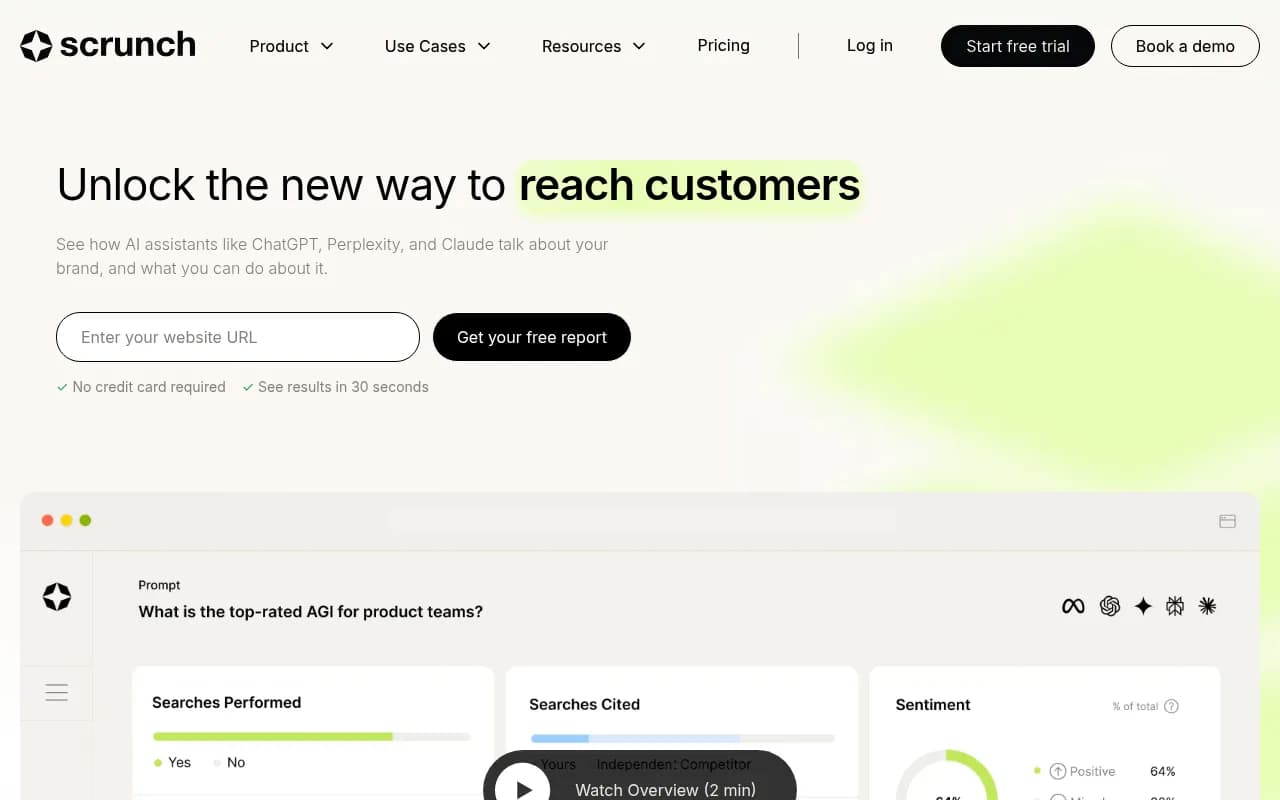
For deeper tracking with content optimization:
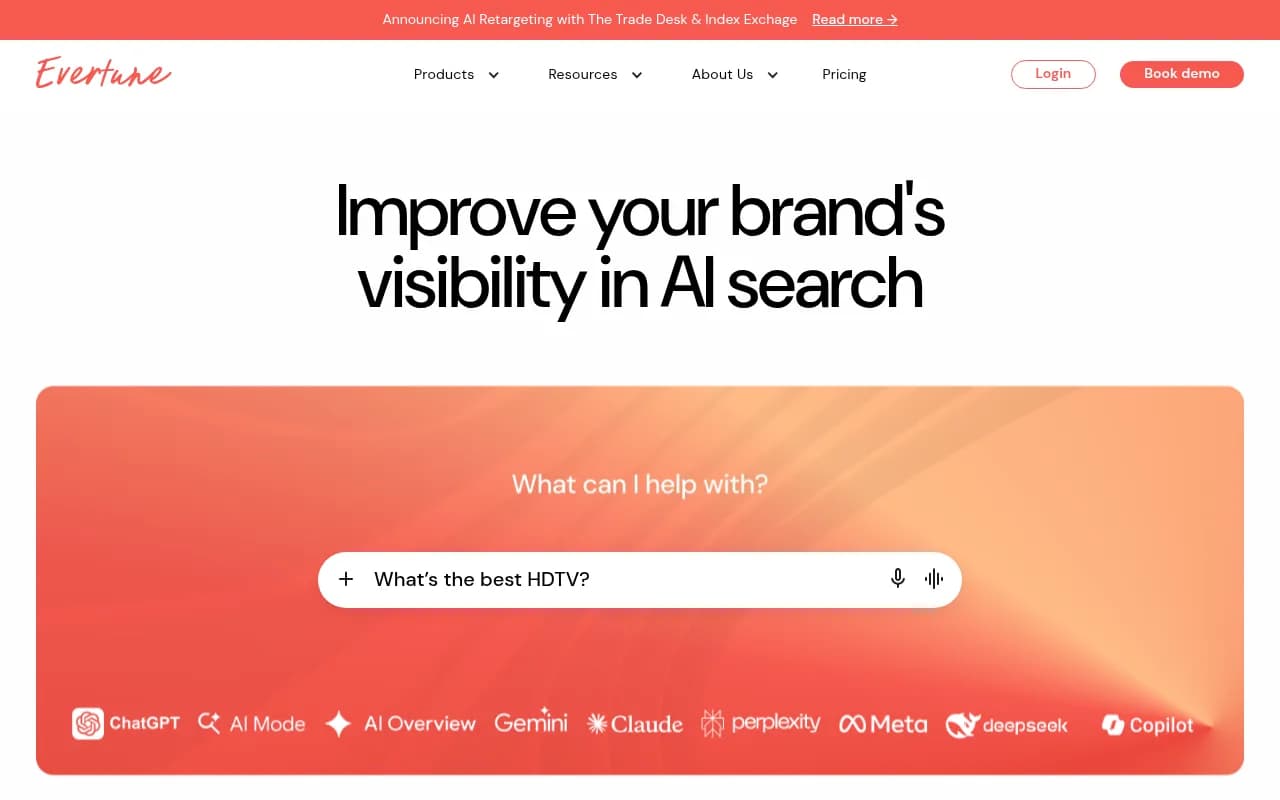
For enterprise-scale programs:
Profound
Most monitoring-only tools will give you visibility data and some SOV benchmarking. The gap is in what you do with that data. Platforms that help you identify content gaps and generate content to fill them -- rather than just showing you a dashboard -- are where the real value is in 2026.
The practical answer
AI search visibility and share of voice are complementary, not competing, metrics. Visibility tells you if you're in the conversation. Share of voice tells you how much of the conversation you own.
For most marketing teams in 2026, share of voice is the metric worth optimizing for, because it's inherently competitive and directly tied to whether you're winning or losing in your category. But you need visibility data to understand why your SOV is where it is and what to do about it.
The brands pulling ahead aren't just tracking these numbers. They're using them to identify specific gaps, create content that fills those gaps, and then watching their visibility scores improve as AI models start citing their new content. That cycle -- measure, identify gaps, create, track -- is what separates the brands that will dominate AI search from the ones that will still be invisible when their buyers are asking AI engines for recommendations.