Revuze Review 2026
Analyzes customer reviews at scale to surface product and content insights for ecommerce marketing teams. Includes a Marketing Hub for content optimization.
Key takeaways
- Revuze is a comprehensive Voice of Customer (VoC) platform that goes well beyond basic review aggregation -- it connects reviews, social data, surveys, and sales signals into a unified intelligence layer across five dedicated hubs.
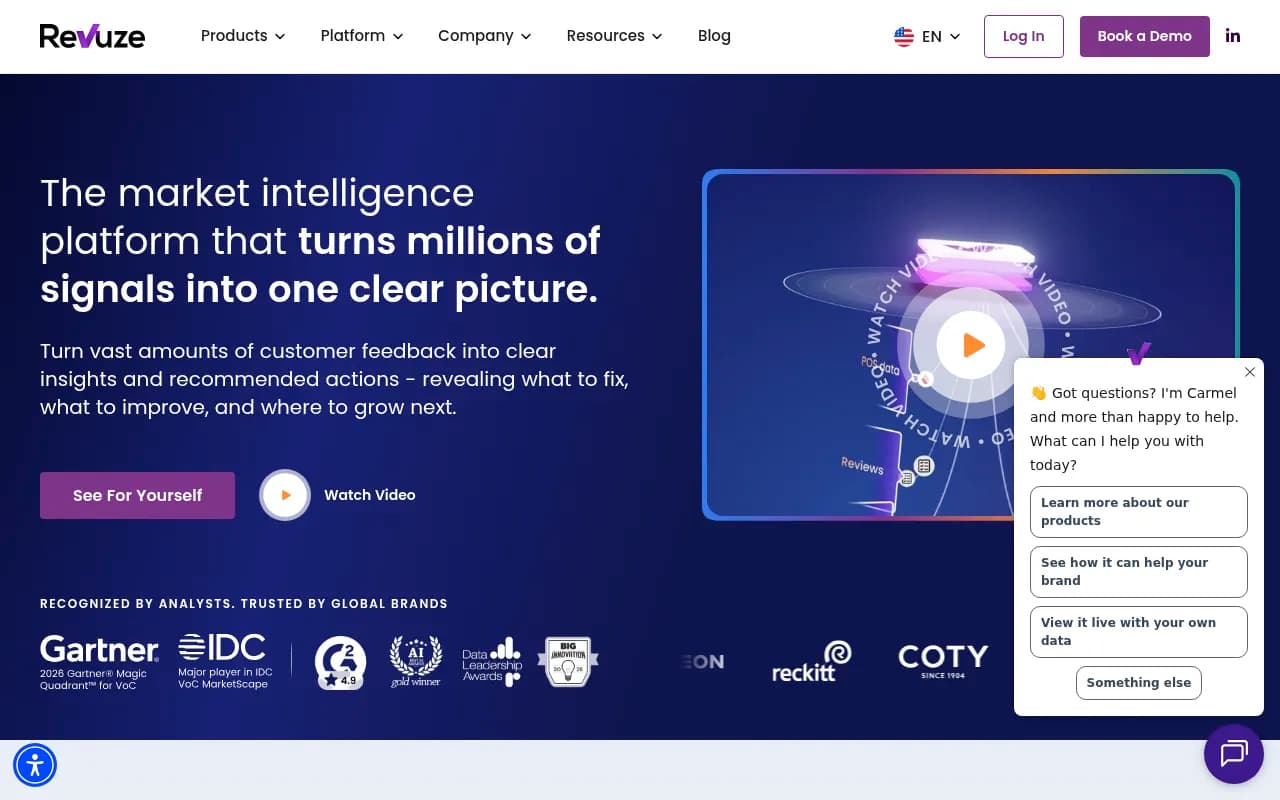
- Recognized in the 2026 Gartner Magic Quadrant for Voice of the Customer Platforms and named a Major Player in the IDC MarketScape for Voice of the Customer Applications -- meaningful third-party validation for enterprise buyers.
- Best suited for mid-to-large consumer goods brands (electronics, cosmetics, home appliances, footwear) that need category-level and SKU-level insight across multiple teams simultaneously.
- Pricing starts around $30,000/year, making it a serious enterprise investment -- not a fit for small brands or solo marketers.
- The platform claims 90%+ accuracy via proprietary LLMs, and customer testimonials from brands like L'Oreal, Dyson, P&G, and Pilot suggest the data quality holds up in practice.
Revuze is an AI-powered market intelligence platform built for consumer goods companies that need to make sense of massive volumes of customer feedback. The core idea is straightforward: instead of having your insights team manually scrape Amazon reviews into spreadsheets (a workflow that Pilot's VP of Consumer Marketing literally described before switching to Revuze), the platform ingests millions of signals from ecommerce reviews, social media, customer care interactions, and surveys, then surfaces structured, actionable insights at the category and SKU level.
The company is Israel-based and has been building in the VoC space for several years. By 2026, it's earned recognition from both Gartner and IDC -- two analyst firms that don't hand out placements lightly -- which puts it in a different tier than most review analytics startups. Its customer list includes Dyson, P&G, Bosch, L'Oreal, Coty, Reckitt, SanDisk, and Wilson, which tells you something about the scale it's designed to operate at.
The target audience is enterprise and mid-market consumer brands, specifically the product, ecommerce, consumer insights, social, and customer care teams within those organizations. Revuze positions itself as a shared source of truth across all those functions -- one platform where a product manager, a social media strategist, and an ecommerce analyst can each find what they need without duplicating research efforts.
Key features
Product Hub -- category and SKU-level product intelligence
This is arguably Revuze's strongest module. It covers the full product development lifecycle from research through validation. On the research side, you get trend analysis, competitor 360-degree views, star rating drivers, health scores, product return analysis, SWOT analysis, and purchase motivation breakdowns. The ideation layer adds "hype or trend" detection (a genuinely useful distinction -- not every spike in mentions is a durable trend), product wishlists, and improvement area identification. Validation tools include met/unmet needs analysis, a product launch tracker, a survey studio, and product benchmarking.
In practice, this means a product manager at a home appliance brand can pull up a dishwasher category view, see which features (noise levels, rack capacity, app connectivity) are driving positive and negative sentiment, identify what competitors are getting right that you're not, and validate whether a proposed new feature addresses a real unmet need -- all without commissioning a separate research project.
Social Hub -- beyond standard social listening
Most social listening tools track mentions and sentiment. Revuze's Social Hub connects social conversations with review data, customer care data, and commerce data to give SKU-level recommendations. That cross-referencing is the differentiator. Features include hype-or-trend detection, brand tracking, competitor 360-degree analysis, video analysis, influencer discovery, and content creation tools (PDP enrichment, post scheduling, influencer kits, video scripts). The measurement layer covers campaign monitoring, video virality tracking, GEO optimization, influencer compliance, and content performance.
Consumer Insights Hub -- always-on structured research
The CI Hub is designed to replace slow, manual research cycles. It provides continuous access to structured insights without requiring manual tagging or theme setup -- the algorithms handle categorization automatically. You can track key metrics over time, analyze pricing landscapes, monitor new product launches, understand usage purposes, and get share-of-voice data. The "opportunity matrix" and "hype or trend" tools help teams prioritize where to focus. There's also a Report World feature for distributing insights internally and a Survey Studio for primary research.
eCommerce Hub -- digital shelf management
This module covers the full ecommerce performance picture: share of voice, competitor 360-degree analysis, TikTok Shop tracking, product assortment analysis, geo optimization, retailer analysis, Amazon SEO ranking, and Amazon sales data. On the conversion side, it handles PDP enrichment, price tier analysis, shopper experience analysis, MAP monitoring, and competitor pricing. The customer care and star rating optimization features round it out. For brands selling across multiple retailers and marketplaces, having all of this in one place -- rather than stitching together separate tools for Amazon analytics, pricing intelligence, and review management -- is a real operational advantage.
Care Hub -- omnichannel customer service integration
The Care Hub brings AI-powered conversational bots, a unified inbox, CRM integration, and 15+ channel support into the platform. It's positioned as a complete VoC platform for customer service teams, with mobile app support and real-time reporting. The integration of care data with the rest of the platform means recurring issues surfaced in support tickets can feed back into product and ecommerce decisions -- closing the loop between customer complaints and business action.
Proprietary LLMs and data quality
Revuze claims 90%+ accuracy through proprietary large language models that cleanse, organize, and filter review data before it reaches the dashboard. This matters more than it might sound. Review data is notoriously noisy -- fake reviews, off-topic comments, spam, and bot-generated content can significantly distort sentiment analysis if not filtered properly. The company's claim of "data integrity that outperforms the market" is backed by customer testimonials specifically praising data reliability (multiple G2 reviews from power tools and cosmetics brands mention accuracy and reliability as standout qualities).
No-setup operation
One feature that comes up repeatedly in customer feedback: you don't need to define SKU lists, set up themes, or configure hashtags manually. The algorithms handle categorization automatically. For enterprise teams managing hundreds of SKUs across multiple categories, this is a significant time saver compared to platforms that require extensive manual configuration before you can get useful output.
Reporting Hub and data distribution
The Reporting Hub provides business intelligence reporting across all the other modules. Combined with the "Report World" feature in the CI Hub, it gives teams a way to package and distribute insights internally without exporting raw data and rebuilding it in PowerPoint. This matters for organizations where insights need to reach executives, regional teams, or cross-functional stakeholders who aren't going to log into the platform themselves.
Who is it for
Revuze is built for consumer goods companies with complex product portfolios and multiple teams that need access to customer intelligence. Think a brand like Bosch or Dyson where the product team, the ecommerce team, the social team, and the consumer insights team all need different cuts of the same underlying data. At that scale, having a shared platform with role-specific hubs makes more sense than buying five separate point solutions.
The industries where it clearly shines are electronics, cosmetics and fragrances, home appliances, home care, footwear, and fashion -- all categories where review volume is high, SKU counts are large, and competitive dynamics shift quickly. A cosmetics brand tracking ingredient trends across hundreds of SKUs and dozens of competitors is exactly the use case Revuze is optimized for. The L'Oreal testimonial about "breadth and speed" across teams and regions captures this well.
Company size matters here. With pricing starting around $30,000/year, Revuze is not a tool for a 10-person DTC brand or a solo ecommerce operator. It's designed for mid-market and enterprise organizations with dedicated insights, product, and ecommerce functions -- companies where the cost of slow or inaccurate market research is measured in missed product launches and lost market share, not just wasted analyst hours.
Who should not use this: small brands without a dedicated insights or ecommerce team, companies in B2B or service industries where review volume is low, and anyone looking for a lightweight or self-serve tool. The platform's depth is a strength for the right buyer, but it's overkill -- and overpriced -- for simpler needs.
Integrations and ecosystem
Revuze pulls data from ecommerce platforms (Amazon prominently, with specific Amazon SEO ranking and sales data features), social media channels, TikTok Shop, and customer care systems. The Care Hub supports 15+ channels and CRM integration, though specific CRM names aren't listed publicly.
The Survey Studio is built into the platform, which means primary research can be conducted and analyzed within the same environment as passive review and social data -- a meaningful integration that eliminates the need to reconcile survey results with review data manually.
The platform mentions GEO optimization as a feature within both the Social Hub and the eComm Hub, suggesting some capability around optimizing content for AI-driven search surfaces, though this appears to be a supporting feature rather than a core focus.
Export and reporting capabilities exist through the Reporting Hub, and the platform supports multi-language and multi-region analysis. Specific API documentation isn't publicly detailed, but enterprise deployments typically include custom data delivery options.
Pricing and value
Based on available data, Revuze's main platform pricing starts around $30,000 per year. There's also a separate survey product with a pay-as-you-go option starting at $1.50 per response, plus a Bronze plan for small teams.
The main platform pricing puts it firmly in enterprise territory. For comparison, point solutions like Brandwatch or Sprinklr's listening modules operate in similar price ranges, but Revuze's multi-hub approach means you're potentially replacing several separate tools. For a brand that would otherwise buy a social listening tool, a review analytics platform, an ecommerce intelligence tool, and a survey platform separately, the consolidated pricing may actually represent reasonable value.
A free trial is listed as available, which is worth taking advantage of given the investment level. The "book a demo" model for the main platform suggests pricing is customized based on scope, number of SKUs, and which hubs are included.
Strengths and limitations
What it does well:
- Cross-functional coverage: The five-hub structure genuinely serves different teams without requiring each team to buy and manage separate tools. The shared data layer means insights are consistent across functions.
- Data quality: The 90%+ accuracy claim and consistent customer feedback about data reliability suggest the proprietary LLM approach to data cleansing is working. This is harder to achieve than it sounds in review analytics.
- No-setup operation: Automatic categorization without manual SKU list definitions or theme configuration is a real differentiator for teams managing large, complex product portfolios.
- Analyst recognition: Gartner Magic Quadrant inclusion and IDC Major Player status in 2026 provide third-party validation that matters for enterprise procurement processes.
- Depth of ecommerce intelligence: Amazon SEO ranking, sales data, MAP monitoring, TikTok Shop tracking, and PDP enrichment in one place is a strong combination for brands managing complex retail relationships.
Honest limitations:
- Price point: $30,000+/year is a real barrier. Smaller brands or those with simpler needs will find better value elsewhere.
- Demo-gated access: The "book a demo" model for the main platform means you can't self-serve evaluate the tool. For buyers who prefer to explore before talking to sales, this is friction.
- Complexity: The breadth of features across five hubs means there's a learning curve. Teams that only need one or two of the hubs may find the platform overwhelming relative to a focused point solution.
Bottom line
Revuze makes the most sense for mid-to-large consumer goods brands -- think companies with $100M+ in revenue, multiple product lines, and dedicated teams across product, ecommerce, social, and consumer insights -- that are currently running fragmented research processes across multiple tools or, worse, manual spreadsheet workflows. The platform's ability to unify review, social, survey, and care data into a single source of truth, with role-specific hubs for each team, addresses a real organizational problem at that scale.
Best use case in one sentence: a consumer electronics or personal care brand that needs category-level and SKU-level intelligence across product development, ecommerce optimization, and social strategy -- all from one platform, without manual data wrangling.
Tags:
Frequently asked questions
What is Revuze?
Who is Revuze built for?
How much does Revuze cost?
What makes Revuze different from other review analytics tools?
Is Revuze recognized by industry analysts?
What industries does Revuze serve best?
Similar and alternative tools to Revuze