Key takeaways
- Peec AI is a clean, easy-to-use monitoring tool with strong multilingual coverage, but it stops at tracking -- no content gap analysis, no AI writing tools, no crawler logs
- Morningscore adds gamified SEO alongside some AI visibility features, but its AI search coverage is shallow compared to dedicated GEO platforms
- Rankability is built primarily for traditional SEO and agency reporting, with AI search features that feel bolted on rather than core to the product
- Promptwatch is the only platform in this comparison that closes the full loop: find visibility gaps, generate content engineered to get cited, and track whether it worked
Why this comparison matters in 2026
AI search isn't a trend anymore. ChatGPT crossed 900 million weekly users. Google AI Overviews appear on the majority of informational queries. Perplexity is routing millions of research sessions away from traditional search. And when someone asks one of these models "what's the best [your category] tool?", your brand either shows up or it doesn't.
The tools that help you answer that question have multiplied fast. Some are genuinely useful. Some are dashboards dressed up as strategy platforms. And a few are actually built to help you do something about the gaps they find.
This guide compares four platforms that come up repeatedly in 2026 buying conversations: Peec AI, Promptwatch, Morningscore, and Rankability. They're different enough that the "right" answer depends heavily on what you actually need -- so let's get into it.
The four platforms at a glance
| Platform | Primary focus | AI engines tracked | Content generation | Crawler logs | Best for |
|---|---|---|---|---|---|
| Peec AI | AI visibility monitoring | 10 | No | No | Global brands needing multilingual tracking |
| Promptwatch | AI visibility + optimization | 10+ | Yes (built-in AI writer) | Yes | Teams that want to monitor AND fix gaps |
| Morningscore | SEO + basic AI visibility | Limited | No | No | Small teams wanting one SEO tool |
| Rankability | Agency SEO + AI search | Limited | Partial | No | Agencies focused on traditional + AI SEO |
Peec AI: clean UX, solid monitoring, limited action
Peec AI has earned a reputation for being one of the most approachable tools in this space. The interface is genuinely clean -- if you've tried some of the more data-heavy platforms and felt overwhelmed, Peec AI is a breath of fresh air. Setup is fast, the dashboard makes sense, and you can get your first tracking results running within an hour.

The headline number is 115+ languages across 10 AI engines. For global brands that need to track AI visibility in French, German, Japanese, or Portuguese, that's a real differentiator. Most competitors either cap language support or charge extra for it.
But here's the honest limitation: Peec AI is a monitoring tool. It shows you where you appear and where you don't. It doesn't tell you what content to create to fix the gaps, doesn't generate that content for you, and doesn't give you crawler logs to understand how AI engines are actually reading your site. One review from generatemore.ai put it plainly: "Peec AI does not provide a playbook or AI-search visibility auditing tool that shows all issues with your site and how to fix them."
If you're a global brand that primarily needs a clean dashboard to track AI mentions across markets, Peec AI does that well. If you want to actually move the needle on your AI visibility, you'll hit a ceiling quickly.
Pricing: Starts at €85/month (Starter, 50 prompts, 3 engines). Higher tiers unlock more prompts and engines.
Strengths: Multilingual coverage, clean UX, fast onboarding
Weaknesses: No content gap analysis, no AI writing, no crawler logs, no Reddit/YouTube tracking
Morningscore: gamified SEO with some AI visibility features
Morningscore takes a different approach. It's fundamentally an SEO platform -- keyword tracking, backlink monitoring, site health -- with AI visibility features layered on top. The gamification angle (missions, scores, rewards for SEO tasks) makes it genuinely engaging for small teams or solo marketers who find traditional SEO dashboards dry.
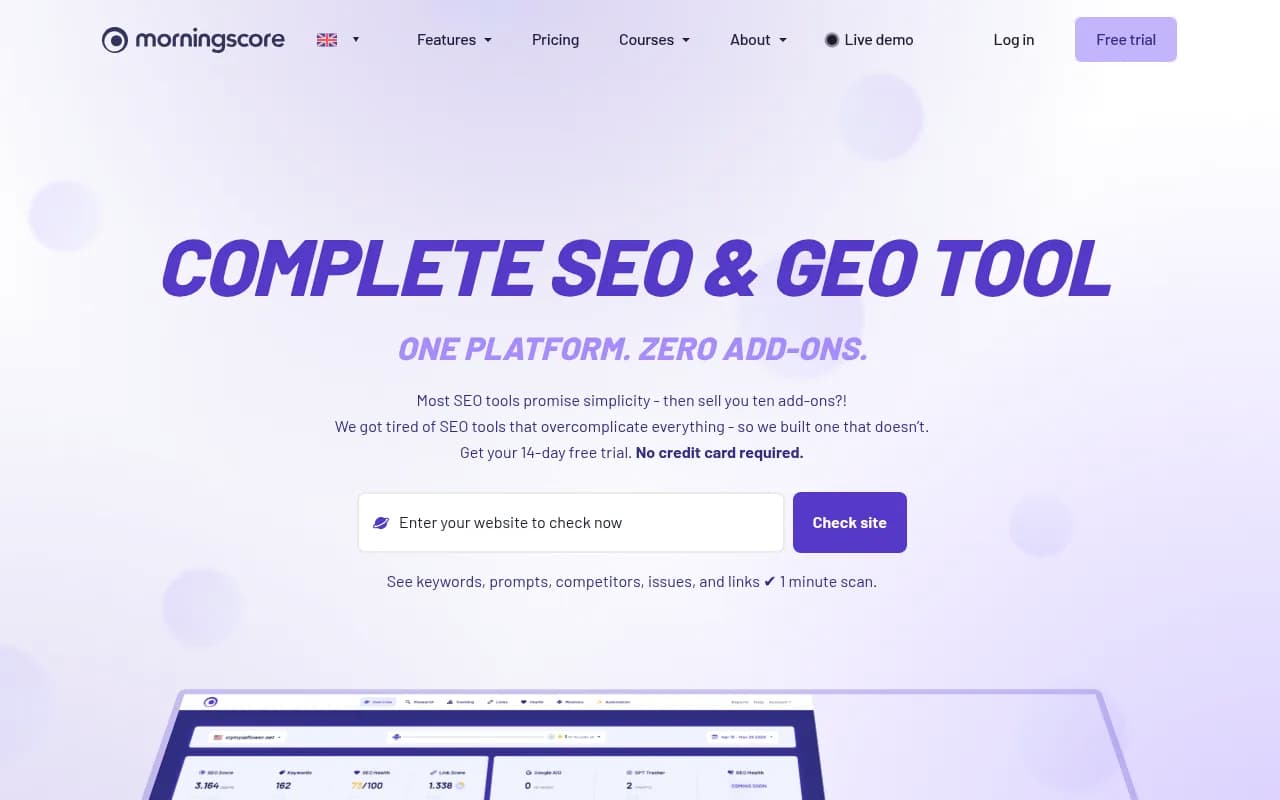
The AI visibility component tracks brand mentions in AI-generated responses, but the coverage is shallower than dedicated GEO platforms. You're not getting the depth of prompt intelligence, query fan-outs, or citation-level analysis that platforms built specifically for AI search provide.
Where Morningscore makes sense: if you're a small business or startup that wants one tool covering traditional SEO and basic AI visibility, and you don't need deep GEO analytics. The gamified interface genuinely helps with SEO task completion -- there's something to be said for a tool that makes the work feel less like a chore.
Where it falls short: if AI search visibility is a serious priority, Morningscore's AI features feel like a checkbox rather than a core capability. There's no content generation tied to AI citation data, no crawler log analysis, and the prompt tracking depth doesn't compare to purpose-built platforms.
Pricing: Starts around $49/month. Free trial available.
Strengths: Gamified interface, combines traditional SEO with basic AI tracking, accessible for small teams
Weaknesses: Shallow AI visibility features, no content gap analysis, limited prompt intelligence
Rankability: agency-focused SEO with AI search add-ons
Rankability is built for agencies managing SEO at scale. It handles content briefs, on-page optimization, rank tracking, and reporting -- the core agency workflow. The platform has added AI search tracking features as the GEO category has grown, but the DNA is still traditional SEO.
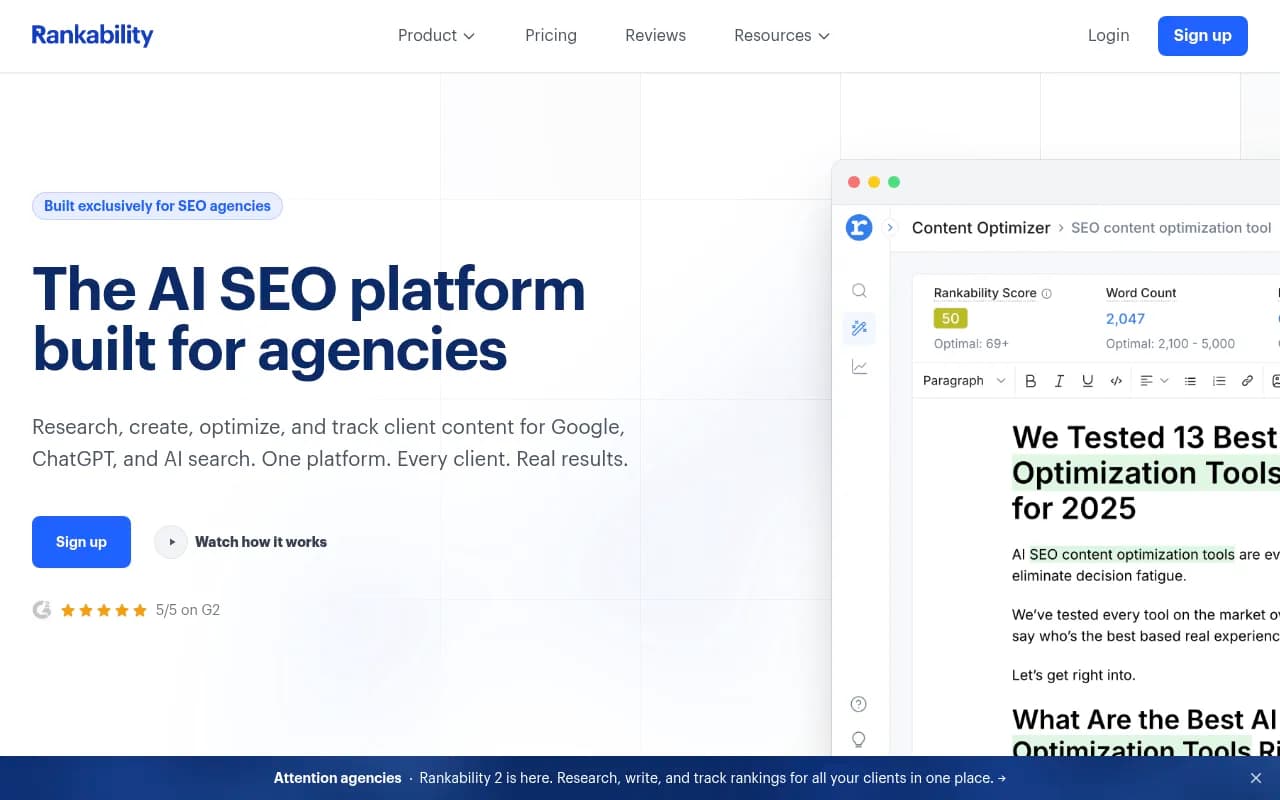
For agencies that primarily serve clients on Google rankings and want a single platform that also gives them some AI visibility data to report on, Rankability has appeal. The content brief functionality is solid, and the reporting layer is designed for client-facing work.
The limitation is similar to Morningscore: AI search features feel secondary. You won't find deep prompt intelligence, citation analysis, Reddit/YouTube tracking, or an AI writing agent that generates content specifically engineered to get cited by ChatGPT or Perplexity. If a client asks "why aren't we appearing in AI search results and what do we do about it?", Rankability gives you data but not a clear path to fixing it.
Pricing: Starts around $99/month. Agency plans available.
Strengths: Strong content brief tools, good for agency reporting, covers traditional SEO well
Weaknesses: AI search features are supplementary, no content generation tied to AI citation data, limited GEO depth
Promptwatch: the only platform that closes the loop
Most platforms in this comparison -- and most in the category generally -- are monitoring tools. They show you a dashboard of where you appear in AI search results. That's useful. But it's step one of a three-step process, and most tools stop there.
Promptwatch is built around what happens after you see the data.

The core workflow is: find the gaps, create content that fills them, track whether it worked.
Finding the gaps means Answer Gap Analysis -- seeing exactly which prompts your competitors are visible for that you're not. Not just "you're missing in this category" but the specific questions, angles, and topics that AI models want to answer but can't find on your site.
Creating content means a built-in AI writing agent that generates articles, listicles, and comparisons grounded in real citation data (880M+ citations analyzed). This isn't generic SEO content -- it's engineered around what actually gets cited by ChatGPT, Claude, Perplexity, and other models.
Tracking results means page-level visibility scores that show which specific pages are getting cited, how often, and by which models. Plus traffic attribution through a code snippet, Google Search Console integration, or server log analysis -- so you can connect AI visibility improvements to actual revenue.
Beyond the core loop, Promptwatch has capabilities none of the other three platforms in this comparison offer:
- AI Crawler Logs: real-time logs of when ChatGPT, Claude, Perplexity, and other AI crawlers visit your site, which pages they read, and what errors they encounter
- Reddit & YouTube Insights: surfaces discussions that directly influence AI recommendations -- a channel most platforms ignore
- ChatGPT Shopping Tracking: monitors when your brand appears in ChatGPT's product recommendations and shopping carousels
- Prompt Intelligence: volume estimates and difficulty scores for each prompt, plus query fan-outs showing how one prompt branches into sub-queries
- Competitor Heatmaps: side-by-side visibility comparison across LLMs
Coverage spans 10+ AI models: ChatGPT, Perplexity, Google AI Overviews, Google AI Mode, Claude, Gemini, Meta/Llama, DeepSeek, Grok, Mistral, and Copilot.
Pricing: Essential $99/mo (1 site, 50 prompts, 5 articles), Professional $249/mo (2 sites, 150 prompts, 15 articles, crawler logs), Business $579/mo (5 sites, 350 prompts, 30 articles). Free trial available.
Strengths: Full action loop (monitor → fix → track), AI content generation, crawler logs, Reddit/YouTube tracking, ChatGPT Shopping, prompt intelligence, 10+ models
Weaknesses: Higher price point than basic monitoring tools; more features than some small teams need
Head-to-head: feature comparison
| Feature | Peec AI | Promptwatch | Morningscore | Rankability |
|---|---|---|---|---|
| AI engines tracked | 10 | 10+ | Limited | Limited |
| Multilingual support | 115+ languages | Yes (multi-region) | Basic | Basic |
| Prompt volume data | No | Yes | No | No |
| Answer gap analysis | No | Yes | No | No |
| Built-in AI content generation | No | Yes | No | Partial |
| AI crawler logs | No | Yes | No | No |
| Reddit/YouTube tracking | No | Yes | No | No |
| ChatGPT Shopping tracking | No | Yes | No | No |
| Traffic attribution | No | Yes | No | No |
| Traditional SEO features | No | No | Yes | Yes |
| Free trial | Yes | Yes | Yes | Yes |
| Starting price | €85/mo | $99/mo | ~$49/mo | ~$99/mo |
Which platform should you choose?
The answer depends on what you're actually trying to accomplish.
Choose Peec AI if you're a global brand that needs multilingual AI visibility tracking across many markets and languages, and your primary goal is monitoring rather than optimization. The clean UX and 115+ language support are genuine advantages for international teams.
Choose Morningscore if you're a small business or solo marketer who wants one tool that covers traditional SEO and gives you a basic read on AI visibility. The gamified interface is a real differentiator for teams that struggle with SEO task completion.
Choose Rankability if you're an agency primarily focused on traditional SEO deliverables -- content briefs, rank tracking, client reporting -- and you want AI search data as a supplementary metric rather than a core focus.
Choose Promptwatch if AI visibility is a serious business priority and you need more than a dashboard. The distinction matters: if you're asking "how do I actually get cited by ChatGPT and Perplexity?", Promptwatch is the only platform here that answers that question with tools to act on it. The Answer Gap Analysis, AI writing agent, and crawler logs form a complete workflow that the other three platforms don't offer.
The monitoring vs. optimization gap
One thing worth naming directly: there's a real difference between tools that show you data and tools that help you do something with it.
Peec AI, Morningscore, and Rankability all give you visibility data. That's valuable -- you can't improve what you can't measure. But the next question is always "okay, so what do I do?" And for that question, three of these four platforms leave you on your own.
The Reddit community around AI SEO has noticed this. A 2026 thread on r/Agentic_SEO praised Peec AI's clean UX but noted the gap: you get the data, but the path from data to action isn't built into the product.
Promptwatch's design philosophy is different. The platform was built around the assumption that monitoring is step one, not the destination. That's why the content generation, crawler logs, and traffic attribution are core features rather than add-ons -- they're what turns visibility data into actual business results.
For teams that are serious about AI search as a channel, that distinction is the one that matters most in 2026.