Key takeaways
- Most AI visibility platforms are monitoring dashboards -- they tell you the problem but don't help you solve it.
- Peec AI is strong at tracking brand mentions across LLMs but lacks content generation, crawler logs, and traffic attribution.
- AirOps approaches AI visibility as a content engineering workflow tool, not a dedicated monitoring platform.
- Searchable includes built-in content generation but has limited LLM coverage and prompt intelligence depth.
- Promptwatch is the only platform in this comparison that closes the full loop: find gaps, generate content, track results, and attribute traffic -- across 10 AI models.
There's a pattern emerging in the AI visibility space. A brand buys a monitoring tool, gets a dashboard full of share-of-voice charts, sees that competitors are getting cited and they aren't, and then... sits there. The tool did its job. It showed you the problem. What it didn't do is help you fix it.
That gap between "here's your data" and "here's what to do about it" is the real differentiator in 2026. This comparison looks at four platforms that are frequently shortlisted together -- Peec AI, Promptwatch, AirOps, and Searchable -- and cuts through the feature marketing to answer one question: which one actually helps you move the needle?
What we're comparing and why it matters
Before getting into the tools, it's worth being clear about what "AI visibility" actually requires. It's not just knowing that ChatGPT mentioned a competitor. It's understanding:
- Which prompts your customers are typing into AI engines
- Which competitors are getting cited for those prompts (and why)
- What content gaps on your site are causing AI models to skip you
- How to create content that AI engines will actually cite
- Whether your new content is working, and whether it's driving real traffic
A tool that only handles steps one and two is a monitoring tool. A tool that handles all five is an optimization platform. That distinction matters a lot when you're trying to justify the spend.
Peec AI: solid monitoring, limited action
Peec AI launched in early 2025 and raised a $21M Series A by November -- fast growth by any measure. The platform tracks brand visibility across ChatGPT, Perplexity, and Claude, with decent prompt management and share-of-voice reporting.

What Peec AI does well: the monitoring layer is clean. You can set up prompts, track how often your brand appears, and compare yourself against competitors across a handful of LLMs. The UI is straightforward and the onboarding is quick.
Where it falls short is everything that comes after the data. According to a review on generatemore.ai, "Peec AI does not provide a playbook or AI-search visibility auditing tool that shows all issues with your site and how to fix them." There's no built-in content generation, no crawler log analysis, no traffic attribution, and no Reddit or YouTube tracking. You get a clear picture of the problem. You don't get a path to solving it.
For a team that already has strong content operations and just needs a monitoring layer to feed into their existing workflow, Peec AI works. For a team that wants to act on what they find, it's a starting point, not a complete solution.
LLMs covered: ChatGPT, Perplexity, Claude (3 engines on entry plan) Pricing: Starts at €85/month (Starter, 50 prompts, 3 engines) Best for: Teams that want clean monitoring and have separate content resources
AirOps: content engineering with visibility as an input
AirOps is a different kind of tool. It's primarily a content engineering platform -- built around AI-powered workflows for creating SEO and GEO content at scale. AI visibility data feeds into its prioritization layer, but it's not a dedicated monitoring platform.
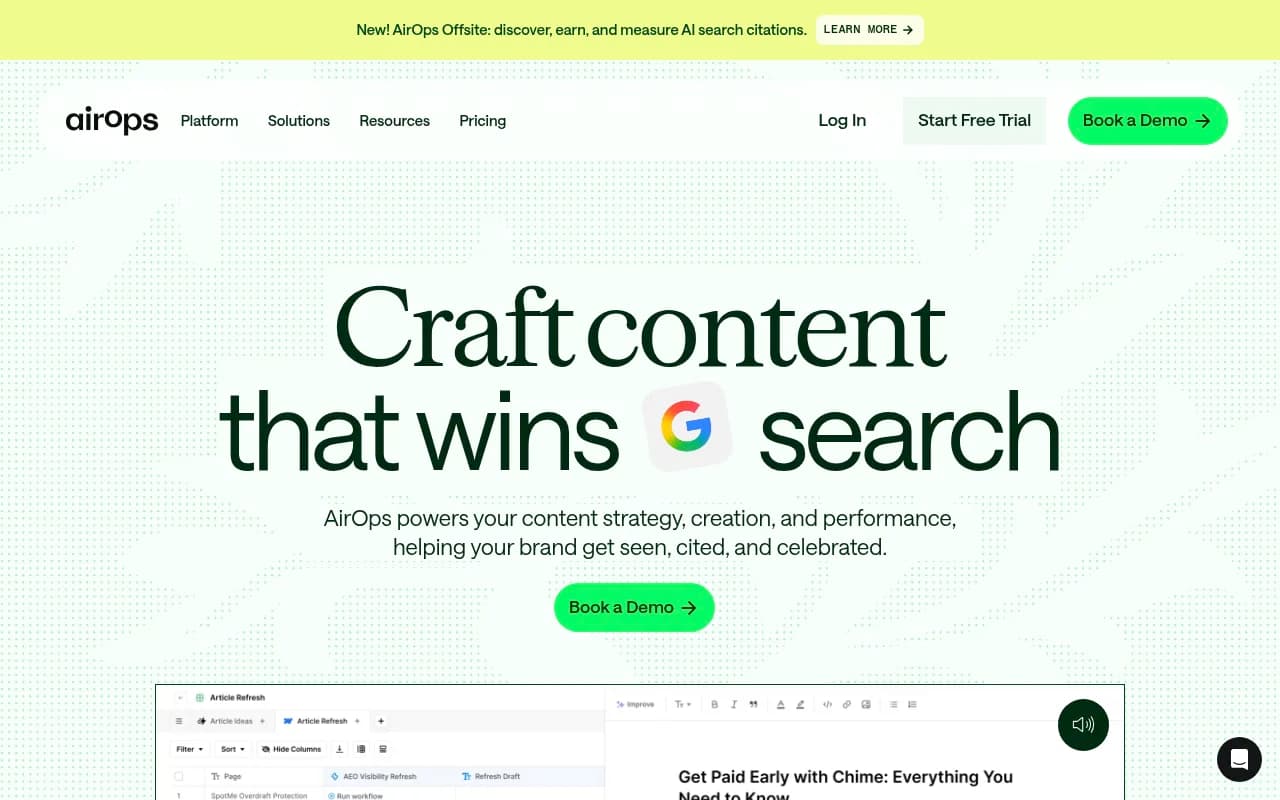
According to AirOps' own positioning (from their comparison page with Peec.ai): "AirOps treats AI visibility as an input to prioritization, not the core product." That's an honest description. If you're running a content team that needs to produce a high volume of AI-optimized articles and wants some visibility data to inform what to write, AirOps is genuinely useful.
What it lacks is the monitoring depth you'd get from a dedicated GEO platform. There's no real-time LLM tracking, no citation analysis showing which sources AI models are pulling from, no crawler logs, and no traffic attribution tied to AI referrals. The content output can be strong, but without knowing which prompts you're winning or losing, you're optimizing somewhat blind.
AirOps makes the most sense for content-heavy teams -- agencies or in-house teams producing dozens of articles per month -- who want AI assistance in the writing process and are willing to use a separate tool for the monitoring side.
Best for: Content teams prioritizing production volume over visibility depth Key gap: Not a monitoring platform; limited LLM tracking and no citation analysis
Searchable: monitoring plus content, but with gaps
Searchable sits closer to the "full platform" end of the spectrum than Peec AI or AirOps. It includes both AI visibility tracking and built-in content generation, which puts it in a more interesting position for teams that want to act on their data without stitching together multiple tools.
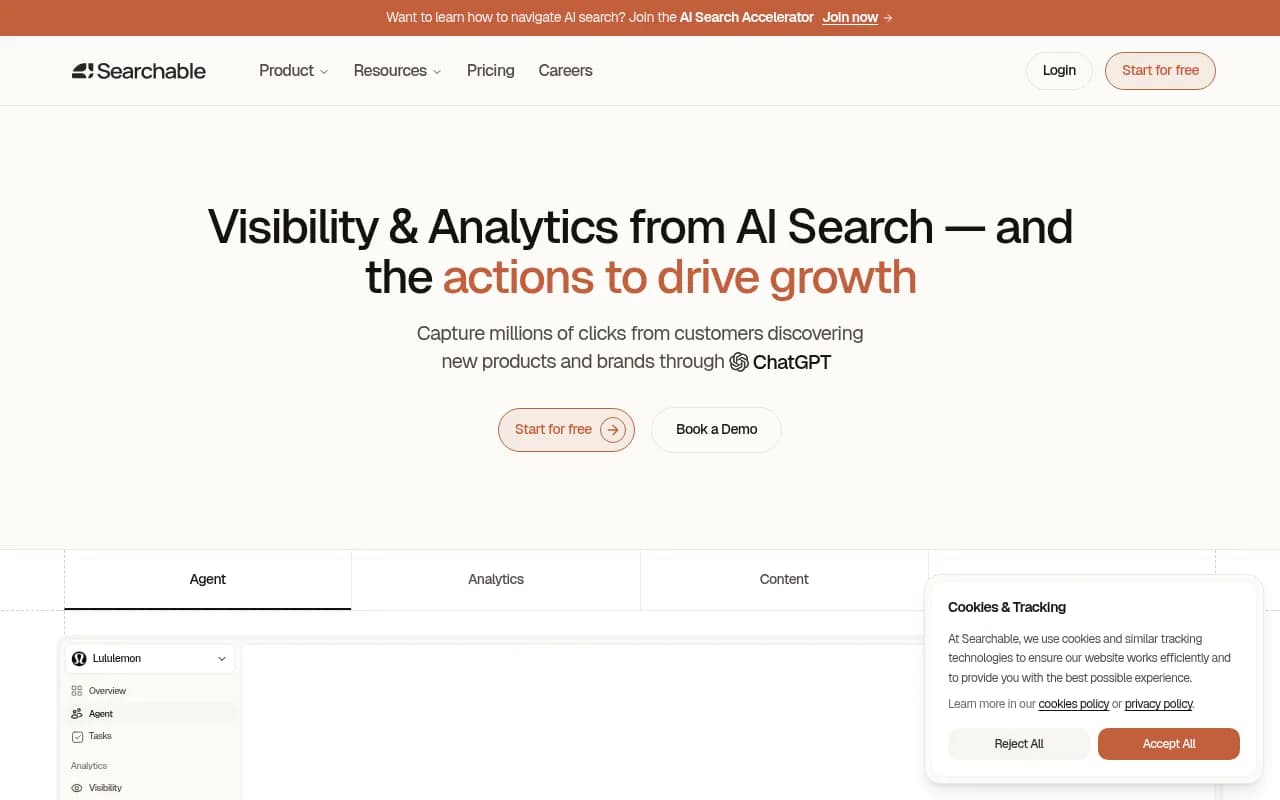
The content generation capability is real -- Searchable can produce articles informed by visibility data, which is more than most monitoring-only tools offer. But the depth of the monitoring layer is thinner than what you'd get from a dedicated platform. LLM coverage is more limited, prompt intelligence (volume estimates, difficulty scoring, query fan-outs) is less developed, and there's no crawler log analysis or Reddit/YouTube citation tracking.
For smaller teams or brands just getting started with GEO, Searchable's combination of monitoring and content in one place is appealing. For teams that need to understand exactly which AI crawler is hitting which pages, or want to track ChatGPT Shopping appearances, or need multi-region persona-based monitoring, it starts to show its limits.
Best for: Smaller teams wanting monitoring + content without managing two tools Key gap: Shallower prompt intelligence and limited LLM coverage vs. dedicated platforms
Promptwatch: the full action loop
Promptwatch is the platform in this comparison that's built explicitly around the idea that monitoring without action is incomplete. The core product logic is a three-step loop: find the gaps, create content that fills them, track whether it worked.

The "find the gaps" piece is Answer Gap Analysis -- it shows you exactly which prompts competitors are being cited for that you're not. Not just "you're behind on this topic" but the specific questions AI models are answering with your competitor's content instead of yours.
The "create content" piece is a built-in AI writing agent that generates articles, listicles, and comparisons grounded in citation data (880M+ citations analyzed), prompt volumes, and competitor analysis. This isn't generic content -- it's built around what AI models are actually citing.
The "track results" piece closes the loop with page-level tracking (which pages are being cited, by which models, how often) and traffic attribution through a code snippet, GSC integration, or server log analysis.
Beyond the core loop, Promptwatch adds things that most competitors skip entirely: real-time AI crawler logs (so you can see when GPTBot or ClaudeBot visits your site and what errors they hit), Reddit and YouTube citation tracking, ChatGPT Shopping monitoring, and competitor heatmaps across 10 LLMs.
It covers 10 AI models -- ChatGPT, Perplexity, Google AI Overviews, Google AI Mode, Claude, Gemini, Meta/Llama, DeepSeek, Grok, Mistral, and Copilot -- which is the widest coverage in this comparison.
Pricing: Essential $99/mo (1 site, 50 prompts, 5 articles), Professional $249/mo (2 sites, 150 prompts, 15 articles, crawler logs), Business $579/mo (5 sites, 350 prompts, 30 articles). Free trial available. Best for: Marketing and SEO teams that want to monitor, optimize, and prove ROI from AI visibility
Head-to-head comparison
| Feature | Peec AI | AirOps | Searchable | Promptwatch |
|---|---|---|---|---|
| LLMs monitored | 3 | Limited | Limited | 10 |
| Prompt volume & difficulty scoring | No | No | Partial | Yes |
| Answer gap / content gap analysis | No | No | Partial | Yes |
| Built-in AI content generation | No | Yes (primary focus) | Yes | Yes |
| AI crawler logs | No | No | No | Yes |
| Reddit & YouTube citation tracking | No | No | No | Yes |
| ChatGPT Shopping tracking | No | No | No | Yes |
| Traffic attribution | No | No | No | Yes (snippet, GSC, server logs) |
| Page-level citation tracking | No | No | Partial | Yes |
| Multi-region / multi-persona | Partial | No | No | Yes |
| Starting price | €85/mo | Custom | Varies | $99/mo |
| Free trial | Yes | Yes | Yes | Yes |
Which tool is right for your situation?
The honest answer depends on what you're trying to accomplish.
If you need clean LLM monitoring and have a separate content team: Peec AI does the monitoring job well enough, and its UI is easy to get started with. Just know you'll need other tools to act on what you find.
If you're running a high-volume content operation and want AI writing assistance: AirOps is worth evaluating. It's less a GEO platform and more a content workflow tool, but for agencies producing a lot of articles, that's not necessarily a problem.
If you're a smaller team wanting monitoring and content in one place without complexity: Searchable is a reasonable starting point. The coverage gaps matter less when you're just getting started.
If you want to understand your AI visibility, fix it, and prove it's working: Promptwatch is the only platform here that covers the full cycle. The combination of Answer Gap Analysis, AI content generation grounded in citation data, crawler logs, and traffic attribution is genuinely different from what the other three offer.
The monitoring-only tools in this space aren't bad -- they're just incomplete. Knowing you have a problem is step one. Steps two through five are where the actual work happens.
A note on the broader market
This comparison focuses on four platforms, but the AI visibility space has exploded. There are now well over 100 tools claiming some version of GEO or AEO capability. Most of them are monitoring dashboards with varying levels of LLM coverage. A smaller number are trying to build the content optimization layer on top. Very few close the loop all the way to traffic attribution.
If you're evaluating beyond these four, a few others worth knowing about:
Otterly.AI

Otterly.AI is a clean monitoring tool at a lower price point ($29/month entry) -- good for teams with tight budgets who just want basic LLM tracking.
Profound

Profound has strong enterprise features and wide LLM coverage, but sits at a higher price point with no Reddit tracking or ChatGPT Shopping monitoring.

AthenaHQ is monitoring-focused and well-regarded for enterprise use cases, but like most competitors, stops before the content optimization and generation layer.
The pattern across all of them is the same: most tools are better at showing you the problem than helping you fix it. That's the gap worth paying attention to when you're making a buying decision.