Key takeaways
- Peec AI is one of the cleanest monitoring tools in the market -- great UX, unlimited seats, easy onboarding -- but it stops at tracking.
- Junia AI is a capable AI content writer with SEO features, but it wasn't built for GEO and doesn't track AI citations.
- Atomic AGI combines multi-engine tracking with workflow automation, making it useful for teams that want to act on data -- though its GEO-specific features are still maturing.
- Promptwatch is the only platform in this comparison that closes the full loop: find gaps, generate content engineered for AI citation, then track the results. It's the only one rated "Leader" across all GEO categories in 2026.
- If your goal is to actually appear in ChatGPT, Perplexity, Claude, and Google AI Overviews -- not just know that you don't -- the platform you choose matters enormously.
The GEO tool market has gotten crowded fast. Two years ago, most brands were still asking "what is AI search?" Now they're asking "why isn't my brand showing up in it?" and "which tool do I use to fix that?"
That second question is harder than it sounds. There are now dozens of platforms claiming to help with AI visibility, and most of them do roughly the same thing: they run a set of prompts through ChatGPT or Perplexity, check if your brand appears, and show you a dashboard. That's useful. But it's not optimization.
This guide compares four platforms that come up frequently in 2026: Peec AI, Promptwatch, Atomic AGI, and Junia AI. They're often mentioned in the same breath, but they're solving different problems. Understanding what each one actually does -- and doesn't do -- will save you from buying the wrong tool.
What "GEO platform" actually means in 2026
Generative Engine Optimization (GEO) is the practice of making your content more likely to be cited by AI models. It's distinct from traditional SEO in a few ways: there are no "rankings" in the classic sense, citations depend on what content AI models have ingested and trust, and visibility varies by model, persona, and prompt phrasing.
A real GEO platform needs to do three things:
- Tell you where you're visible (and where you're not) across AI models
- Help you understand why -- which content gaps, which competitors are winning, which prompts matter
- Help you create content that closes those gaps
Most tools on the market do step one. A few attempt step two. Very few do all three.
Peec AI: the cleanest entry point for monitoring
Peec AI has built a reputation for being genuinely easy to use. The UX is polished, onboarding is fast, and the dashboards are clear enough that non-technical stakeholders can read them without a tutorial. For teams that are just starting to think about AI visibility, it's a reasonable first tool.

What Peec AI does well:
- Tracks brand mentions across ChatGPT, Perplexity, and Claude
- Unlimited seats, so the whole team can log in without per-user fees adding up
- Prompt suggestions to help you get started if you're not sure what to track
- Clean competitor comparison views
What it doesn't do: Peec AI is a monitoring tool. It tells you where you appear and where you don't. It doesn't tell you what content to create to fix the gaps, it doesn't generate that content, and it doesn't have crawler logs to show you how AI bots are actually interacting with your site. The Reddit community reviewing AI search platforms in April 2026 called it "very intuitive and easy to use" -- but also noted it's best for teams that want simple monitoring rather than deep optimization.
For agencies that need a clean, presentable dashboard to show clients their AI visibility score, Peec AI works well. For teams that want to actually move that score, it's a starting point, not an endpoint.
Junia AI: content generation with SEO roots, not GEO roots
Junia AI is primarily a content writing platform. It uses AI to generate SEO-optimized articles, product descriptions, and long-form content. It has solid features for traditional SEO content -- keyword integration, content briefs, readability optimization.
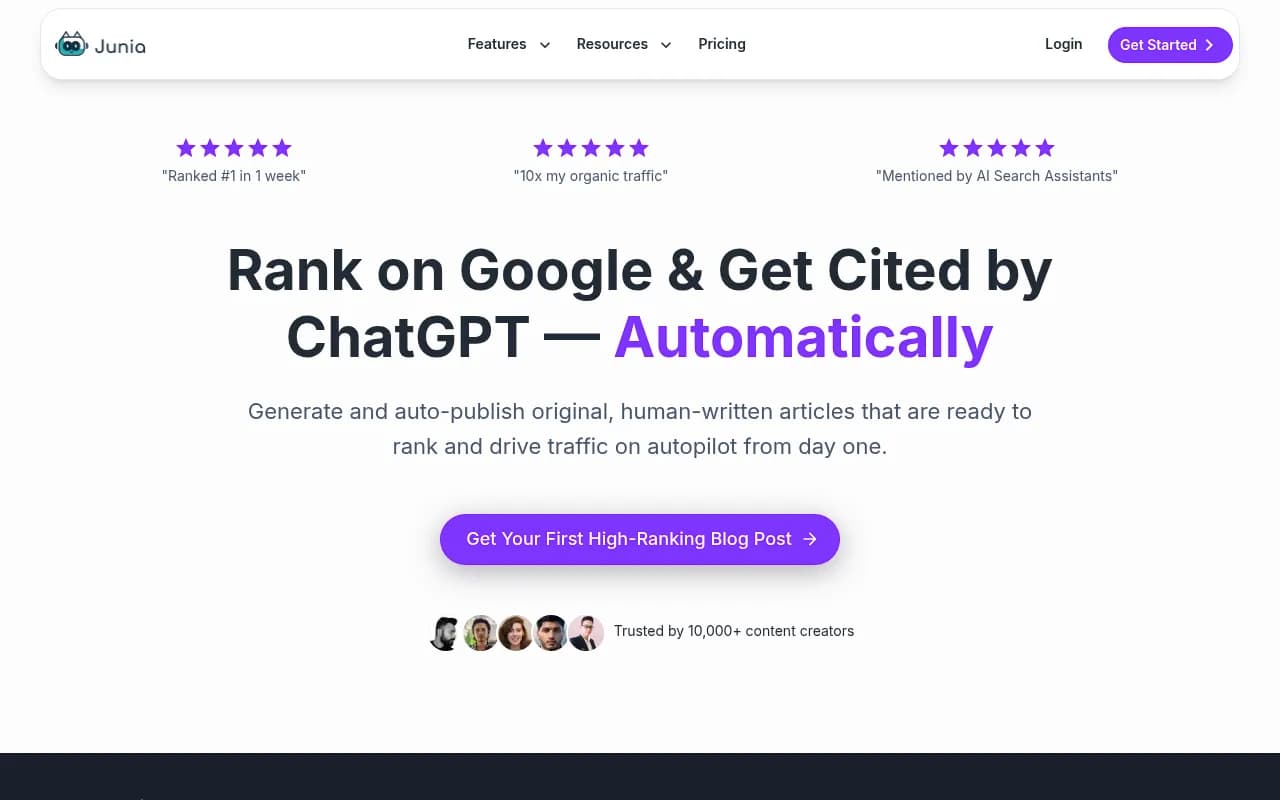
The honest assessment: Junia AI wasn't built for GEO. It doesn't track your brand's visibility in ChatGPT or Perplexity. It doesn't analyze which prompts your competitors are winning. It doesn't tell you what content gaps are causing AI models to cite your competitors instead of you.
What it does do is help you write content faster. If you already know what you need to create -- because you've done the analysis elsewhere -- Junia AI can help you produce it. But the "analysis elsewhere" part is doing a lot of work in that sentence. Without knowing which prompts matter, which angles AI models respond to, and what citation patterns look like across models, you're writing content and hoping it gets picked up. That's not optimization.
Junia AI is a good tool for content production. It's not a GEO platform.
Atomic AGI: tracking plus workflow automation
Atomic AGI takes a different approach. It combines AI visibility tracking with workflow automation, which makes it interesting for teams that want to do more than just monitor. The platform tracks brand mentions across multiple AI engines and includes tools for building automated workflows around that data.
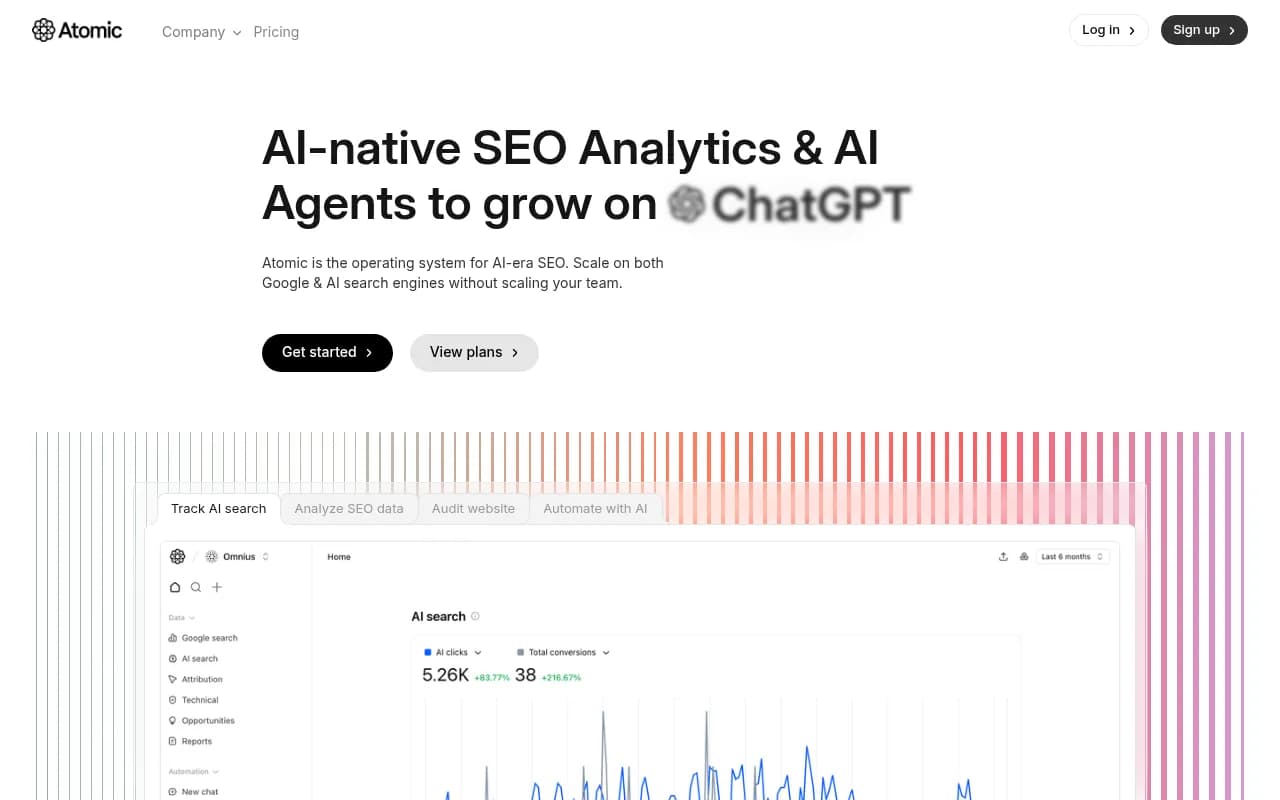
Where Atomic AGI has an edge over pure monitoring tools: the workflow layer. If you want to set up automated alerts, route visibility data into other systems, or trigger actions based on what AI models are saying about your brand, Atomic AGI gives you more flexibility than most.
Where it's still developing: the GEO-specific features -- content gap analysis, prompt intelligence, citation-level tracking -- aren't as deep as dedicated GEO platforms. The automation is powerful, but you still need to know what to automate. If you're trying to understand why you're not appearing in AI search and what to do about it, Atomic AGI gets you partway there.
It's a reasonable choice for technically-oriented teams that want to build custom workflows around AI visibility data. Less ideal for marketing teams that want a clear path from "we're invisible in AI search" to "here's the content we need to create."
Promptwatch: the full optimization loop
Promptwatch is the platform that most directly addresses the gap between monitoring and optimization. The core difference isn't a feature -- it's a workflow.

Most GEO tools stop at showing you data. Promptwatch is built around what happens after you see the data. The cycle works like this:
Find the gaps. Answer Gap Analysis shows you exactly which prompts your competitors are appearing for that you're not. Not just "you're invisible for these topics" -- it shows you the specific content your site is missing, the questions AI models want answered but can't find on your pages.
Create content that gets cited. The built-in AI writing agent generates articles, listicles, and comparisons grounded in real citation data. Promptwatch has analyzed over 880 million citations across AI models, so the content it generates isn't generic filler -- it's built around what AI models actually cite. Prompt volumes, difficulty scores, competitor analysis, and persona targeting all feed into the output.
Track the results. Page-level tracking shows which of your pages are being cited, how often, and by which models. Traffic attribution (via code snippet, Google Search Console integration, or server log analysis) connects AI visibility to actual revenue.
Beyond the core loop, Promptwatch has features that most competitors don't: real-time AI crawler logs showing which pages ChatGPT, Claude, and Perplexity are reading (and which errors they're hitting), Reddit and YouTube citation tracking, ChatGPT Shopping monitoring, and query fan-outs that show how a single prompt branches into sub-queries.
It monitors 10 AI models: ChatGPT, Perplexity, Google AI Overviews, Google AI Mode, Claude, Gemini, Meta/Llama, DeepSeek, Grok, Mistral, and Copilot. Multi-language and multi-region support means you can monitor AI responses in any language, from any country.
Pricing starts at $99/month for the Essential plan (1 site, 50 prompts, 5 articles), $249/month for Professional (2 sites, 150 prompts, 15 articles, crawler logs), and $579/month for Business (5 sites, 350 prompts, 30 articles). A free trial is available.
In a 2026 comparison of 12 GEO platforms, Promptwatch was the only one rated "Leader" across all categories -- the distinction being that it's an optimization platform, not just a tracker.
Head-to-head comparison
| Feature | Peec AI | Junia AI | Atomic AGI | Promptwatch |
|---|---|---|---|---|
| AI visibility tracking | Yes | No | Yes | Yes |
| Models monitored | 3+ | None | Multiple | 10 |
| Content gap analysis | No | No | Partial | Yes (Answer Gap Analysis) |
| AI content generation | No | Yes | No | Yes (citation-grounded) |
| AI crawler logs | No | No | No | Yes |
| Prompt volume/difficulty | No | No | No | Yes |
| Reddit/YouTube citation tracking | No | No | No | Yes |
| ChatGPT Shopping tracking | No | No | No | Yes |
| Traffic attribution | No | No | No | Yes |
| Query fan-outs | No | No | No | Yes |
| Unlimited seats | Yes | Varies | No | No |
| Starting price | ~$49/mo | ~$19/mo | Custom | $99/mo |
| Best for | Simple monitoring | Content production | Workflow automation | End-to-end GEO optimization |
Which tool should you actually use?
The answer depends on what problem you're trying to solve.
If you're just getting started with AI visibility and want a clean dashboard to understand where you stand: Peec AI is a good entry point. It's easy, the UX won't frustrate your team, and the unlimited seats mean you can loop in stakeholders without worrying about costs. Just know you'll outgrow it quickly if you want to actually improve your visibility.
If you need to produce more content and you already know what to write: Junia AI can help you write it faster. But it's not a GEO tool -- it won't tell you what to write or whether it's working in AI search.
If you're a technically-oriented team that wants to build custom workflows around AI visibility data: Atomic AGI is worth exploring. The automation layer is genuinely useful, and it's more flexible than most monitoring-only tools.
If you want to actually move your AI visibility scores -- not just measure them: Promptwatch is the only platform in this comparison that closes the full loop. The combination of gap analysis, citation-grounded content generation, crawler logs, and traffic attribution means you can go from "we're invisible in AI search" to "here's the content we created, here's how it's being cited, here's the traffic it's driving." That's a different category of tool.
The question worth asking before you buy
Before choosing a GEO platform, ask yourself: what happens after I see the data?
If your answer is "we'll figure it out," you probably want a tool that helps you figure it out -- not just one that shows you the problem. Monitoring is necessary but not sufficient. The brands that are winning in AI search in 2026 aren't just tracking their visibility; they're systematically creating content that AI models want to cite, then verifying it's working.
That loop -- find gaps, create content, track results -- is what separates GEO optimization from GEO monitoring. The platform you choose should support the whole loop, not just the first step.