Key takeaways
- Peec AI, Vaylis, and Ansehn are primarily monitoring tools — they show you where your brand appears in AI search, but leave the "what to do about it" question largely unanswered.
- Promptwatch is the only platform in this group with built-in content generation, answer gap analysis, and AI crawler logs — making it an optimization tool, not just a tracker.
- Peec AI is the easiest to get started with and works well for teams that just want a clean dashboard without complexity.
- Vaylis and Ansehn are newer entrants with solid fundamentals but limited depth compared to the more established options.
- If tracking accuracy matters, Promptwatch's 1.1 billion+ citations processed gives it a data advantage that smaller tools can't match.
The GEO tool market has gotten crowded fast. Two years ago there were maybe five serious options. Now there are dozens, and most of them look identical at first glance: a dashboard, some prompts, a few AI engines, a share-of-voice chart. The real differences only show up when you ask: what do I actually do with this data?
This comparison focuses on four tools that often get mentioned together in the "lightweight but capable" tier: Peec AI, Promptwatch, Vaylis, and Ansehn. They're not the same. One of them is genuinely trying to be something different from the others.
What we're comparing
Before getting into the tools, it's worth being clear about what "lightweight GEO tool" actually means in 2026. It's not a knock. It means tools that are accessible to marketing teams without a dedicated data team, priced for mid-market budgets, and focused on AI search visibility rather than traditional SEO. The question is whether "lightweight" also means "limited" — and for some of these tools, it does.
The two dimensions that matter most:
Tracking accuracy — How many AI engines does it cover? How fresh is the data? Does it show you page-level citation detail or just brand-level mentions?
Improvement features — Does the tool tell you why you're not appearing, and what to do about it? Or does it stop at the dashboard?
Peec AI
Peec AI is probably the most frequently recommended entry point for teams new to GEO monitoring. It's genuinely easy to use — the interface is clean, setup is fast, and you can get a basic picture of your AI visibility within minutes of signing up.

On tracking, Peec AI covers ChatGPT, Perplexity, and Claude as its core engines. Some additional engines are available as add-ons, but the base plan is limited to three. For most teams, that's enough to start — those three handle a significant chunk of AI search traffic. The data is prompt-based: you define a set of prompts, Peec runs them, and you see whether your brand appears in the response.
Where Peec AI starts to feel limited is on the improvement side. It shows you your visibility score and tracks it over time, but it doesn't tell you why you're not appearing for a given prompt, which competitors are winning that prompt, or what content you'd need to create to change the outcome. You're left to draw your own conclusions.
That's fine if you have an experienced SEO or content team who can interpret the data and act on it. It's frustrating if you're hoping the tool will guide you toward what to fix.
Pricing starts at €85/month for the Starter plan (50 prompts, 3 engines). It's one of the more affordable options in this comparison for what it covers.
Verdict: Best for teams that want a clean, no-fuss monitoring dashboard and are comfortable doing their own analysis. Not the right tool if you want the platform to help you improve.
Vaylis
Vaylis is a newer entrant that positions itself as an AI search visibility platform with a focus on brand tracking across ChatGPT, Perplexity, and Google AI. It's building toward a fuller feature set, but right now it's primarily a monitoring tool.
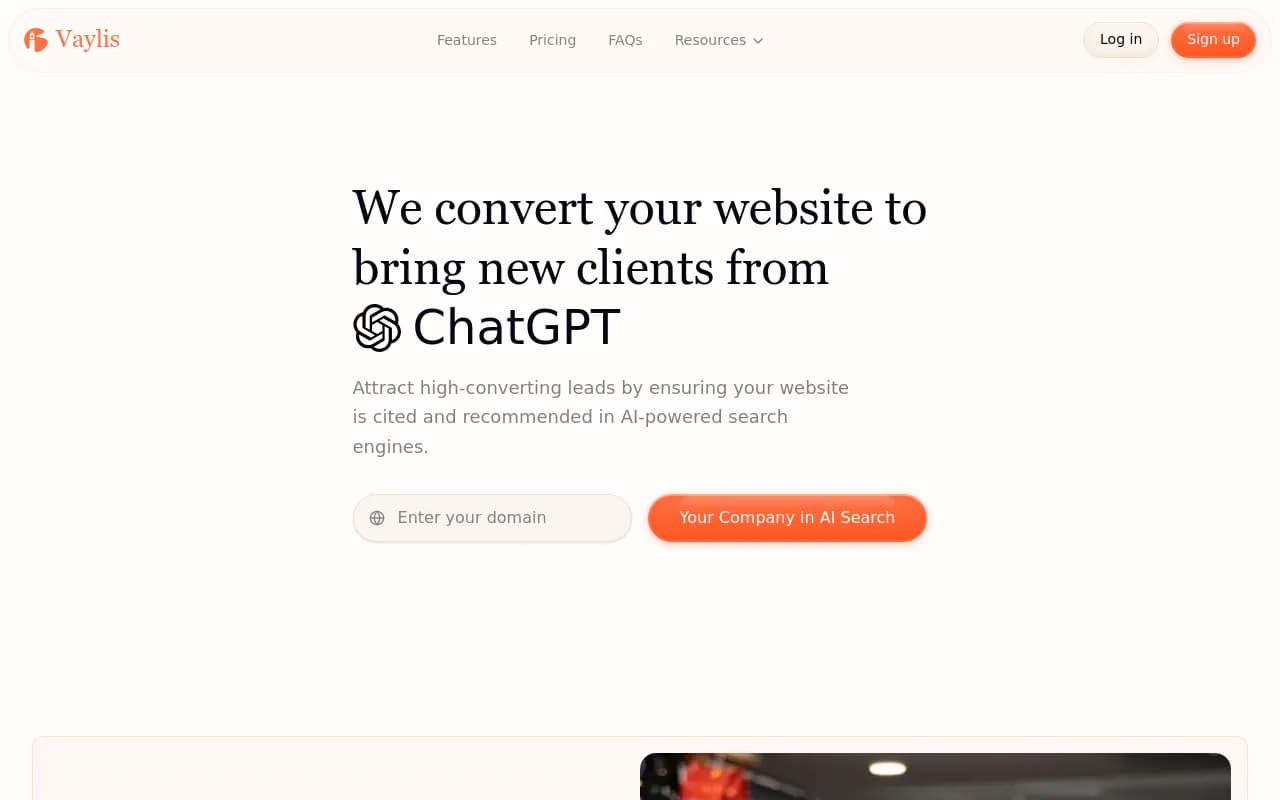
The interface is modern and the onboarding is straightforward. Vaylis tracks brand mentions, citation rates, and share of voice across its supported engines. It also surfaces some competitor comparison data, which is useful for understanding your relative position.
What Vaylis doesn't yet have in any meaningful depth: content gap analysis, AI crawler monitoring, or content generation. It can tell you that a competitor is appearing more often than you for a given prompt category, but it can't tell you what specific content is driving that or what you should write to compete.
The tool is worth watching — the team appears to be actively developing it — but in its current state it sits firmly in the monitoring-only camp.
Verdict: Decent for brand monitoring basics. Too early-stage to rely on for optimization workflows.
Ansehn
Ansehn covers ChatGPT, Perplexity, and Google AI Overview tracking with a clean dashboard and some basic prompt management features. Like Vaylis, it's a newer platform that's still finding its footing.
Ansehn
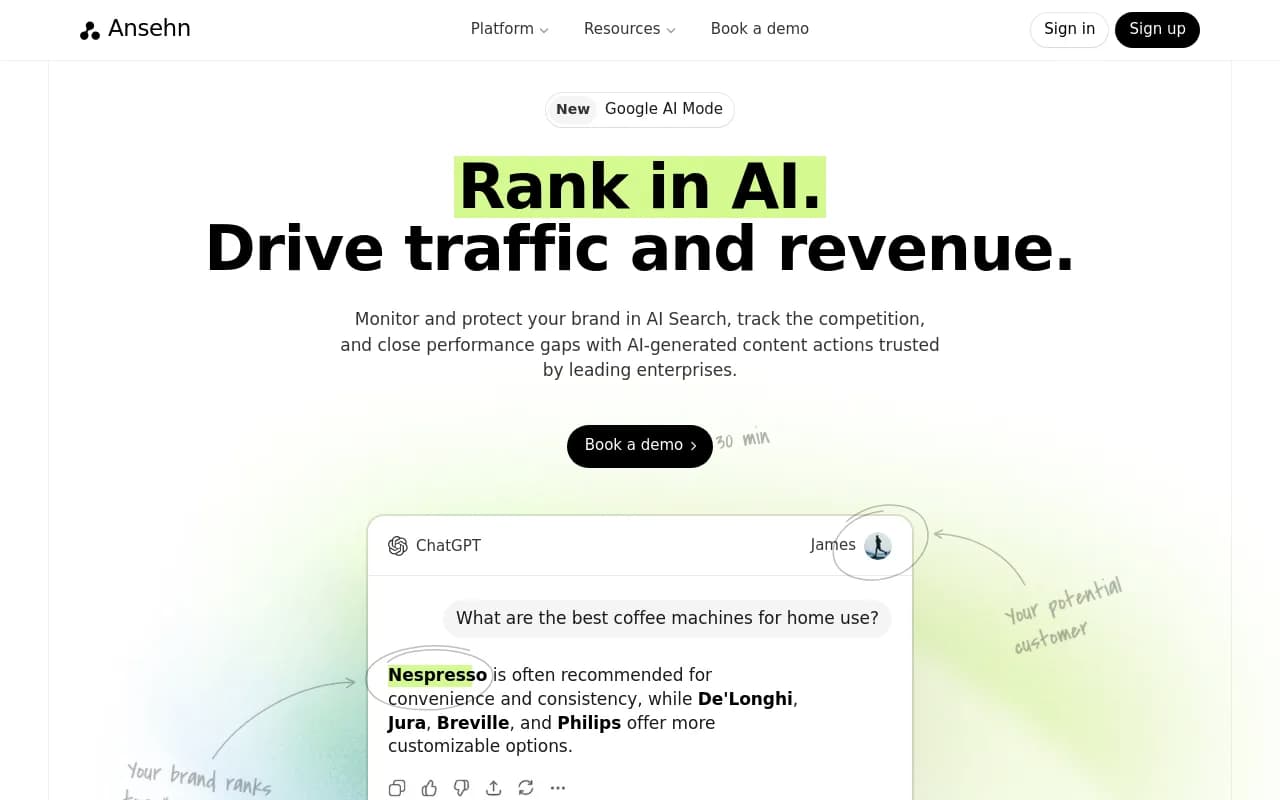
The tracking functionality works. You can set up prompts, see where your brand appears, and track changes over time. There's some competitor visibility data included, which helps contextualize your numbers.
The improvement story is thin. Ansehn doesn't offer content recommendations, gap analysis, or any mechanism for understanding why AI models aren't citing you. It's a visibility window, not a workflow.
One thing worth noting: the research data available on Ansehn is limited compared to the more established tools in this comparison. That's partly because it's newer, but it does make it harder to evaluate tracking accuracy with confidence.
Verdict: Functional for basic monitoring. Not yet a serious optimization platform.
Promptwatch
Promptwatch is the most established and most capable tool in this comparison, and it's also the one that's hardest to call "lightweight" — not because it's complex to use, but because it does substantially more than the others.

Tracking accuracy
On coverage, Promptwatch monitors 10 AI models: ChatGPT, Perplexity, Claude, Gemini, Google AI Overviews, Google AI Mode, Grok, DeepSeek, Mistral, and Copilot. That's the broadest coverage in this comparison by a significant margin. Peec AI covers 3 engines on its base plan. Vaylis and Ansehn cover 3-4.
The data behind Promptwatch's tracking is also meaningfully larger. With 1.1 billion citations, clicks, and prompts processed, the platform has a dataset that smaller tools simply can't match. That matters for accuracy — the more citation data you have, the better you can identify patterns in what AI models actually cite and why.
Page-level tracking is available, so you can see exactly which pages on your site are being cited, by which AI model, and how often. That's a level of granularity that brand-level mention tracking (what most monitoring-only tools provide) doesn't give you.
The AI Crawler Logs feature is genuinely unique in this comparison: real-time logs of when AI crawlers (ChatGPT's GPTBot, Claude's ClaudeBot, Perplexity's bot) visit your site, which pages they read, and any errors they encounter. None of the other three tools in this comparison offer anything like this.
Improvement features
This is where Promptwatch separates itself most clearly from Peec AI, Vaylis, and Ansehn.
The Answer Gap Analysis shows you exactly which prompts your competitors are appearing for that you're not. Not just "you're missing some prompts" — it shows you the specific questions, the competitor responses, and what topics your site is failing to address. That's actionable in a way that a visibility score isn't.
From there, Promptwatch's built-in AI writing agent can generate content — articles, listicles, comparisons — grounded in actual citation data. The content is engineered to get cited by AI models, not just to rank in Google. That's a meaningful distinction. You can go from "I'm invisible for this prompt" to "I have a draft article that addresses this gap" without leaving the platform.
Traffic attribution closes the loop: a code snippet, Google Search Console integration, or server log analysis connects your AI visibility improvements to actual website traffic and revenue. Most monitoring tools can't do this at all.
Pricing: Essential at $99/month (1 site, 50 prompts, 5 articles), Professional at $249/month (2 sites, 150 prompts, 15 articles, crawler logs), Business at $579/month (5 sites, 350 prompts, 30 articles). Free trial available.
Verdict: The only tool in this comparison that functions as a full optimization platform rather than a monitoring dashboard. The price reflects that.
Feature comparison
| Feature | Peec AI | Vaylis | Ansehn | Promptwatch |
|---|---|---|---|---|
| AI engines (base plan) | 3 | 3-4 | 3 | 10 |
| Page-level citation tracking | No | No | No | Yes |
| Competitor visibility | Basic | Basic | Basic | Detailed heatmaps |
| Answer gap analysis | No | No | No | Yes |
| AI content generation | No | No | No | Yes |
| AI crawler logs | No | No | No | Yes |
| Traffic attribution | No | No | No | Yes |
| Reddit/YouTube insights | No | No | No | Yes |
| ChatGPT Shopping tracking | No | No | No | Yes |
| Prompt volume/difficulty scores | No | No | No | Yes |
| Starting price | €85/mo | Custom | Custom | $99/mo |
| Free trial | Yes | Varies | Varies | Yes |
Which tool should you choose?
The honest answer depends on what you're actually trying to do.
If you're a small team that wants to start tracking AI visibility without committing to a complex platform, Peec AI is the most straightforward entry point. It's well-designed, affordable, and gives you a clear picture of your baseline. Just know that you'll hit its ceiling quickly if you want to act on what you find.
If you're evaluating Vaylis or Ansehn, they're worth keeping an eye on as they develop, but neither is mature enough to be a primary tool for teams that need reliable data and clear improvement paths. They're monitoring dashboards in early-to-mid development.
If you want to actually improve your AI visibility — not just measure it — Promptwatch is the only tool in this group built for that. The gap analysis, content generation, and crawler logs aren't nice-to-haves; they're the difference between knowing you have a problem and being able to fix it. The price is higher, but you're getting a fundamentally different category of tool.
A useful way to think about it: Peec AI, Vaylis, and Ansehn show you the scoreboard. Promptwatch shows you the scoreboard and then helps you practice.
What most GEO tools get wrong
The monitoring-only model made sense in 2024 when AI search was new and brands just needed to know if they were appearing at all. In 2026, that's table stakes. The question isn't "am I visible?" — it's "what do I need to create to become more visible, and is it working?"
Most lightweight GEO tools are still answering the 2024 question. That's not a criticism of the teams building them; it's just where the category is. The tools that will matter in 12 months are the ones that close the loop between data and action.
For teams that are serious about AI search visibility as a growth channel, the monitoring-only approach creates a frustrating workflow: you see a gap, you leave the tool, you try to figure out what content to create, you publish something, you come back weeks later to see if it moved the needle. Promptwatch is designed to keep that entire cycle inside one platform.
That said, not every team needs the full cycle right now. If you're just starting to understand your AI visibility and want to build a baseline before investing in optimization, Peec AI is a reasonable place to start. Just plan for where you'll go next.
Bottom line
Peec AI is the best pure monitoring tool in this comparison for teams that want simplicity. Vaylis and Ansehn are early-stage options that aren't ready to be primary platforms. Promptwatch is the only tool here that goes beyond monitoring to actually help you rank in AI search — and for teams that are serious about GEO as a channel, that difference matters more than the price gap.