Key takeaways
- Peec AI and Orchly are solid monitoring tools, but they stop at showing you the data -- neither has meaningful content generation or gap-fixing capabilities built in.
- Scrunch AI has strong enterprise tracking features but sits at a higher price point and lacks Reddit/YouTube citation tracking and AI traffic attribution.
- Promptwatch is the only platform in this comparison that closes the full loop: find gaps, generate content engineered to get cited, then track whether it worked.
- If your team's goal is to understand AI visibility AND act on it without switching between five tools, Promptwatch is the clearest choice.
- Budget matters: Peec AI starts at $89/month, Orchly at $49/month, Promptwatch at $99/month. Scrunch AI is significantly more expensive.
There's a version of this comparison that's easy to write. You list four tools, give each one a score out of ten, and call it a day. But that misses the actual question most marketing teams are asking in 2026: not "which tool shows me the most data?" but "which tool helps me do something about it?"
AI search has changed the game. ChatGPT, Perplexity, Claude, Gemini -- these platforms now answer questions that used to drive organic clicks. Your brand can rank #1 in Google and still be completely invisible when someone asks an AI assistant for a recommendation in your category. That's a real problem, and it's why GEO (Generative Engine Optimization) platforms have exploded in the last 18 months.
The four tools in this comparison -- Peec AI, Promptwatch, Scrunch AI, and Orchly -- are all positioned in roughly the same space. They all track AI visibility. They all show you where your brand appears (or doesn't) across AI models. But they diverge sharply on what happens after the monitoring.
Let's get into it.
What we're actually comparing
Before the feature breakdown, it's worth being clear about what matters. There are three things a GEO platform needs to do well:
- Show you where you appear across AI models (and where you don't)
- Tell you why you're missing -- what content gaps are causing the invisibility
- Help you fix it -- either by generating content or giving you specific enough guidance to act
Most platforms nail point one. Some get to point two. Very few reach point three. That gap is where the real differentiation lives.
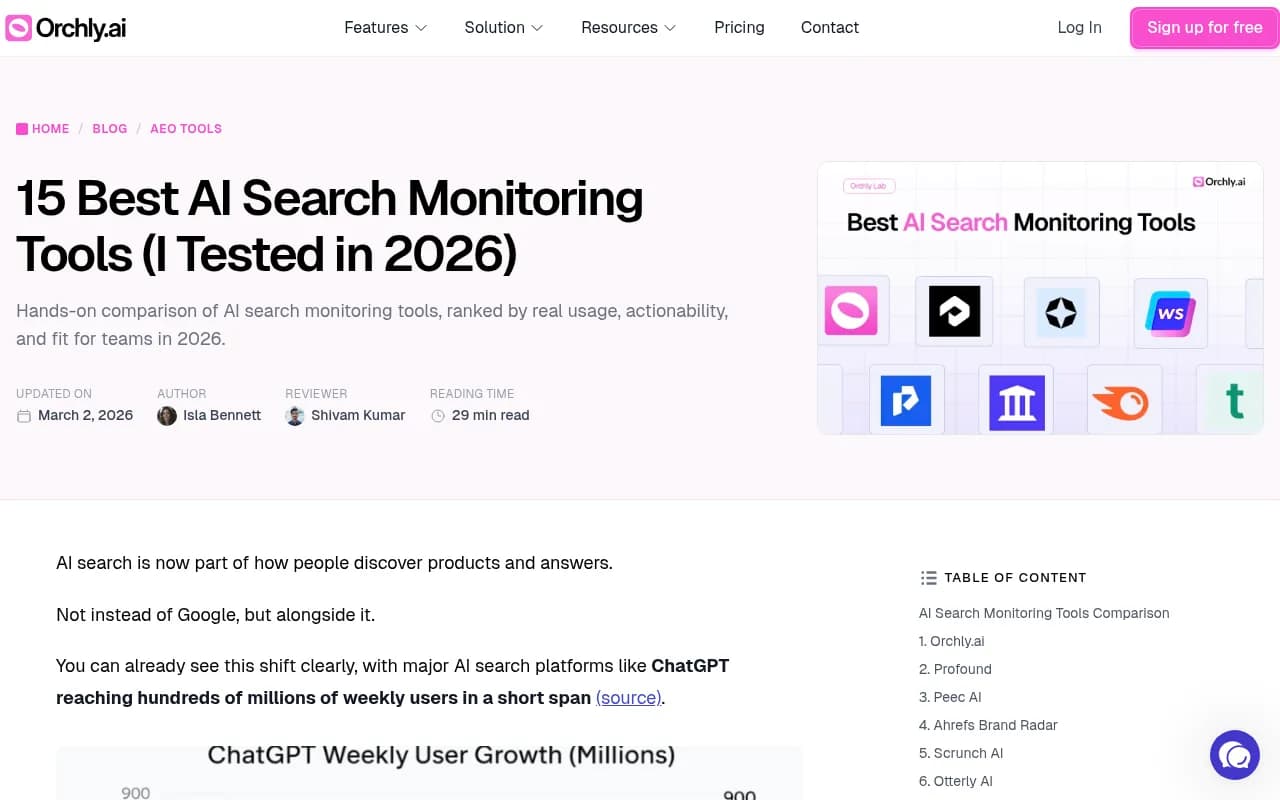
Peec AI: clean and intuitive, but monitoring-only
Peec AI has a reputation for being one of the easiest GEO tools to get into. The interface is clean, onboarding is fast, and the reporting is genuinely readable. For teams that are new to AI visibility tracking, that matters.
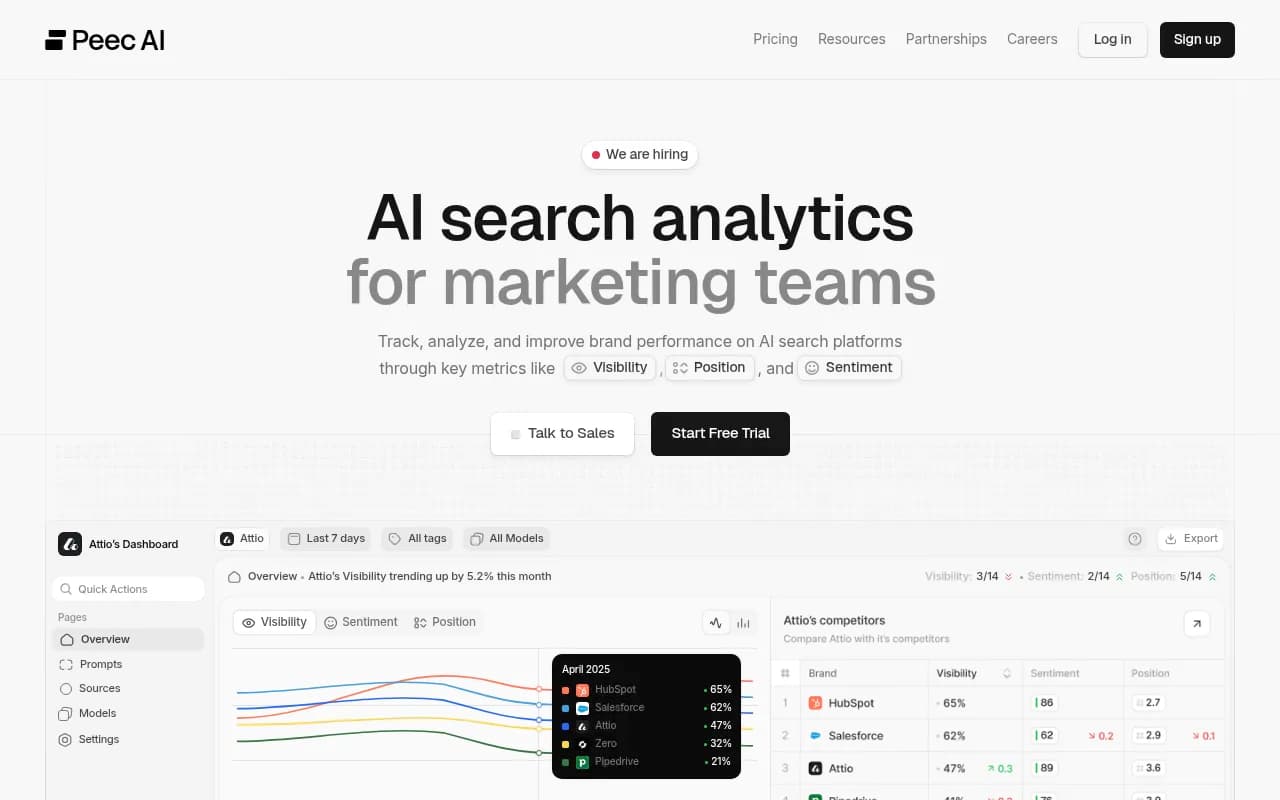
What Peec AI does well:
- Tracks brand mentions across ChatGPT, Perplexity, and Claude
- Clean dashboards that non-technical stakeholders can actually understand
- Reasonable pricing starting around $89/month
- Good fit for agencies that need to show clients something quickly
Where it falls short:
- No content generation or content gap analysis
- Limited AI model coverage compared to platforms tracking 10+ models
- No crawler log access (you can't see which pages AI bots are actually reading)
- No Reddit or YouTube citation tracking
- No traffic attribution -- you can't connect AI visibility to actual revenue
The honest assessment: Peec AI is a good monitoring dashboard. If you need to show a client "here's where you appear in AI search," it does that job. But if you need to know why you're not appearing for certain prompts, or what content to create to fix it, you'll hit a wall fast.
One Reddit user in r/GEO_optimization put it plainly when asking about alternatives: "Is it to track visibility only? Or are you looking for something that can help in optimization based on insights?" That question captures exactly where Peec AI sits -- firmly in the "track only" camp.
Orchly: affordable entry point, limited depth
Orchly positions itself as an SEO + AI visibility platform in one, which sounds appealing. The pricing is aggressive at $49/month, making it the cheapest option in this comparison by a meaningful margin.
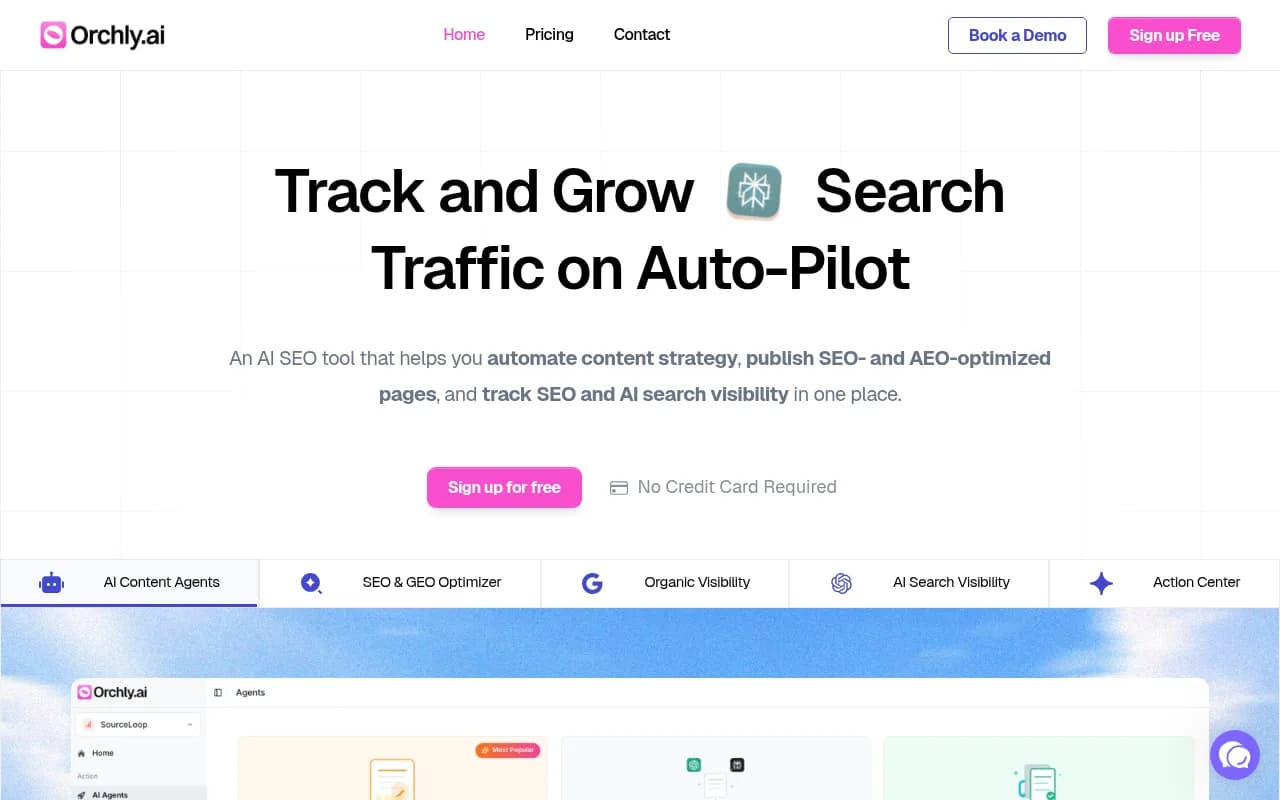
What Orchly does well:
- Combines some traditional SEO tracking with AI visibility monitoring
- Accessible price point for smaller teams
- Has an "Action Center" concept that gestures toward optimization
Where it falls short:
- The action capabilities are limited in practice -- the Action Center is more of a recommendations list than a true optimization engine
- AI model coverage is narrower than Promptwatch or Scrunch AI
- No AI-powered content generation grounded in citation data
- Crawler log access and traffic attribution are absent
- Less mature data infrastructure than the other tools in this comparison
Orchly is worth considering if budget is the primary constraint and you need basic AI visibility reporting. But the gap between "here are some recommendations" and "here's content that will actually get cited by ChatGPT" is significant. Orchly doesn't bridge it.
Scrunch AI: strong enterprise tracking, expensive
Scrunch AI is a more serious platform than either Peec AI or Orchly. It has broader AI model coverage, stronger analytics, and is clearly built for larger organizations with dedicated SEO or marketing teams.
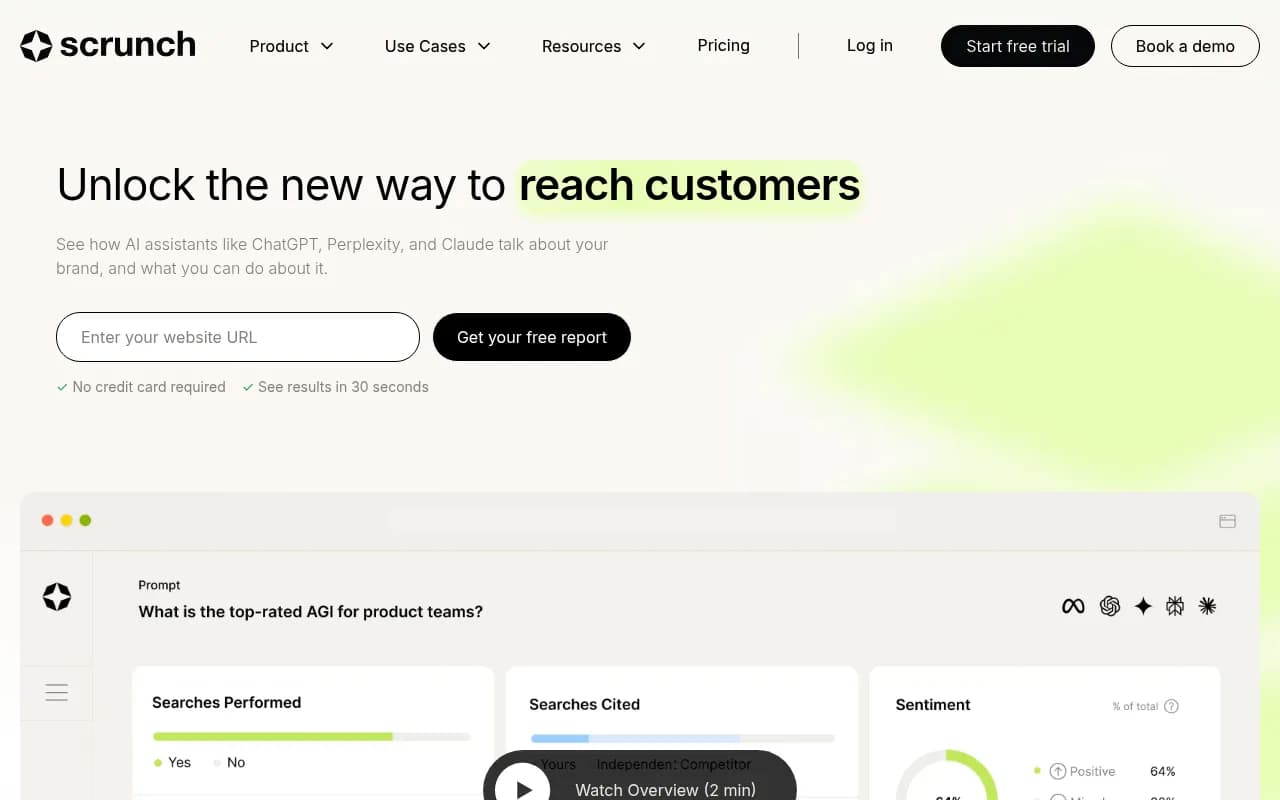
What Scrunch AI does well:
- Solid coverage across major AI models
- More detailed analytics than the lighter tools in this space
- Enterprise-grade reporting features
- API access for custom workflows
Where it falls short:
- Pricing puts it out of reach for most mid-market teams
- No Reddit or YouTube citation tracking (a significant blind spot, since these sources heavily influence what AI models cite)
- No ChatGPT Shopping tracking
- Content generation is not a core capability -- it's still primarily a monitoring platform
- Traffic attribution is limited
The enterprise positioning is both Scrunch AI's strength and its limitation. If you're a large brand with a big budget and you need deep monitoring across multiple markets, it's a reasonable choice. But for teams that need to actually create content that ranks in AI search, Scrunch AI doesn't get you there.
Promptwatch: the only one that closes the loop
Promptwatch is the platform that most directly answers the question this comparison is built around. It's not just a monitoring tool -- it's built around what the team calls an "action loop": find gaps, create content, track results.

The monitoring side is comprehensive. Promptwatch tracks 10 AI models including ChatGPT, Claude, Gemini, Perplexity, Grok, DeepSeek, Copilot, Mistral, Meta AI, and Google AI Overviews. That's broader coverage than any other tool in this comparison.
But the monitoring is just the starting point. Here's what sets it apart:
Answer Gap Analysis shows you exactly which prompts competitors are visible for but you're not. Not just "you're missing from these queries" -- it shows you the specific content your site is missing that AI models want to cite. That's a fundamentally different kind of insight.
Content generation grounded in citation data. The built-in AI writing agent creates articles, listicles, and comparisons based on analysis of 880M+ real citations. This isn't generic AI content -- it's engineered to match what AI models actually cite when answering questions in your category.
Crawler logs. You can see in real time which AI crawlers (ChatGPT, Claude, Perplexity) are hitting your pages, which pages they're reading, and what errors they're encountering. Most competitors don't offer this at all.
Traffic attribution. Via a code snippet, Google Search Console integration, or server log analysis, you can connect AI visibility to actual website traffic and revenue. This is the piece that turns GEO from a vanity metric into a business case.
Reddit and YouTube tracking. These platforms heavily influence what AI models cite, and Promptwatch surfaces the specific discussions and videos that are shaping AI recommendations in your category. Peec AI, Orchly, and Scrunch AI all skip this entirely.
ChatGPT Shopping tracking. If your brand sells products, this matters -- Promptwatch monitors when you appear in ChatGPT's product recommendations and shopping carousels.
Pricing starts at $99/month for the Essential plan (1 site, 50 prompts, 5 articles), $249/month for Professional (2 sites, 150 prompts, 15 articles, crawler logs), and $579/month for Business (5 sites, 350 prompts, 30 articles). There's a free trial available.
The jump from $89 (Peec AI) to $99 (Promptwatch Essential) is minimal. The difference in what you can actually do with the platform is not.
Head-to-head comparison
| Feature | Peec AI | Orchly | Scrunch AI | Promptwatch |
|---|---|---|---|---|
| AI models tracked | 3-4 | 4-5 | 6-8 | 10 |
| Answer Gap Analysis | No | No | Limited | Yes |
| Content generation | No | No | No | Yes (citation-grounded) |
| AI crawler logs | No | No | No | Yes |
| Reddit/YouTube tracking | No | No | No | Yes |
| ChatGPT Shopping tracking | No | No | No | Yes |
| Traffic attribution | No | No | Limited | Yes |
| Prompt volume/difficulty scoring | No | No | No | Yes |
| Query fan-outs | No | No | No | Yes |
| Page-level citation tracking | No | No | Partial | Yes |
| Competitor heatmaps | Basic | Basic | Yes | Yes |
| Multi-language/region | Limited | No | Yes | Yes |
| API access | No | No | Yes | Yes (higher tiers) |
| Starting price | $89/mo | $49/mo | $499+/mo | $99/mo |
| Free trial | Yes | Yes | No | Yes |
Who should use what
Choose Peec AI if you're brand new to AI visibility tracking, have a very limited budget, and primarily need to show clients or stakeholders a clean report of where the brand appears. Accept that you'll outgrow it quickly.
Choose Orchly if you want the cheapest possible entry point and some basic SEO integration alongside AI monitoring. Good for solo consultants or very small teams doing initial exploration.
Choose Scrunch AI if you're at an enterprise with a significant budget, need deep monitoring across multiple markets, and have a separate content team that will handle optimization work independently.
Choose Promptwatch if you want to actually improve your AI search visibility, not just measure it. It's the only platform here that finds the gaps, helps you create content to fill them, and then tracks whether it worked. For most marketing teams and agencies, this is the one that pays for itself.
The monitoring-only trap
There's a pattern worth naming. A lot of teams buy a GEO monitoring tool, spend a few weeks looking at dashboards, and then... don't know what to do next. The data shows they're invisible for certain prompts, but the tool doesn't tell them what content to create or how to create it. So the subscription renews, the dashboards get checked less frequently, and nothing changes.
This is the monitoring-only trap. Peec AI, Orchly, and to a large extent Scrunch AI all leave you in it. You get visibility into your invisibility, but no path out.
Promptwatch is designed around avoiding that trap. The Answer Gap Analysis tells you specifically what's missing. The content generation tool creates something you can actually publish. The crawler logs tell you whether AI bots are finding your new content. The traffic attribution tells you if it's driving results. That's a complete workflow, not just a dashboard.
For teams that are serious about AI search visibility in 2026, the question isn't really "which monitoring tool should I use?" It's "which platform will actually help me rank in AI search?" Those are different questions with different answers.
Bottom line
All four tools in this comparison have a place. But they're not equivalent, and treating them as interchangeable monitoring dashboards misses the point.
Peec AI and Orchly are good starting points for teams that are just getting oriented. Scrunch AI is a reasonable enterprise monitoring choice. Promptwatch is the platform for teams that want to move from tracking to actually winning in AI search.
The gap between monitoring and optimization is where most GEO strategies stall. The right tool is the one that helps you cross it.