Key takeaways
- All four platforms track brand visibility across AI search engines like ChatGPT, Perplexity, and Google AI Overviews — but they differ dramatically in what happens after you see the data.
- Profound and AthenaHQ are strong monitoring and analytics platforms, but neither has built-in content generation to act on what they find.
- Scrunch offers solid tracking with a clean interface, but sits closer to the monitoring-only camp.
- Promptwatch is the only platform in this group that closes the loop: find gaps, generate content engineered to get cited by AI models, then track whether it worked.
- If your team needs to actually improve AI visibility — not just report on it — the platform with an action loop built in will save you months of manual work.
There's a question that keeps coming up in marketing teams right now: "We can see that we're invisible in ChatGPT and Perplexity — but what do we actually do about it?"
That question is what separates the GEO platforms worth paying for from the ones that just give you a prettier dashboard of bad news.
In 2026, four platforms consistently come up in enterprise conversations: Profound, Promptwatch, Scrunch, and AthenaHQ. They all track AI search visibility. They all have dashboards. They all let you monitor competitor mentions. But the similarities mostly end there.
This guide is for teams who've moved past "should we care about AI search?" and are now asking "which tool will actually help us win?"
What "enterprise GEO" actually means in 2026
Before comparing platforms, it's worth being clear about what the category even is.
Generative Engine Optimization (GEO) is the practice of getting your brand cited and recommended by AI models — ChatGPT, Claude, Perplexity, Gemini, Google AI Overviews, and others. Unlike traditional SEO, where you're optimizing for a ranked list of links, GEO is about being the source an AI model pulls from when someone asks a relevant question.
The enterprise version of this problem has a few specific requirements:
- Multi-brand or multi-site monitoring
- Competitive benchmarking across many prompts
- Attribution — connecting AI visibility to actual traffic and revenue
- Content workflows that can scale across teams
- Reporting that works for stakeholders who don't live in the tool
With that in mind, here's how the four platforms stack up.
Profound
Profound

Profound is the most analytics-heavy platform in this comparison. It's built for teams that want deep, research-grade intelligence on how AI models represent their brand — and it shows. The reporting is thorough, the prompt coverage is broad, and the competitive benchmarking is genuinely useful for understanding where you stand.
Where Profound earns its reputation is in the data layer. You can track brand mentions across 9+ AI engines, see sentiment trends over time, and generate the kind of stakeholder-ready reports that justify GEO investment to a CMO. One Reddit thread in r/b2bmarketing described it as feeling "more enterprise / research-grade" — which is accurate, and also a hint at its limitation.
The limitation: Profound is primarily a measurement platform. It tells you what's happening with impressive precision. It doesn't tell you what to write, and it doesn't help you write it. Teams using Profound typically need to pair it with a separate content workflow — which adds friction, cost, and time between insight and action.
Some users have also flagged that translating Profound's insights into concrete next steps requires significant internal expertise. If your team has strong content operations already, that's manageable. If you're starting from scratch on GEO content, you'll feel the gap.
Pricing sits at the higher end of the market, which makes sense for what it delivers — but means it's harder to justify for teams that aren't already running mature content programs.
AthenaHQ

AthenaHQ positions itself around revenue attribution — the idea that AI visibility should connect to pipeline, not just brand metrics. That's a genuinely important angle, and AthenaHQ has invested in making that connection clearer than most competitors.
The platform has a 4.9 rating on G2, with customers including SoFi, ZoomInfo, and Wix. Its State of AI Search 2026 report found that brands actively optimizing for AI search reach up to 56.7% of AI answers — compared to a market average of 17.2%. That's a useful data point for making the case internally.
AthenaHQ covers a wide range of AI platforms and has built workflows around AEO (Answer Engine Optimization) best practices: assess visibility, optimize content, monitor results. The interface is clean and the onboarding is more guided than Profound's.
The honest limitation here is similar to Profound's: AthenaHQ is fundamentally a monitoring and analytics platform. The "optimize content" step in their workflow is largely advisory — the platform surfaces what you should fix, but the actual content creation happens elsewhere. Some users have noted difficulty translating insights into concrete action without significant internal resources.
For teams where revenue attribution is the primary metric and content production is already handled, AthenaHQ is a strong choice. For teams that need the full loop — find gaps, create content, measure results — it's half the solution.
Scrunch
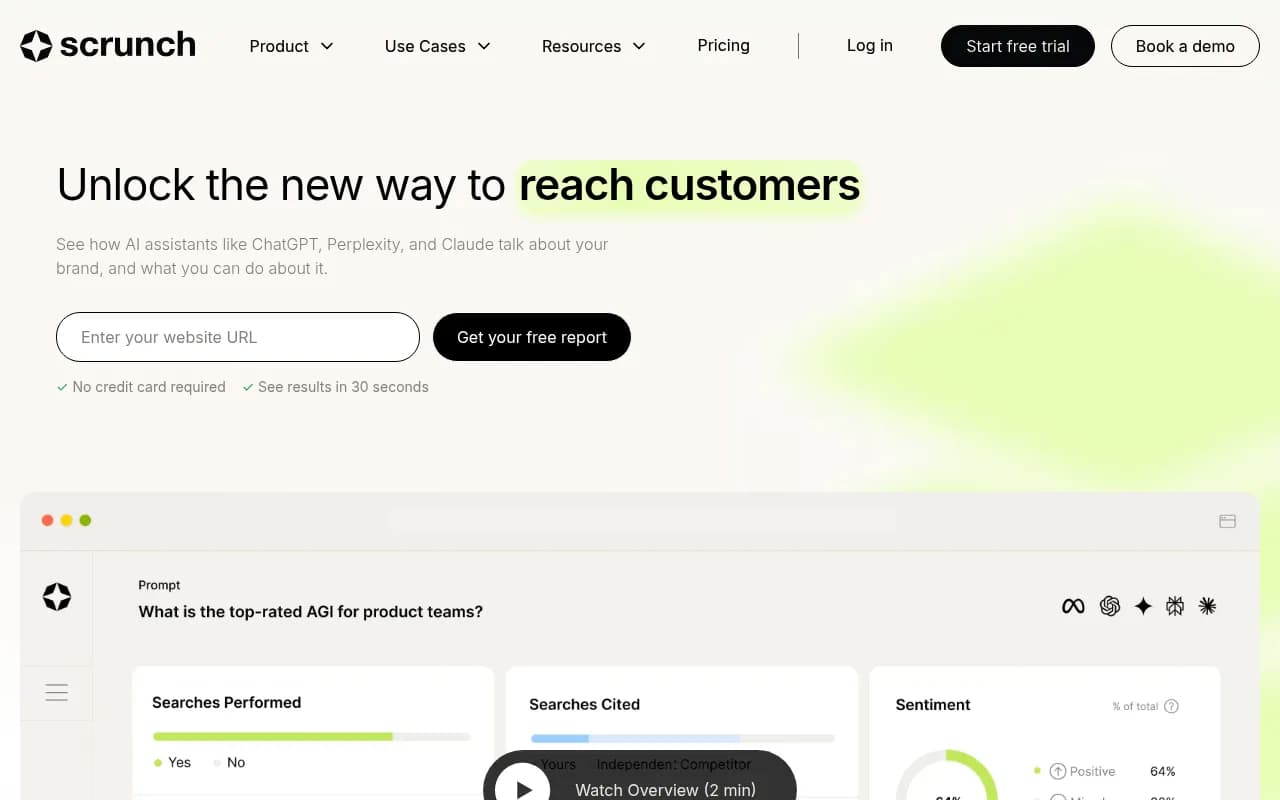
Scrunch is a solid mid-market option that tracks AI visibility across the major LLMs with a cleaner, more accessible interface than the heavier enterprise platforms. It's worth considering if your team is earlier in the GEO journey and needs something that doesn't require a six-week onboarding.
The platform covers the core use cases: brand mention tracking, competitor comparisons, and prompt-level visibility data. The reporting is straightforward and the learning curve is lower than Profound or AthenaHQ.
The trade-off is depth. Scrunch doesn't have the same analytical horsepower as Profound, and like the others in this comparison, it doesn't include built-in content generation. You'll see where you're missing — you just won't get help fixing it from within the platform.
For smaller enterprise teams or those in an early evaluation phase, Scrunch is a reasonable starting point. For teams that need to show measurable improvement in AI visibility quarter over quarter, the lack of an action layer will eventually become a bottleneck.
Promptwatch
Promptwatch takes a different approach to the category, and it's worth being direct about why.

Most GEO platforms are built around the monitoring problem: how do we show brands where they appear (or don't appear) in AI responses? Promptwatch is built around the improvement problem: how do we actually get brands cited more?
The difference shows up in three connected capabilities:
Answer Gap Analysis finds the specific prompts where competitors are getting cited but you're not. Not just "you're missing in this topic area" — the actual prompts, with data on which competitors are winning and what content they're using to do it. That's a content brief, not just a report.
AI content generation turns those gaps into articles, listicles, and comparisons grounded in 880M+ real citations analyzed. This isn't generic SEO content — it's engineered to match the citation patterns of ChatGPT, Claude, Perplexity, and other models. The writing agent understands prompt volumes, difficulty scores, and competitor positioning before it writes a word.
Page-level tracking and traffic attribution closes the loop. Once content is published, you can see exactly which pages are being cited, by which AI models, and how often. The traffic attribution layer (via code snippet, Google Search Console integration, or server log analysis) connects AI visibility to actual revenue — so you're not just reporting on impressions.
Beyond the action loop, Promptwatch has capabilities the other platforms in this comparison don't: real-time AI crawler logs showing which pages ChatGPT, Claude, and Perplexity are actually reading (and which errors they're hitting), Reddit and YouTube tracking to surface discussions that influence AI recommendations, ChatGPT Shopping tracking for product-focused brands, and query fan-outs that show how one prompt branches into sub-queries.
It monitors 10 AI models — OpenAI/ChatGPT, Perplexity, Google AI Overviews, Google AI Mode, Claude, Gemini, Meta/Llama, DeepSeek, Grok, Mistral, and Copilot — with multi-language and multi-region support.
Pricing starts at $99/month for the Essential plan (1 site, 50 prompts, 5 articles), $249/month for Professional (2 sites, 150 prompts, 15 articles, crawler logs), and $579/month for Business (5 sites, 350 prompts, 30 articles). A free trial is available.
The platform is used by 6,700+ brands and agencies including Booking.com, Center Parcs, and Wortell.
Side-by-side comparison
| Feature | Profound | AthenaHQ | Scrunch | Promptwatch |
|---|---|---|---|---|
| AI model coverage | 9+ | Wide | Core LLMs | 10 models |
| Brand mention tracking | Yes | Yes | Yes | Yes |
| Competitor benchmarking | Yes | Yes | Yes | Yes |
| Prompt volume / difficulty scoring | Limited | Limited | No | Yes |
| Answer Gap Analysis | No | No | No | Yes |
| Built-in AI content generation | No | No | No | Yes |
| AI crawler logs | No | No | No | Yes |
| Reddit / YouTube tracking | No | No | No | Yes |
| ChatGPT Shopping tracking | No | No | No | Yes |
| Traffic attribution | No | Revenue-focused | No | Yes (GSC, snippet, logs) |
| Query fan-outs | No | No | No | Yes |
| Multi-language / multi-region | Yes | Yes | Limited | Yes |
| Starting price | High | High | Mid | $99/mo |
| Free trial | No | No | No | Yes |
Which platform fits which team
The honest answer is that the right choice depends on what your team actually needs to accomplish.
Choose Profound if you have a mature content operation already running and your primary need is deep, research-grade analytics and stakeholder reporting. Profound's data quality is strong, and if you're not looking for the platform to help you create content, the monitoring depth is hard to beat.
Choose AthenaHQ if revenue attribution is your primary metric and you need to connect AI visibility to pipeline in a way that resonates with finance and leadership. The G2 ratings are strong, and the platform is well-suited to teams with existing content workflows.
Choose Scrunch if you're earlier in the GEO journey, have a smaller team, and need something accessible without a heavy onboarding process. It covers the basics well and won't overwhelm a team that's still figuring out its AI search strategy.
Choose Promptwatch if your goal is to actually improve your AI visibility — not just measure it. The combination of gap analysis, content generation, and attribution tracking means your team can move from "we're invisible for these prompts" to "we published content and our citation rate improved" within weeks, not quarters. For teams that need to show results, not just data, this is the meaningful difference.
The question worth asking before you buy
Every platform in this comparison will show you a dashboard with your AI visibility scores. Every one will show you where competitors are outperforming you. Every one will generate a report you can share with leadership.
The question that actually matters: what happens the day after you get that report?
If your team has the content resources, the editorial process, and the expertise to turn monitoring data into published content that gets cited by AI models — any of these platforms can feed that process. Profound or AthenaHQ will give you the richest data to work with.
If your team needs the platform to help bridge the gap between "here's where you're missing" and "here's the content that fixes it" — Promptwatch is the only option in this group that does that end-to-end.
The GEO market in 2026 is full of tools that measure the problem. Fewer help you solve it.