Key takeaways
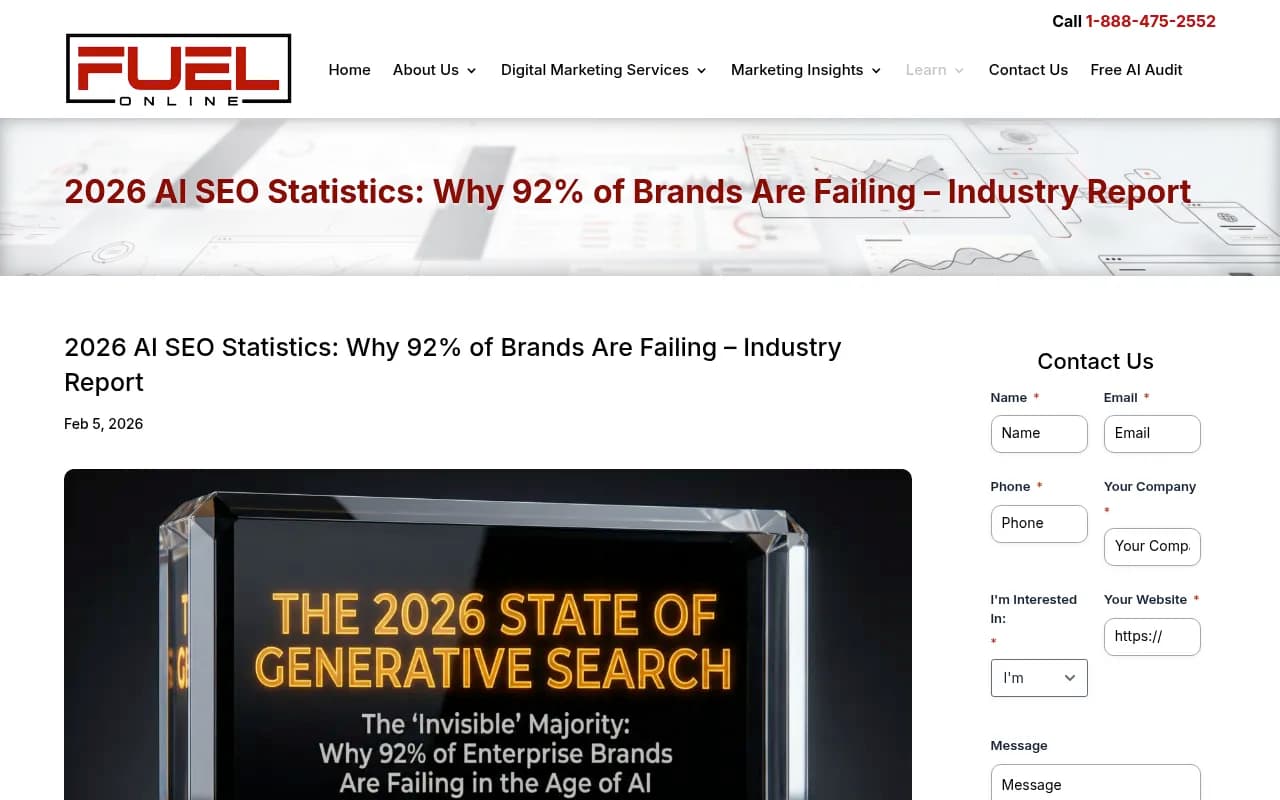
- According to the 2026 Fuel AI Index, 92% of enterprise brands are effectively invisible to AI search engines -- ChatGPT fails to cite them in 81% of test queries about their core services.
- A separate analysis found 77% of brands across 2,000 companies have zero AI visibility, and only 18% of brands recommended by AI are the top-ranking SEO players.
- Finance, technology, and health are the most cited industries; local services, niche B2B, and mid-market retail remain largely invisible.
- Citation rates vary wildly by platform -- the same brand can go from 0.59% on ChatGPT to 27% on Grok, a 46x gap.
- The fix isn't traditional SEO. AI models evaluate entity authority, structured data, third-party citations, and content depth -- not just page rankings.
The visibility crisis no one expected
Here's the uncomfortable reality of 2026: you can rank #1 on Google for your most important keyword and still be completely absent from every AI-generated answer your potential customers see.
That's not a hypothetical. Conductor research found that 62% of AI-generated responses include brand recommendations, but only 18% of those brands are the top-ranking SEO players. The overlap between "winning at Google" and "winning at ChatGPT" is smaller than most marketing teams realize.
The 2026 Fuel AI Index, which audited 1,000 enterprise domains across SaaS, legal, finance, and retail, found that 62% are "technically invisible" to generative AI models. When tested with direct, unbranded questions about their core services, AI models failed to cite them in 81% of cases. A separate Reddit-circulated study of 2,000 brands put the invisibility rate even higher: 77% have zero AI visibility.
This isn't a fringe problem. It's the default state for most brands right now.
Why Google rankings don't translate to AI citations
Before getting into which industries are winning and losing, it's worth understanding why the gap exists at all.
Traditional SEO is about page authority -- backlinks, keyword density, technical crawlability. AI citation is about something different: entity authority. ChatGPT, Claude, and Perplexity don't rank pages; they synthesize information from sources they've learned to trust. That trust is built through:
- How consistently your brand is mentioned across authoritative third-party sources (Wikipedia, major publications, industry directories)
- Whether your website has valid structured data that helps AI models understand what your organization actually does
- The depth and specificity of your content -- not just whether it exists, but whether it actually answers the questions people are asking
The Fuel AI Index found that only 12.4% of Fortune 1000 companies have valid Organization schema linked to a Knowledge Graph ID. That's a basic technical requirement for AI models to confidently identify and cite your brand. Most companies haven't done it.
There's also a self-inflicted wound worth mentioning: 34% of B2B SaaS companies actively block AI crawlers in their robots.txt files. They're trying to protect their content, but the practical effect is that ChatGPT and Perplexity can't read their site at all. You can't be cited if you can't be read.
Which industries are winning in AI search
Financial services and wealth management
Finance is one of the most actively cited industries in AI search, and a March 2026 study makes clear why. Gregory agency analyzed 201,233 AI citations across 279 prompts on ChatGPT, AI Overviews, Gemini, Claude, and Perplexity -- all focused on wealth management queries.
The findings are worth sitting with. National comparison sites like NerdWallet and Bankrate dominate broad queries. Tier-1 media (Wall Street Journal, CNBC, Forbes, Barron's) get pulled heavily for general financial advice. But the picture shifts dramatically by query type:
- Local queries favor Forbes' "Best in State" rankings and geographically specific directory content -- and even Forbes' own citation rate swings from 21.6% in Southern California to just 3% in Dallas-Fort Worth.
- Persona-driven queries (e.g., "best advisor for a young professional with student debt") favor brand-owned content, especially for niche audiences that major media doesn't cover well.
- Comparative prompts reward firms with clear, differentiated messaging across both owned and earned media.
The lesson: there isn't one leaderboard in AI search. Every question creates its own. Financial brands that have invested in both media coverage and specific, persona-targeted content are benefiting from that now.

Technology and SaaS
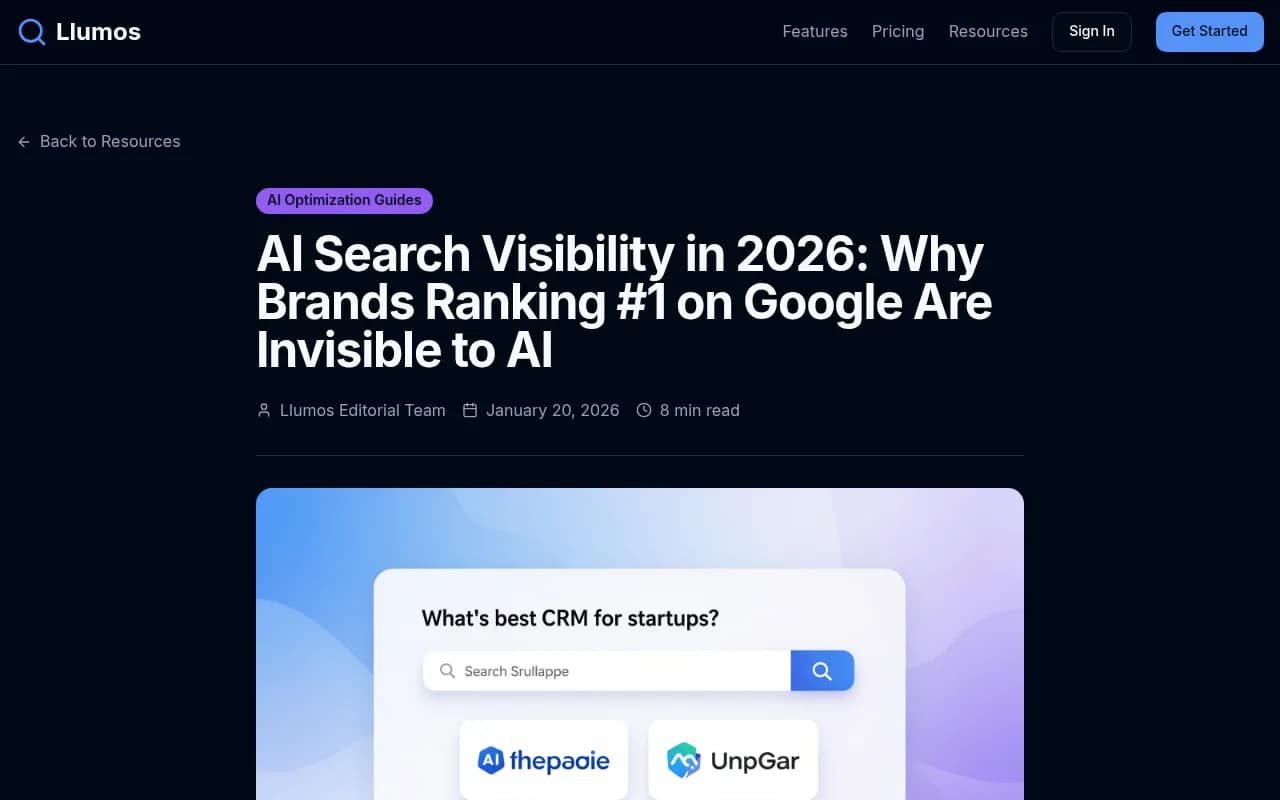
Tech brands -- especially established SaaS companies with strong Wikipedia presence, G2 and Capterra profiles, and coverage in publications like TechCrunch and The Verge -- tend to get cited frequently in product recommendation queries. "What's the best CRM for a 50-person team?" or "Which project management tool works for remote teams?" are exactly the kinds of questions AI models answer with brand recommendations.
The catch: the brands winning these queries are usually the category leaders. Mid-market and niche SaaS companies with strong Google rankings but thin third-party coverage are largely invisible. The 34% of B2B SaaS companies blocking AI crawlers compounds this problem significantly.
Health and wellness
Health queries generate enormous AI response volume, and established health brands, medical institutions, and authoritative health publishers (Mayo Clinic, WebMD, Healthline) are cited constantly. Consumer health brands with strong review profiles and media coverage also surface regularly.
The challenge here is that AI models are cautious about health claims -- they tend to cite sources they perceive as authoritative and conservative. Newer brands or those with primarily social media presence struggle to break through regardless of their Google rankings.
Which industries are still largely invisible
Local services
Plumbers, electricians, local accountants, regional law firms -- these businesses are almost entirely absent from AI-generated answers. The reason is structural: AI models are trained on web-scale data that skews heavily toward national brands, publications, and aggregators. A local HVAC company might rank #1 in Google Maps and still never appear when someone asks ChatGPT "who's the best HVAC company near me?"
This is starting to change as AI models get better at location-aware responses, but for now, local service businesses are operating in a world where AI search essentially doesn't include them.
Mid-market retail
Large retailers (Amazon, Walmart, major DTC brands) get cited. Small boutique brands with strong Instagram followings but limited media coverage don't. The middle ground -- brands doing $10M-$100M in revenue with decent SEO but no Wikipedia page and no major press coverage -- is where the invisibility crisis hits hardest.
Niche B2B
Specialized B2B companies -- industrial suppliers, niche software vendors, professional services firms serving specific verticals -- tend to have thin digital footprints outside their own websites. AI models have little to draw on when constructing answers about them, so they default to the category leaders instead.
The citation rate gap across platforms
One of the more surprising data points from 2026 research: the same brand can have wildly different visibility across AI platforms. According to Superlines' AI search statistics, citation rates for a single brand can range from 0.59% on ChatGPT to 27% on Grok -- a 46x difference.
This matters because most brands, if they're tracking AI visibility at all, are only tracking one or two platforms. A brand might feel comfortable because it appears regularly in Perplexity responses, while being almost completely absent from ChatGPT -- which handles far more queries.
The variation comes from how different models are trained and what sources they weight. ChatGPT tends to favor Reddit, Wikipedia, and established news sites. Perplexity pulls more from real-time web results. Grok, trained on X (formerly Twitter) data, has different source biases entirely. A brand with strong Reddit presence but weak Wikipedia coverage will look very different across these platforms.
| Platform | Typical citation bias | Best for brands with... |
|---|---|---|
| ChatGPT | Wikipedia, Reddit, major news | Strong entity presence, media coverage |
| Perplexity | Real-time web, authoritative sites | Fresh content, good technical SEO |
| Google AI Overviews | Google's own index, structured data | Strong traditional SEO + schema |
| Grok | X/Twitter data, social signals | Active social presence, viral content |
| Claude | Training data, authoritative sources | Long-form content, academic/professional credibility |
| Gemini | Google ecosystem, YouTube | Google Business Profile, YouTube presence |
What separates visible brands from invisible ones
The brands that consistently appear in AI responses share a few characteristics that have nothing to do with their Google rankings:
Entity completeness. They have Wikipedia pages (or at least Wikidata entries), Google Knowledge Panels, and consistent NAP (name, address, phone) data across directories. AI models use these signals to confirm a brand is real and trustworthy.
Third-party validation. They're mentioned in publications that AI models consider authoritative. For B2B brands, that means industry trade press. For consumer brands, it means major publications, review aggregators, and community platforms like Reddit.
Structured data. Valid Organization, Product, and FAQ schema markup helps AI models understand what a brand does without having to infer it from unstructured text.
Content that answers real questions. Not keyword-stuffed landing pages, but content that genuinely addresses the questions people are asking AI models. The brands winning in AI search have often published detailed comparison guides, FAQ pages, and use-case-specific content that AI models can draw on when constructing answers.
Consistent brand signals across the web. AI models synthesize from many sources. A brand that appears consistently across its own site, press coverage, review sites, and community discussions builds a stronger signal than one that exists primarily on its own domain.
How to diagnose your own AI visibility
Most brands don't know where they stand. The first step is actually checking -- manually prompting ChatGPT, Perplexity, and Google AI Overviews with the questions your customers are asking, and seeing whether your brand appears.
That manual approach breaks down quickly at scale. For systematic tracking across multiple AI platforms and prompts, tools like Promptwatch let you monitor how often your brand appears across ChatGPT, Claude, Perplexity, Gemini, and others, identify the specific prompts where competitors are visible but you're not, and track changes over time as you make optimizations.

The answer gap analysis approach is particularly useful here: instead of guessing which content to create, you can see exactly which questions AI models are answering for your competitors but not for you. That's a much more targeted starting point than generic content audits.
For brands that want a simpler starting point, tools like Otterly.AI and Peec AI offer basic monitoring across the main AI platforms.
Otterly.AI


If you're an enterprise brand or agency managing multiple clients, Profound and AthenaHQ offer more robust tracking with deeper data exports.
Profound


The content gap is the real problem
Here's what most of the visibility conversation gets wrong: it focuses on monitoring without addressing the underlying issue. Knowing you're invisible is useful. Knowing why you're invisible and what to do about it is what actually moves the needle.
The brands that are winning in AI search in 2026 aren't just the ones with the best monitoring dashboards. They're the ones that identified the specific content gaps -- the questions AI models want to answer but can't find authoritative content for on their site -- and then created that content.
That's a different workflow than traditional SEO. It requires understanding which prompts drive volume, which ones your competitors are winning, and what kind of content (comparison articles, FAQ pages, use-case guides) tends to get cited for each prompt type. The research data from 201,000+ citations in the wealth management study makes this concrete: persona-driven queries favor brand-owned content, comparative queries favor clear differentiation, local queries favor directory presence. Each prompt type has its own playbook.
The structural shift isn't slowing down
SparkToro's research shows over 65% of Google searches now end without a click. With AI Overviews appearing at the top of results and conversational AI handling increasingly complex queries, the zero-click trend is accelerating. Organic CTR for informational queries has dropped 61% since AI Overviews rolled out, according to the Fuel AI Index.
The brands that treat this as a temporary disruption and keep optimizing for traditional SEO are going to find themselves increasingly invisible to the customers who are asking AI models for recommendations. The brands that adapt -- building entity authority, earning third-party citations, creating content that answers real questions -- are the ones that will show up in those answers.
The industry breakdown in 2026 is stark: finance, tech, and health are ahead because they've accumulated the third-party coverage and entity signals that AI models trust. Local services, niche B2B, and mid-market retail are behind because they haven't. The gap between those groups isn't closing on its own.
The 92% invisibility rate isn't a permanent condition. It's a gap that can be closed -- but only by brands that understand what AI models actually need to cite them, and then build it.