Key takeaways
- Bluefish AI is a well-funded Fortune 500 platform, but its quote-based pricing, no free trial, and enterprise sales process make it inaccessible for most mid-market teams and agencies.
- The best alternatives in 2026 go beyond monitoring: platforms like Promptwatch combine gap analysis, AI content generation, and crawler logs to help you actually improve visibility, not just measure it.
- Enterprise-grade options like Profound, Evertune, and Relixir offer strong tracking across 10+ AI models, but vary significantly on whether they help you act on the data.
- Mid-market and agency teams will find better value in Promptwatch, Otterly.AI, Peec AI, or Gauge — all of which offer transparent pricing and self-serve access.
- The core question to ask any tool: does it show you what to fix, or just what's broken?
Bluefish AI has a genuinely impressive origin story. The founding team sold companies to both Microsoft and Facebook, NEA and Salesforce Ventures backed the Series A, and clients include Adidas and Omnicom. Revenue grew 10x in six months during 2025. On paper, it's hard to argue with.
But here's the problem: Bluefish is built for Fortune 500 brands with enterprise procurement processes and six-figure budgets. There's no public pricing, no free trial, no self-serve option. If you want to test it, you book a demo and enter a sales cycle. The platform requires you to build your own prompt strategy from scratch, which demands internal expertise most teams don't have yet.
For the 80%+ of companies that aren't Fortune 500, Bluefish is effectively off the table. And even for larger teams, the monitoring-first approach leaves a real gap: knowing you're invisible in ChatGPT is only useful if you know what to do about it.
This guide covers the best alternatives in 2026 — what they actually do, who they're built for, and where each one falls short.
Why AI visibility tracking matters more than ever
According to Nobori.ai's AI Search Visibility Statistics 2025 report, B2B companies tracking AI search visibility jumped from 8% to 47% in a single year. That's not a trend — it's a category forming in real time. Meanwhile, AI-referred visitors convert at 1.2x the rate of traditional organic traffic (WebFX, 2025).
The challenge isn't whether to track AI visibility. It's figuring out which tools actually help you improve it, versus which ones just show you a dashboard and leave you stuck.
The best Bluefish AI alternatives in 2026
1. Promptwatch — best overall for teams that want to act, not just monitor
Most AI visibility tools show you a score. Promptwatch shows you a score and then helps you fix it.
The platform tracks brand visibility across 10 AI models — ChatGPT, Claude, Perplexity, Gemini, Google AI Overviews, DeepSeek, Grok, Mistral, Meta AI, and Copilot. But the part that separates it from the field is what happens after you see the data.
Answer Gap Analysis identifies exactly which prompts your competitors rank for that you don't. You see the specific topics and questions AI models want to answer but can't find on your site. From there, the built-in AI writing agent generates articles, listicles, and comparisons grounded in 880M+ citations analyzed — content engineered to get cited by AI models, not generic SEO filler. Then page-level tracking shows you which new pages are getting cited, how often, and by which models.
That loop — find gaps, create content, track results — is what makes it an optimization platform rather than a monitoring dashboard. Other features worth noting: real-time AI crawler logs (which pages ChatGPT and Claude are reading, errors they encounter), prompt volume and difficulty scores, Reddit and YouTube citation tracking, ChatGPT Shopping monitoring, and traffic attribution via GSC integration or server log analysis.
Pricing is transparent and self-serve: Essential at $99/month (1 site, 50 prompts, 5 articles), Professional at $249/month (2 sites, 150 prompts, 15 articles, crawler logs), Business at $579/month (5 sites, 350 prompts, 30 articles). Free trial available.

Best for: Marketing teams, SEO teams, and agencies that want to improve AI visibility, not just measure it. Limitation: Newer platform compared to some enterprise incumbents; agency/enterprise pricing requires a conversation.
2. Profound — best for enterprise monitoring depth
Profound is the enterprise heavyweight in this space. It tracks brand presence across 10+ AI platforms including ChatGPT, Claude, Gemini, and Perplexity, with strong sentiment analysis, share-of-voice metrics, and competitive benchmarking. The platform is designed for large marketing and insights teams that need structured reporting and stakeholder dashboards.
Where Profound excels is data richness. Where it falls short is the same place most enterprise tools do: it's primarily a monitoring platform. You get excellent visibility into what's happening, but less guidance on what to do about it. No built-in content generation, no crawler logs, no Reddit/YouTube citation tracking.
Pricing is custom and quote-based, which puts it in similar territory to Bluefish for smaller teams.
Profound

Best for: Enterprise brands that need deep monitoring and executive-level reporting. Limitation: No content optimization or generation capabilities; pricing requires sales engagement.
3. Evertune — best for Fortune 500 brand perception tracking
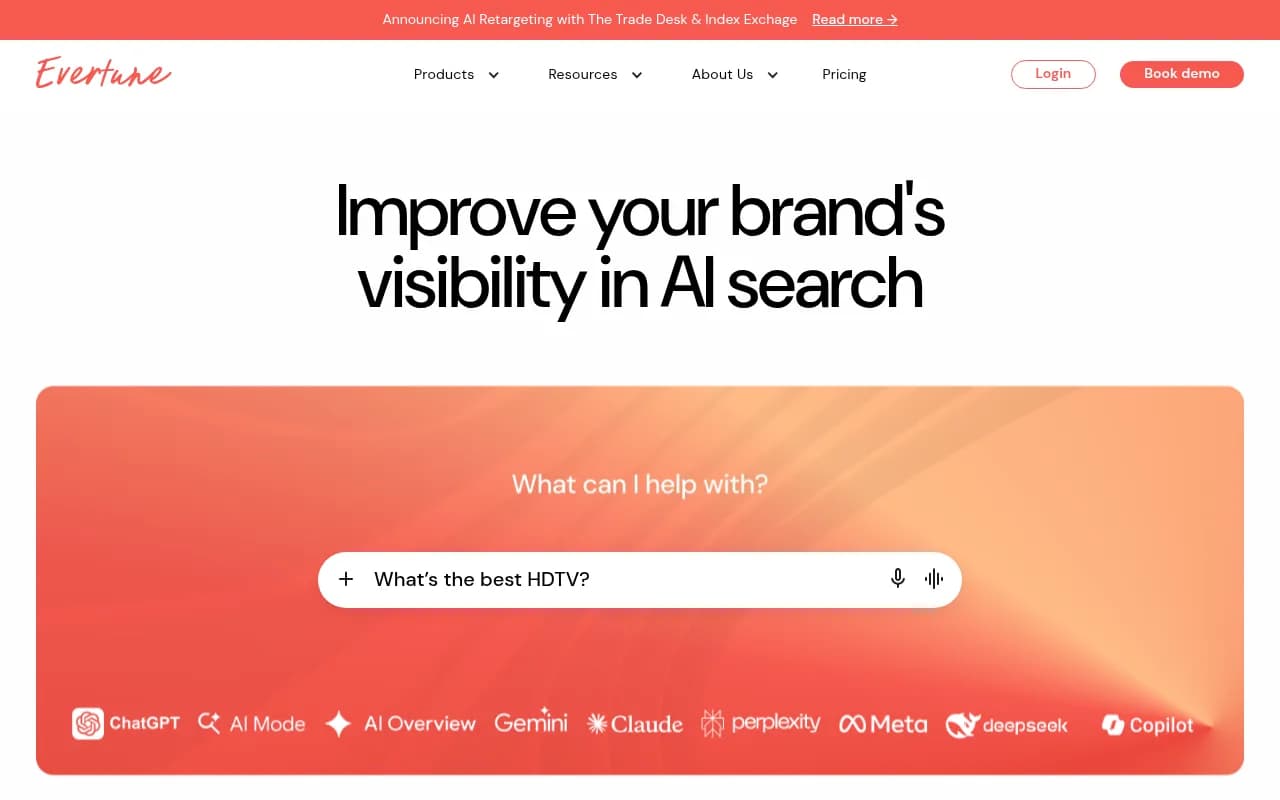
Evertune positions itself specifically for Fortune 500 brands tracking AI visibility and brand perception. It focuses on how AI models describe and recommend your brand — useful for brand safety, reputation management, and understanding sentiment shifts across models.
The platform has strong capabilities around brand perception analysis and competitive positioning in AI responses. Like Profound, it's monitoring-focused and enterprise-priced.
Best for: Large enterprise brands with brand safety and perception concerns in AI environments. Limitation: Enterprise-only pricing; monitoring-focused without content optimization tools.
4. Relixir — best end-to-end GEO engine for enterprise
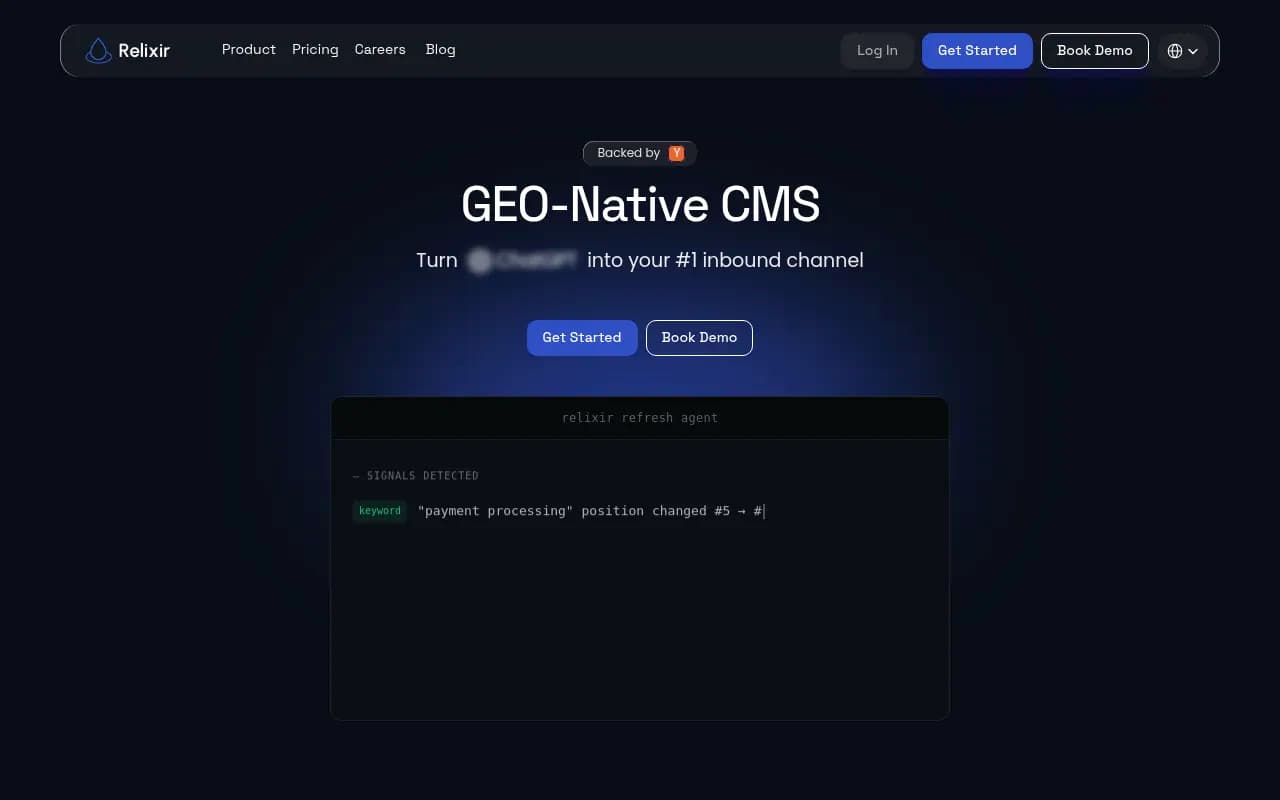
Relixir describes itself as an end-to-end GEO (Generative Engine Optimization) engine. It goes further than pure monitoring by including content recommendations and optimization workflows, making it one of the closer competitors to Promptwatch in terms of the full loop.
The platform is built for enterprise brands and agencies that want to systematically improve AI search visibility rather than just report on it. Pricing is enterprise-tier and requires a demo.
Best for: Enterprise teams that want a structured GEO workflow with content optimization built in. Limitation: Enterprise pricing; less transparent than self-serve platforms.
5. Otterly.AI — best for straightforward monitoring on a budget
Otterly.AI is one of the more established monitoring platforms in this space. It tracks brand mentions across ChatGPT, Perplexity, and Google AI Overviews, with clean dashboards and reasonable pricing for smaller teams.
It's genuinely good at what it does: showing you where you appear, how often, and alongside which competitors. The limitation is that it stops there. No content generation, no crawler logs, no traffic attribution. If you need a monitoring-only tool and want something that works without a sales call, Otterly.AI is solid.
Otterly.AI

Best for: Small teams and startups that want basic AI visibility monitoring without enterprise complexity. Limitation: Monitoring only — no content optimization, no crawler logs, no traffic attribution.
6. Peec AI — best for international and multi-language tracking
Peec AI has carved out a niche in multi-language and multi-region AI visibility tracking. If your brand operates across markets and you need to understand AI visibility in different languages and geographies, Peec is worth a look.
It tracks visibility across major AI models and offers competitive benchmarking, but like most monitoring tools, it doesn't help you act on what you find.

Best for: International brands that need multi-language AI visibility tracking. Limitation: Monitoring-focused; limited content optimization capabilities.
7. Gauge — best for data-driven competitive strategy
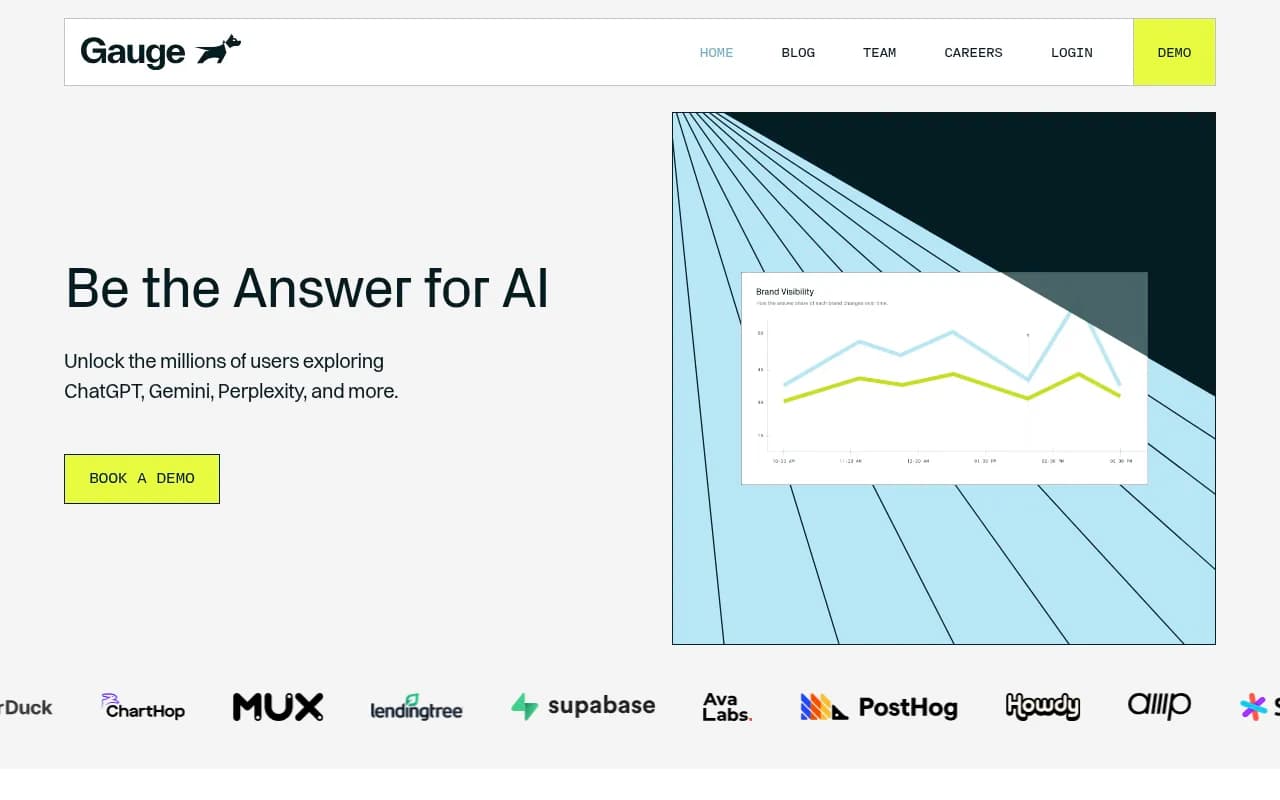
Gauge positions itself around transforming AI visibility data into competitive strategy. It tracks brand mentions across AI engines and includes gap analysis features that help teams understand where competitors are winning and why.
The platform is more action-oriented than pure monitoring tools, with roadmap-style outputs that help teams prioritize. It's a reasonable mid-market option for teams that want more than a dashboard.
Best for: Mid-market teams that want competitive strategy outputs from their AI visibility data. Limitation: Content generation capabilities are less developed than Promptwatch.
8. Scrunch AI — best for agencies managing multiple clients
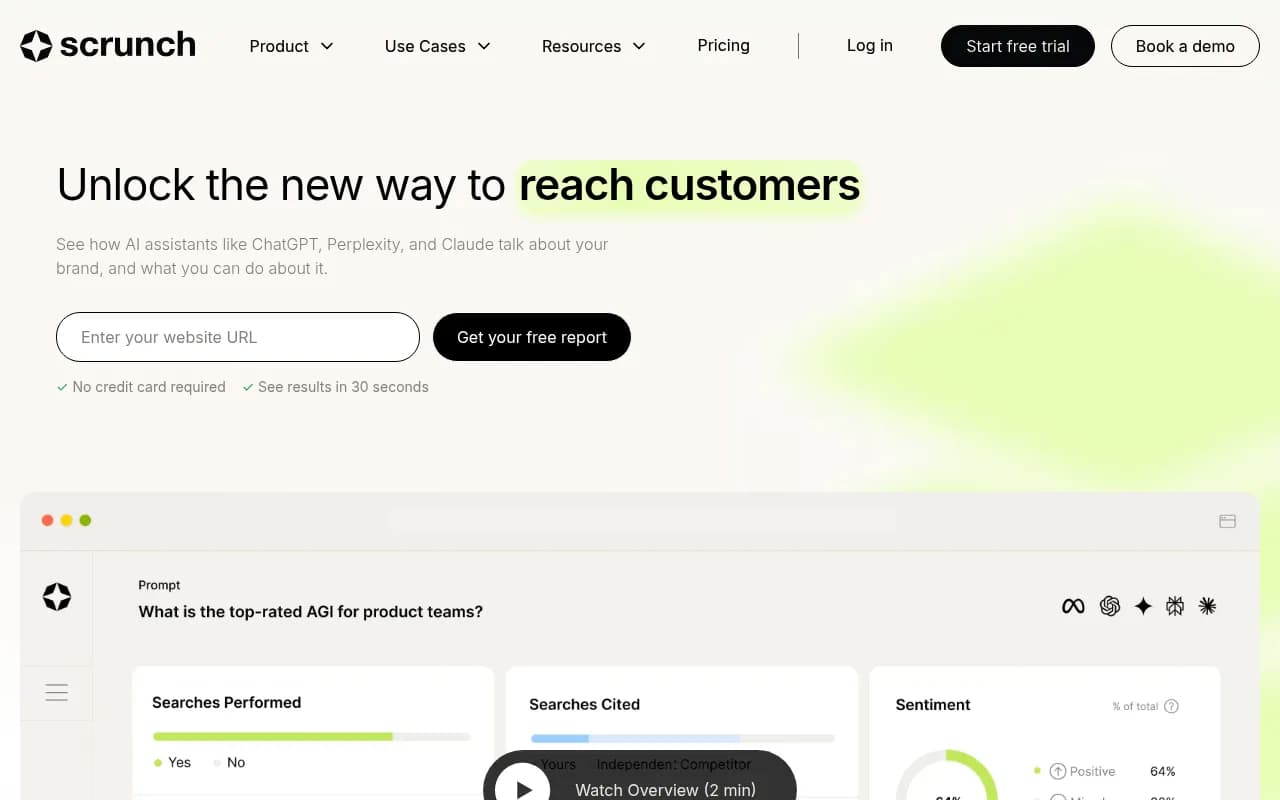
Scrunch AI is built with agency workflows in mind. It tracks AI search visibility across multiple clients and brands, with reporting features designed for client-facing work. If you're running an agency and need to show clients their AI visibility performance, Scrunch handles the multi-brand complexity reasonably well.
Best for: Agencies managing AI visibility for multiple clients. Limitation: Less focused on content optimization; primarily a tracking and reporting tool.
9. AthenaHQ — best for teams focused on prompt-level analysis
AthenaHQ focuses on tracking and optimizing brand visibility at the prompt level. It offers detailed analysis of how your brand appears in response to specific queries, with competitive benchmarking and share-of-voice metrics.
It's a monitoring-focused platform with strong analytical depth, but like most competitors, it doesn't include content generation or crawler log analysis.

Best for: Teams that want deep prompt-level analysis of AI visibility. Limitation: Monitoring-focused; no content generation or crawler logs.
10. LLM Pulse — best lightweight option for getting started
LLM Pulse is a lighter-weight platform for teams just starting to track AI visibility. It covers the major AI models and offers basic monitoring and competitive benchmarking at accessible price points.
It's not the most feature-rich option, but it's a reasonable starting point for teams that want to understand the landscape before committing to a more comprehensive platform.
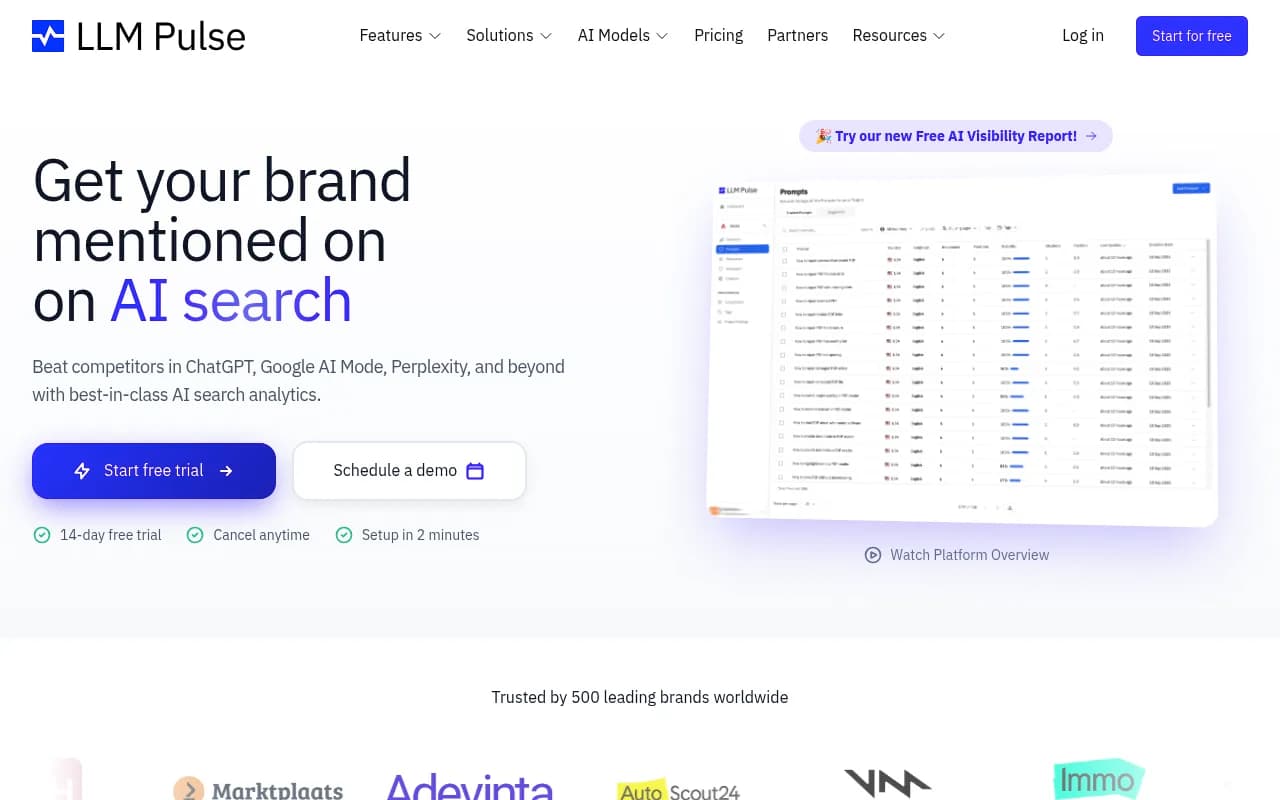
Best for: Teams new to AI visibility tracking that want a low-commitment starting point. Limitation: Limited depth compared to more established platforms; basic feature set.
Feature comparison table
| Tool | Pricing model | Content generation | Crawler logs | Traffic attribution | Reddit/YouTube tracking | Free trial |
|---|---|---|---|---|---|---|
| Promptwatch | From $99/mo (transparent) | Yes (built-in AI writer) | Yes | Yes (GSC, logs) | Yes | Yes |
| Profound | Custom/enterprise | No | No | Limited | No | No |
| Evertune | Custom/enterprise | No | No | No | No | No |
| Relixir | Custom/enterprise | Partial | No | No | No | No |
| Otterly.AI | Transparent, lower tier | No | No | No | No | Limited |
| Peec AI | Transparent, mid-tier | No | No | No | No | Yes |
| Gauge | Transparent, mid-tier | Partial | No | No | No | Yes |
| Scrunch AI | Custom | No | No | No | No | No |
| AthenaHQ | Custom | No | No | No | No | No |
| LLM Pulse | Transparent, lower tier | No | No | No | No | Yes |
| Bluefish AI | Custom/enterprise | No | No | No | No | No |
How to choose the right alternative
The right tool depends on what you actually need from it. A few honest framings:
If you need to improve visibility, not just measure it: Promptwatch is the only platform in this list that closes the full loop — gap analysis, content generation, and tracking in one place. Most competitors stop at monitoring.
If you're a Fortune 500 brand with brand safety concerns: Profound or Evertune are worth evaluating. They're built for enterprise procurement processes and offer the depth of reporting that large organizations need.
If you're an agency: Scrunch AI or Promptwatch's agency/enterprise tier are the most relevant options. Promptwatch's multi-site plans and white-label reporting make it workable for client-facing work.
If you're just getting started: Otterly.AI, Peec AI, or LLM Pulse offer transparent pricing and self-serve access. They won't help you fix anything, but they'll show you where you stand without a sales call.
If budget is tight: Promptwatch's Essential plan at $99/month covers 1 site and 50 prompts with content generation included — more value than most monitoring-only tools at similar price points.
The monitoring trap
One thing worth saying plainly: most tools in this category are monitoring dashboards. They show you that you're invisible in ChatGPT. They show you that a competitor is winning for a prompt you care about. And then they stop.
That's useful data. But data without action is just anxiety. The question to ask any platform before you commit: "Once I see the gap, what does this tool help me do about it?"
Most tools don't have a good answer. The ones that do — Promptwatch most clearly, Relixir to a lesser extent — are the ones worth prioritizing if your goal is actually improving AI search visibility rather than just reporting on it.
The AI search landscape is moving fast. Brands that figure out the optimization loop now will have a meaningful head start. The tools that help you run that loop are the ones worth your time.