Key takeaways
- Omnia is a solid monitoring tool for AI share of voice, but it stops at analytics — it won't help you create content or fix visibility gaps
- Promptwatch is the strongest full-stack alternative: it tracks visibility across 10+ AI models AND helps you close gaps with built-in content generation and citation analysis
- Peec AI, Rankshift, and TrackMyBusiness are good lightweight options for teams that just need monitoring without the complexity
- LLM Pulse is worth considering if you're on a tight budget and want multi-model coverage with a free tier
- The right choice depends on whether you need monitoring only, or a platform that actually helps you improve your AI visibility
AI search is no longer a niche concern. ChatGPT crossed 900 million weekly users. Google AI Overviews now appear in the majority of searches. Perplexity is eating into informational query traffic. And your customers are asking these tools questions that used to send them to your website.
Omnia has positioned itself as an AI visibility platform focused on share of voice analytics and brand mention monitoring. It's a reasonable starting point. But a lot of teams hit a ceiling with it: you can see that competitors are getting cited more than you, but Omnia doesn't tell you what to do about it.
That gap is exactly why people go looking for alternatives. This guide covers the best ones in 2026, with honest assessments of what each tool actually does well.
Why look beyond Omnia?
Omnia's core value is competitive benchmarking — seeing how your brand's AI visibility compares to rivals across platforms like ChatGPT, Perplexity, and Gemini. That's genuinely useful data.
The friction comes when you want to act on it. Omnia shows you the problem. It doesn't help you fix it. There's no content gap analysis, no built-in writing tools, no crawler logs showing how AI bots are actually reading your site, and no prompt-level intelligence to tell you which queries are worth targeting.
For teams that want to go from "we're invisible in AI search" to "here's what we published and here's how our visibility improved," Omnia leaves a big gap in the workflow.
The other common reason people switch: pricing and feature depth don't always align. Depending on your team size and the number of prompts you need to track, there are tools that offer more for less, or more specialized capabilities for specific use cases.
The best Omnia alternatives in 2026
1. Promptwatch — best for teams that want to actually improve visibility, not just measure it
Promptwatch is the alternative that makes the most sense if you've outgrown monitoring-only tools. It tracks brand visibility across 10 AI models (ChatGPT, Perplexity, Claude, Gemini, Google AI Overviews, Google AI Mode, Grok, DeepSeek, Copilot, and Mistral), but the more interesting part is what happens after you have the data.
The Answer Gap Analysis shows you exactly which prompts your competitors are appearing for that you're not. Not vague category-level insights — specific prompts, with visibility scores and difficulty ratings. From there, the built-in AI writing agent generates content engineered to get cited: articles, listicles, comparisons, all grounded in 880M+ citations analyzed across AI models.
A few things Promptwatch does that most competitors don't:
- AI Crawler Logs: real-time logs of when ChatGPT, Claude, Perplexity, and others crawl your site, which pages they read, and what errors they hit
- Reddit and YouTube tracking: surfaces discussions that directly influence AI recommendations
- ChatGPT Shopping tracking: monitors when your brand appears in product recommendation carousels
- Query fan-outs: shows how one prompt branches into sub-queries, so you can see the full scope of a topic
- Traffic attribution: connects AI visibility to actual revenue via GSC integration, code snippet, or server log analysis
Pricing starts at $99/month for one site and 50 prompts. The $249/month Professional plan adds crawler logs, city/state tracking, and 15 articles per month. There's a free trial.

The honest limitation: if you genuinely only need a lightweight dashboard to check brand mentions a few times a month, Promptwatch has more capability than you'll use. But for any team treating AI search as a real channel, it's the most complete option available.
2. Peec AI — best for monitoring with smart suggestions
Peec AI focuses on tracking brand visibility across ChatGPT, Perplexity, and Claude, with some built-in suggestions for improving your positioning. It's more opinionated than a pure monitoring tool — it'll flag when your brand is being described inaccurately or when competitors are pulling ahead on specific queries.
Where it falls short: no content generation, no crawler logs, and limited depth on prompt-level analytics. It's monitoring with a layer of recommendations on top, which is a step up from raw data but still leaves you doing the actual optimization work yourself.
Good fit for: smaller teams that want actionable nudges without a full platform investment.

3. Rankshift — best for straightforward AI rank tracking
Rankshift does what it says: tracks your brand's visibility across ChatGPT, Perplexity, and other AI search engines, and shows you how your rankings shift over time. The interface is clean and the setup is fast.
It's a solid choice if your main question is "are we showing up more or less than last month?" rather than "why aren't we showing up, and what do we do about it?" The tool doesn't offer content optimization or gap analysis, but it's reliable for the tracking use case.

4. TrackMyBusiness — best for quick, no-frills AI monitoring
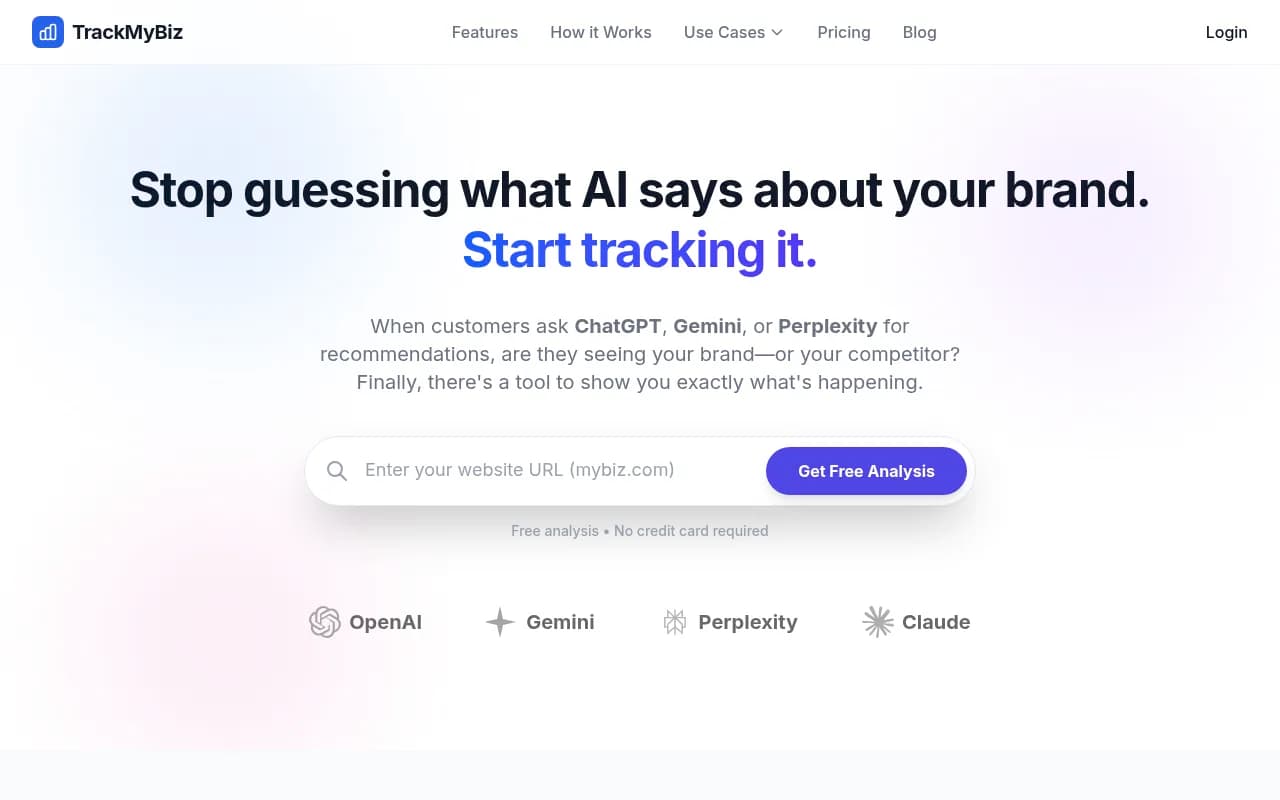
TrackMyBusiness is built around a simple premise: tell it your brand name and a few competitors, and it'll show you what ChatGPT, Gemini, and Perplexity are saying about you. No complex setup, no steep learning curve.
The trade-off is depth. You won't get prompt-level analytics, citation source data, or any optimization features. But if you're a small business owner or early-stage startup that just wants to know whether AI tools are recommending you, it covers the basics without overwhelming you.
5. LLM Pulse — best budget option with solid multi-model coverage
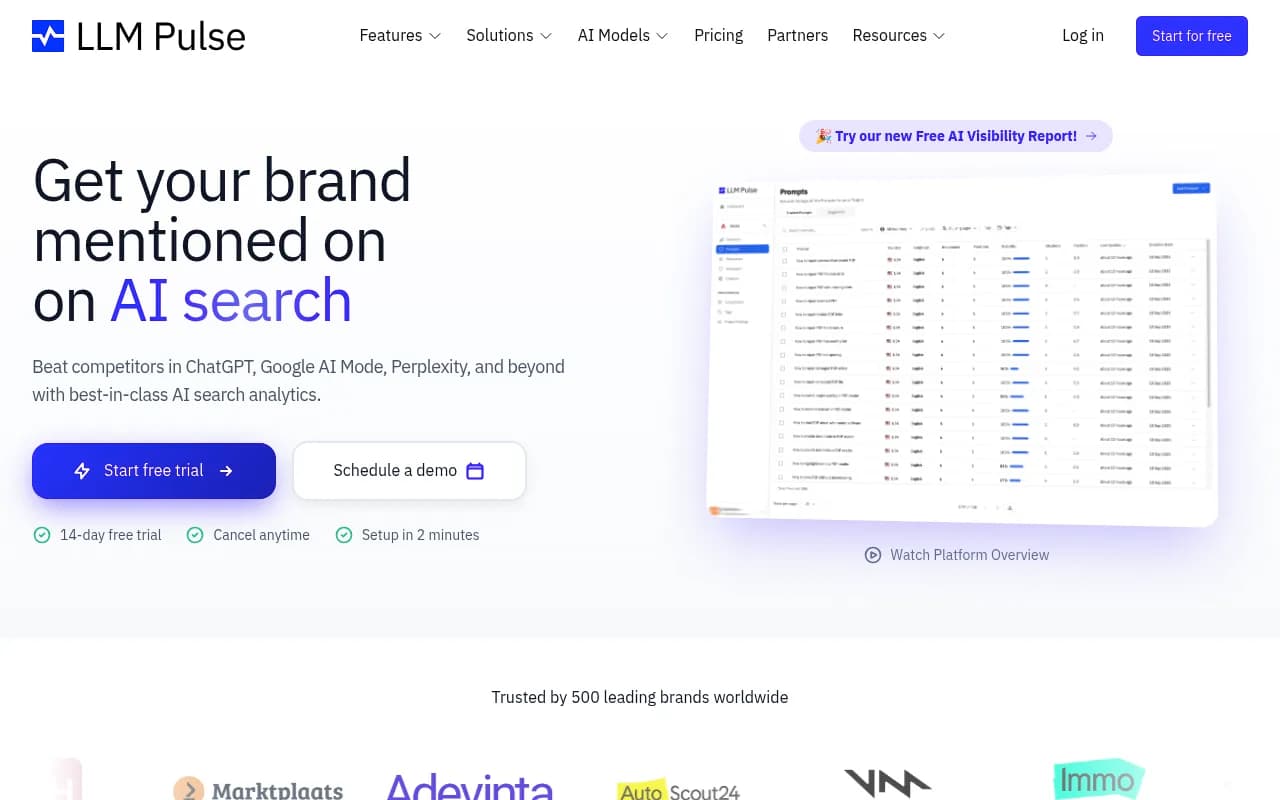
LLM Pulse tracks brand mentions, citations, and share of voice across ChatGPT, Gemini, and Google AI Mode, with a free tier and paid plans starting at €49/month. For teams that need multi-model coverage without a large budget, it's one of the more accessible options.
The platform includes data export and API connectors, which makes it easier to pull AI visibility metrics into existing reporting workflows. It's stronger on AI search visibility than traditional SEO metrics, so if you need both in one tool, you'd need to pair it with something else.
6. Otterly.AI — best for affordable monitoring across major AI platforms
Otterly.AI covers ChatGPT, Perplexity, and Google AI Overviews with a focus on affordability. It's frequently cited as one of the more accessible entry points into AI visibility monitoring, with a clean dashboard and straightforward prompt tracking.
Like most monitoring-focused tools, it doesn't offer content generation or gap analysis. But for teams that want reliable tracking without a large budget commitment, it's a reasonable choice.
Otterly.AI

7. Profound — best for enterprise teams with complex needs
Profound is one of the more feature-rich platforms in this space, covering 9+ AI search engines with strong analytics depth. It's built for enterprise marketing teams that need detailed reporting, multi-stakeholder access, and integration with existing data stacks.
The trade-off is price — Profound sits at a higher price point than most alternatives here, and it's more monitoring-oriented than optimization-oriented. If you're a Fortune 500 brand that needs comprehensive data and has a team to act on it, Profound is worth evaluating. If you need the platform to help you act on the data too, Promptwatch is a better fit.
Profound

8. Scrunch AI — best for tracking brand mentions with competitive context
Scrunch AI tracks brand visibility across LLMs with a focus on competitive context — showing you not just whether you're mentioned, but how you're positioned relative to competitors in AI-generated responses. It's a step up from basic mention tracking.

Side-by-side comparison
| Tool | Monitoring | Content generation | Crawler logs | Prompt analytics | Free tier | Starting price |
|---|---|---|---|---|---|---|
| Promptwatch | 10+ models | Yes (built-in AI writer) | Yes | Yes (volume, difficulty, fan-outs) | No (free trial) | $99/mo |
| Omnia | Yes | No | No | Limited | Yes | Varies |
| Peec AI | Yes | No | No | Basic suggestions | Limited | Varies |
| Rankshift | Yes | No | No | Basic | No | Varies |
| TrackMyBusiness | Yes (3 models) | No | No | No | Yes | Varies |
| LLM Pulse | 5+ models | No | No | Basic | Yes | €49/mo |
| Otterly.AI | Yes | No | No | No | Limited | Varies |
| Profound | 9+ models | No | No | Yes | No | High |
| Scrunch AI | Yes | No | No | Basic | No | Varies |
How to choose the right alternative
The decision mostly comes down to one question: do you need monitoring, or do you need optimization?
If you just need to know whether your brand is showing up in AI search results and how that compares to competitors, most tools on this list will serve you. Peec AI, Rankshift, TrackMyBusiness, and LLM Pulse are all reasonable choices depending on your budget and the number of AI models you care about.
If you need to actually improve your AI visibility — identify which content is missing, create content that gets cited, track whether it's working, and connect that back to traffic and revenue — the list gets much shorter. Promptwatch is the only platform in this comparison that closes the full loop from gap identification to content creation to result tracking.
A few other factors worth weighing:
Budget: LLM Pulse and TrackMyBusiness are the most accessible entry points. Promptwatch's $99/month Essential plan is competitive given the feature depth. Profound sits at the higher end.
Team size and workflow: If you have a dedicated SEO or content team, a platform with content generation built in (Promptwatch) saves a lot of back-and-forth. If you're a solo marketer, a simpler dashboard might be all you need.
Model coverage: If you care specifically about Google AI Overviews, make sure the tool you choose covers it. Not all of them do. Promptwatch, LLM Pulse, and Profound all include it.
Agency use: If you're running an agency managing multiple clients, look for multi-site support and white-label options. Promptwatch's Business and Agency plans are built for this.
The monitoring-only problem
One thing worth naming directly: the AI visibility tool market in 2026 is full of platforms that show you data and stop there. You get a dashboard, a share of voice percentage, a list of prompts where competitors beat you. Then you close the tab and figure out what to do on your own.
That's fine if you have a content team that can take the data and run with it. But for most marketing teams, the bottleneck isn't knowing there's a gap — it's knowing exactly what content to create and having the bandwidth to create it.
This is the core difference between monitoring tools (Omnia, Peec AI, Rankshift, most of the market) and optimization platforms (Promptwatch, and a handful of others). The monitoring tools are useful inputs. The optimization platforms are where the actual work gets done.
If you're evaluating Omnia alternatives because you feel like you have data but no clear path to improvement, that's the signal you need an optimization platform, not just a different monitoring tool.
Bottom line
Omnia is a reasonable tool for teams that want AI share of voice data and competitive benchmarking. But if you've hit the ceiling of "we know we're invisible, now what?", it's worth looking at alternatives that go further.
For most teams, Promptwatch is the strongest alternative — not because it has the most impressive feature list, but because it's built around actually improving your AI visibility rather than just measuring it. The combination of gap analysis, built-in content generation, crawler logs, and traffic attribution makes it the only tool here that covers the full workflow.
For teams with simpler needs or tighter budgets, Peec AI, LLM Pulse, and TrackMyBusiness are all worth a look. They won't help you fix the gaps, but they'll at least show you clearly where they are.