Key takeaways
- Semrush's AI Toolkit uses fixed prompts and lacks AI traffic attribution, making it a weak choice if AI search visibility is your main goal.
- For full AI search optimization (tracking + content generation + traffic attribution), Promptwatch is the most complete platform available in 2026.
- Ahrefs and SE Ranking are strong traditional SEO alternatives with some AI visibility features bolted on.
- Dedicated GEO platforms like Profound and Otterly.AI offer deeper AI monitoring but vary significantly in whether they help you act on the data.
- Your choice depends on what you actually need: traditional SEO, AI monitoring, or a platform that does both and helps you fix gaps.
Why people are looking beyond Semrush right now
Semrush built its reputation on keyword research, backlink analysis, and site auditing. For traditional search, it's still a capable tool. But the way people find information has shifted. A growing share of searches now happen inside ChatGPT, Perplexity, Claude, and Google's AI Overviews — and Semrush wasn't designed for that world.
The specific complaints you'll hear from marketers who've tried Semrush's AI Toolkit: the prompts are fixed (you can't customize them to match how your actual customers search), there's no way to attribute AI-driven traffic back to revenue, and the feature set feels like an afterthought rather than a core product.
That's not a knock on Semrush as a whole. It's just that if AI search visibility is your priority in 2026, you're probably going to need something else — either instead of Semrush or alongside it.
Here's a breakdown of the best alternatives, organized by what they're actually good at.
The best Semrush alternatives in 2026
Promptwatch — best for end-to-end AI search optimization
Promptwatch is the most complete AI search visibility platform available right now. The core difference from most tools in this space: it doesn't just show you where you're invisible, it helps you do something about it.

The workflow is built around three steps. First, Answer Gap Analysis identifies which prompts your competitors are appearing for but you're not — with specific topics and questions your site is missing. Second, a built-in AI writing agent generates content (articles, listicles, comparisons) grounded in real citation data from 880M+ citations analyzed. Third, page-level tracking shows which pages are being cited by which AI models, and traffic attribution connects that visibility to actual revenue.
On top of that, Promptwatch monitors 10 AI models (ChatGPT, Perplexity, Claude, Gemini, Google AI Overviews, Grok, DeepSeek, Copilot, Meta AI, Mistral), logs real-time AI crawler activity on your site, surfaces Reddit and YouTube discussions that influence AI recommendations, and tracks ChatGPT Shopping appearances.
Pricing starts at $99/month for the Essential plan (1 site, 50 prompts, 5 articles). The Professional plan at $249/month adds crawler logs, city/state tracking, and 15 articles per month. A free trial is available.
For anyone who's frustrated that most AI visibility tools show you a dashboard and then leave you stuck, Promptwatch is the answer.
Ahrefs — best traditional SEO tool with an AI visibility layer
Ahrefs has been one of the most trusted names in SEO for years, and in 2026 it's added AI search tracking to its existing suite. If you're already using Ahrefs for backlink analysis, keyword research, and site auditing, the AI visibility features are a reasonable extension of what you already have.
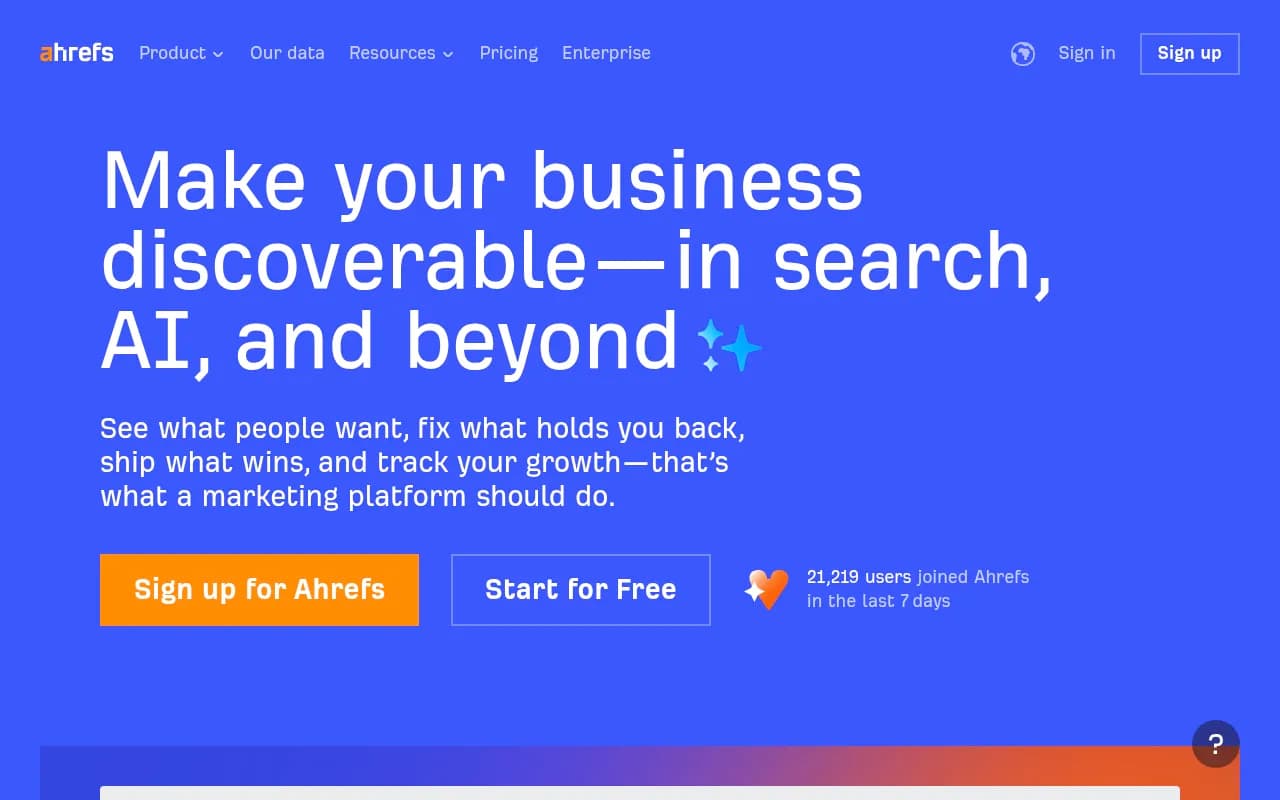
The AI tracking in Ahrefs is more of an add-on than a core feature. It covers some AI search monitoring, but it doesn't go as deep as dedicated GEO platforms on things like content gap analysis, citation-level data, or traffic attribution from AI sources. Where Ahrefs genuinely shines is in the traditional SEO toolkit — the backlink database is excellent, keyword data is reliable, and the Site Explorer is one of the best competitive research tools available.
Best for: teams that need a strong traditional SEO foundation and want some AI visibility data without switching platforms entirely.
SE Ranking — best budget-friendly full-suite alternative
SE Ranking is probably the most direct Semrush alternative for teams that want similar functionality at a lower price point. It covers keyword research, rank tracking, site auditing, backlink analysis, and content optimization — all the core SEO use cases.
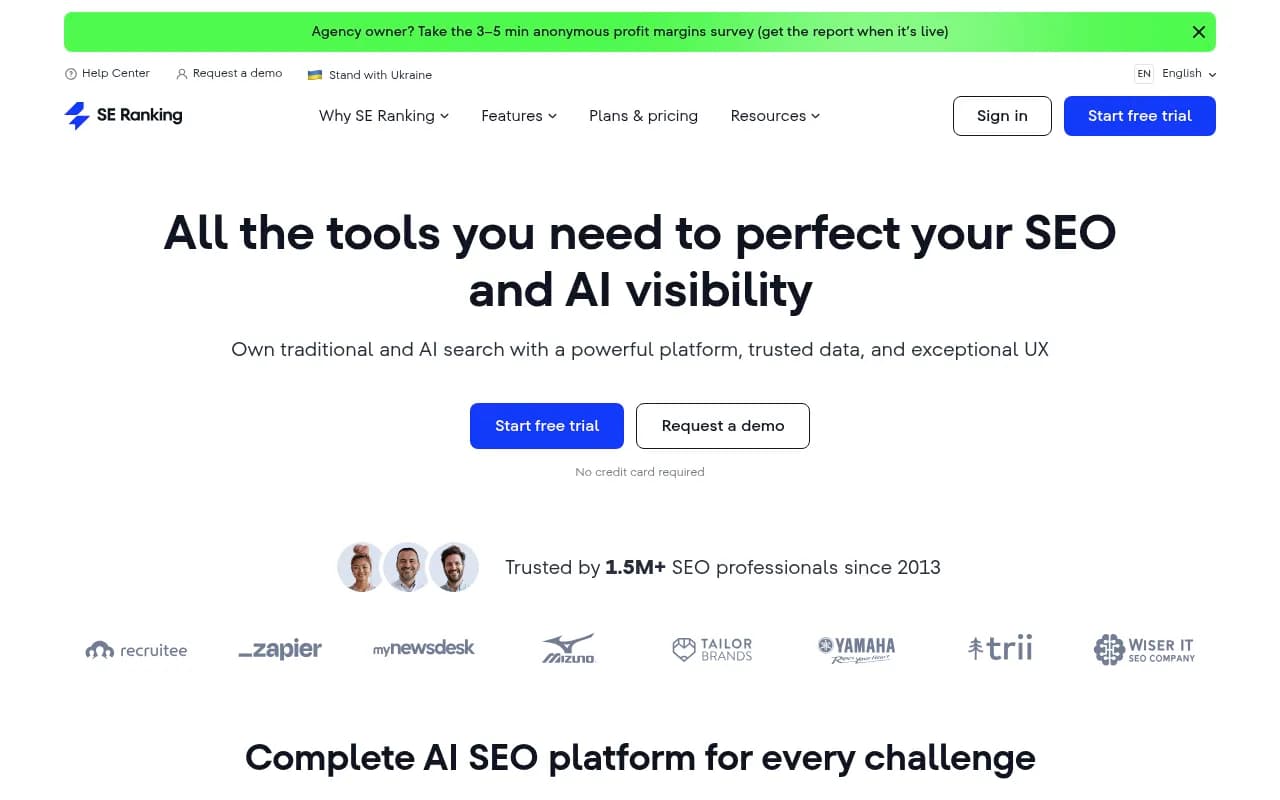
In 2026, SE Ranking has added AI-related features including some monitoring for AI search appearances. It's not as deep as dedicated GEO tools, but for a team that primarily needs traditional SEO and wants to dip a toe into AI visibility without committing to a separate platform, it's a reasonable choice.
Pricing is significantly lower than Semrush, which is the main draw. The interface is clean and the learning curve is gentler than Semrush's.
Best for: small to mid-size teams that want Semrush-level traditional SEO features at a more accessible price.
Profound — best for enterprise AI monitoring
Profound is one of the more established dedicated AI visibility platforms. It tracks brand mentions across ChatGPT, Perplexity, and 9+ other AI search engines, with solid data on how your brand appears in AI-generated responses.
Profound

The platform is strong on the monitoring side. Where it gets more complicated is on the "what do I do about this" side — Profound is primarily a tracking and analytics tool rather than an optimization platform. It doesn't generate content or give you a direct path from "I'm not appearing here" to "here's what to publish." For enterprise teams with dedicated content resources, that's fine. For smaller teams that need the full loop, it's a gap.
Pricing is on the higher end compared to most alternatives here, which makes it a harder sell for teams that aren't already committed to a dedicated GEO budget.
Best for: enterprise marketing and brand teams that need detailed AI visibility reporting and have separate resources for acting on the data.
Otterly.AI — best for simple AI monitoring on a budget
Otterly.AI is a monitoring-focused platform that tracks brand mentions across ChatGPT, Perplexity, and Google AI Overviews. It's relatively affordable and straightforward to set up.
Otterly.AI

The honest limitation: Otterly.AI is a dashboard. It shows you data about where you appear (or don't) in AI search results, but it doesn't help you fix it. No content generation, no crawler logs, no traffic attribution. For teams that just need basic visibility monitoring and are comfortable doing their own analysis and content work, it's a reasonable entry point.
Best for: teams with tight budgets that want basic AI search monitoring and don't need optimization features.
Nightwatch — best for rank tracking with AI overview monitoring
Nightwatch has traditionally been a rank tracking tool, and it's good at that. In 2026 it's added AI tracking features, particularly around Google AI Overviews, which makes it relevant for teams that care about that specific channel.
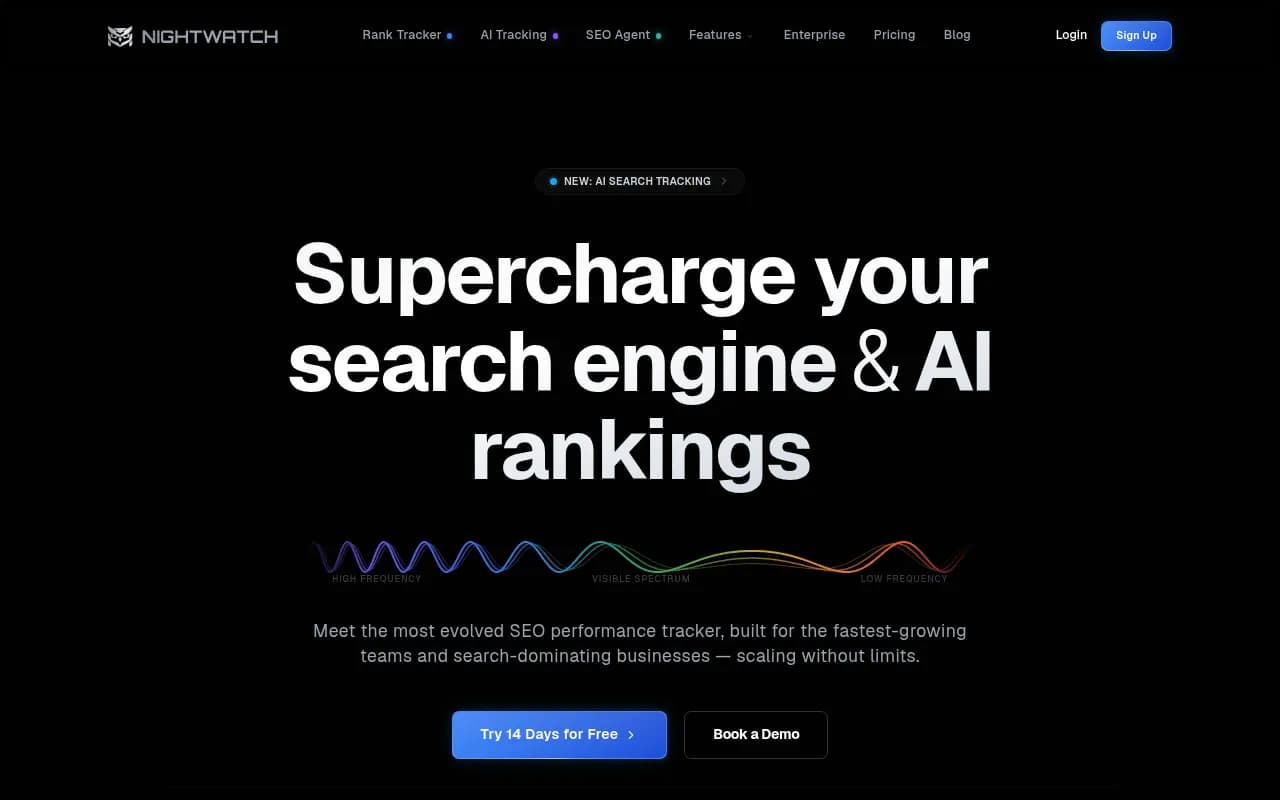
It's not a full GEO platform — the AI features are more limited than dedicated tools — but the core rank tracking is accurate and the interface is clean. If you're primarily a rank tracking user and want some AI Overview visibility on top, Nightwatch is worth considering.
Best for: SEO teams that prioritize traditional rank tracking and want basic AI Overview monitoring.
Moz Pro — best for link building and domain authority
Moz Pro is a long-standing Semrush alternative that's particularly strong on link building, domain authority metrics, and local SEO. It doesn't have meaningful AI search visibility features, but it's a solid choice if traditional SEO is your focus.
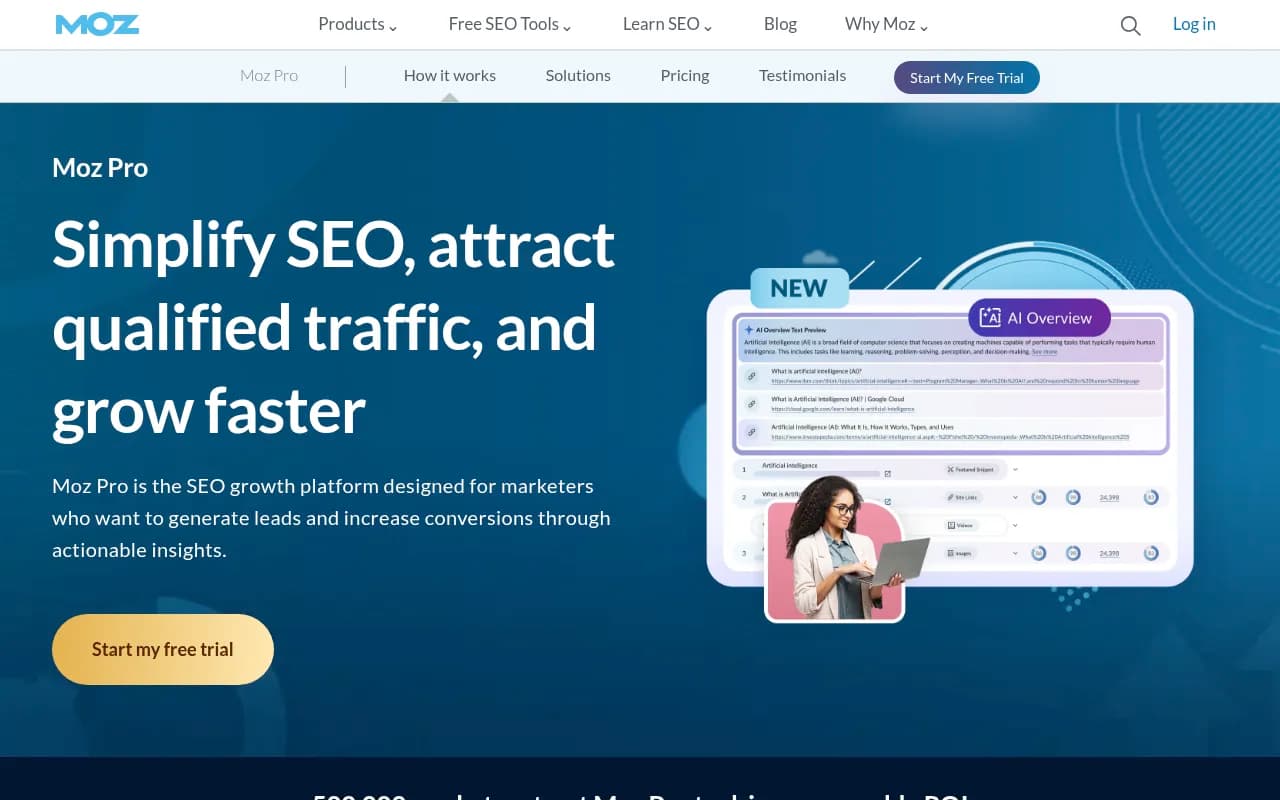
The Domain Authority metric that Moz invented is still widely used as a benchmark, and the link research tools are genuinely useful. For teams that don't need AI visibility features and want a reliable traditional SEO platform, Moz Pro is a proven option.
Best for: SEO teams focused on link building and domain authority tracking.
Scrunch AI — for AI visibility with content insights
Scrunch AI tracks brand visibility across AI search engines and provides some analysis of the content and sources that AI models are citing. It's more focused on the AI visibility space than traditional SEO tools.
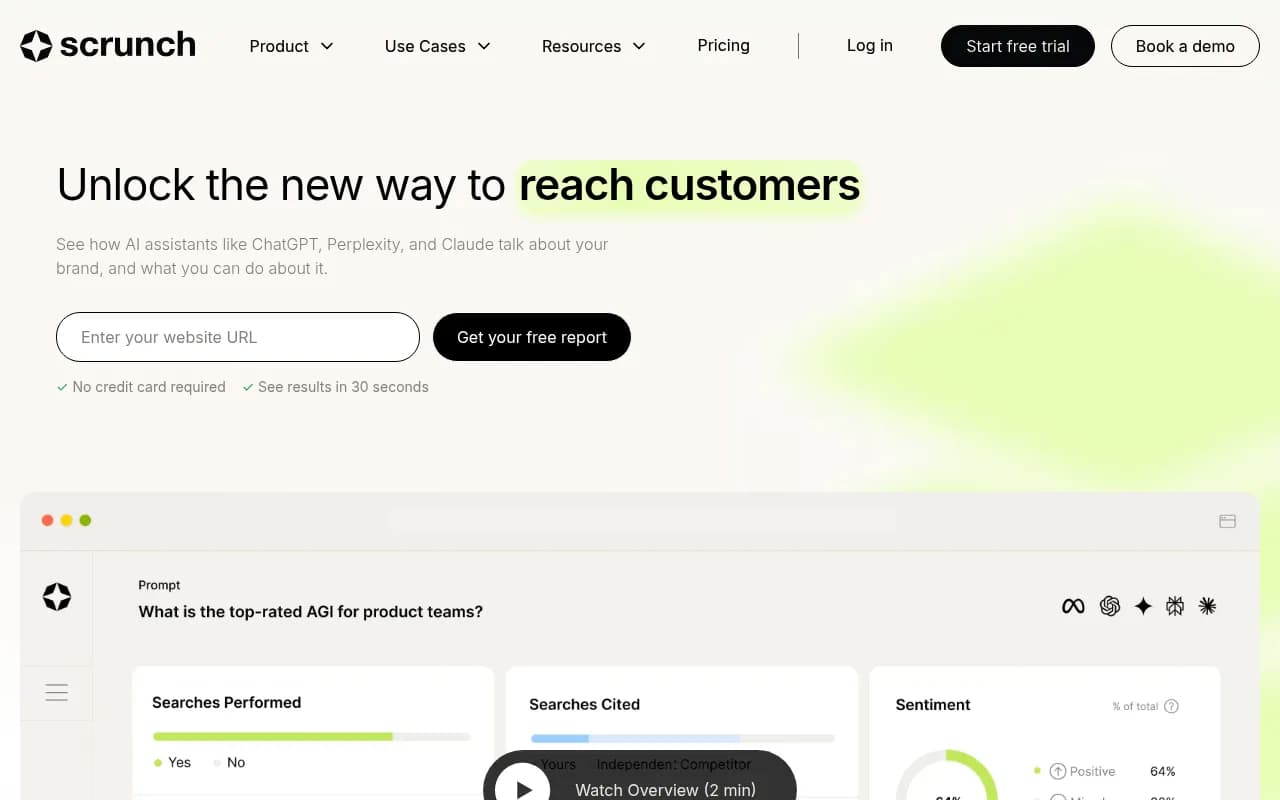
Like Profound, Scrunch is stronger on monitoring than on helping you act. It gives you data on where you appear and what's being cited, but the path from insight to action requires more manual work. It's a reasonable choice for teams that want AI-specific monitoring without the full price tag of enterprise platforms.
Best for: mid-market teams that want dedicated AI visibility monitoring with some content insight.
Peec AI — lightweight AI visibility tracker
Peec AI tracks brand visibility across ChatGPT, Perplexity, and Claude. It's a simpler tool aimed at teams that want to get started with AI monitoring without a lot of setup complexity.

The feature set is limited compared to more established platforms — no content generation, no crawler logs, no traffic attribution. But the simplicity is also its appeal for teams that are just starting to think about AI search visibility and want a low-friction way to see where they stand.
Best for: teams new to AI search visibility that want a simple starting point.
How these tools compare
| Tool | Traditional SEO | AI monitoring | Content generation | Traffic attribution | AI crawler logs | Starting price |
|---|---|---|---|---|---|---|
| Promptwatch | Limited | 10 AI models | Yes (built-in) | Yes | Yes | $99/mo |
| Ahrefs | Excellent | Basic | No | No | No | ~$129/mo |
| SE Ranking | Excellent | Basic | Limited | No | No | ~$65/mo |
| Profound | No | Strong (9+ models) | No | No | No | ~$200+/mo |
| Otterly.AI | No | Moderate | No | No | No | ~$49/mo |
| Nightwatch | Good | AI Overviews | No | No | No | ~$39/mo |
| Moz Pro | Good | None | No | No | No | ~$99/mo |
| Scrunch AI | No | Moderate | Limited | No | No | ~$99/mo |
| Peec AI | No | Basic | No | No | No | ~$49/mo |
| Semrush | Excellent | Fixed prompts only | Limited | No | No | ~$140/mo |
What Semrush actually gets wrong on AI visibility
It's worth being specific about why Semrush falls short here, because "it's not built for AI" is vague.
The core issue is that Semrush's AI Toolkit uses a fixed set of prompts. You can't customize them to match the actual questions your customers are asking in ChatGPT or Perplexity. That means you're measuring visibility for generic queries that may have nothing to do with your business.
Second, there's no traffic attribution. Semrush can't tell you whether the AI visibility you do have is actually driving clicks or revenue. You're tracking a metric with no connection to business outcomes.
Third, there's no content gap analysis. Semrush won't tell you what specific content you need to create to start appearing in AI search results. You see the problem but not the path forward.
These aren't minor gaps. They're the core of what makes AI visibility optimization useful.
Which tool should you actually use?
The honest answer depends on what you're trying to do.
If AI search visibility is your primary concern and you want a platform that takes you from "I don't know where I stand" to "I'm appearing in ChatGPT responses and I can prove it's driving traffic," Promptwatch is the most complete option available. The combination of gap analysis, content generation, and traffic attribution is unique in the market.
If you need strong traditional SEO with some AI visibility data on the side, Ahrefs or SE Ranking are the better picks. SE Ranking in particular is worth a look if you're currently paying Semrush prices and not using half the features.
If you're at an enterprise and need detailed AI visibility reporting for stakeholders, Profound has the depth of data and the reporting capabilities to support that use case — just budget for separate content resources.
If you're just starting out and want to understand where you stand in AI search without a big investment, Otterly.AI or Peec AI give you a basic read for a reasonable price.
The one thing I'd push back on: don't treat AI search visibility as a "nice to have" that you'll get to later. The brands that are building AI search presence now are going to be significantly harder to displace in 12 months. The tools exist. The question is just which one fits your situation.