Key takeaways
- Industrial buyers research suppliers in ChatGPT, Perplexity, and Google AI Overviews long before they fill out an RFQ form. A GEO tool tells you whether your company shows up in those answers.
- Most GEO tools were built for SaaS and consumer brands. For manufacturers, the features that matter are crawler logs, citation tracking, and content gap analysis, not a pretty dashboard of mentions.
- Promptwatch is the strongest all-round pick because it closes the loop from tracking to publishing. Profound, Semrush, and Ahrefs Brand Radar are reasonable alternatives depending on budget and existing stack.
- Software alone rarely fixes the problem. Spec sheets, product pages, and documentation do most of the work, and many manufacturers need help producing them.
- No public research covers manufacturing prompts specifically yet, so treat any industrial citation statistic with caution, including the ones in this guide.
Why manufacturers need a different GEO approach
A SaaS company can win AI visibility with a few strong comparison pages and a G2 profile. A manufacturer of hydraulic fittings, industrial valves, or custom enclosures has a harder job. The buyer is an engineer or a procurement lead asking things like "which suppliers make food-grade stainless steel check valves with 3-A certification?" The answer depends on spec data, certifications, and distributor listings, much of it buried in PDFs.
The sales cycle is also long. The ABM Agency's industrial report claims the typical deal involves around 13 stakeholders, and that 73% of B2B buyers now use AI tools in research. Treat those numbers as vendor-sourced and unverified. The direction is believable though. If an engineer asks ChatGPT for a shortlist and you are not on it, you rarely find out. There is no lost click in your analytics, just a missing inquiry.
That invisibility problem is the reason GEO tools exist. The question is which ones fit an industrial company's reality: a smaller marketing team, a catalog of hundreds or thousands of SKUs, a website that may be a mix of old CMS pages and PDFs, and distributors who often outrank you.
What the data says about what AI cites
Here is the honest caveat first. No Promptwatch report covers industrial or manufacturing prompts. The closest vertical reports are software, automotive, healthcare, and travel. Use them as directional signals, not as manufacturing benchmarks.
What does transfer is the content-type picture. In Promptwatch Data's analysis of ChatGPT citations by content type (Sep 28 to Oct 4, 2026), product pages were the most cited type at 22.4% of classified citations, with landing pages next at 16.8%. Documentation earned 7.5% and FAQ pages 3.3%. For commercial prompts, where buyers compare options, product pages hit 26.0% and landing pages 20.6%.
For a manufacturer, that is oddly good news. Pages describing what you sell are the most cited format, and you already own those. The catch is quality: complete specs, clear certifications, and factual copy that a model can quote directly.
The software vertical data points the same way. In Promptwatch's software citation report for the same week, docs and help centers earned the largest share and vendor sites sat well above review sites. Again, that is software, not industrial. But the lesson that your own site and technical documentation are the main citation surface probably carries over.
One more finding matters for planning. Promptwatch's content half-life report found that news pages lose half their citations in roughly five weeks, while landing pages and docs keep most of theirs for months. Press releases about a new plant are nice. Evergreen product and application pages are what keep you cited.
What to look for in a GEO tool as a manufacturer
Before comparing vendors, decide which capabilities you need. Here is the short list I would use.
- Prompt tracking that matches how engineers actually ask. You need custom prompts about materials, tolerances, standards, and applications, not just brand-name queries.
- Citation source data. You want to see which pages, distributors, and directories AI pulls from when it answers, since distributors and marketplaces often outrank manufacturers.
- AI crawler logs. Many industrial sites have old CMSs, gated PDFs, or robots rules that block AI bots without anyone noticing.
- Content gap analysis. If AI answers a question and you have no page for it, that is a to-do item.
- Multi-region and multi-language tracking, since many manufacturers sell across the US, Europe, and Latin America.
- Traffic attribution. Industrial deals are slow, so you need to connect AI visits to RFQs eventually.
The best GEO tools for manufacturers in 2026
Comparison table
| Tool | Best for | Tracks AI visibility | Crawler logs | Content creation | Fit for industrial |
|---|---|---|---|---|---|
| Promptwatch | Teams that want to fix visibility, not just watch it | Yes, real UI data | Yes, IP-verified | Yes, with CMS publishing | Strong |
| Profound | Large enterprises with budget | Yes | Limited | No agentic execution | Good but pricey |
| Semrush AI Toolkit | Teams already in Semrush | Yes, fixed prompt sets | No | Partial | Decent |
| Ahrefs Brand Radar | Teams already in Ahrefs | Yes | No | No | Decent |
| Otterly.AI | Small teams needing basic monitoring | Yes | No | No | Basic |
| Peec AI | Marketing teams wanting simple tracking | Yes | No | No | Basic |
| Botify | Large sites with technical SEO needs | Partial | Log analysis | No | Good for big catalogs |
Promptwatch
Promptwatch is the one I would start with for most industrial teams, and not because it tracks more prompts than anyone else. Most GEO platforms stop at "was my brand mentioned?" Promptwatch goes further: it shows why you are or are not cited, then helps you act on it.

For manufacturers, a few features stand out. The AI crawler logs are IP-verified, so you can see whether GPTBot, ClaudeBot, or PerplexityBot are actually reading your product pages or hitting errors. This matters because a lot of industrial sites run on legacy platforms where bots get blocked or served broken pages. Fixing crawler access was a big part of how TreeHouse, the company behind Pararius, grew AI search to roughly 25% of its organic conversions.
The citation analytics show which of your pages get cited and which third-party pages, like distributor listings or trade directories, AI uses instead of yours. The content gap analysis then points to the questions where competitors are cited and you are not. From there, the Content Agent can draft and publish pages to WordPress, Webflow, or Framer, with a review inbox so an engineer can check the technical claims before anything goes live. Site audits run weekly, and visitor analytics track AI-driven traffic.
Pricing starts with a free Explore tier, then Essential at $95 per month and Professional at $245 per month. Business at $579 per month adds the automated Content Agent and state or city tracking. Confirm current numbers at promptwatch.com/pricing. For a mid-size manufacturer, Essential or Professional is usually enough to start.
The weakness: it is a platform that rewards someone actually using it. If nobody on your team will own the Action Board each week, you are paying for features you will not touch.
Profound
Profound is the enterprise name most people have heard. Its monitoring is strong and it covers many AI engines.
Profound

The trade-off is price and scope. It sits at a higher price point than most industrial marketing budgets want to defend, and it leans toward monitoring rather than agentic execution. If you are a Fortune 500 industrial conglomerate with a dedicated analytics team, it is worth a demo. For a 200-person fabricator, it is probably overkill.
Semrush AI Toolkit
If your team already lives in Semrush, the AI toolkit is the path of least resistance.
The limits are what you would expect from an SEO suite bolting on AI tracking: fixed prompt sets, shallow AI-specific data, and no crawler logs or AI traffic attribution. It is a fine starting point for seeing whether you appear at all. It is a weak tool for diagnosing why you do not.
Ahrefs Brand Radar
Ahrefs Brand Radar is the same story with a different logo. If you already use Ahrefs for backlinks and keyword research, adding Brand Radar gives you a view of AI mentions without a new vendor.

It answers "how often are we mentioned?" reasonably well. It does not help much with "what do we publish next?"
Otterly.AI and Peec AI
These are lightweight prompt trackers. Otterly.AI and Peec AI are cheap and quick to set up.
Otterly.AI


They work if all you need is a weekly check on whether your brand shows up for ten or twenty prompts. They lack crawler logs, visitor analytics, and content generation, which means you will need other tools to act on what you learn.
Botify and technical SEO crawlers
Manufacturers with huge catalogs often have a technical problem before they have a GEO problem. Botify combines enterprise crawling and log analysis with AI search features, and suits sites with tens of thousands of product pages.
For smaller sites, Screaming Frog is a cheap way to audit crawlability, missing schema, and orphaned product pages.
Supporting tools that matter for industrial GEO
GEO tools measure. You still need things that produce and structure content.
- Schema and entity markup. WordLift helps with structured data and entities, which matters when you have product specs and certifications to expose. Sell with Marketing's own audit of 200 US manufacturers claims only 1.6% carry FAQ schema an AI engine can cite with confidence. That is a vendor figure, but the gap seems plausible.
- Search Console and Bing Webmaster Tools. Both are free and show which pages rank in traditional search, which you can compare to what AI cites. Google Search Console is the obvious start.
- Prerendering. If your catalog runs on a JavaScript-heavy front end, Prerender.io can make sure bots see real content.
- ABM and attribution. Long cycles with many stakeholders make attribution hard. Dreamdata and Demandbase can tie AI-driven visits to accounts, though neither is a GEO tool.
Software or agency? How to decide
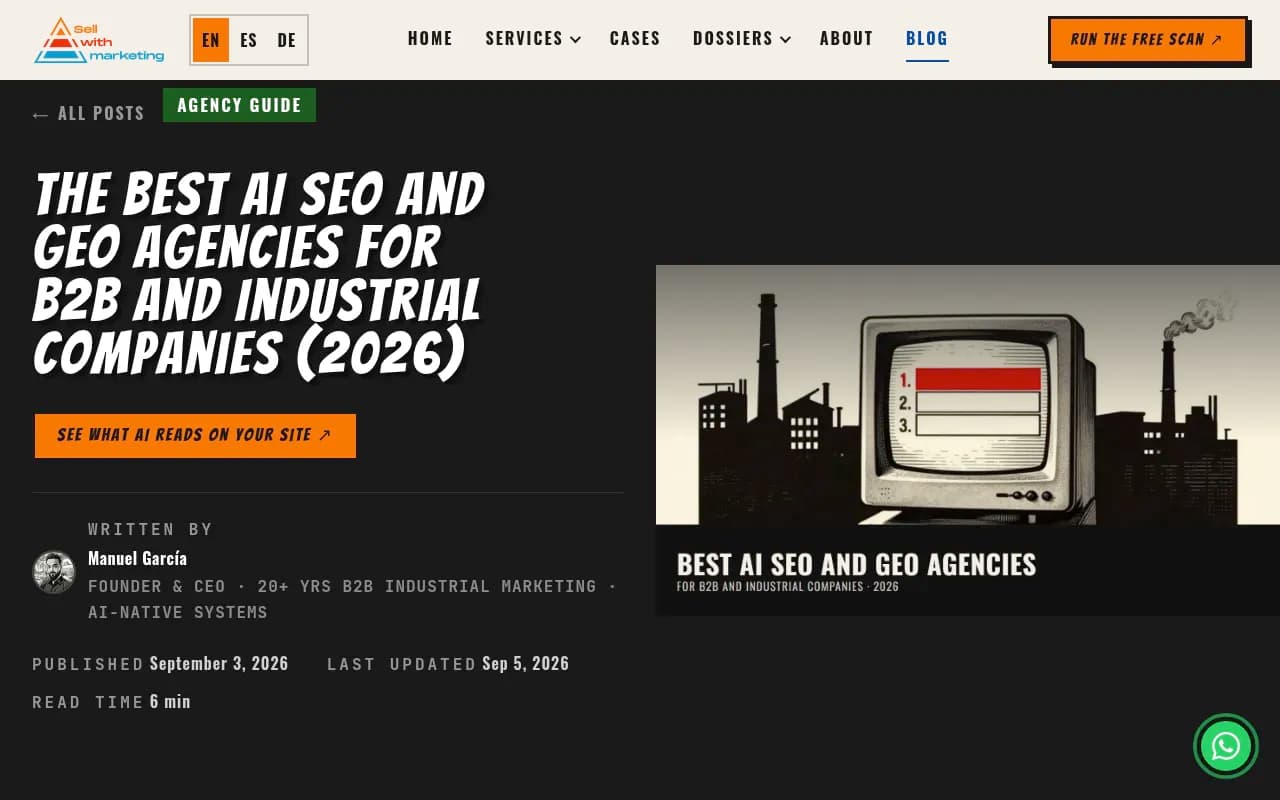
There is a real split here, and the research reflects it. Several of the sources I reviewed are agency rankings, not tool rankings. Sell with Marketing and Windmill Strategy are built around industrial buyers. The ABM Agency, First Page Sage, Gorilla 76, TREW Marketing, and Weidert Group show up in industrial lists too. Note that several of these lists are published by the agencies being ranked, so read the rankings with that in mind. For instance, The ABM Agency ranks itself number one.
A rough rule:
| Situation | Better fit |
|---|---|
| In-house marketer or small team, comfortable with SEO | Software, such as Promptwatch Essential or Professional |
| Large catalog, thin content, no writers | Software plus content help, or an agency |
| No one with time to own the data | Agency |
| Multi-language, multi-region industrial sales | Agency with native-language coverage, plus a tracking tool |
| Enterprise with analytics team | Software, possibly Profound or Promptwatch Business |
If you go the agency route, ask whether they actually use a tracking platform and will show you the data. 1001 SEO Media, which publishes this site, works on technical SEO, content, and AI search for brands and uses Promptwatch for its own GEO tracking. Whatever agency you choose, insist on monthly reporting tied to citations and traffic, not a vague promise of "AI visibility."
For a wider look at tools by category, the GEO software directory lists far more options than this guide covers.
A practical workflow for a manufacturer
Here is a sequence that works for a team of one to three people.
Step 1: build a prompt list from real buyer questions
Start with what your sales engineers hear. Think about application questions ("best coating for marine fasteners"), standards ("ISO 9001 certified CNC machining suppliers"), and comparisons ("stainless vs. titanium flanges for chemical processing"). Add 30 to 50 prompts. Most tools let you tag them by product line.
Step 2: check crawler access first
Before writing anything, confirm AI bots can read your site. Check robots.txt, CDN rules, and whether your product PDFs are indexable. This is the cheapest fix and often the most valuable. If you use Promptwatch, the crawler logs show which bots visit and which pages return errors.
Step 3: find where AI gets its answers instead of you
Look at which domains get cited for your prompts. For industrial categories, expect distributors, trade directories, standards bodies, and Wikipedia-style reference pages. Those are your offsite targets: get accurate listings, be named in the roundups AI uses, and make sure distributor pages carry correct specs.
Step 4: fix product and application pages
Given that product pages and landing pages were the top cited formats in ChatGPT, this is where effort pays. Put complete specs in HTML, not only in a PDF. Add certifications, tolerances, materials, and lead times where you can. Publish comparison pages and application guides. Keep documentation and FAQ pages public.
Step 5: refresh, then measure
Evergreen pages hold citations. Tag each updated page, then watch whether it gets crawled, cited, and visited over the following weeks. Tie the visits to RFQs in your CRM when you can.
Mistakes I would avoid
- Buying an enterprise platform before fixing crawlability. If bots cannot read your site, no dashboard will help.
- Tracking only brand-name prompts. Engineers rarely ask for you by name at the start.
- Relying on press releases. News pages decay fast in AI citations.
- Trusting vendor statistics blindly. Claims like "300% more qualified leads in 90 days" from agency marketing pages are unverified. Measure your own baseline.
- Letting marketing publish technical content without engineering review. A wrong tolerance in an AI-cited page is worse than no page.
Final recommendation
For most manufacturers and industrial companies, the shortlist is short. If you want to find out why you are invisible and then fix it, start with Promptwatch's free Explore tier or a monthly Essential trial, run your 30 to 50 real buyer prompts, and see what the crawler logs and citation data show. If your team already pays for Semrush or Ahrefs, try their AI add-ons as a cheap first look, but expect to outgrow them. If you have no one to run any of this, hire an agency that shows you its tracking data, and make it earn its fee against citations and AI-referred traffic.
And keep the caveat in mind: there is no published manufacturing-specific citation dataset yet. Your own tracking data is the best evidence you will get.