Demandbase Review 2026
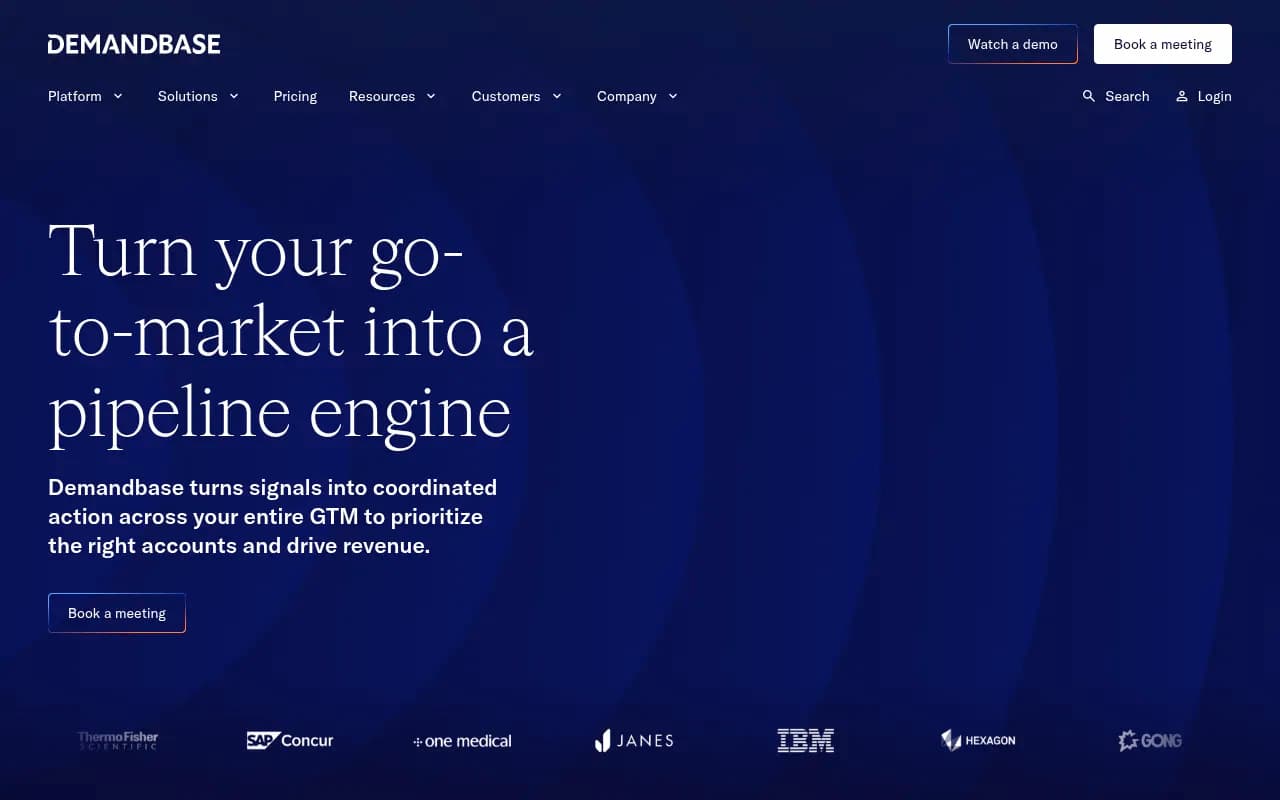
Demandbase is an enterprise ABM platform for B2B sales and marketing teams. It combines AI-driven account intelligence, intent data, advertising, and sales insights to help teams prioritize the right accounts and drive revenue.
Key takeaways
- Demandbase is a full-stack Account-Based Marketing (ABM) platform built for enterprise B2B teams, covering advertising, sales intelligence, data, and cross-functional orchestration in one place
- Pricing starts around $24K/year and can exceed $300K for large enterprise deployments -- this is not a tool for small teams or startups
- Strong at unifying marketing, sales, and revenue operations around shared account priorities, with AI-driven signal processing and buying group identification
- Customers like Adobe, SAP Concur, Zoom, and Thermo Fisher report meaningful pipeline and conversion improvements
- The platform is complex and takes real implementation effort -- onboarding costs alone can run ~$29K, and getting full value requires organizational buy-in across multiple teams
Demandbase has been one of the more recognizable names in B2B marketing technology for over a decade. Founded in 2006 and headquartered in San Francisco, the company built its early reputation on account-based advertising -- the idea that B2B companies should target specific companies rather than spray-and-pray to broad audiences. Over the years it expanded well beyond advertising into a full go-to-market platform, acquiring Engagio in 2020 (which brought in Jon Miller, one of the original architects of ABM as a category) and later Insideview and DemandMatrix to bolster its data capabilities.
Today, Demandbase positions itself as an end-to-end ABM platform that connects marketing, sales, revenue operations, and customer success around a shared view of accounts and buying groups. The pitch is straightforward: most B2B GTM teams already have data, but they lack a way to act on it in a coordinated way. Demandbase tries to solve that by using AI to process signals, prioritize accounts, and activate programs across channels -- all from one platform.
The target audience is clearly enterprise. Customers listed on the site include IBM, Salesforce, Adobe, DocuSign, SAP Concur, Visa, and Thermo Fisher. These are not SMB logos. If you're a 10-person startup looking for a lightweight ABM tool, Demandbase is almost certainly overkill. But if you're running a B2B marketing or sales operation at scale -- think 200+ person GTM teams, complex buying cycles, multiple product lines -- the platform's breadth starts to make sense.
Key features
Account intelligence and signal processing
At the core of Demandbase is its ability to ingest and interpret signals from multiple sources: first-party website data, third-party intent data, CRM activity, advertising engagement, and more. The platform uses AI to score accounts based on their likelihood to buy, factoring in firmographic fit, behavioral signals, and buying group activity. This isn't just lead scoring -- it's account-level prioritization that considers the full buying committee, not just individual contacts.
In practice, this means marketing and sales teams see a ranked list of accounts showing real buying activity, rather than a flat list of everyone in their CRM. The AI continuously re-evaluates these scores as new signals come in, so the prioritization stays current.
Buying group identification and tracking
One of Demandbase's more differentiated capabilities is its focus on buying groups rather than individual leads. B2B purchases typically involve multiple stakeholders -- economic buyers, technical evaluators, champions, blockers -- and Demandbase tries to map these relationships and track engagement across the full group.
The platform can identify who within a target account is engaging with your content, ads, or sales outreach, and surface that information to both marketing and sales. This helps sellers understand where they have coverage and where they have gaps in a deal.
Account-based advertising
Demandbase has its own demand-side platform (DSP) for running targeted display and social advertising to specific accounts. You can build audience segments based on account lists, intent signals, or journey stage, then activate campaigns across channels. The advertising module connects directly to the rest of the platform, so ad engagement feeds back into account scores and sales alerts.
This is one area where Demandbase has a genuine advantage over point solutions -- the feedback loop between advertising data and sales intelligence is tighter than you'd get by stitching together separate tools.
Sales intelligence
The sales-facing side of Demandbase gives reps a view of which accounts are active, who's involved, and what they're engaging with. This includes website visit alerts, intent signal summaries, and buying group maps. Reps can see when a target account suddenly spikes in research activity -- a signal that something has changed in their buying process.
The platform integrates with CRM systems (Salesforce primarily) so this intelligence surfaces inside the tools reps already use, rather than requiring them to log into another dashboard.
Web personalization and account-based experiences
Demandbase can personalize website content based on the visiting account. If someone from a financial services company visits your site, you can show them industry-specific messaging, case studies, or CTAs. This personalization is driven by the same account data that powers the rest of the platform, so it stays consistent with your broader targeting strategy.
SAP Concur's case study on the site specifically credits this capability with a 4x increase in funnel velocity -- they used journey stage data combined with behavioral signals to serve different experiences to accounts at different points in the buying process.
Revenue operations and measurement
For RevOps teams, Demandbase provides a unified view of pipeline activity across programs, channels, and teams. You can track which marketing programs are actually influencing pipeline, measure account engagement over time, and connect activity data to revenue outcomes. The platform supports multi-touch attribution and journey stage tracking, which helps teams move beyond vanity metrics and prove what's actually working.
AI-driven orchestration and automation
Demandbase has been building out what it calls "agent-led automation" -- AI that can trigger coordinated actions across marketing and sales based on account signals. For example, when an account crosses a certain intent threshold, the system can automatically enroll them in a nurture program, alert the assigned rep, and adjust ad spend toward that account. This kind of cross-functional orchestration is where the platform's breadth becomes a real advantage.
Data foundation
Demandbase acquired DemandMatrix and Insideview specifically to strengthen its data layer. The platform maintains its own account and contact database, intent data network, and technographic data. This matters because the quality of ABM execution is only as good as the underlying data -- if your account identification is off, everything downstream suffers.
Who is it for
Demandbase is built for enterprise B2B companies with complex sales cycles and large GTM teams. The sweet spot is companies with dedicated marketing operations, sales operations, and revenue operations functions -- organizations where multiple teams need to coordinate around the same set of target accounts. Think SaaS companies selling to mid-market and enterprise, financial services firms, healthcare technology companies, and large professional services organizations.
The platform works best when there's organizational alignment around ABM as a strategy. If your marketing and sales teams are still debating whether to do account-based marketing at all, Demandbase won't solve that problem -- it amplifies whatever strategy you already have. Companies that get the most value tend to have already committed to a target account list approach and are looking for a platform to execute it at scale.
Customer success teams also get meaningful value from the platform's expansion and risk signal capabilities. If you're managing a large installed base and want to spot upsell opportunities or churn risk earlier, the account intelligence layer applies just as well to existing customers as to prospects.
Who should not use Demandbase: startups and small businesses will find the pricing prohibitive and the complexity overwhelming. Companies without dedicated marketing ops or RevOps resources will struggle to implement and maintain the platform effectively. And if your sales cycle is short and transactional -- think SMB SaaS with a 14-day trial-to-close motion -- the account-based approach Demandbase is built around doesn't really fit.
Integrations and ecosystem
Demandbase integrates with the major B2B marketing and sales technology stack. Salesforce is the primary CRM integration and is deeply supported -- account scores, alerts, and buying group data surface directly in Salesforce records. HubSpot integration is also available, though Salesforce gets more depth.
On the marketing automation side, the platform connects with Marketo, Eloqua, HubSpot Marketing Hub, and Pardot. These integrations allow Demandbase account data to flow into campaign targeting and lead scoring within your existing MAP.
For advertising, Demandbase connects to LinkedIn, Google, and programmatic display networks through its own DSP. The LinkedIn integration is particularly useful for B2B advertisers who want to layer Demandbase's account intelligence on top of LinkedIn's targeting.
The platform also integrates with sales engagement tools like Outreach and Salesloft, analytics platforms including Google Analytics and Tableau, and data warehouses for more advanced reporting use cases.
Demandbase has a public API and maintains a GitHub presence (github.com/demandbase), though the API is primarily used for data export and custom integrations rather than as a developer-first product. There's no native mobile app -- the platform is web-based and designed for desktop use.
Pricing and value
Demandbase does not publish pricing on its website -- you have to fill out a form and talk to sales. Based on publicly available information, pricing starts around $24,000 per year for basic ABM capabilities and can exceed $300,000 per year for full enterprise deployments with all modules.
Onboarding costs are a real consideration: implementation fees can run approximately $29,000, which is significant and worth factoring into your total cost of ownership calculation. Per-user fees and add-on costs for specific modules (advertising, data enrichment, etc.) can add up quickly.
There is no free trial or freemium tier. This is an enterprise sales motion -- expect a multi-week evaluation process, custom pricing, and a contract negotiation.
Compared to alternatives like 6sense (which operates in a similar price range) or Terminus (generally positioned slightly lower), Demandbase is competitive for the breadth of capabilities it offers. The question is whether your organization will actually use all of it. Companies that only need intent data or only need account-based advertising might find more cost-effective point solutions. The full platform value shows up when you're using advertising, sales intelligence, web personalization, and measurement together.
Strengths and limitations
Where Demandbase does well:
- Breadth of the platform: Very few competitors offer advertising, sales intelligence, web personalization, data, and orchestration in a single platform. This reduces integration complexity and creates tighter feedback loops between channels.
- Buying group focus: The emphasis on tracking engagement across the full buying committee -- not just individual leads -- reflects how B2B buying actually works and gives sales teams more useful context.
- Enterprise-grade data: The combination of Insideview, DemandMatrix, and Demandbase's own intent network gives the platform a strong data foundation. Account identification accuracy matters enormously in ABM, and Demandbase has invested heavily here.
- Customer outcomes: The case studies from Adobe, SAP Concur, Zoom, and Thermo Fisher are specific and credible. These aren't vague "improved efficiency" claims -- they cite conversion rate increases, deal size growth, and pipeline velocity improvements.
- Security and compliance: ISO/IEC 27001 certification and SOC 2 compliance matter for enterprise procurement teams, and Demandbase has both.
Honest limitations:
- Cost and complexity: The pricing is enterprise-only, and the implementation effort is real. Getting full value from the platform requires dedicated resources and organizational alignment that many teams underestimate.
- Salesforce-centric: While other CRM integrations exist, the platform is clearly optimized for Salesforce users. Teams on HubSpot or other CRMs may find some features less polished.
- No self-serve path: The absence of any trial or freemium option means you can't evaluate the platform without going through a sales process. For teams that want to test before committing, this is a friction point.
Bottom line
Demandbase is a serious enterprise ABM platform for B2B companies that have committed to an account-based go-to-market strategy and have the team, budget, and organizational alignment to execute it. The platform's breadth -- covering advertising, sales intelligence, web personalization, data, and cross-functional orchestration -- is genuinely differentiated at the enterprise level.
Best use case: a B2B company with 100+ person GTM teams, complex multi-stakeholder sales cycles, and a dedicated RevOps function that wants to unify marketing and sales execution around a shared set of target accounts.
Tags:
Frequently asked questions
What is Demandbase?
How much does Demandbase cost?
Is there a free trial for Demandbase?
Who is Demandbase best suited for?
What does Demandbase integrate with?
How does Demandbase compare to 6sense?
Similar and alternative tools to Demandbase