Key takeaways
- Most AI visibility platforms track what APIs return, not what users actually see -- a meaningful gap that affects accuracy.
- Peec AI, ZipTie, Scriptbee, Evertune, and Promptwatch take different approaches to crawler behavior, and only some of them give you real logs.
- Monitoring alone doesn't move the needle. The platforms that help you act on data -- through content generation, gap analysis, or crawler diagnostics -- deliver more ROI than pure dashboards.
- Promptwatch is the only platform in this comparison that combines real AI crawler logs with content gap analysis and built-in content generation, closing the loop from "you're invisible" to "here's what to publish."
- If you're choosing between these five, your decision should hinge on one question: do you need to understand what's happening, or do you need to fix it?
There's a version of this comparison that just lists features in a table and calls it a day. This isn't that.
The real question behind "which AI visibility tool should I use" is messier: do these platforms actually show you what AI crawlers are doing on your site, or are they just querying APIs and calling it monitoring? Because those are very different things, and the gap between them matters more than most vendors admit.
Let's get into it.
Why "AI crawler behavior" is the right question to ask
When ChatGPT or Perplexity decides whether to cite your content, a few things happen. Their crawlers visit your pages, parse the content, and index it. Later, when a user asks a relevant question, the model pulls from what it indexed.
Most AI visibility tools skip the crawling part entirely. They send a query to an API, record the response, and report back whether your brand appeared. That's useful, but it's downstream of the real action. If your pages aren't being crawled correctly -- JavaScript rendering issues, crawl errors, thin content, blocked bots -- you'll never show up, and a monitoring dashboard won't tell you why.
The platforms that actually show you crawler behavior give you logs: which pages GPTBot or PerplexityBot visited, what errors they hit, how often they return. That's a different category of insight.
With that framing, here's how these five platforms stack up.
Peec AI

Peec AI has built a reputation as a solid entry point for AI visibility monitoring, particularly for European companies that care about GDPR compliance. It uses browser-level rendering rather than raw API calls, which means it captures closer to what users actually see -- a genuine differentiator compared to tools that only hit the API.
The platform tracks brand mentions across ChatGPT, Perplexity, Claude, Gemini, and Google AI Overviews, with sentiment analysis and share-of-voice metrics baked in. For teams that need a clean, compliant monitoring dashboard, it works well.
The limitations show up when you want to go deeper. The base tier caps you at 25 prompts and two or three platforms. If you're managing multiple brands or domains, costs stack up fast -- one review noted that running three Peec AI Pro accounts for three separate brands ran to roughly €597/month. There's also no AI crawler log access, no content generation, and no gap analysis. You can see that you're invisible; you can't easily find out why or fix it.
For GDPR-regulated teams that need a compliant monitoring baseline, Peec AI is a reasonable choice. For teams that want to actually improve their AI visibility, it's a starting point, not a destination.
ZipTie
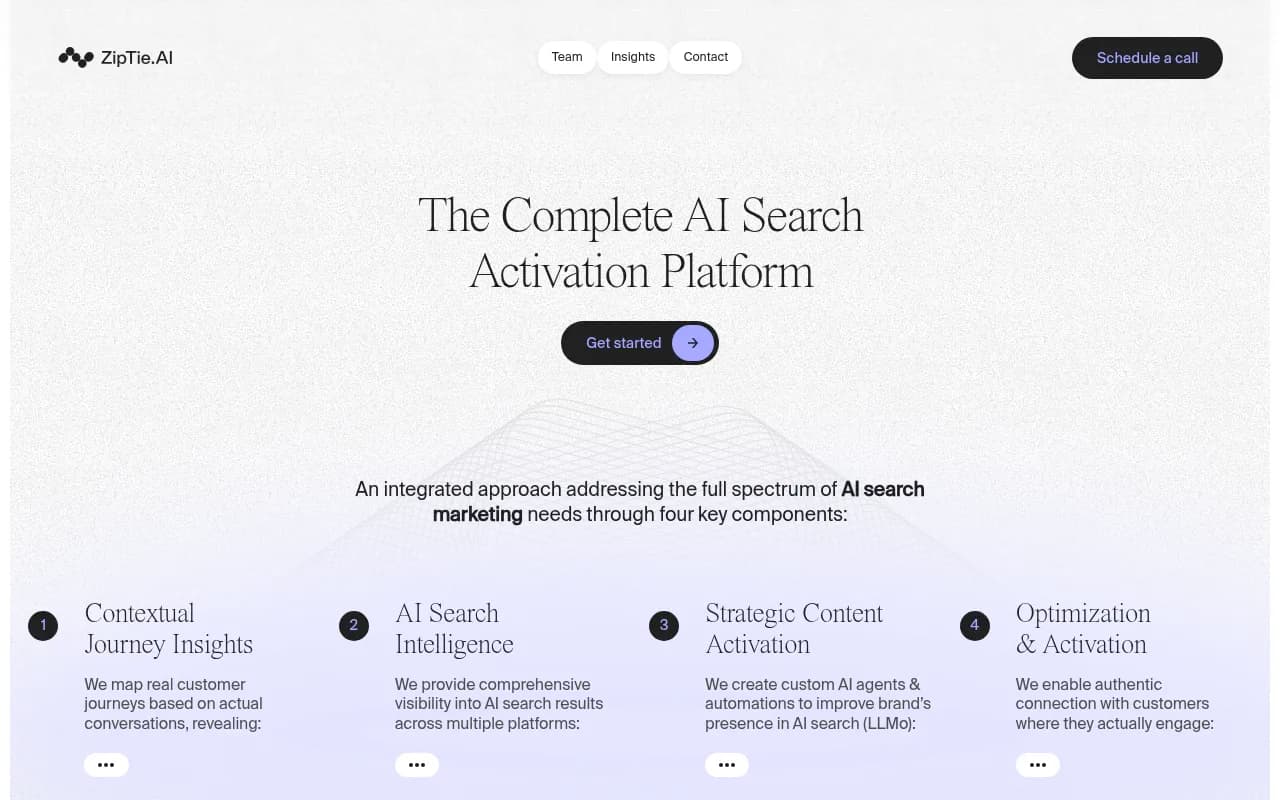
ZipTie takes an interesting angle: it focuses on UI simulation rather than API-only tracking. The argument is that API responses and what users actually see in ChatGPT or Perplexity can differ, and that difference matters if you're trying to understand real-world brand visibility.
The platform covers ChatGPT, Perplexity, and Google AI Overviews (three engines as of mid-2026), with screenshot capture so you can see the actual rendered response. It also includes an "AI Success Score" that tries to quantify how well you're performing across tracked queries.
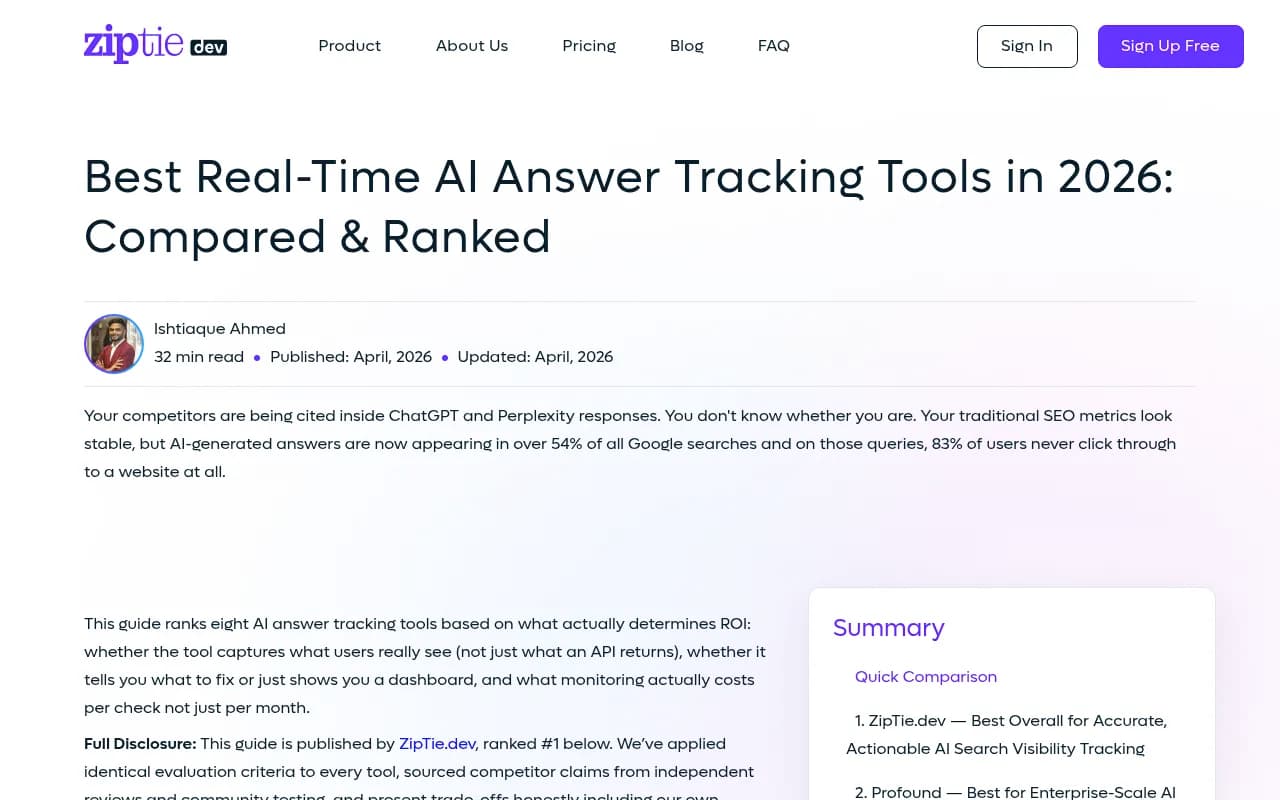
ZipTie's self-published comparison ranks it first, which you should weigh accordingly. What the platform does well is accuracy at the response level -- if you want to know exactly what a user in a specific region sees when they ask a question, the screenshot capture is genuinely useful. The trade-off is coverage: three engines is narrow compared to platforms that track ten or more, and there's no crawler log access, no content generation, and limited prompt volume data.
It's a good fit for teams that want high-fidelity response capture on a small set of high-priority queries. It's less suited for teams running broad visibility programs across many prompts and markets.
Scriptbee
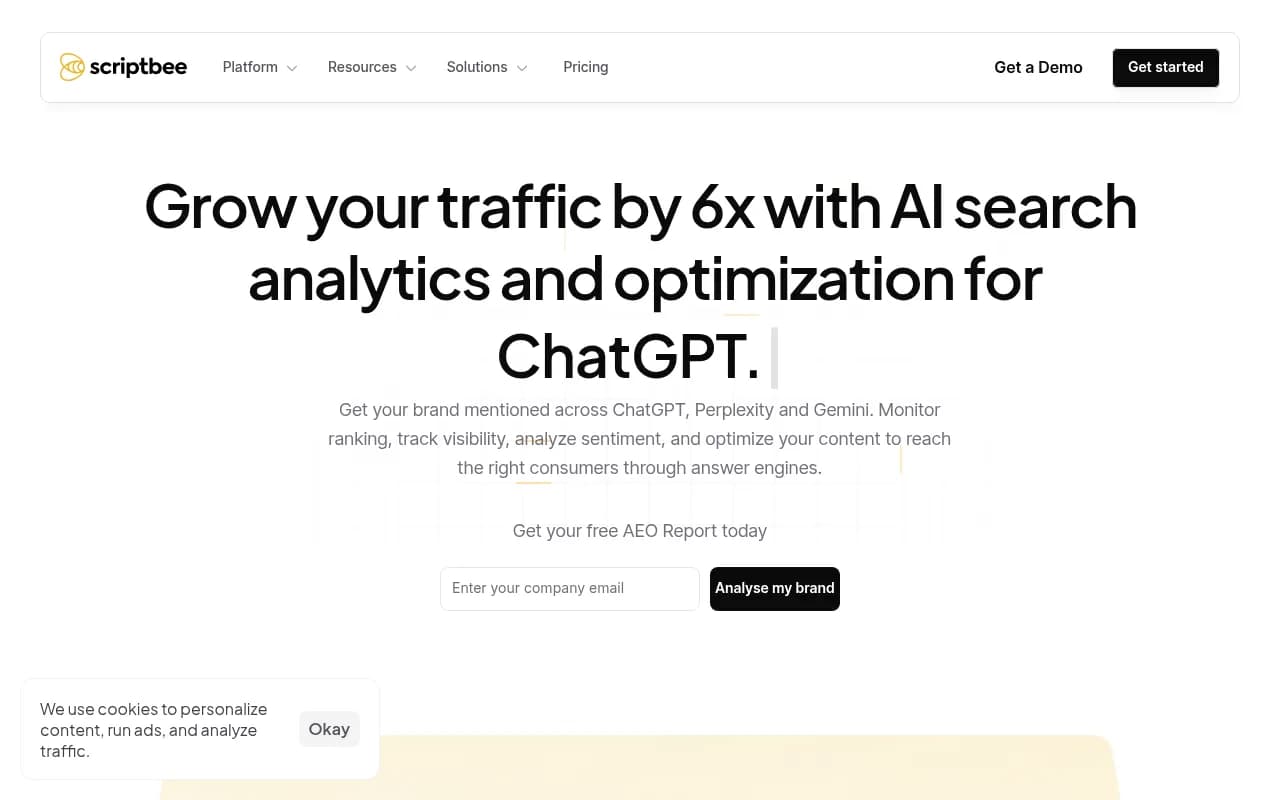
Scriptbee positions itself as the "built by operators" alternative to Peec AI, and the pitch is credible. The founders came from a background of managing multiple brands across competitive markets and got frustrated with single-domain limits and siloed data.
The platform's headline differentiator is unlimited domain tracking -- a real advantage for agencies or multi-brand teams. It also includes real-time AI crawler logs, which puts it in a smaller category of tools that actually show you what GPTBot and PerplexityBot are doing on your site. On top of that, it integrates natively with Semrush, Ahrefs, and Google Analytics, so you can connect AI visibility data to your existing SEO workflow.
Where Scriptbee is thinner: content generation is not a core feature. You get the diagnostic data -- crawler logs, prompt-level insights, visibility scores -- but the platform doesn't help you create content to close the gaps it identifies. You'd need to take those insights and act on them elsewhere.
For agencies managing many client domains who want crawler visibility and SEO tool integration, Scriptbee is worth a serious look. For teams that want a full optimization loop, there's a gap.
Evertune
Evertune markets itself as an "end-to-end AI visibility platform" built for enterprise brands. The platform covers brand monitoring across major AI models, competitive benchmarking, and what it calls GEO insights -- recommendations for how to improve your AI presence.
The enterprise positioning is real: Evertune is built for Fortune 500-scale programs, with the pricing and onboarding process that implies. If you're a large brand with a dedicated team and budget to match, the depth of competitive benchmarking and the GEO recommendations are genuinely useful.
The gaps are notable for mid-market teams. There's no AI crawler log access in the traditional sense -- Evertune focuses on response-level monitoring rather than crawl-level diagnostics. Content generation is advisory rather than built-in. And the pricing structure puts it out of reach for most teams that aren't enterprise.
Evertune is a strong choice if you're a large brand that needs executive-level reporting and competitive benchmarking. It's overkill -- and over-budget -- for most marketing teams.
Promptwatch
Promptwatch sits in a different category from the other four, and it's worth being direct about why.

The other platforms in this comparison are primarily monitoring tools. Some do monitoring better than others. Some add crawler logs. Some add integrations. But the core loop is: track what AI models say about you, report it back.
Promptwatch is built around a different question: after you know you're invisible, what do you do about it?
The platform includes real-time AI crawler logs -- you can see exactly which pages GPTBot, ClaudeBot, PerplexityBot, and others are visiting, what errors they're hitting, and how often they return. That's the diagnostic layer. But it doesn't stop there.
The Answer Gap Analysis shows you which prompts your competitors are appearing for that you're not. Not just "you're missing from these queries" -- it shows you the specific content your site is missing that AI models want to answer those queries. Then the built-in AI writing agent generates articles, listicles, and comparisons grounded in real citation data (880M+ citations analyzed), so you can publish content that's actually engineered to get cited.
The result is a loop: find gaps, create content, track whether your visibility improves. Page-level tracking shows which specific pages are being cited, by which models, and how often. Traffic attribution connects that visibility to actual sessions and revenue.
That's a materially different value proposition from "here's your share of voice score."
Promptwatch monitors 10 AI models (ChatGPT, Perplexity, Claude, Gemini, Google AI Overviews, Google AI Mode, DeepSeek, Grok, Copilot, Meta/Llama), with prompt volume estimates, difficulty scores, and query fan-outs that show how one prompt branches into sub-queries. It also tracks Reddit and YouTube as citation sources -- channels that directly influence AI recommendations and that most competitors ignore.
Pricing starts at $99/month for the Essential tier (1 site, 50 prompts, 5 articles), $249/month for Professional (2 sites, 150 prompts, 15 articles, crawler logs, state/city tracking), and $579/month for Business (5 sites, 350 prompts, 30 articles). A free trial is available.
Feature comparison
| Feature | Peec AI | ZipTie | Scriptbee | Evertune | Promptwatch |
|---|---|---|---|---|---|
| AI engines covered | 5+ | 3 | 5+ | 5+ | 10 |
| Browser/UI simulation | Yes (GDPR-native) | Yes (screenshot capture) | Partial | No | No |
| Real AI crawler logs | No | No | Yes | No | Yes |
| Content gap analysis | No | No | No | Advisory | Yes (Answer Gap Analysis) |
| Built-in content generation | No | No | No | No | Yes (AI writing agent) |
| Multi-domain support | 1 per plan | Limited | Unlimited | Enterprise | Up to 5 (Business tier) |
| Prompt volume/difficulty | No | No | No | No | Yes |
| Reddit/YouTube tracking | No | No | No | No | Yes |
| ChatGPT Shopping tracking | No | No | No | No | Yes |
| Traffic attribution | No | No | Partial (GA integration) | No | Yes (GSC, snippet, logs) |
| GDPR compliance | Yes (EU-native) | No | No | No | Yes (Dutch company) |
| Pricing (entry) | ~€99/mo | Custom | Custom | Enterprise | $99/mo |
| Free trial | Yes | Yes | Yes | No | Yes |
How to choose
The honest answer is that the right tool depends on what you're actually trying to accomplish.
If your primary concern is GDPR compliance and you need a clean monitoring baseline for a European brand, Peec AI is the most purpose-built option. The browser-level rendering is a genuine advantage for accuracy, and the compliance story is solid.
If you want high-fidelity response capture -- literally seeing screenshots of what users see -- and you're focused on a small number of high-priority queries, ZipTie's UI simulation approach is worth testing. The three-engine coverage is a real constraint, but for narrow use cases it works.
If you're an agency managing many client domains and you want crawler logs plus SEO tool integration, Scriptbee's unlimited domain model and native Semrush/Ahrefs connections make it a strong fit. You'll need to bring your own content strategy.
If you're a Fortune 500 brand with a dedicated GEO team and budget, Evertune's enterprise depth and competitive benchmarking are worth the investment.
If you want to actually improve your AI visibility -- not just measure it -- Promptwatch is the only platform here that closes the full loop. The combination of real crawler logs, Answer Gap Analysis, built-in content generation, and traffic attribution means you're not just watching a dashboard. You're running an optimization program.
Most teams that start with a monitoring-only tool eventually hit the same wall: they know they're invisible, but the tool doesn't help them fix it. That's the gap Promptwatch is built to close.
The crawler behavior question, answered
To come back to the original question: which of these platforms actually shows you real AI crawler behavior?
Scriptbee and Promptwatch are the two platforms in this comparison that provide genuine AI crawler logs -- real-time data on which bots are visiting your pages, what they're reading, and what errors they encounter. That's the foundation of understanding why your content is or isn't being cited.
The others track what AI models say, which is valuable, but it's a different layer. You can have excellent response-level monitoring and still have no idea that GPTBot is hitting a 404 on your most important product page, or that ClaudeBot is being blocked by your robots.txt.
If crawler behavior is your specific concern, start with Scriptbee or Promptwatch. If you want crawler visibility plus the ability to act on what you find, Promptwatch is the more complete platform.
The market for AI visibility tools is moving fast, and the gap between monitoring and optimization is where the real competitive advantage lives in 2026. The teams that figure out how to close that loop -- find gaps, fix them, track results -- are the ones that will own AI search visibility over the next few years.