Key takeaways
- Traditional SEO giants (Semrush, Ahrefs, Moz) have added AI visibility features, but these are bolt-ons to platforms built for Google rankings — not purpose-built for GEO.
- Dedicated AI visibility tools like Peec AI and Promptwatch are built from the ground up to track how brands appear in ChatGPT, Perplexity, Claude, Gemini, and other AI engines.
- The biggest gap between tools isn't monitoring depth — it's whether the tool helps you do something about what you find. Most tools stop at showing you data.
- Promptwatch is the only platform in this comparison that closes the full loop: find visibility gaps, generate AI-optimized content, track results, and attribute traffic to revenue.
- If you're already paying for Semrush or Ahrefs for traditional SEO, you don't need to cancel them — but you likely need a dedicated AI visibility tool running alongside them.
The SEO world has fractured. A year ago, you could reasonably argue that ranking well on Google was enough. Now, a growing share of search queries never reach a traditional results page at all — they get answered directly by ChatGPT, Perplexity, Google AI Overviews, or one of a dozen other AI engines. And if your brand isn't being cited in those answers, you're invisible to a chunk of your audience that you can't even measure with Google Analytics.
That's the context for this comparison. Five tools, two fundamentally different approaches to the same problem. Let's get into it.
The two camps: what we're actually comparing
Before diving into features, it's worth being clear about what each tool was built to do.
Semrush, Ahrefs, and Moz were built for traditional SEO. They're excellent at keyword research, backlink analysis, technical audits, and rank tracking in Google. Over the past 12-18 months, all three have added some form of AI search monitoring — but these features were grafted onto platforms designed for a different era.
Peec AI and Promptwatch were built specifically for the AI search era. They don't care about your Google rankings (at least, not primarily). They care about whether ChatGPT recommends you, whether Perplexity cites your pages, and whether you show up when someone asks an AI assistant which product to buy.
This isn't a knock on either camp. It's just important to understand what you're evaluating.
Semrush: the all-in-one that added AI features
Semrush is the most comprehensive traditional SEO platform on the market. Keyword research, competitive analysis, backlink auditing, content optimization, local SEO, PPC research — it does all of it, and does most of it well.
For AI search, Semrush launched its AI Search Health feature and ContentShake AI tool. The AI Search Health module lets you track brand mentions across a handful of AI engines. It's functional, but there are real limitations worth knowing about:
- Semrush uses fixed, preset prompts rather than letting you define your own. You can't track the specific questions your customers are actually asking.
- There's no content gap analysis — you can see where you're missing, but the platform won't tell you what to create to fix it.
- No AI crawler logs, so you can't see how AI engines are actually crawling your site.
- No Reddit or YouTube tracking, which matters because AI models frequently cite these sources.
The honest summary: Semrush's AI features are a good starting point if you're already a Semrush customer and want a basic read on AI visibility without adding another tool. But if AI search is a serious priority, you'll hit the ceiling quickly.
Ahrefs: strong on backlinks, limited on AI
Ahrefs has long been the go-to for backlink research and content gap analysis in traditional SEO. Its Site Explorer and Keywords Explorer are genuinely best-in-class for Google-focused work.
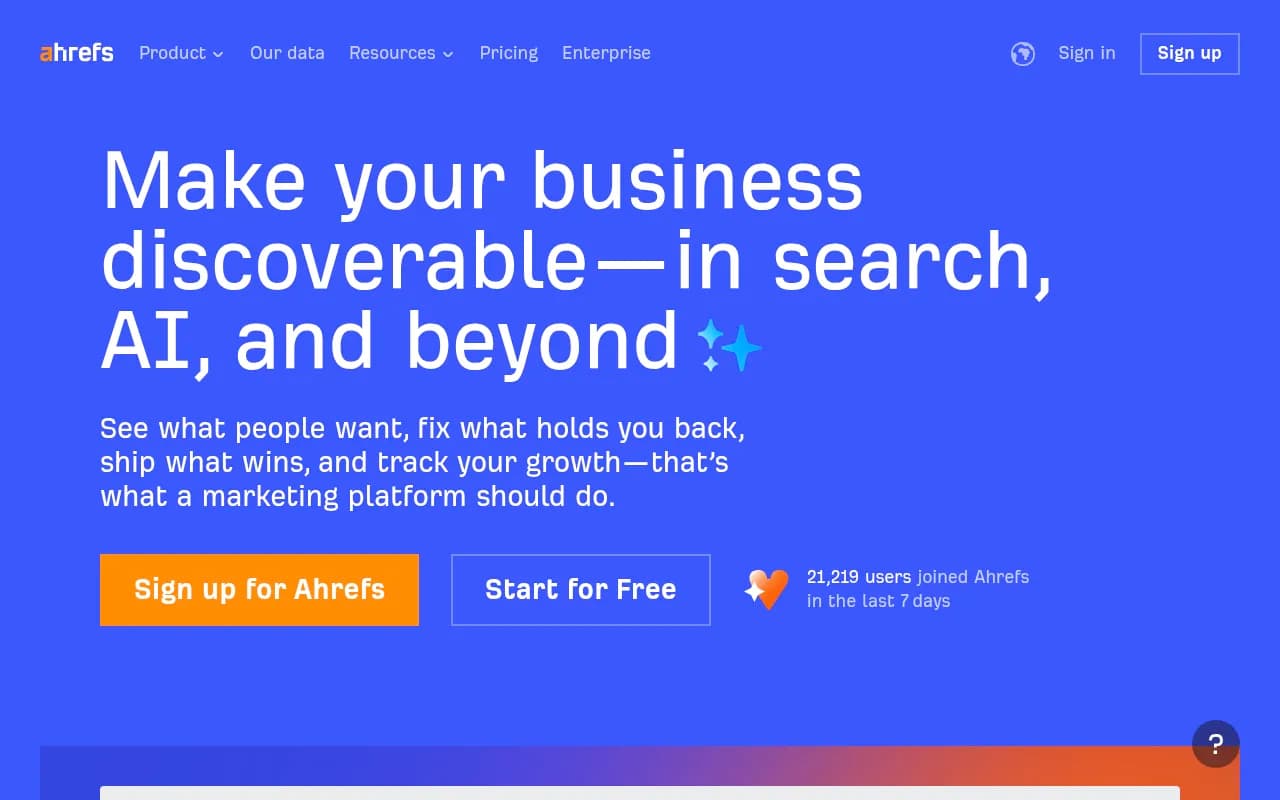
For AI visibility, Ahrefs launched Brand Radar — a feature that tracks brand mentions across AI engines. Like Semrush, it uses fixed prompts rather than custom ones, which limits how actionable the data is. There's also no AI traffic attribution, so you can't connect AI visibility to actual website visits or revenue.
The Ahrefs vs. Semrush debate for 2026 mostly comes down to whether you prefer Ahrefs' cleaner interface and backlink depth, or Semrush's broader feature set. For AI search specifically, neither has a decisive edge — both are monitoring-only with limited customization.
Moz: the original SEO authority, catching up on AI
Moz built its reputation on Domain Authority, link research, and making SEO accessible to non-technical marketers. It's still a solid choice for traditional SEO, particularly for teams that want a less overwhelming interface than Semrush.
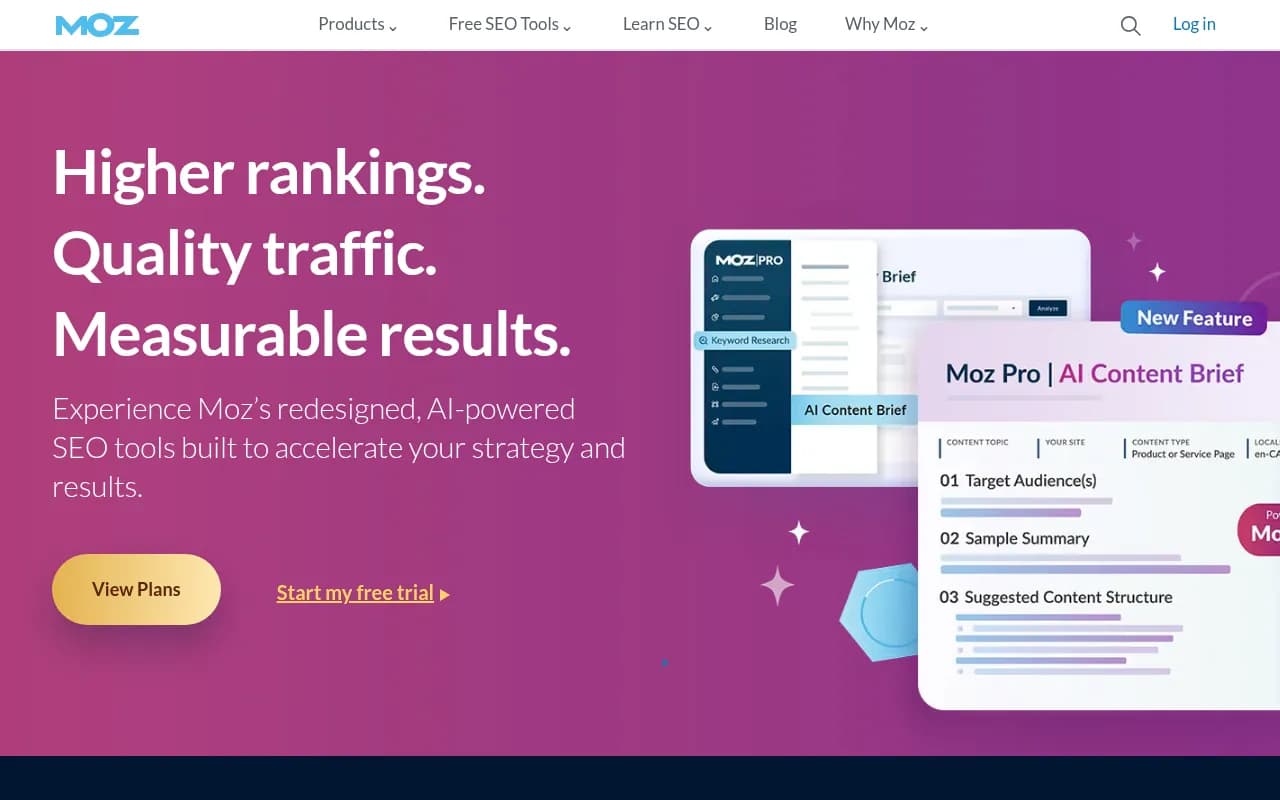
On AI visibility, Moz is the furthest behind of the three traditional tools. As of mid-2026, Moz's AI search features are minimal compared to what Semrush and Ahrefs have shipped. If AI visibility is on your roadmap, Moz isn't the right primary tool for that job right now.
Peec AI: purpose-built for AI search analytics
Peec AI is a focused AI visibility platform built specifically for marketing teams that need to understand their brand's presence in AI-generated answers. It doesn't try to be an all-in-one SEO platform — it does AI search analytics and does it well.
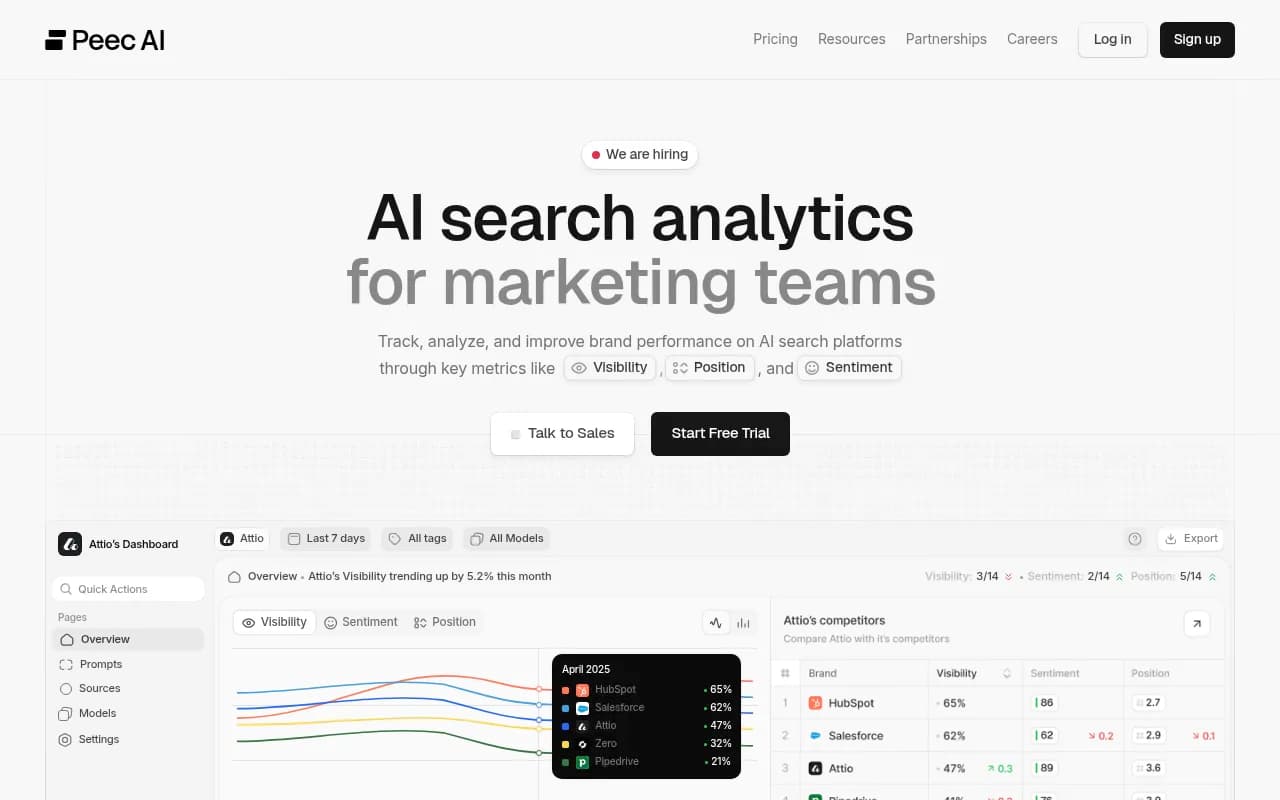
Where Peec AI has a real advantage over Semrush and Ahrefs:
- Custom prompt tracking. You define the prompts that matter to your business, rather than being limited to presets.
- Source analysis showing which specific URLs are being cited in AI responses.
- Persona-based tracking to understand how AI responds differently to different customer segments.
- Better trend data for understanding how your visibility changes over time.
The limitation is that Peec AI is primarily a monitoring and analytics tool. It shows you where you stand and how things are changing, but the platform doesn't help you create content to improve your position. You get the diagnosis without the treatment.
Promptwatch: the full loop from gap to content to results
Promptwatch takes a different approach from every other tool in this comparison. It's not just a monitoring dashboard — it's built around the idea that knowing you have a visibility problem is useless unless you can fix it.

The core workflow is a three-step loop:
Step 1: Find the gaps. Answer Gap Analysis shows you exactly which prompts your competitors are visible for that you're not. You see the specific topics, questions, and angles that AI models want to answer but can't find on your site.
Step 2: Create content that gets cited. The built-in AI writing agent generates articles, listicles, and comparisons grounded in real citation data — 880M+ citations analyzed. This isn't generic content; it's engineered to get cited by ChatGPT, Claude, Perplexity, and other AI models.
Step 3: Track the results. Page-level tracking shows exactly which pages are being cited, how often, and by which models. Traffic attribution (via code snippet, Google Search Console integration, or server log analysis) connects AI visibility to actual revenue.
Beyond the core loop, Promptwatch covers capabilities that none of the other tools in this comparison offer:
- AI Crawler Logs showing real-time data on which AI crawlers are hitting your site, which pages they're reading, and what errors they're encountering.
- Prompt Intelligence with volume estimates and difficulty scores, so you can prioritize high-value, winnable prompts.
- Reddit and YouTube tracking, surfacing discussions that directly influence AI recommendations.
- ChatGPT Shopping Tracking for brands that appear in product recommendations and shopping carousels.
- Competitor heatmaps comparing your AI visibility against competitors across different LLMs.
- Multi-language and multi-region monitoring with customizable personas.
Promptwatch monitors 10 AI models: ChatGPT, Perplexity, Google AI Overviews, Google AI Mode, Claude, Gemini, Meta/Llama, DeepSeek, Grok, Mistral, and Copilot. That's broader coverage than any other tool here.
Pricing starts at $99/month for the Essential plan (1 site, 50 prompts, 5 articles), $249/month for Professional (2 sites, 150 prompts, 15 articles, crawler logs), and $579/month for Business (5 sites, 350 prompts, 30 articles). A free trial is available.
Head-to-head comparison
| Feature | Promptwatch | Peec AI | Semrush | Ahrefs | Moz |
|---|---|---|---|---|---|
| Custom prompt tracking | Yes | Yes | No (fixed prompts) | No (fixed prompts) | Limited |
| AI models monitored | 10+ | ~5 | ~4 | ~4 | ~2 |
| Content gap analysis | Yes (Answer Gap) | No | No | No | No |
| AI content generation | Yes (built-in agent) | No | Partial (ContentShake) | No | No |
| AI crawler logs | Yes | No | No | No | No |
| Traffic attribution | Yes | No | No | No | No |
| Reddit/YouTube tracking | Yes | No | No | No | No |
| ChatGPT Shopping tracking | Yes | No | No | No | No |
| Prompt volume/difficulty | Yes | Limited | No | No | No |
| Traditional SEO features | No | No | Yes | Yes | Yes |
| Page-level citation tracking | Yes | Yes | Limited | Limited | No |
| Competitor heatmaps | Yes | Yes | Limited | Limited | No |
| Starting price | $99/mo | ~$99/mo | $140/mo | $129/mo | $99/mo |
Which tool should you actually use?
The answer depends on what you're trying to solve.
If traditional SEO is your primary focus and AI visibility is secondary, Semrush or Ahrefs makes sense as your main platform. Both have enough AI monitoring to give you a basic read on the landscape. Ahrefs tends to win on backlink depth and interface cleanliness; Semrush wins on breadth. Neither is ideal for serious AI visibility work.
If you want dedicated AI search analytics without content creation, Peec AI is a solid choice. It's purpose-built for the job, offers custom prompt tracking, and gives you better data quality than the AI features bolted onto Semrush or Ahrefs.
If you want to actually improve your AI visibility, not just measure it, Promptwatch is the only tool in this comparison that closes the loop. The combination of gap analysis, content generation grounded in real citation data, and traffic attribution makes it an optimization platform rather than a monitoring dashboard. For marketing teams that treat AI search as a growth channel rather than a vanity metric, that distinction matters a lot.
The most common setup for serious teams in 2026: keep Semrush or Ahrefs for traditional SEO work, and run Promptwatch alongside it for AI visibility. They're not redundant — they're solving different problems.
The deeper question: monitoring vs. optimization
The real divide in this market isn't between traditional SEO tools and AI visibility tools. It's between tools that show you data and tools that help you act on it.
Semrush, Ahrefs, Moz, and Peec AI all sit on the monitoring side of that line. They tell you where you stand. Promptwatch is built around the premise that visibility data is only valuable if it leads to action — content created, gaps closed, citations earned, traffic attributed.
That's not a criticism of monitoring tools. You need to know where you stand before you can improve. But if you're paying for visibility data and not doing anything with it, you're leaving the most valuable part of the workflow on the table.
The brands winning in AI search right now aren't just tracking their visibility scores. They're using that data to figure out what content to create next, creating it, publishing it, and watching their citation rates improve. That's the loop that matters.
Bottom line
Semrush and Ahrefs remain strong choices for traditional SEO in 2026. Moz is solid for teams that want simplicity. None of them were built for the AI search era, and it shows in their AI features.
Peec AI is a capable dedicated monitoring tool if you need clean AI visibility analytics without the overhead of a full SEO platform.
Promptwatch is the only tool here that treats AI visibility as something to be optimized, not just observed. For teams that want to turn AI search into a real acquisition channel, that's a meaningful difference.