Key takeaways
- Bombora is the gold standard for third-party intent data coverage, powering signals across 5,000+ B2B websites through its co-op model -- but it's data infrastructure, not a full marketing platform.
- 6sense scores highest in independent evaluations (36/40 in Growleads' 2026 scorecard) thanks to its predictive AI and full ABM suite, but the price tag is enterprise-level.
- Demandbase (34/40) is a strong second for teams that want ABM orchestration with solid intent data built in, especially if they're already invested in the Salesforce ecosystem.
- Factors.ai is the most accessible option for mid-market B2B teams that want intent signals, LinkedIn ad optimization, and attribution without a six-figure contract.
- The right choice depends on whether you need raw intent data to plug into existing tools, or an end-to-end platform that acts on those signals automatically.
B2B buying has changed. The average enterprise purchase now involves 6-10 stakeholders, and most of them do significant research before ever talking to sales. Intent data tries to solve a specific problem: knowing which companies are actively researching solutions like yours, before they raise their hand.
The challenge is that "intent data" means very different things depending on who's selling it. Bombora tracks content consumption across thousands of B2B media sites. 6sense builds predictive models that estimate where accounts sit in the buying journey. Demandbase layers intent signals into a full ABM platform. Factors.ai connects intent to actual pipeline attribution.
This guide breaks down how each platform actually works, what the data quality looks like, and which teams should be using which tool.
What is B2B intent data (and why does the source matter)?
Intent data comes in two main flavors: first-party and third-party.
First-party intent is behavior on your own website -- pages visited, content downloaded, pricing pages viewed. You already have this data if you have any analytics set up. It's high-quality but limited: it only captures people who already found you.
Third-party intent is where it gets interesting. Providers track content consumption across large networks of B2B websites -- industry publications, review sites, forums -- and aggregate that signal at the account level. When a cluster of employees at a company starts consuming content about "cloud security" or "marketing automation," that's a buying signal even if they've never visited your site.
The source matters enormously because not all third-party data is equal. A co-op model (like Bombora's) where publishers share data directly tends to produce cleaner, more reliable signals than scraped or modeled data. Review-based intent (like G2's) captures accounts that are actively comparing vendors -- very high intent, but narrow coverage.
The four platforms compared
Bombora
Bombora runs the largest B2B intent data co-op available, aggregating behavioral signals from over 5,000 B2B media sites. When an account cluster starts consuming content around a specific topic, Bombora registers a "surge" -- a spike in activity relative to that account's baseline.
What makes Bombora different from the other platforms here is that it's primarily a data provider, not a marketing platform. You typically access Bombora data through integrations with your CRM, MAP, or DSP rather than through Bombora's own interface. It powers the intent layer inside tools like Salesforce, HubSpot, LinkedIn, and many of the platforms on this list.
The co-op model is both Bombora's strength and its limitation. Because publishers opt in and share data directly, the signals are generally more trustworthy than scraped alternatives. But the model skews toward English-language, North American B2B content -- global coverage is thinner.
Bombora scores 33/40 in Growleads' 2026 B2B intent data scorecard, behind 6sense and Demandbase but ahead of most other providers. It's the right choice when you want clean, reliable third-party intent data to feed into your existing stack rather than a new platform to manage.
Pricing is not publicly listed and varies based on data volume and integrations. Expect enterprise-level contracts.
6sense
6sense is the most comprehensive platform in this comparison. It combines third-party intent data (partly powered by Bombora), first-party signals, AI-based predictive scoring, and a full ABM execution layer. The platform tries to answer one question: which accounts are in-market right now, and what stage of the buying journey are they in?
The predictive model is genuinely impressive. 6sense uses machine learning to estimate buying stage across accounts, not just flag intent spikes. An account might be in "awareness," "consideration," or "decision" -- and the platform routes them to different campaigns accordingly. It also does contact-level identification, trying to surface the actual buyers within an account rather than just the company.
In the Growleads 2026 scorecard, 6sense leads the pack at 36/40. G2 reviews consistently highlight the quality of the AI predictions and the depth of the platform. The complaints are equally consistent: the implementation is complex, the learning curve is steep, and the pricing is high enough that smaller teams rarely make it past the demo stage.
6sense doesn't publish pricing. Based on market reports and user disclosures, annual contracts typically start around $60,000 and scale significantly from there. It's built for enterprise marketing and sales teams with dedicated RevOps support.
Demandbase
Demandbase takes a similar approach to 6sense -- full ABM platform with intent data built in -- but with a slightly different emphasis. Where 6sense leans heavily on predictive AI, Demandbase has historically been stronger on the advertising and account engagement side.
The platform includes account identification, intent data (both first-party and third-party), advertising capabilities, sales intelligence, and analytics. It integrates deeply with Salesforce and other enterprise CRMs, which matters a lot for teams where sales and marketing alignment is the core problem to solve.
Demandbase scores 34/40 in the same Growleads evaluation, just behind 6sense. Users on G2 tend to praise the advertising targeting and the account engagement analytics. The common criticism is that the platform can feel like multiple products stitched together rather than a unified experience -- a consequence of Demandbase's acquisition-heavy growth strategy.
Pricing is also enterprise-level and not publicly disclosed. Expect similar contract sizes to 6sense.
Factors.ai
Factors.ai approaches intent data from a different angle. Rather than building a massive third-party data co-op, it focuses on helping B2B marketing teams connect intent signals to actual pipeline outcomes -- particularly through LinkedIn and Google ad attribution.
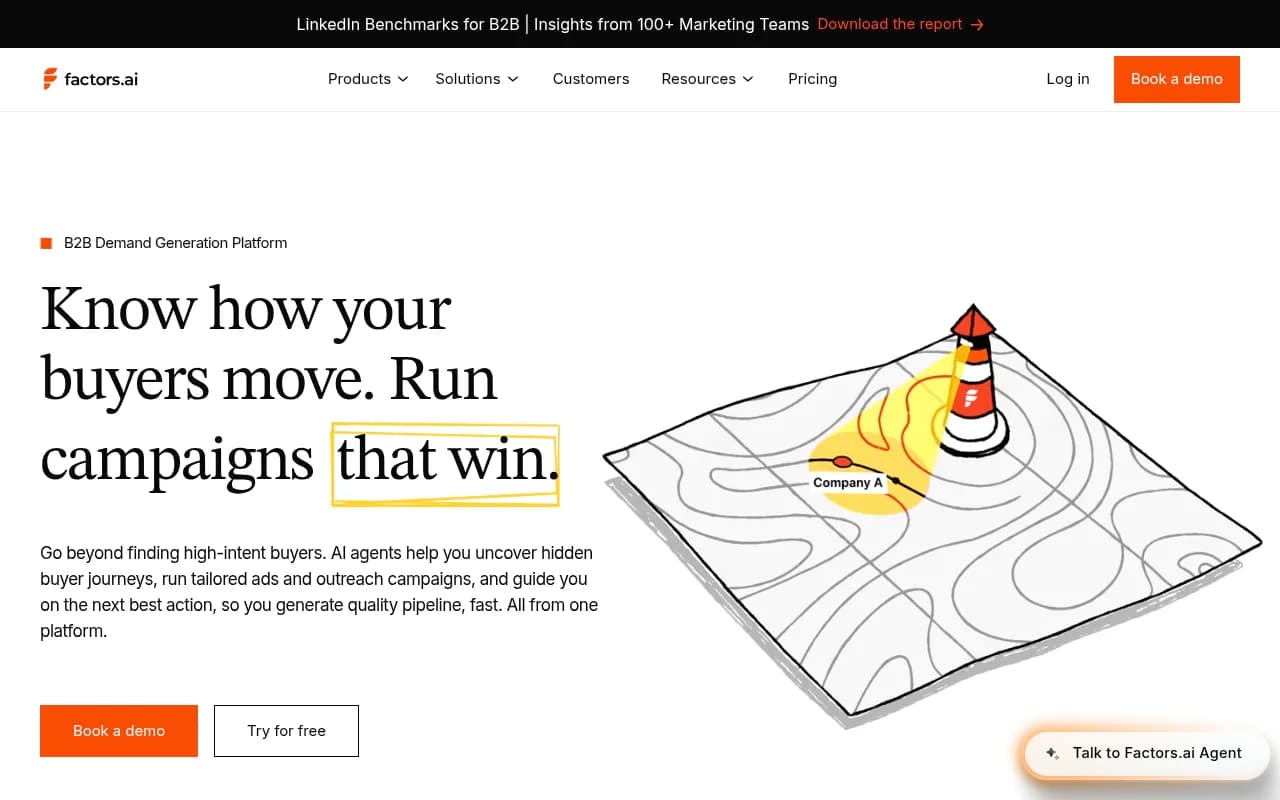
The platform identifies anonymous website visitors at the account level, tracks engagement across touchpoints, and connects that data to LinkedIn campaign performance. Its LinkedIn Adpilot and Google Adpilot products are specifically built to prove which ad spend is actually driving pipeline, not just clicks.
For intent data specifically, Factors.ai surfaces account-level signals from your own website and integrates with third-party sources. It's not trying to compete with Bombora's co-op coverage -- it's trying to help you act on intent signals more intelligently, especially if LinkedIn is a core channel.
The pricing is significantly more accessible than the enterprise platforms. Factors.ai offers plans starting around $399/month, with mid-market and growth tiers that don't require a six-figure commitment. That's a meaningful difference for teams that can't justify a $60K+ ABM platform.
Head-to-head comparison
| Bombora | 6sense | Demandbase | Factors.ai | |
|---|---|---|---|---|
| Primary use case | Third-party intent data | Full ABM + predictive AI | ABM + advertising | Attribution + LinkedIn ads |
| Intent data type | Third-party co-op | Third-party + first-party | Third-party + first-party | First-party + integrations |
| Co-op network size | 5,000+ B2B sites | Proprietary | Proprietary | N/A |
| Predictive AI scoring | No | Yes (core feature) | Yes | Basic |
| ABM execution | No (data only) | Yes | Yes | Partial |
| LinkedIn integration | Via partners | Yes | Yes | Deep (Adpilot) |
| Attribution | No | Basic | Basic | Strong |
| Pricing transparency | No | No | No | Partial |
| Starting price (est.) | Enterprise | ~$60K+/yr | ~$60K+/yr | ~$399/mo |
| Best for | Data infrastructure | Enterprise ABM | Enterprise ABM + ads | Mid-market, attribution-focused |
| G2 / independent score | 33/40 | 36/40 | 34/40 | N/A |
| Global coverage | US-heavy | Broad | Broad | Depends on integrations |
Which platform should you actually use?
The honest answer is that these tools serve different teams at different stages.
Use Bombora if you already have a marketing stack you're happy with and you just need reliable third-party intent data to feed into it. Bombora works best as infrastructure -- it powers the intent layer in your CRM or MAP rather than replacing it. If your sales team is already using Salesforce and you want to surface surging accounts inside that workflow, Bombora is the cleanest way to do it.
Use 6sense if you're an enterprise marketing team with a RevOps function, a dedicated ABM budget, and the patience to implement a complex platform. The predictive AI is genuinely best-in-class, and the buying stage modeling can meaningfully improve how you prioritize accounts. But you need the resources to use it properly -- teams that buy 6sense and don't invest in implementation rarely see the ROI they expected.
Use Demandbase if you're running account-based advertising at scale and want intent data and ad targeting in the same platform. It's particularly strong for teams that run programmatic display alongside their ABM motion and want unified reporting across both. The Salesforce integration is also a real advantage if your sales team lives in that CRM.
Use Factors.ai if you're a mid-market B2B team that needs to prove marketing ROI on LinkedIn and Google spend, and you want intent signals to inform that targeting without a six-figure platform contract. It's the most accessible option here and the most focused on attribution -- connecting ad spend to actual pipeline rather than just flagging in-market accounts.
Other intent data providers worth knowing
The four platforms above aren't the only options. A few others come up consistently in 2026 evaluations:
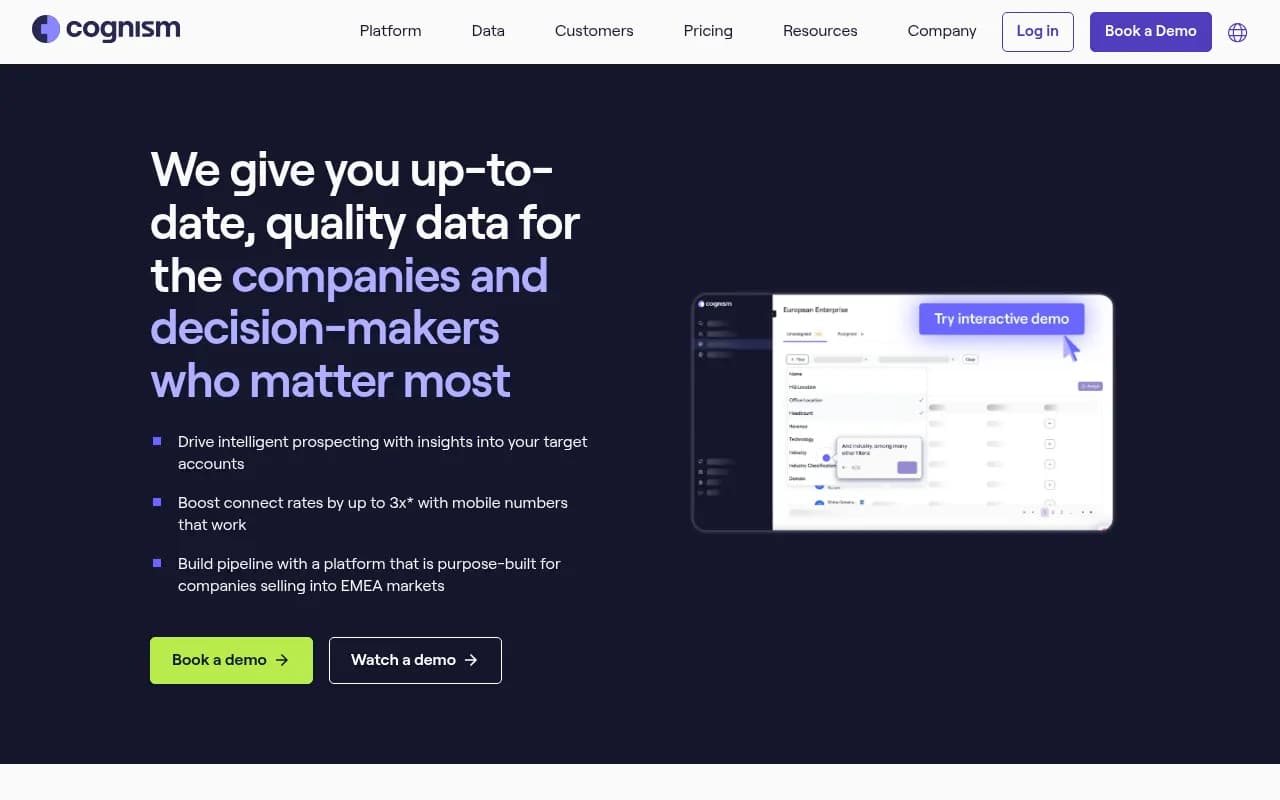
Cognism combines Bombora-powered intent signals with its own contact database, which is particularly strong in EMEA. If you need intent data plus verified contact data in a single tool (especially for European markets), Cognism is worth evaluating.
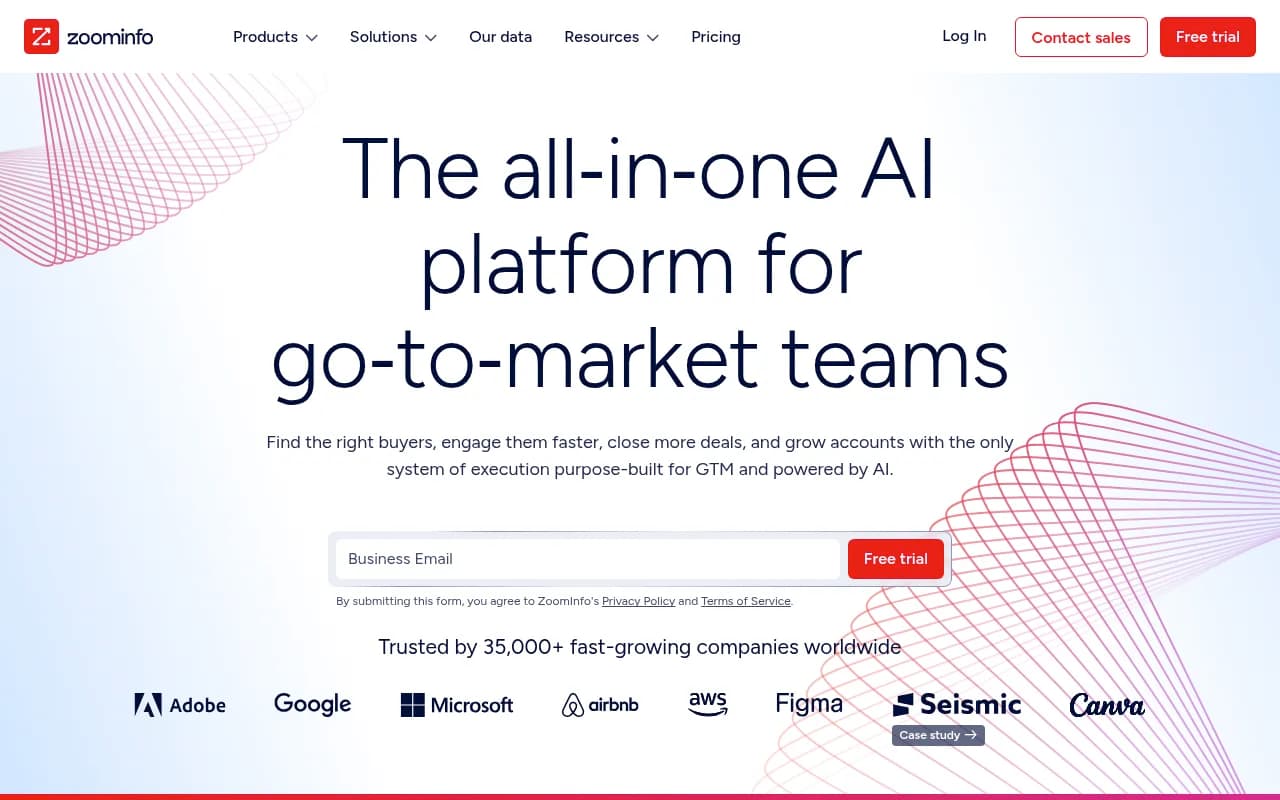
ZoomInfo has its own intent data layer built into its contact database platform. It's not as sophisticated as 6sense's predictive model, but if you're already a ZoomInfo customer, the intent signals are a useful add-on rather than a separate purchase.
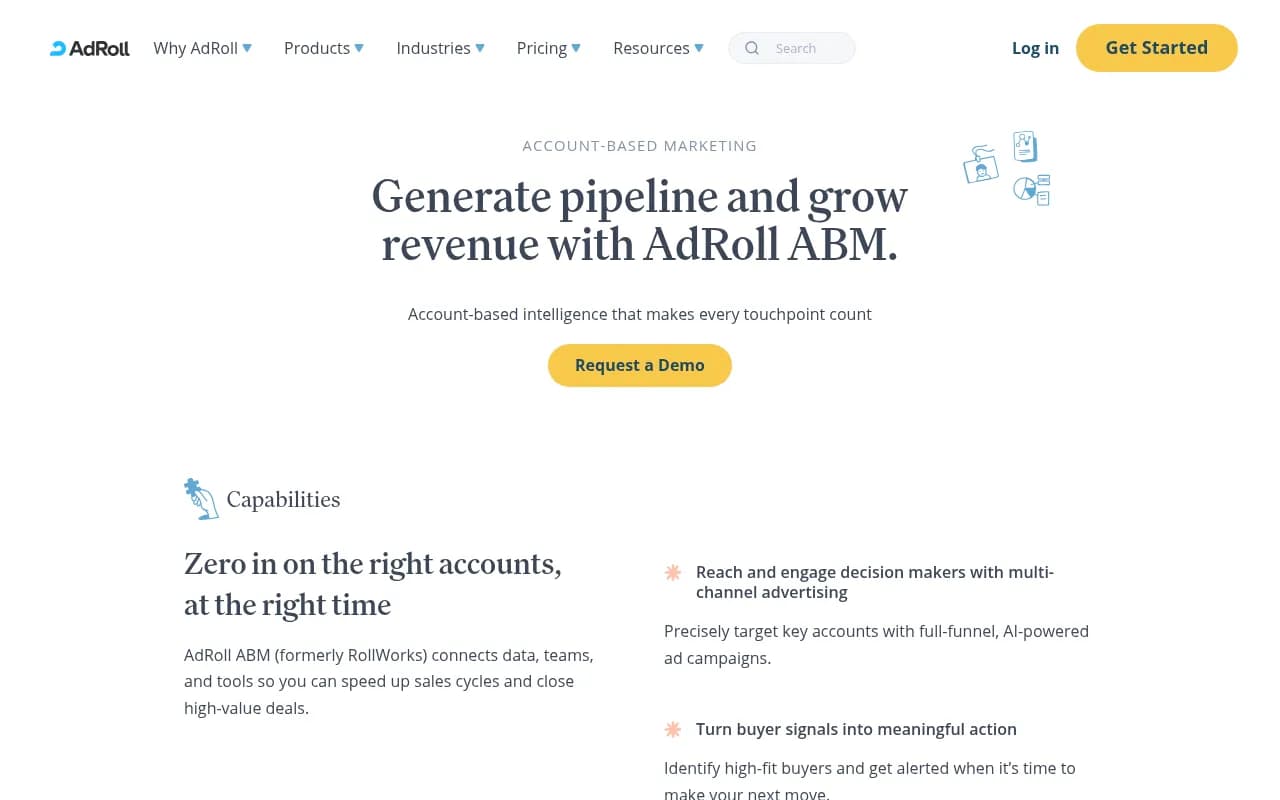
RollWorks is a more accessible ABM platform that uses intent data (partly Bombora-powered) for account targeting. It's a reasonable middle ground between Factors.ai's price point and 6sense's feature depth.
Terminus focuses on multi-channel ABM execution with intent data built in, particularly strong for teams running coordinated email, advertising, and chat campaigns against target account lists.
What to look for when evaluating intent data quality
Before signing any contract, ask these questions:
Where does the data come from? Co-op models (publisher-direct data sharing) are generally more reliable than scraped or modeled data. Ask specifically how the provider collects signals and what the publisher relationships look like.
How is "intent" defined? Some platforms flag any content consumption as intent. Better platforms look for surges -- spikes above an account's baseline activity -- which filters out noise. Understand what threshold triggers an intent signal.
What's the topic taxonomy? Bombora has thousands of intent topics. Some competitors have hundreds. More topics means more precise targeting, but also more complexity in setup. Make sure the topics map to your actual buyer's research behavior.
How fresh is the data? Intent signals decay fast. An account that was surging on "marketing automation" three weeks ago may have already made a decision. Weekly or bi-weekly data refreshes are the minimum; daily is better.
How does it integrate with your stack? Intent data is only useful if it flows into the tools your sales and marketing teams actually use. Check native integrations with your CRM, MAP, and ad platforms before committing.
The bottom line
Intent data has moved from a nice-to-have to a core part of B2B go-to-market strategy. But the category is genuinely fragmented -- Bombora is data infrastructure, 6sense and Demandbase are full platforms, and Factors.ai is focused on attribution and ad performance.
The mistake most teams make is buying the most impressive demo rather than the tool that fits their actual workflow. A mid-market team with a two-person marketing function doesn't need 6sense's predictive AI -- they need something that tells them which accounts to focus on and connects that to their LinkedIn spend. Conversely, an enterprise team running coordinated ABM across 500 target accounts needs the orchestration layer that only 6sense or Demandbase can provide.
Start with the question: what decision do I need to make with this data? The answer will point you to the right platform faster than any feature comparison.