Key takeaways
- Frase wins on SERP research depth and content brief quality -- it's the faster path from keyword to structured brief.
- Scalenut bundles more into one dashboard: AI writing, SEO scoring, a humanizer, and GEO tracking, all at the same entry price.
- Both tools start at $39/month (annual billing), so price alone won't make the decision for you.
- Frase offers a 7-day free trial with no credit card required; Scalenut requires a card upfront.
- Neither tool tracks how your content performs in AI search engines like ChatGPT or Perplexity -- that's a separate problem requiring a different category of tool.
Two tools keep coming up whenever SEO teams debate AI content platforms: Frase and Scalenut. Both sit in the same price range, both claim to speed up content production, and both have genuine fans in the SEO community. But they're built around different philosophies, and picking the wrong one will slow you down rather than help.
This guide breaks down the real differences -- not the marketing copy, but the actual workflows, feature gaps, and scenarios where one clearly beats the other.
What each tool is actually built for
Before comparing features side by side, it helps to understand the core design philosophy behind each platform.
Frase
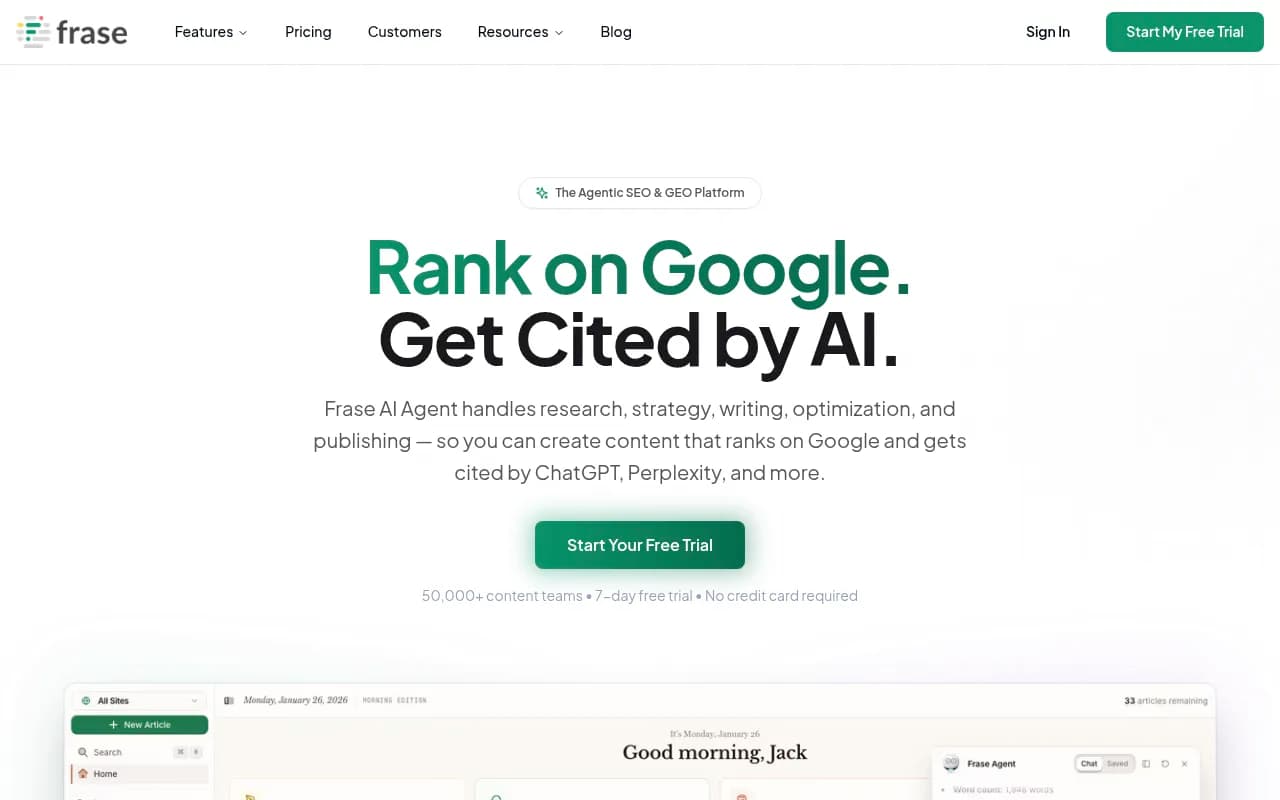
Frase is fundamentally a research and briefing tool that grew an AI writer on top. The product is organized around a single workflow: you enter a keyword, Frase pulls the top-ranking pages from Google, analyzes what they cover, and builds you a structured content brief. The AI writer then helps you draft content against that brief, with a content score that tracks how well you're covering the topic.
That SERP-first approach is Frase's biggest strength. If your bottleneck is the research phase -- figuring out what to write, what questions to answer, what structure to use -- Frase cuts that from 30-60 minutes of manual work to roughly 2 minutes. Teams at companies like Oracle, Coursera, and GitLab have used it at scale, which tells you it holds up under production volume.
Scalenut
Scalenut takes a broader approach. It's trying to be the one dashboard where you do keyword research, content planning, AI writing, SEO optimization, and humanization. The "Cruise Mode" feature is the headline: you enter a keyword, answer a few questions, and get a full draft with an SEO score in a few minutes.
What separates Scalenut from most competitors at its price point is the AI humanizer. It detects AI-generated patterns in your content and rewrites them to read more naturally -- a feature that Frase doesn't offer at all, and that Surfer SEO locks behind its $175/month tier. Scalenut also includes GEO tracking features, which is increasingly relevant as teams start thinking about visibility in AI-generated answers.

Feature comparison
| Feature | Frase | Scalenut |
|---|---|---|
| SERP research & analysis | Excellent | Good |
| Content brief generation | Excellent | Good |
| AI article writer | Good | Good |
| Content/SEO scoring | Good | Good |
| AI humanizer | No | Yes |
| GEO tracking | No | Basic |
| Keyword research | Basic | Good |
| Content planning / topic clusters | Limited | Yes |
| Free trial | 7 days, no card | Card required |
| Entry price (annual) | $39/mo | $39/mo |
| Best-known enterprise clients | Oracle, Coursera, GitLab | Smaller brands |
SERP research and content briefs
This is where Frase has a clear lead. When you run a keyword through Frase, you get a breakdown of the top-ranking pages: their word counts, headings, questions they answer, and topics they cover. The brief builder pulls all of this into a structured outline you can edit before writing.
The practical benefit is that you're not guessing what Google wants to see. You're looking at what's already ranking and building toward that standard. For content teams that produce a lot of articles -- say, 10 to 40 per month -- this research automation is genuinely valuable. It's the kind of work that burns hours when done manually.
Scalenut does SERP analysis too, but it's less granular. The briefs it generates are solid, but they don't give you the same depth of competitor breakdown. If your writers need detailed research to work from, Frase's briefs are more useful as standalone documents.
AI writing quality
Both tools produce serviceable first drafts. Neither will give you publish-ready copy without editing -- that's true of every AI writer in 2026, regardless of what the marketing says.
Scalenut's Cruise Mode is faster for getting a full draft. You go from keyword to complete article in a few minutes, with the SEO score updating as you write. The workflow is designed for speed, which suits teams that need volume.
Frase's writer is more integrated with the research layer. As you write, you can pull in statistics, quotes, and headings from the competitor analysis panel without switching tabs. That's useful when accuracy matters -- you're writing with sources visible, not from a blank context.
Neither tool solves the fundamental problem that AI-generated content often sounds like AI-generated content. Scalenut's humanizer helps with this. Frase doesn't address it at all, so you'd need a separate tool like Grammarly or a manual editing pass.
Pricing breakdown
Both tools start at $39/month on annual billing, which makes them the most affordable entry points in the AI SEO content space. (Surfer SEO, the other major competitor, starts at $79/month.)
| Plan | Frase | Scalenut |
|---|---|---|
| Entry (annual) | $39/mo | $39/mo |
| Mid-tier | $115/mo | $79/mo |
| Team/Agency | $149/mo | $149/mo |
| Free trial | 7 days, no card | Card required |
The pricing tiers are broadly similar, but the free trial situation is worth noting. Frase's no-credit-card trial is genuinely low-friction -- you can evaluate the product without committing. Scalenut requires a card upfront, which is a minor but real barrier if you're comparing multiple tools at once.
The humanizer question
This is the feature that most comparisons gloss over, but it matters more than it used to.
Google's ability to detect AI-generated content has improved, and many SEO teams now run a humanization pass on AI drafts before publishing. Scalenut's built-in Detect and Humanize feature handles this inside the same workflow. You write, score, humanize, and publish without leaving the platform.
Frase has no equivalent. If you're using Frase, you're exporting your draft and running it through a separate tool, which adds friction and cost. For teams that care about this -- and increasingly, most do -- Scalenut's all-in-one approach saves a step.
GEO and AI search visibility
This is where both tools have a gap worth acknowledging.
Scalenut includes some GEO tracking features, which is more than Frase offers. But "some GEO tracking" is not the same as actually understanding how your content performs in AI search engines. Neither tool tells you whether ChatGPT, Perplexity, or Google AI Overviews are citing your pages, which prompts are driving AI visibility, or what content gaps are costing you citations.
That's a separate category of tool entirely. If your team is starting to think about AI search visibility -- not just Google rankings -- you'll need something purpose-built for that. Promptwatch is the platform built specifically for this: it tracks citations across 10 AI models, identifies which prompts your competitors are visible for that you're not, and generates content to close those gaps.

The point isn't that Frase or Scalenut are failing -- they're SEO content tools, not GEO platforms. But if AI search visibility is on your roadmap, don't expect either of these tools to cover it.
Integrations and workflow fit
Frase integrates with Google Search Console, which lets you pull in your existing keyword data and see which pages are underperforming. It also has a WordPress plugin for publishing directly from the editor. For teams already in the Google ecosystem, this is a smooth connection.
Scalenut integrates with WordPress and has API access on higher tiers. It's less tightly connected to Google's data, but the broader feature set means you're doing more inside the platform anyway.
Both tools work well as standalone writing environments. Neither has deep integrations with project management tools or CMS platforms beyond WordPress, so if you're running a complex content operation with multiple stakeholders, you'll still need a separate workflow layer.
Who should use Frase
Frase makes the most sense for:
- Content marketing teams where research quality is the bottleneck
- Writers who need detailed briefs to work from, not just a topic
- Teams producing 10-40 articles per month who want to cut research time
- Anyone who wants to evaluate a tool before paying (the free trial is genuinely useful)
It's less suited for solo creators who want everything in one place, or teams that need AI humanization built in.
Who should use Scalenut
Scalenut makes the most sense for:
- Solo creators, freelancers, or small teams who want one dashboard for everything
- Teams that publish AI-generated content and need humanization built into the workflow
- Anyone who wants keyword research, content planning, and writing in one place
- Teams starting to think about GEO alongside traditional SEO
It's less suited for teams where brief quality is the primary concern, or where writers need deep competitor research to do their best work.
Other tools worth knowing
If neither Frase nor Scalenut fits your exact needs, a few other platforms are worth considering:
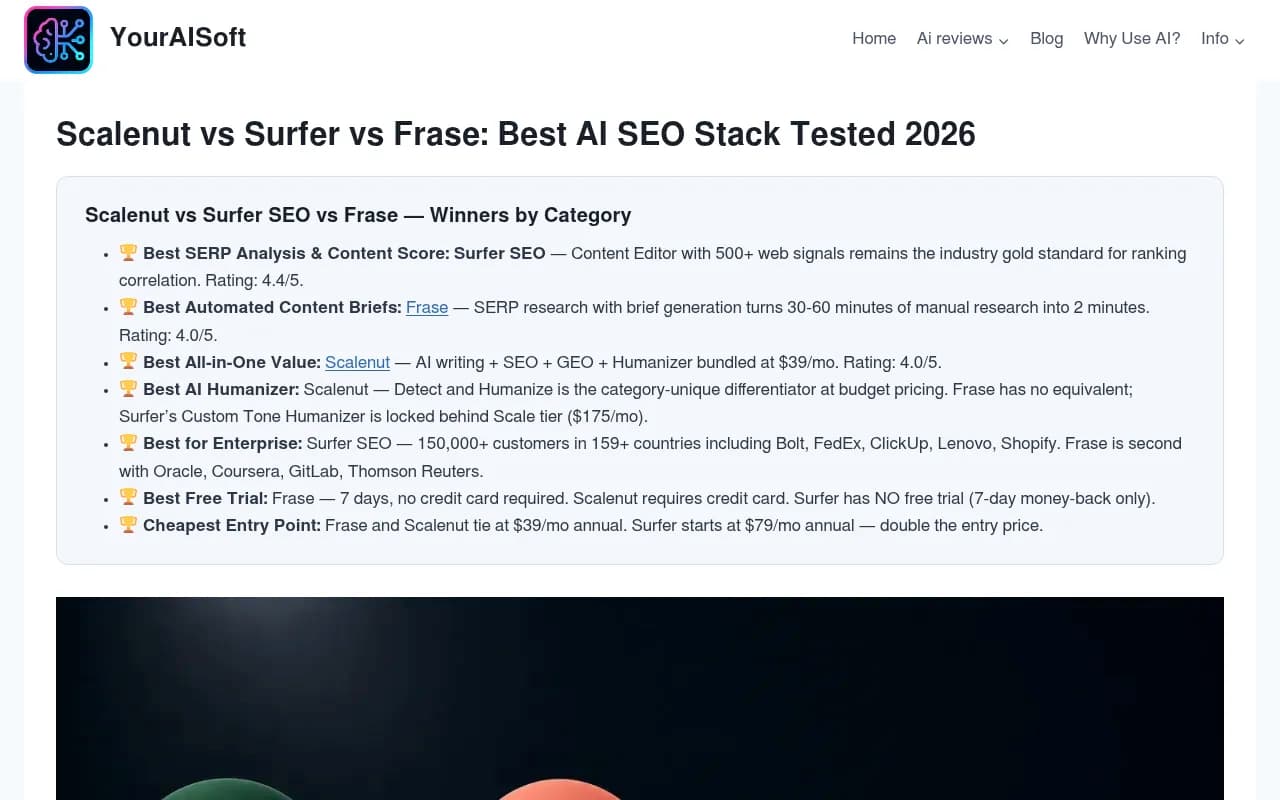
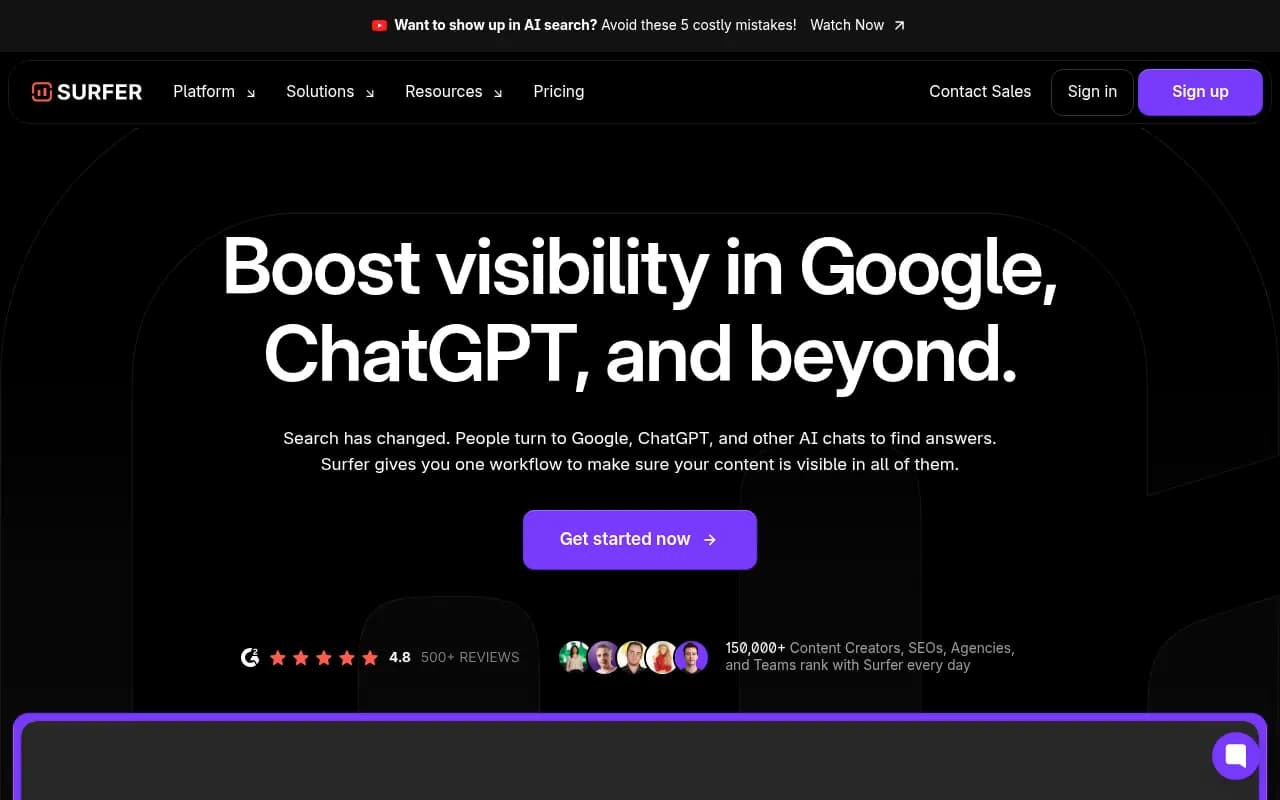
Surfer SEO is the third major player in this space. It has the most sophisticated content scoring (500+ web signals) and is the choice for agencies with strict ranking KPIs. It starts at $79/month, double the entry price of Frase and Scalenut.
Clearscope is a strong option for enterprise content teams that prioritize content grading and editor simplicity. It's more expensive but has a clean workflow that non-SEO writers can use without training.

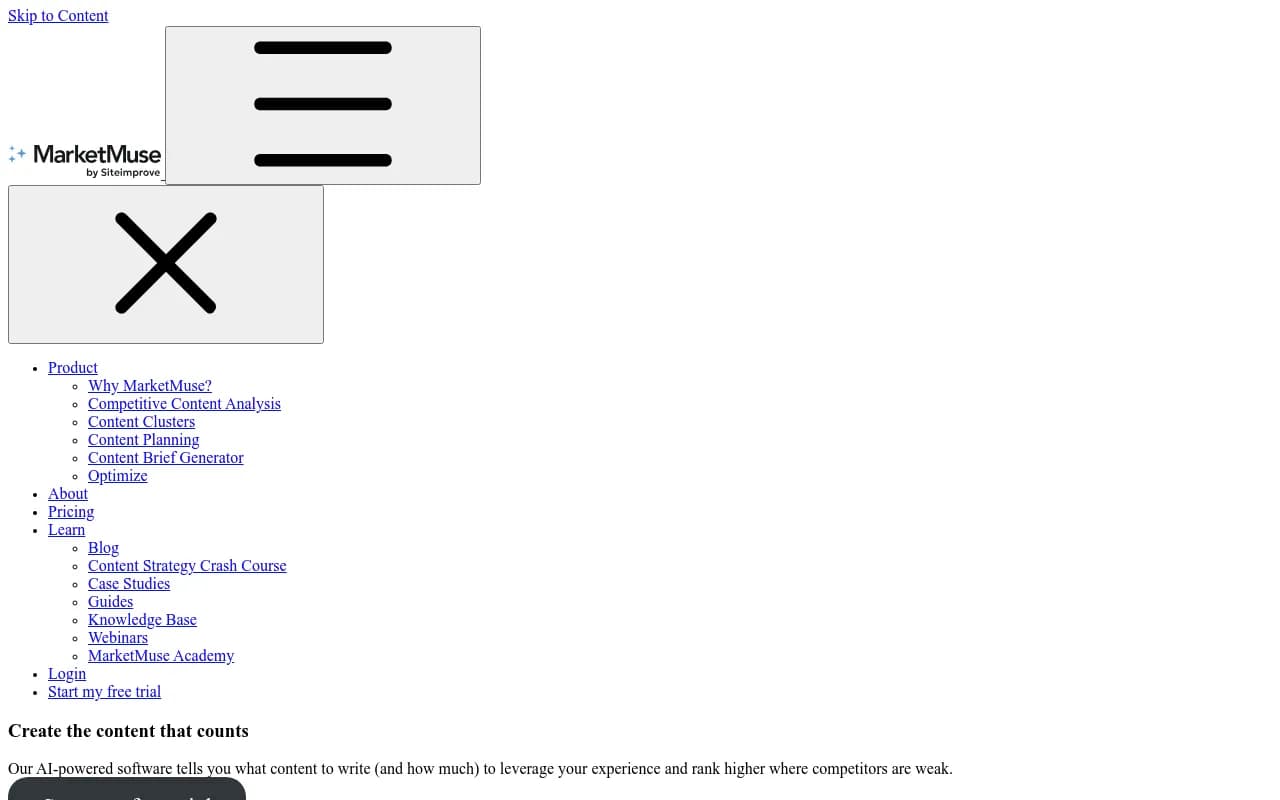
MarketMuse goes deeper on content strategy and topical authority mapping. It's built for teams that think in content programs, not individual articles.
SE Ranking offers content optimization as part of a broader SEO platform, which suits teams that want rank tracking, site audits, and content tools in one subscription.
The bottom line
Frase and Scalenut are genuinely useful tools that solve real problems. They're not interchangeable.
If your team's biggest time sink is research -- understanding what to write, what competitors cover, what structure works -- Frase is the better tool. The brief quality is higher, the SERP analysis is deeper, and the free trial makes it easy to verify that before spending anything.
If you want one platform that handles more of the content workflow, including humanization and basic GEO awareness, Scalenut's all-in-one approach is worth the trade-off in brief depth.
What neither tool does is tell you how your content performs once it's published in AI search. That's a growing concern for SEO teams in 2026, and it requires a different kind of platform to address.