Demandbase One Review 2026
Target and engage B2B accounts with personalized campaigns. Combines advertising, ABM, and sales intelligence in one unified platform.
Key Takeaways:
• Best for enterprise B2B teams running account-based go-to-market strategies -- particularly those managing complex buying committees and multi-stakeholder deals • Core strength: Buying group identification and orchestration across the full GTM stack (advertising, web personalization, sales outreach, CRM) from a single platform • Standout capability: Agentbase AI agents that automate account research, prioritization, and personalized outreach based on real-time intent signals • Pricing: Custom enterprise pricing only (typically $18K-$300K+/year) -- not suitable for small teams or startups • Limitations: Steep learning curve, requires dedicated resources to implement and manage, overkill for companies with simple sales cycles
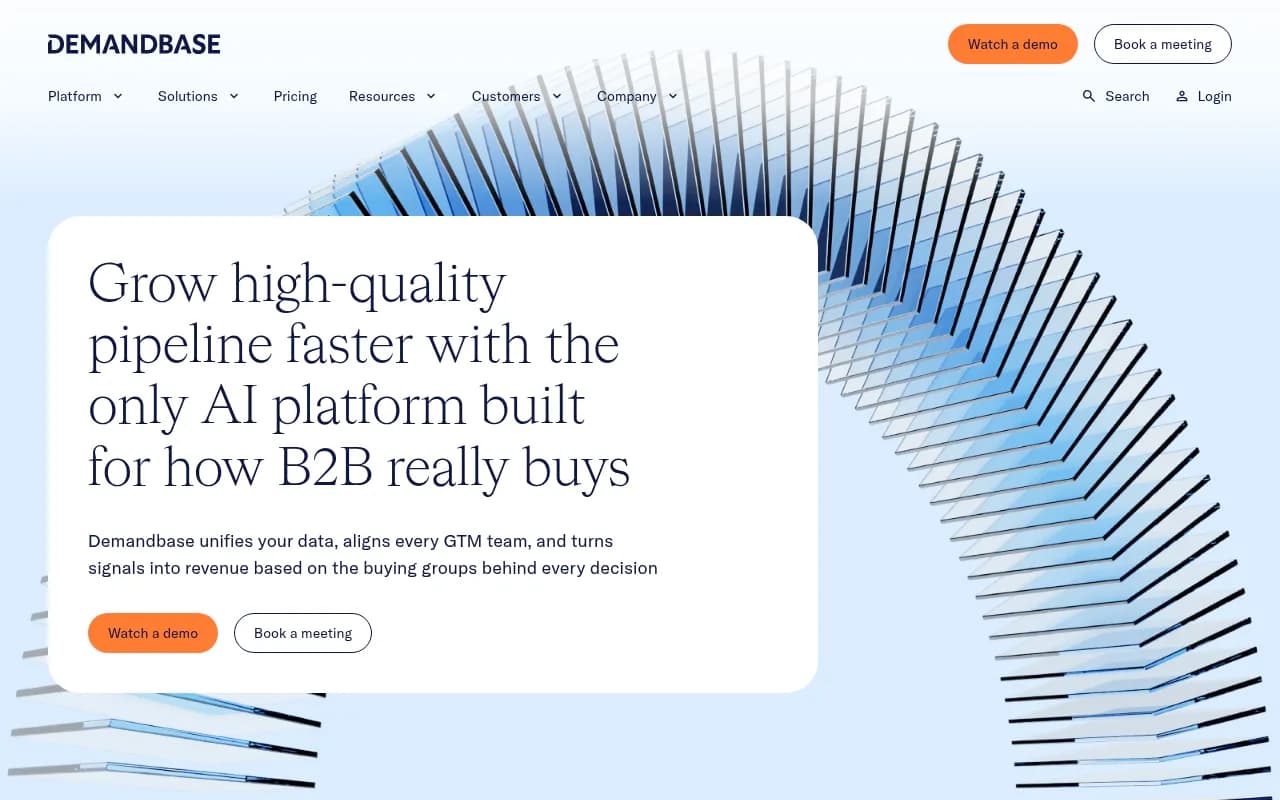
Demandbase One is an enterprise account-based marketing (ABM) and sales intelligence platform built specifically for how B2B companies actually buy -- through buying groups, not individual contacts. Founded in 2006 and headquartered in San Francisco, Demandbase pioneered the ABM category and has evolved into what they call a "Pipeline AI platform" that unifies data, insights, and automated actions across marketing, sales, and customer success teams. The platform is used by over 1,000 enterprise customers including Adobe, IBM, Salesforce, SAP Concur, Thermo Fisher Scientific, and Gong.
The core problem Demandbase solves: B2B purchases involve 6-10 stakeholders on average, but most GTM tools treat accounts as collections of individual leads rather than coordinated buying groups. Sales and marketing teams end up with fragmented data, misaligned outreach, and no clear view of which accounts are actually in-market. Demandbase addresses this by identifying entire buying groups within target accounts, tracking their collective intent signals, and orchestrating personalized engagement across every channel -- advertising, web, email, sales outreach -- based on where each buying group sits in their journey.
Buying Group Intelligence: The platform's flagship capability is identifying and tracking buying groups -- the specific people within an account who collectively make purchase decisions. Demandbase uses AI to analyze first-party data (CRM, marketing automation, web activity, email/calendar data) combined with third-party intent signals to map out who's involved in each deal, what roles they play (economic buyer, technical evaluator, champion, etc.), and what stage they're at. This goes beyond basic contact discovery -- it shows you the relationships between stakeholders, which topics each person cares about, and how engaged the group is as a whole. You can then build campaigns that target the entire buying group with role-specific messaging rather than blasting generic content to whoever downloaded a whitepaper.
Agentbase AI Agents: Launched in 2024, Agentbase is Demandbase's answer to the "what do I do with all this data" problem. These are autonomous AI agents that take action on your behalf -- researching accounts, prioritizing outreach, drafting personalized emails, updating CRM records, and triggering plays based on intent signals. For example, when a buying group shows high intent (multiple stakeholders visiting pricing pages, engaging with competitive content, attending webinars), an agent can automatically enrich the account record, alert the sales rep, generate a personalized outreach sequence, and launch targeted ads -- all without manual intervention. The agents are trained on 20+ years of B2B buying behavior data and can be customized with your own playbooks and rules. This is a major differentiator vs competitors like 6sense or ZoomInfo, which provide data and insights but leave the "now what" to you.
Account Intelligence & Intent Data: Demandbase aggregates intent signals from multiple sources -- website activity, content engagement, ad interactions, third-party intent topics (what accounts are researching across the web), technographic data (what tools they use), and firmographic data (company size, industry, revenue). The platform scores accounts based on fit (do they match your ICP?) and engagement (are they showing buying signals?). You get a unified account view that shows which buying group members are active, what topics they're researching, how they compare to other in-market accounts, and predicted likelihood to buy. The intent data includes both keyword-based topics ("marketing automation," "CRM integration") and behavioral signals (pricing page visits, demo requests, competitor research). Demandbase claims to track intent across 4 billion business interactions monthly.
Advertising & Personalization: Built-in advertising capabilities let you run display, video, and social ads targeted at specific accounts and buying groups across LinkedIn, programmatic networks, and connected TV. You can suppress existing customers, target only accounts showing intent, or build custom audiences based on buying stage. The platform also includes web personalization -- dynamically changing your website content, CTAs, and messaging based on which account is visiting and what stage their buying group is at. For example, early-stage accounts might see educational content while late-stage accounts see case studies and pricing. This is all managed from the same platform as your email campaigns and sales outreach, so messaging stays consistent.
Sales Intelligence & Orchestration: For sales teams, Demandbase provides account prioritization (which accounts to focus on today), buying group insights (who to reach out to and why), and automated plays (trigger sequences when accounts hit certain thresholds). The platform integrates with Salesforce, HubSpot, Outreach, Salesloft, and other sales tools to surface insights directly in the tools reps already use. Sales reps get alerts when key accounts show intent spikes, new stakeholders join buying groups, or competitors are being researched. The platform also includes conversation intelligence features (analyzing sales calls and emails for buying signals) and account-based analytics that show pipeline velocity, deal progression, and revenue attribution by account.
Data Foundation & Integrations: Demandbase's data layer ingests first-party data from your CRM, marketing automation platform (Marketo, Eloqua, HubSpot, Pardot), web analytics, chat tools, and sales engagement platforms. It enriches this with third-party data -- account identification (which companies are visiting your site), contact data, firmographics, technographics, and intent signals. The platform uses AI to resolve identities across devices and channels, de-duplicate records, and build a single source of truth for each account. Integrations include Salesforce, Microsoft Dynamics, HubSpot, Marketo, Eloqua, Pardot, Outreach, Salesloft, Gong, Drift, 6sense, LinkedIn, Google Ads, and 100+ other tools via API. You can push Demandbase data into your existing tools or pull data from those tools into Demandbase.
Analytics & Reporting: The platform includes dashboards for tracking account engagement, buying group progression, campaign performance, pipeline generation, and revenue attribution. You can see which accounts are moving through stages, which campaigns are driving engagement, and how marketing activities correlate with closed deals. Attribution models include first-touch, multi-touch, and account-based attribution that credits the entire buying group journey rather than individual lead conversions. Reporting can be customized by team (marketing, sales, customer success) and exported to BI tools like Tableau, Looker, or Power BI.
Who Is It For
Demandbase is built for mid-market to enterprise B2B companies with complex sales cycles and multi-stakeholder buying processes. The ideal customer is a company selling software, technology, professional services, or high-value B2B products where deals involve 5+ decision-makers and sales cycles run 3-12+ months. Think SaaS companies selling to IT and marketing departments, cybersecurity vendors, enterprise software providers, consulting firms, and B2B manufacturers.
Team size: Best suited for organizations with dedicated ABM, demand gen, or revenue operations teams -- typically 50+ employees with at least 5-10 people in marketing and sales combined. You need resources to implement the platform, build campaigns, and act on the insights. Smaller teams (under 20 people) will struggle to justify the cost and complexity.
Company stage: Growth-stage companies ($10M+ revenue) through large enterprises. Startups and early-stage companies should look at simpler, lower-cost alternatives like HubSpot ABM tools or Clearbit. Demandbase makes sense once you have a defined ICP, a target account list of 500+ companies, and the budget to run coordinated ABM programs.
Industries: Particularly strong in technology, software, cybersecurity, financial services, healthcare IT, and manufacturing. Any industry where buying decisions involve committees and long evaluation cycles.
Who should NOT use Demandbase: Small businesses, B2C companies, transactional B2B businesses with short sales cycles (under 30 days), or companies selling low-ticket products (under $10K ACV). If your sales process is primarily inbound-driven with individual buyers making quick decisions, you don't need buying group orchestration. Also avoid if you lack the internal resources to manage an enterprise ABM platform -- implementation takes 2-3 months and ongoing management requires dedicated headcount.
Integrations & Ecosystem
Demandbase integrates with 100+ tools across the B2B tech stack. Key integrations include Salesforce (bi-directional sync of account data, activities, and insights), Microsoft Dynamics 365, HubSpot CRM, Marketo (campaign orchestration, lead scoring, account-based nurture), Eloqua, Pardot, HubSpot Marketing Hub, Outreach (sales engagement, automated plays), Salesloft, Gong (conversation intelligence), Drift (chat and conversational marketing), 6sense (complementary intent data), LinkedIn Campaign Manager, Google Ads, Facebook Ads, Snowflake (data warehouse integration), Segment (customer data platform), Zapier (workflow automation), and Slack (alerts and notifications).
The platform offers a REST API for custom integrations and data exports. Developer documentation is available for building custom workflows, pulling data into BI tools, or pushing Demandbase insights into proprietary systems. There's also a Chrome extension for sales reps to see account insights while browsing LinkedIn or company websites.
Demandbase has a partner ecosystem including implementation partners (agencies and consultants who help with setup and strategy), technology partners (complementary tools like Gong, Drift, and 6sense), and data partners (third-party intent and firmographic data providers).
Pricing & Value
Demandbase does not publish pricing publicly -- all pricing is custom and quote-based. Based on third-party research and user reports, typical pricing ranges from $18,000 to $300,000+ per year depending on the number of accounts you're targeting, which modules you use (advertising, sales intelligence, web personalization), and the size of your team. Most mid-market customers report spending $50K-$150K annually, while enterprise customers with large account lists and full-platform usage can exceed $300K.
Pricing is typically structured around the number of target accounts (e.g., 500 accounts, 2,000 accounts, 10,000+ accounts) and which products you license (Demandbase One includes multiple modules -- ABM/Advertising, Sales Intelligence, Data, and Analytics). There are no public free trials, but Demandbase offers demos and proof-of-concept engagements for qualified prospects.
Compared to competitors: 6sense pricing is similarly opaque and enterprise-focused ($50K-$200K+ range). ZoomInfo is more transparent with published pricing starting around $15K/year but focuses more on contact data than ABM orchestration. HubSpot's ABM tools are included in Marketing Hub Enterprise ($3,600/year for 3 users) but lack the depth of buying group intelligence and AI automation. Terminus (now part of Anteriad) is more affordable ($20K-$60K range) but has fewer features.
Value assessment: For enterprise teams running sophisticated ABM programs, Demandbase delivers strong ROI -- customers report 50-83% increases in pipeline velocity, 3x conversion rate improvements, and 50%+ growth in average deal size. However, you need the budget, resources, and deal sizes to justify the investment. If your average deal is under $50K, the math gets harder. For companies with $100K+ ACV and complex buying committees, the platform pays for itself by accelerating deals and improving win rates.
Strengths & Limitations
Strengths: • Buying group focus: The only ABM platform that truly centers on buying groups rather than individual leads -- this is a fundamental shift in how B2B GTM works and Demandbase executes it better than anyone • AI automation: Agentbase agents actually take action (research, outreach, campaign orchestration) rather than just surfacing insights -- this is a major time-saver for stretched teams • Unified platform: Advertising, web personalization, sales intelligence, and analytics in one system -- no need to stitch together 5 different tools • Data quality: 20+ years of B2B data and intent signals from 4 billion monthly interactions -- the data foundation is deeper than most competitors • Enterprise-grade: Built for scale with robust integrations, APIs, and support for large, complex organizations
Limitations: • Pricing opacity: No public pricing makes it hard to evaluate fit before investing time in sales conversations -- this is frustrating for buyers • Steep learning curve: The platform is powerful but complex -- expect 2-3 months to implement and ongoing training for teams to use it effectively • Overkill for smaller teams: If you have fewer than 500 target accounts or a small GTM team, you won't use 80% of the features -- better to start with simpler tools • Intent data accuracy: Like all intent data providers, signals can be noisy -- you'll see false positives (accounts showing intent but not actually buying) and need to layer in human judgment • Limited self-service: Most features require working with Demandbase support or professional services to configure -- not a DIY platform
Bottom Line
Demandbase One is the most comprehensive ABM platform for enterprise B2B teams that need to orchestrate complex, multi-stakeholder sales cycles. If you're selling to buying committees, managing 1,000+ target accounts, and have the budget and resources to run sophisticated ABM programs, Demandbase delivers unmatched buying group intelligence and AI-powered automation. The platform excels at unifying data across your GTM stack, identifying who's in-market, and orchestrating personalized engagement at scale. However, the high cost, complexity, and enterprise focus make it a poor fit for startups, small teams, or companies with simple sales motions. For mid-market and enterprise B2B companies with $100K+ ACV and dedicated ABM teams, Demandbase is the gold standard.
Best use case in one sentence: Enterprise B2B companies with complex buying committees and long sales cycles that need to identify, engage, and convert entire buying groups with AI-powered orchestration across advertising, web, and sales channels.
Tags:
Similar and alternative tools to Demandbase One