Bombora Review 2026
Intent data provider that aggregates buying signals from 5,000+ B2B websites. Helps sales and marketing teams identify companies actively researching their solutions.
Key takeaways
- Bombora is the most established B2B intent data provider on the market, with a co-op model that gives it exclusive access to 86% of its data sources -- a genuine competitive moat
- Company Surge is the flagship product: it scores companies by topic-level research activity across 18,000+ intent topics, helping sales and marketing teams prioritize outreach
- Pricing is enterprise-grade and opaque -- expect $50,000-$100,000+/year, which puts it out of reach for most SMBs and early-stage companies
- Works best as a data layer feeding into existing platforms (Salesforce, HubSpot, LinkedIn, programmatic DSPs) rather than a standalone tool
- The co-op model is both its biggest strength and its biggest limitation: coverage is excellent for established B2B verticals but can be thin for niche or emerging markets
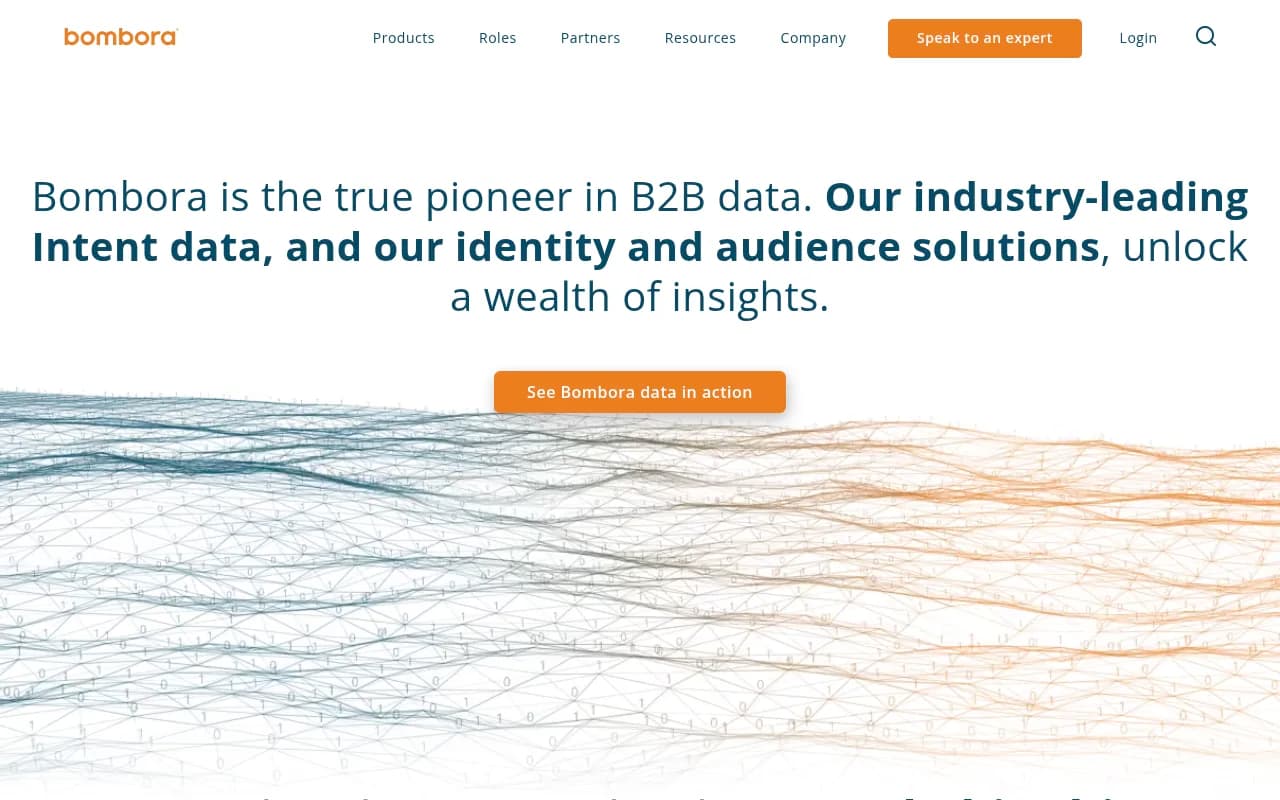
Bombora has been around since 2014, founded by Erik Matlick and Mike Burton, two veterans of the B2B media world. The core idea was simple but genuinely clever: instead of scraping the web or relying on a single publisher's data, Bombora built a cooperative of B2B publishers who pool their audience data. Members of the co-op share their first-party data in exchange for access to the aggregated intelligence. The result is a dataset that, by Bombora's own count, covers billions of content consumption events every month across thousands of trusted B2B sources.
The company positions itself as a data provider, not a platform -- and that distinction matters. You won't find a slick self-serve dashboard where you log in and start prospecting. Bombora's data flows into the tools your team already uses: your CRM, your marketing automation platform, your DSP, your ABM tool. That's either a feature or a frustration depending on how you look at it.
The target audience is squarely enterprise B2B: revenue operations teams at mid-market and large companies, demand generation marketers running ABM programs, and sales teams trying to prioritize outreach across large account lists. FedEx, Box, JLL, and TriNet are among the named customers on the site, which gives you a sense of the company tier Bombora is built for.
Key features
Company Surge Intent Data
This is the product Bombora is known for. Company Surge scores companies on a scale of 0-100 for any given topic, based on how much their employees are consuming content about that topic relative to their historical baseline. A score of 60+ typically indicates meaningful research activity. The key insight is that it's not just about volume -- it's about the change in volume. A company that suddenly starts reading a lot about "cloud security" is more interesting than one that always reads about it.
The topic library covers 18,000+ intent topics, which is genuinely broad. You can track research activity around your product category, competitor names, specific technologies, regulatory topics, or industry trends. The data refreshes weekly, so you're working with reasonably current signals rather than stale historical data.
Data Co-op model
The co-op is what makes Bombora different from competitors like TechTarget or G2 Buyer Intent, which rely on their own owned-and-operated properties. Bombora's co-op includes thousands of B2B publishers, brand sites, and premium data providers. Critically, 86% of the data in the co-op is shared exclusively with Bombora for intent derivation purposes -- meaning competitors can't simply replicate the dataset by licensing the same sources.
The co-op added 1,743 new B2B sources in 2024 alone, which suggests active investment in expanding coverage. The breadth matters because intent signals are only meaningful if they capture research happening across the full web, not just a handful of sites.
Identity resolution and enrichment
Beyond intent, Bombora offers identity resolution capabilities that let you identify and enrich anonymous website visitors. This is useful for connecting your first-party data (who's visiting your site) with third-party intent signals (what they're researching elsewhere). The enrichment layer can append firmographic data, technographic data, and contact information to anonymous visitor records.
This capability is increasingly important as third-party cookies continue to fade. Bombora's co-op members share data in a privacy-compliant way, and the company has invested in cookieless identity approaches.
B2B digital audiences
Bombora lets you activate its intent data as audience segments across programmatic advertising platforms. You can build custom audiences based on Company Surge scores, firmographic criteria, or a combination. There are also hundreds of prebuilt segments available for immediate activation.
The practical use case: you identify companies showing high intent for your category, build an audience segment of those companies' employees, and serve them targeted ads on LinkedIn, display networks, or connected TV. This closes the loop between intent intelligence and actual campaign execution.
Insights suite
The Insights suite is Bombora's analytics layer, covering campaign measurement, buyer journey mapping, and competitive intelligence. You can see how your target accounts are progressing through research phases, understand which topics are trending in your market, and measure the impact of your campaigns on account engagement.
The competitive intelligence angle is interesting -- you can track which topics your competitors' customers are researching, which can inform product positioning and content strategy.
Personalization signals
Bombora's data can feed personalization engines for websites, chatbots, and sales outreach. If you know a visiting company has been heavily researching "data governance" for the past three weeks, you can surface relevant content, adjust your chatbot's opening message, or arm your SDR with a more targeted pitch. This requires integration with a personalization platform or CRM, but the signal quality is there.
Predictive modeling support
For teams with data science resources, Bombora's intent data can be used as a feature in predictive models for lead scoring, churn prediction, and TAM analysis. The company explicitly supports this use case, which is a sign of how seriously enterprise customers take the data.
Who is it for
The clearest fit is a B2B company with a defined ICP, an existing ABM program, and a sales team that needs help prioritizing outreach across a large account list. Think: a SaaS company selling to enterprise IT buyers, a financial services firm targeting CFOs, or a professional services firm trying to identify companies about to go through a major transition. If you're running a 500-account ABM program and your SDRs are cold-calling in the dark, Bombora's intent data can meaningfully change how they prioritize their time.
Revenue operations teams at companies with $50M+ in revenue are probably the core buyer. These are teams that have already invested in Salesforce or HubSpot, have a marketing automation platform, and are looking for a data layer that makes everything smarter. Bombora slots in as a signal source rather than a replacement for any existing tool.
Agencies running B2B demand generation programs for clients are also a natural fit -- particularly those managing programmatic campaigns where audience quality directly affects CPL. The Hushly case study on Bombora's site (2x cost reduction on LinkedIn ads) is a good example of this use case.
Who should not use Bombora: SMBs, early-stage startups, and companies with small account lists. The pricing alone ($50,000-$100,000+/year) makes it impractical for anyone without a serious marketing budget. Companies in highly niche verticals may also find coverage thin -- the co-op is strongest in established B2B categories like technology, finance, and professional services. And if you don't have the technical infrastructure to integrate an external data feed into your existing stack, you'll struggle to get value from it.
Integrations and ecosystem
Bombora's "we are a data company, not a platform" positioning means integrations are central to how the product works. The data is designed to flow into:
- CRM platforms: Salesforce and HubSpot are the primary integrations, where Company Surge scores can appear as account-level fields and trigger workflows
- Marketing automation: Marketo, Eloqua, and Pardot integrations allow intent data to influence lead scoring and nurture programs
- ABM platforms: 6sense, Demandbase, and Terminus all integrate with Bombora data, and many of these platforms actually resell Bombora's intent as part of their own offering
- Programmatic advertising: The Trade Desk, LiveRamp, and other DSPs can activate Bombora audience segments
- LinkedIn: Bombora has a direct integration with LinkedIn Campaign Manager for audience activation
- Sales engagement: Outreach and Salesloft integrations allow intent signals to surface in sales workflows
The API is available for enterprise customers who want to build custom integrations or incorporate intent data into proprietary models. Onboarding fees ($5,000-$20,000+) typically cover integration setup and training.
There's no mobile app, which makes sense given the data-layer nature of the product. Browser extensions aren't part of the offering either.
Pricing and value
Bombora does not publish pricing on its website, which is standard for enterprise data providers but frustrating for anyone trying to evaluate it. Based on third-party sources, the pricing structure looks roughly like this:
- Enhanced plans: $50,000-$100,000/year
- Full Audience Solutions: $100,000+/year
- Onboarding fees: $5,000-$20,000+ (one-time)
There is no free tier and no self-serve trial. You need to speak to a sales rep to get a quote, and the sales process is typically several weeks.
For context, this puts Bombora at the high end of the intent data market. Competitors like G2 Buyer Intent or TechTarget Priority Engine operate in similar price ranges for comparable enterprise tiers. Newer entrants and alternatives (some starting around $99/month) exist, but they typically offer narrower data coverage or rely on different signal types.
Whether it's good value depends entirely on how well you can activate the data. Companies that have integrated Bombora into a mature ABM program with clear attribution tracking tend to see strong ROI -- the Cloudera case study (50% decrease in CPL) is a real outcome, not a hypothetical. Companies that buy it without a clear activation plan tend to find it expensive and underutilized.
Strengths and limitations
What Bombora does well:
- The co-op model genuinely differentiates the data quality. 86% exclusive data is a real moat, and the breadth of 18,000+ intent topics means you can track research activity at a granular level that competitors can't match
- The ecosystem integrations are mature. Bombora has been around long enough that most major B2B marketing and sales platforms have native connectors, which reduces implementation friction
- Company Surge's baseline-relative scoring is smarter than raw volume counts. A company that suddenly spikes on a topic is more interesting than one that's always been active, and the algorithm accounts for this
- The co-op's privacy-compliant data sharing model is increasingly important as the industry moves away from third-party cookies
Limitations:
- Pricing is a genuine barrier. At $50,000-$100,000+/year, Bombora is inaccessible to most companies outside the enterprise segment. There's no meaningful entry point for smaller teams
- Coverage in niche or emerging verticals can be thin. The co-op is strongest in established B2B categories, and if your buyers are researching in forums, Slack communities, or specialized publications that aren't co-op members, you'll miss those signals
- It's a data layer, not a complete solution. Getting value requires integration work, a clear activation strategy, and the internal resources to act on the signals. Teams without mature RevOps infrastructure often struggle
- The weekly data refresh cadence, while reasonable, means you're not working with real-time signals. For fast-moving sales cycles, this can be a limitation
Bottom line
Bombora is the right choice for enterprise B2B companies with mature ABM programs, existing CRM and marketing automation infrastructure, and the budget to invest in a premium data layer. The co-op model produces genuinely differentiated intent data, and the ecosystem integrations mean it can slot into most existing stacks without major custom development.
The best use case in one sentence: a B2B revenue team with a 500+ account target list that needs to know which accounts to call this week, not next quarter.
Tags:
Frequently asked questions
What is Bombora?
How much does Bombora cost?
What is Company Surge?
How does Bombora's Data Co-op work?
What tools does Bombora integrate with?
Is Bombora suitable for small businesses?
Similar and alternative tools to Bombora