Key takeaways
- Conductor is an enterprise organic marketing platform that added AI visibility features — it's best suited for large teams that already use it for SEO and want GEO data in the same workflow.
- Dedicated GEO platforms like Promptwatch, AthenaHQ, and Profound offer deeper AI search monitoring, more AI engines covered, and (in some cases) content optimization tools that Conductor lacks.
- Conductor's pricing starts at roughly $3,500+/month (enterprise custom), making it overkill for most mid-market teams who just need AI visibility tracking.
- If your primary goal is getting cited by ChatGPT, Perplexity, Claude, and other LLMs — and fixing the gaps — purpose-built GEO platforms will serve you better.
- The biggest differentiator in 2026 is whether a platform helps you act on data, not just collect it.
What Conductor actually does
Conductor has been around since 2010 as an enterprise SEO and content intelligence platform. It's genuinely good at what it was built for: helping large marketing teams manage organic search strategy, content workflows, and revenue attribution from Google. The platform integrates with Google Search Console, Adobe Analytics, and various CMS tools, giving enterprise teams a single place to track organic performance.
The AI visibility angle came later. Conductor added GEO-related features to its existing platform, positioning itself as a bridge between traditional SEO and the new world of AI search. Their 2026 AEO/GEO Benchmarks Report shows they're taking the space seriously. But "taking it seriously" and "being purpose-built for it" are two different things.
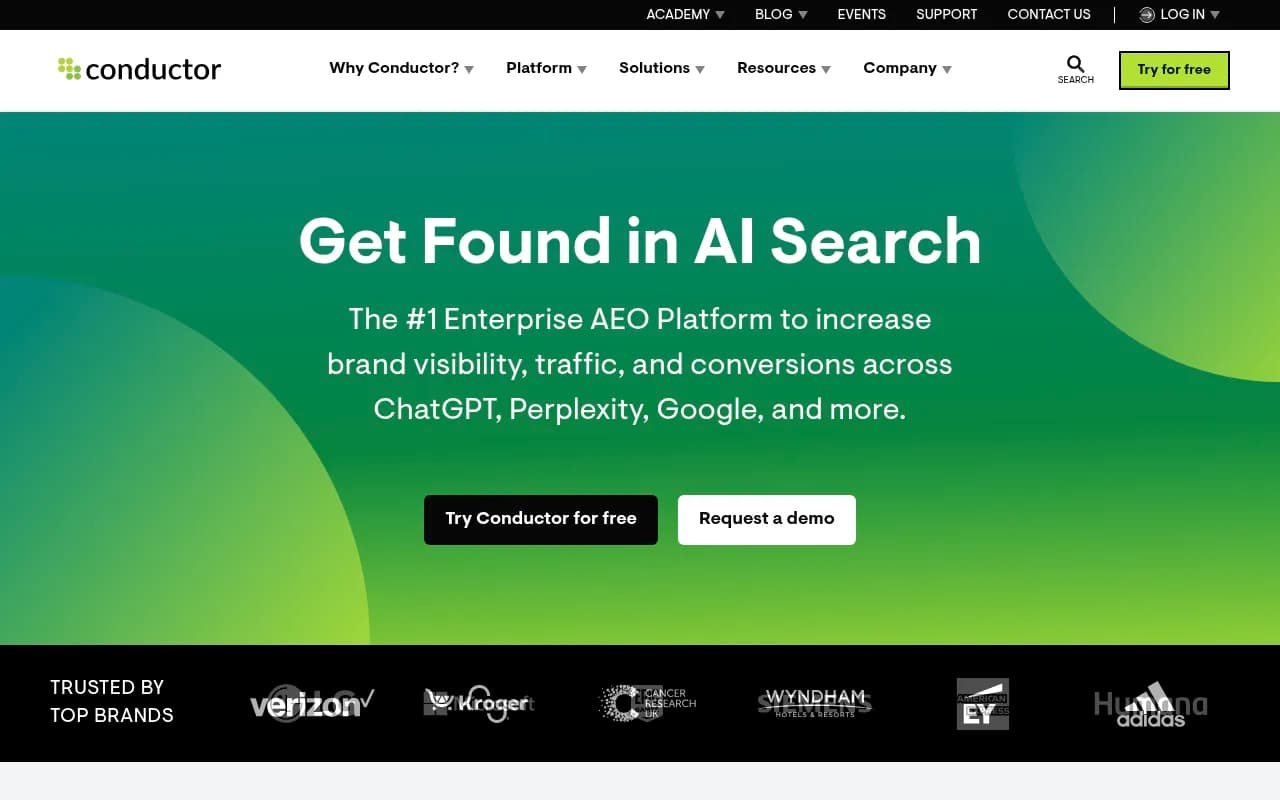
The honest summary: Conductor is a strong choice if you're already an enterprise Conductor customer and want AI visibility data alongside your existing SEO data. It's a harder sell if GEO is your primary need and you're evaluating tools from scratch.
How the GEO platform landscape looks in 2026
The GEO space has exploded. Two years ago, there were maybe five tools worth mentioning. Now there are dozens, ranging from lightweight mention checkers to full-stack optimization platforms. The meaningful divide isn't between "good" and "bad" tools — it's between tools that monitor and tools that help you fix what they find.
Most platforms stop at monitoring. They'll show you a dashboard of how often your brand appears in ChatGPT or Perplexity responses, maybe a sentiment score, maybe a competitor comparison. That's useful, but it leaves you staring at a gap with no clear path to closing it.
A smaller group of platforms — and this is where the real differentiation lives in 2026 — go further. They tell you which prompts competitors are winning that you're not, generate content designed to earn AI citations, and track whether that content actually moved the needle.
Conductor vs the top GEO alternatives: feature comparison
Here's how Conductor stacks up against the leading platforms across the dimensions that matter most for GEO work:
| Platform | AI engines monitored | Content generation | Answer gap analysis | Crawler logs | Pricing |
|---|---|---|---|---|---|
| Conductor | Limited (primarily Google-focused) | Content workflow tools (not GEO-specific) | No | No | $3,500+/mo (enterprise) |
| Promptwatch | 10 (ChatGPT, Claude, Perplexity, Gemini, Grok, DeepSeek, Copilot, Meta AI, Google AI Overviews, Google AI Mode) | Yes — AI writing agent grounded in citation data | Yes | Yes | From $99/mo |
| AthenaHQ | Multiple LLMs | No | Limited | No | Custom |
| Profound | 9+ AI engines | No | Limited | No | Custom (enterprise) |
| Semrush | Google AI Overviews + some LLMs | ContentShake AI | No | No | From $139/mo |
| BrightEdge | Multiple (entity-level analytics) | No automated GEO generation | No | No | Enterprise custom |
| Otterly.AI | ChatGPT, Perplexity, Google AI Overviews | No | No | No | From ~$49/mo |
| Peec.ai | ChatGPT, Perplexity, Claude | No | No | No | From ~$49/mo |
A few things stand out from this table. Conductor's AI engine coverage is the weakest of the group — it was built around Google, and that heritage shows. Platforms like Promptwatch and Profound cover 9-10 AI engines by design, because they were built specifically for the LLM era.

Conductor's strengths (where it genuinely wins)
Enterprise content workflows
If you have a 20-person content team that needs structured brief creation, approval flows, and editorial collaboration at scale, Conductor's workflow tools are genuinely strong. This is its core product, and it shows. Dedicated GEO platforms generally don't offer this depth of content operations tooling.
Unified organic data view
Conductor puts AI visibility data next to your Google Search Console and Adobe Analytics data in one interface. For enterprise teams that live in Conductor already, that consolidation has real value. You don't need to switch between platforms to understand your full organic picture.
Revenue attribution
Conductor has invested heavily in connecting organic performance to pipeline and revenue. If you're reporting to a CFO and need to show how SEO (and now GEO) contributes to business outcomes, Conductor's attribution capabilities are more mature than most dedicated GEO tools.
Where Conductor falls short for GEO
Limited AI engine coverage
The GrackerAI comparison data is telling: Conductor has "no dedicated AI citation tracking across major LLMs." It's primarily a Google-focused platform that has added some AI visibility features, not a platform built from the ground up to monitor ChatGPT, Claude, Perplexity, and the rest. If you're trying to understand your visibility across the full AI search landscape, that's a significant gap.
No answer gap analysis
This is the feature that separates monitoring tools from optimization tools. Answer gap analysis shows you the specific prompts where competitors are getting cited and you're not — giving you a concrete content roadmap. Conductor doesn't offer this. You can see your visibility scores, but you can't easily identify which content gaps are causing them.
No AI-specific content generation
Conductor has content tools, but they're built for Google SEO, not for earning LLM citations. Content that ranks in Google and content that gets cited by ChatGPT are related but not identical problems. The citation patterns, the structure, the sources AI models trust — these require a different approach than traditional SEO content optimization.
Price point
At $3,500+/month, Conductor is priced for Fortune 500 companies with large organic teams. A mid-market brand that primarily wants to track and improve AI visibility is paying for a lot of traditional SEO infrastructure they may not need.
The best Conductor alternatives for GEO in 2026
Promptwatch — best for end-to-end GEO optimization
Promptwatch is the platform that most directly addresses the full GEO workflow: find the gaps, create content to fill them, track the results. It monitors 10 AI engines (more than any competitor in this comparison), surfaces which prompts competitors are winning through Answer Gap Analysis, and has a built-in AI writing agent that generates content grounded in 880M+ real citation data points.
The crawler logs feature is worth calling out specifically — it shows you which AI crawlers (ChatGPT, Claude, Perplexity) are hitting your site, which pages they're reading, and what errors they're encountering. Most platforms don't offer this at all. Pricing starts at $99/month, which is a very different conversation than Conductor's enterprise pricing.
AthenaHQ — best for narrative and tone monitoring
AthenaHQ focuses on how AI models describe your brand — the narrative framing, sentiment, and positioning in AI-generated answers. It's strong for brand teams that care about perception as much as presence. The limitation is that it's primarily a monitoring tool; it doesn't help you create content to change what it finds.

Profound — best for enterprise AI monitoring
Profound covers 9+ AI engines and is built for enterprise teams that need deep visibility data. It's more mature on the monitoring side than most competitors. Like AthenaHQ, though, it stops at the data layer — there's no content generation or gap analysis to help you act on what you find.
Profound

BrightEdge — best for entity-level analytics
BrightEdge is the closest enterprise competitor to Conductor. It has strong multi-engine AI visibility analytics and entity-level optimization features. According to a 2026 comparison, it "leads in multi-engine AI visibility analytics... but stops short of automated GEO execution." A reasonable choice for enterprise teams that want analytics depth but aren't ready to invest in content generation tooling.

Semrush — best for teams already in the Semrush ecosystem
Semrush has added AI visibility features to its existing platform, similar to how Conductor has. If you're already a Semrush user, the AI Overview tracking and ContentShake AI writing tool add meaningful value without requiring a new platform. The limitation is that Semrush uses fixed prompts rather than custom prompt monitoring, and there's no AI traffic attribution.
Otterly.AI — best for lightweight monitoring on a budget
For teams that just want basic brand mention tracking across ChatGPT, Perplexity, and Google AI Overviews without the enterprise price tag, Otterly.AI is a reasonable starting point. It won't help you fix what it finds, but it gives you visibility data at a fraction of the cost of enterprise platforms.
Otterly.AI

Who should actually use Conductor for GEO?
Conductor makes sense for GEO if:
- You're already an enterprise Conductor customer and want AI visibility data in your existing workflow without adding another platform
- Your team's primary work is still Google SEO, and AI visibility is a secondary concern you want to monitor alongside it
- You need the content workflow and revenue attribution features that dedicated GEO tools don't offer
- Budget isn't a constraint and consolidation has organizational value
Conductor is probably the wrong choice if:
- AI search visibility is your primary goal, not a secondary add-on
- You need to monitor more than a handful of AI engines
- You want to identify content gaps and generate content to fill them
- You're a mid-market company without enterprise-level budget
The action gap: why most GEO tools (including Conductor) leave you stuck
The pattern across this space is consistent. Most platforms — Conductor included — are good at showing you data. Where they fall short is helping you do something with it.
Knowing that your brand appears in 23% of relevant ChatGPT responses is interesting. Knowing which specific prompts you're missing, why competitors are winning them, and having a tool that generates the content to close those gaps — that's what actually moves the number.
This is the core difference between monitoring platforms and optimization platforms. In 2026, the distinction matters more than it did a year ago, because the teams that have been running the full optimization loop (find gaps, create content, track results) are pulling ahead in AI visibility while teams that are only monitoring are watching their dashboards without knowing what to do next.
Final take
Conductor is a legitimate enterprise platform that has added real AI visibility capabilities. For large teams already invested in the Conductor ecosystem, it's a reasonable way to get GEO data without adding another tool. But it wasn't built for GEO, and that shows in the feature set — limited AI engine coverage, no answer gap analysis, no AI-specific content generation, and pricing that puts it out of reach for most teams.
If GEO is a priority for your team in 2026, you'll get more value from a purpose-built platform. Promptwatch covers the most AI engines, offers the most complete optimization loop, and starts at a price point accessible to teams that aren't Fortune 500 companies. Profound and AthenaHQ are worth evaluating if deep monitoring is your primary need. BrightEdge is the strongest enterprise alternative if you want Conductor-level workflow features with better AI analytics.
The right choice depends on what you actually need: if it's a unified organic marketing platform with AI visibility as one component, Conductor is defensible. If it's getting cited by AI engines and fixing the gaps, look elsewhere.