Key takeaways
- AI-generated content often earns initial LLM citations due to freshness signals, then loses them within 60-90 days as models re-evaluate sources.
- A 2026 SE Ranking study found AI-generated articles published across 20 new domains largely disappeared from search results after 3 months.
- Pages updated within 3 months are 3x more likely to be cited, according to AirOps research -- making freshness maintenance a core part of any citation strategy.
- The "rank and tank" pattern is driven by a combination of content thinness, lack of off-site signals, and LLM re-crawl cycles that favor authoritative, updated sources.
- Fixing it requires more than republishing dates -- you need original data, structural improvements, and third-party mentions that reinforce your authority.
If you've been running an AI content program for any length of time, you've probably seen this play out. You publish a batch of articles, maybe using AirOps or a similar platform. Within a few weeks, some of those pages start appearing in ChatGPT responses, Perplexity answers, or Google AI Overviews. The team celebrates. Then, two months later, the citations quietly vanish.
This is what practitioners are starting to call "rank and tank" -- a pattern where AI-generated content earns early citation wins, then drops out of LLM answers as models update their source preferences. It's frustrating, it's common, and it's not fully understood yet. But there's enough data now to explain what's actually happening.
What the research actually shows
The clearest evidence comes from a study SE Ranking published in 2026. They pushed 2,000 AI-generated articles across 20 new domains and tracked what happened. The short version: most of the content disappeared from search results after roughly three months.
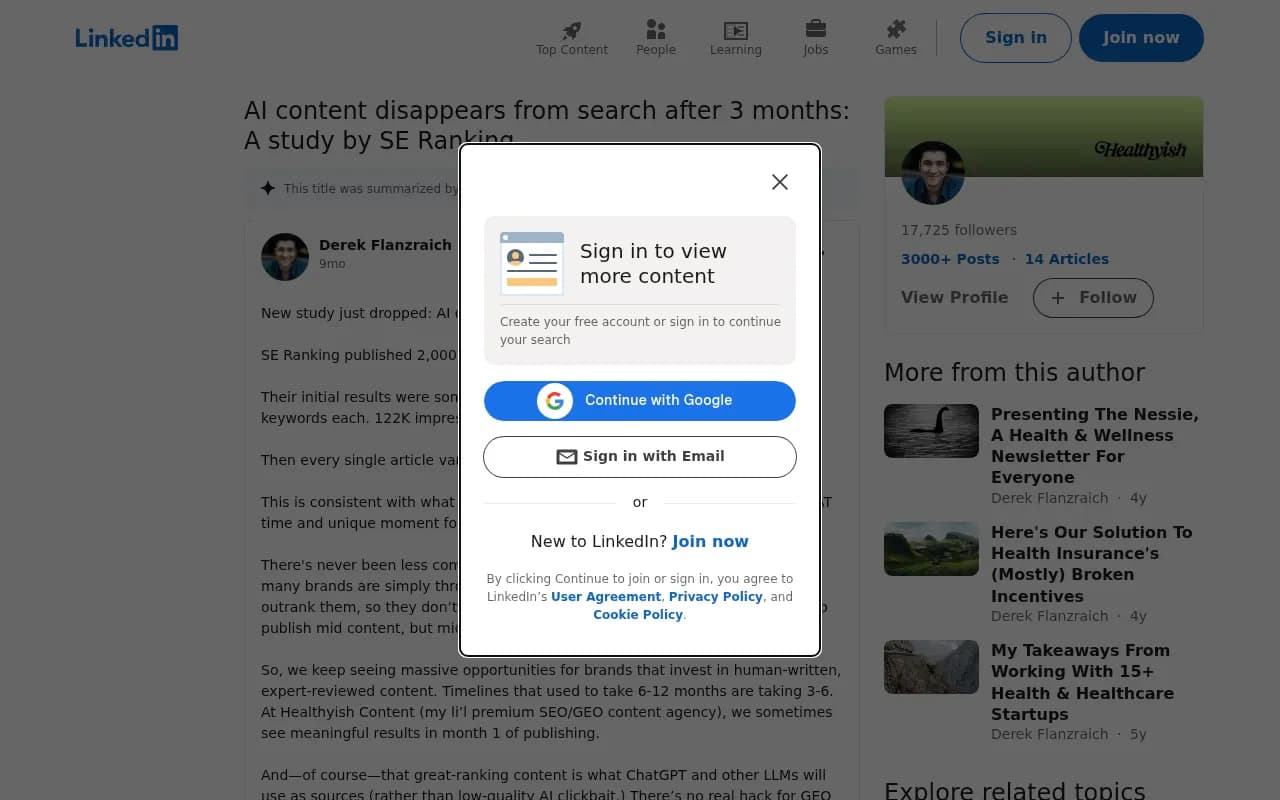
That's a significant finding. It suggests that AI-generated content isn't inherently penalized -- it can rank and get cited initially -- but something changes around the 90-day mark. The initial freshness boost fades, and without other signals to sustain visibility, the content falls out of rotation.
AirOps research adds another angle: pages updated within the past three months are three times more likely to be cited by AI models than older, untouched pages. That's not just about recency for its own sake. It signals to crawlers and models that the content is being maintained, that someone is paying attention to it, and that the information is probably still accurate.
Separately, Ahrefs published data in 2026 showing that only 38% of Google AI Overview citations now come from top-10 ranked pages -- down from 76% a year earlier. That shift matters because it means traditional ranking alone doesn't protect your citation position. AI models are increasingly pulling from sources that aren't necessarily the most-linked or highest-ranked pages. They're looking for something else.
Why the drop happens: four overlapping causes
The "rank and tank" pattern isn't caused by one thing. It's usually a combination of factors that compound over time.
1. The freshness window closes
LLMs don't have a static knowledge base. Models like ChatGPT and Perplexity regularly re-crawl and re-evaluate sources. When your content is new, it benefits from a freshness signal -- it's recent, it's indexed, it's relevant. But once that window closes and you haven't updated the page, the model may deprioritize it in favor of newer sources covering the same topic.
This is especially brutal for AI-generated content because it tends to be published in batches and then left alone. No one goes back to update 200 programmatic articles.
2. Thin content gets filtered out over time
Early citation wins can be misleading. An AI model might cite your page initially because it's the most recent result covering a particular query. But as more content accumulates on that topic, the model has more options. It starts applying a quality filter -- preferring pages with original data, specific claims, transparent methodology, and genuine depth.
Generic AI-generated content that summarizes what's already out there tends to fail this filter. It might answer the question, but it doesn't originate any claim. LLMs, particularly in their retrieval-augmented configurations, have a strong preference for primary sources.
3. Off-site signals never materialized
AirOps research found that 85% of top-of-funnel B2B brand mentions in AI answers come from third-party content -- Reddit threads, YouTube videos, review sites, listicles, and industry publications. Your own pages are only part of the picture.
If you published a lot of content but didn't build any external presence around it -- no mentions, no links, no discussions -- the model has no corroboration. It cited you once because you were there. It stopped citing you because nothing else pointed to you as a reliable source.
4. The re-crawl cycle catches structural problems
There's a theory circulating in the AEO community (and discussed actively on r/aeo) called the "freshness penalty" -- the idea that when you update a page, the AI model needs to re-process it, and during that window, it temporarily loses whatever citation position it had. This is probably real, but it's less of a penalty and more of a re-evaluation.
When a model re-crawls your page and finds that the structure hasn't improved -- no clear answer in the first paragraph, no self-contained sections, no schema markup -- it may simply not re-cite it. The re-crawl is an opportunity that gets wasted.
The AirOps-specific context
AirOps is one of the more capable platforms for generating content at scale specifically for AI search visibility. It's built around the idea of content engineering -- not just writing articles, but structuring them to be retrievable by LLMs.
The rank-and-tank problem shows up in AirOps workflows when teams treat it as a content factory rather than a content system. The platform can generate well-structured, prompt-grounded articles. But if those articles aren't maintained, if they don't earn off-site mentions, and if the underlying strategy doesn't account for citation decay, the initial gains won't hold.
AirOps itself acknowledges this in their research: citation rate is the metric that matters, not rankings. And citation rate is probabilistic -- it varies by model, by query, by day. You need to be tracking it continuously, not just at launch.
What actually holds citation position
Here's what the evidence points to for maintaining AI citations over time, not just earning them initially.
Publish original data, not summaries
LLMs cite pages that originate a claim. If your article says "studies show that X" without being the study, you're a secondary source. Secondary sources get replaced when a better one comes along. If your article contains a proprietary survey, a dataset you collected, or a methodology you developed, you become the primary source. That's much harder to displace.
Front-load your answers
AI models retrieve content in chunks. If the answer to the query isn't in the first 40-60 words of the relevant section, the model may not extract it correctly. Structure your content so that each section opens with a direct answer, then expands with supporting detail. This isn't just good writing practice -- it's how retrieval-augmented generation actually works.
Update pages on a schedule, not just at launch
Given the 3x citation probability for recently-updated pages, a maintenance calendar is as important as a publishing calendar. Updating doesn't mean rewriting -- it can mean adding a new data point, updating a statistic, or adding a section that addresses a new angle. The signal is that the page is alive.
Build off-site presence deliberately
Third-party mentions are the corroboration layer. A Reddit thread discussing your research, a YouTube video citing your data, a listicle that includes your brand -- these signals tell AI models that your content is worth citing because other sources agree. This is the part most content teams skip, and it's probably the biggest reason citation gains don't hold.
Track citation rate across models separately
ChatGPT, Perplexity, Google AI Overviews, and Gemini don't behave the same way. A page that gets cited consistently in Perplexity might never appear in Google AI Overviews. Tracking aggregate "AI visibility" masks these differences. You need model-level data to understand where you're losing ground and why.
Tools like Promptwatch track citation behavior across 10+ AI models with page-level granularity, including crawler logs that show when AI agents visit your pages and when those visits convert to citations. That kind of data makes the rank-and-tank pattern visible before it becomes a problem.

A practical comparison: what different tools help with
Different tools address different parts of the citation decay problem. Here's how the main options stack up:
| Tool | Content generation | Citation tracking | Crawler logs | Off-site signals | Freshness alerts |
|---|---|---|---|---|---|
| AirOps | Yes (core feature) | Yes | No | No | No |
| Promptwatch | Yes (Content Agents) | Yes | Yes | Yes | Yes |
| SE Ranking | No | Partial | No | No | No |
| Ahrefs | No | Partial (AI Overviews) | No | No | No |
| Otterly.AI | No | Yes (basic) | No | No | No |
| Profound | No | Yes | No | No | No |
Otterly.AI

Profound

The gap that matters most for the rank-and-tank problem is the combination of content generation and post-publish tracking. AirOps handles the generation side well. The tracking side -- especially crawler logs and off-site signal monitoring -- requires a dedicated AI visibility platform.
What to do if you're already seeing citation decay
If your content has already dropped out of LLM answers, here's a practical sequence:
Audit what you published. Look at the pages that were getting cited and ask: do they contain any original data? Are answers front-loaded? Are sections self-contained? Most AI-generated content fails at least one of these.
Check your update history. If pages haven't been touched since publication, that's the first thing to fix. Even a meaningful update to one section can re-trigger the freshness signal.
Look for off-site gaps. Search for your brand and content topics on Reddit, in YouTube comments, and on third-party review sites. If there's nothing, that's a gap. You need external corroboration, and you probably need to create it deliberately.
Set up proper tracking. You can't fix what you can't see. If you're not tracking citation rate by model and by page, you're flying blind. Tools like Promptwatch give you the crawler log data to understand when AI agents visit your pages and whether those visits result in citations.
Prioritize depth over volume. The rank-and-tank pattern is often a symptom of publishing too much too fast. Twenty well-maintained, deeply researched pages will outperform 200 thin ones over a six-month window.
The bigger picture
The rank-and-tank pattern is a natural consequence of how LLMs work. They're not static indexes. They continuously re-evaluate sources based on freshness, authority, structure, and corroboration. Content that earns citations by being new and available will lose those citations when better options emerge.
This doesn't mean AI-generated content is a bad strategy. It means the strategy has to account for the full lifecycle -- not just publication, but maintenance, off-site presence, and continuous tracking. AirOps and similar platforms are useful for the generation phase. The teams that hold their citation gains are the ones that treat that as the beginning of the work, not the end.
Kevin Indig's analysis in his Growth Memo newsletter makes this point clearly: ranking well helps, but it doesn't guarantee citations. The models are doing something more complex than pulling the top-ranked page. They're evaluating whether your content is the right source for a specific claim, in a specific context, at a specific moment. That evaluation changes constantly.
The teams winning at AI visibility in 2026 are the ones who've accepted that citation maintenance is an ongoing operation, not a one-time campaign.