Key takeaways
- Peec AI is a solid AI visibility monitor but stops at tracking — no content generation, no crawler logs, no traffic attribution.
- Promptwatch is the only platform here that closes the full loop: find gaps, generate content, track results across 10+ AI models.
- Morningscore bundles traditional SEO with AI visibility in a gamified interface — good for small teams, limited for serious GEO work.
- Rankability is built for agencies doing Google SEO; its AI visibility layer is thin compared to dedicated GEO tools.
- SE Visible (by SE Ranking) gives you solid AI monitoring data but relies on the broader SE Ranking ecosystem for any optimization work.
The AI search visibility space has gotten crowded fast. Eighteen months ago, most SEO teams were still debating whether ChatGPT and Perplexity would "really" affect their traffic. Now those same teams are scrambling to figure out why their brand shows up for competitors but not for them when someone asks an AI assistant for a recommendation.
That's created two distinct product categories. First: dedicated GEO platforms built from scratch for AI visibility. Second: traditional SEO tools bolting on AI monitoring as a feature. This comparison covers both types — Peec AI (dedicated GEO monitor), Promptwatch (end-to-end GEO platform), Morningscore (SEO + AI add-on), Rankability (agency SEO with AI features), and SE Visible (AI monitoring module from SE Ranking).
They're not really competing for the same buyer. But they get compared constantly, so let's sort out who actually belongs in your stack.
What each platform actually does
Peec AI
Peec AI is a purpose-built AI visibility tracker. It monitors how your brand appears across ChatGPT, Perplexity, Claude, Gemini, and a handful of other AI engines — using UI scraping to get results that reflect what real users see, not just API outputs.

The core workflow: you set up prompts, Peec tracks your brand's presence in AI responses, and you get share-of-voice data, citation tracking, and competitor comparisons. Pricing starts around €89/month for the Starter plan with a 7-day trial.
What it does well: the UI-scraping approach means you're seeing realistic results. Prompt-level tracking is solid. Competitor benchmarking is useful.
What it doesn't do: there's no content generation, no crawler log analysis, no traffic attribution, and no built-in way to act on what you find. It tells you where you're invisible. It doesn't help you fix it.
Promptwatch
Promptwatch is the most complete platform in this comparison. It monitors 10 AI models (ChatGPT, Perplexity, Claude, Gemini, Google AI Overviews, Google AI Mode, Grok, DeepSeek, Meta AI, Copilot, Mistral) and then goes further than any other tool here by helping you do something about what you find.

The core loop: Answer Gap Analysis shows you exactly which prompts your competitors rank for but you don't. The built-in AI writing agent generates content — articles, listicles, comparisons — grounded in 880M+ real citations analyzed, prompt volume data, and competitor gaps. Then page-level tracking shows you which new pages are getting cited, by which models, and how often. Traffic attribution (via code snippet, GSC integration, or server log analysis) connects that visibility to actual revenue.
On top of that: real-time AI crawler logs show which pages ChatGPT, Claude, and Perplexity are actually crawling and any errors they hit. Reddit and YouTube tracking surfaces discussions that influence AI recommendations. ChatGPT Shopping tracking monitors product carousel appearances. Prompt volume estimates and difficulty scores help you prioritize.
Pricing: $99/mo (Essential), $249/mo (Professional), $579/mo (Business). Used by 6,700+ brands including Booking.com and Center Parcs.
The honest summary: if you want to monitor and fix your AI visibility, Promptwatch is the only tool in this comparison that does both.
Morningscore
Morningscore is a Danish SEO platform that added AI visibility tracking to its existing suite. The traditional SEO side covers rank tracking, backlink monitoring, site health, and keyword research — all wrapped in a gamified interface where you earn "missions" and level up your website's score.
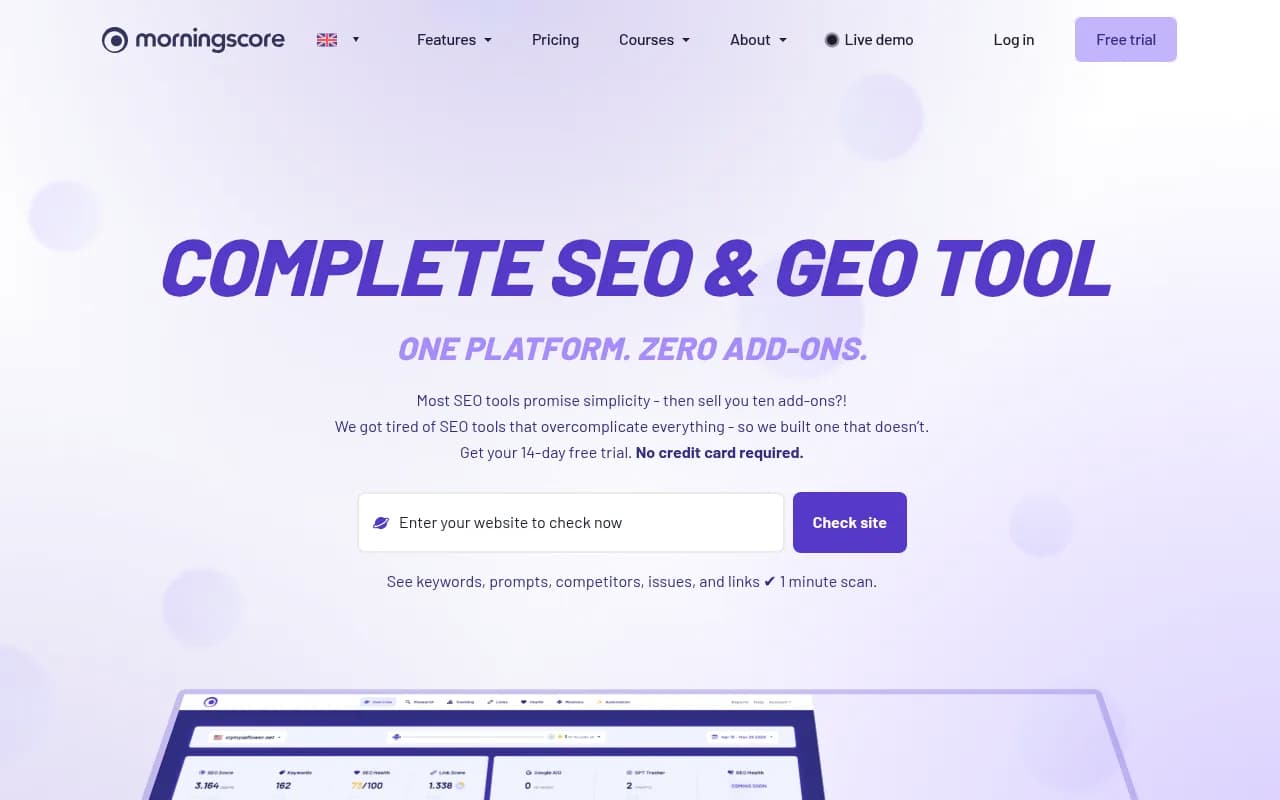
The AI visibility component lets you track brand mentions across ChatGPT, Perplexity, and Google AI Overviews. It's functional but not deep. You get mention tracking and some share-of-voice data, but there's no prompt-level analysis, no content gap identification, and no content generation.
Where Morningscore genuinely shines: the gamification makes SEO accessible for small business owners and solo marketers who find traditional SEO dashboards overwhelming. If you're managing one website and want a single tool for both traditional SEO and basic AI monitoring, it's a reasonable choice. If you're serious about GEO, you'll outgrow the AI features quickly.
Rankability
Rankability is an agency-focused SEO platform. Its core strengths are content optimization for Google — brief generation, content scoring, SERP analysis, and competitive gap identification for traditional search.
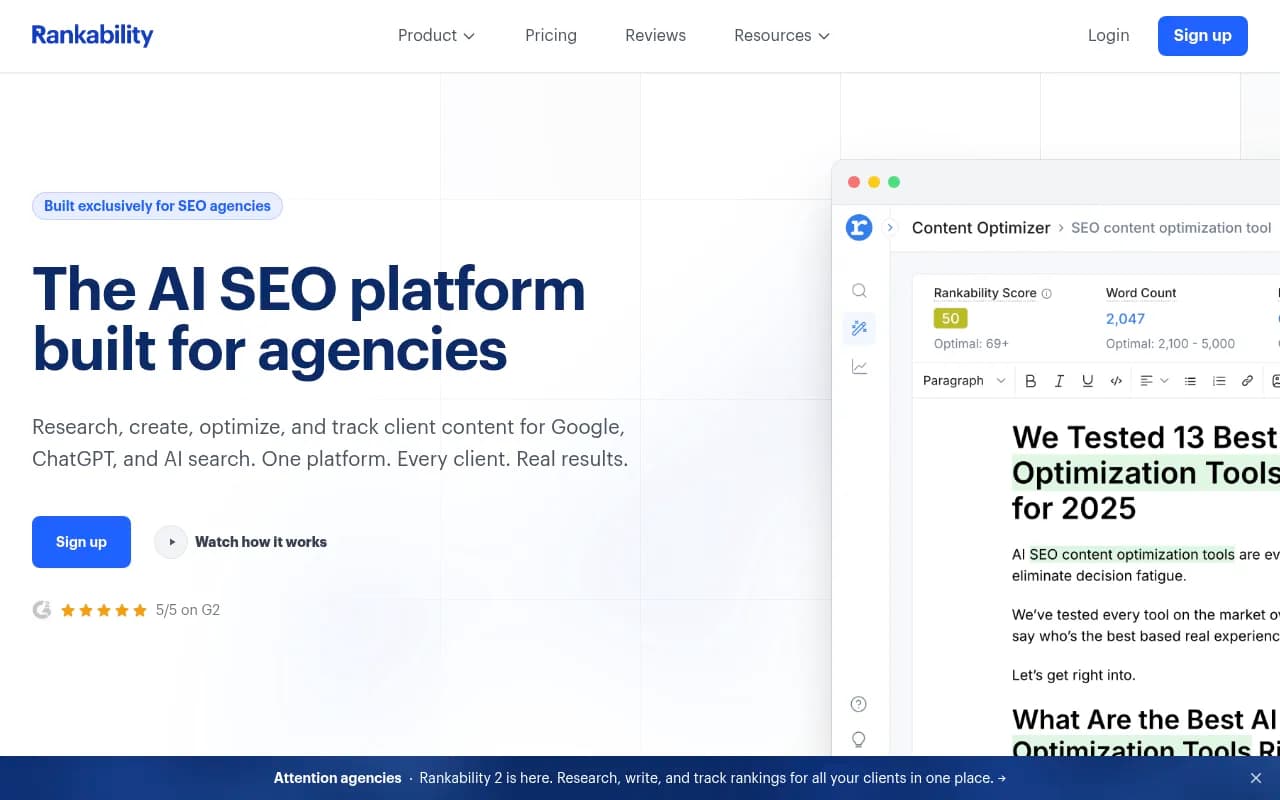
The AI visibility features are relatively recent additions. You can track brand mentions in AI responses and get some basic share-of-voice data, but the platform's DNA is Google SEO. The AI monitoring layer feels like it was added to stay competitive rather than built from the ground up.
For agencies doing content-heavy Google SEO work, Rankability's core features are genuinely strong. For teams whose primary concern is AI search visibility, it's not the right tool.
SE Visible
SE Visible is the AI visibility product from SE Ranking, one of the more established all-in-one SEO platforms. It tracks brand mentions across AI engines, gives you share-of-voice comparisons, and integrates with SE Ranking's broader SEO data.
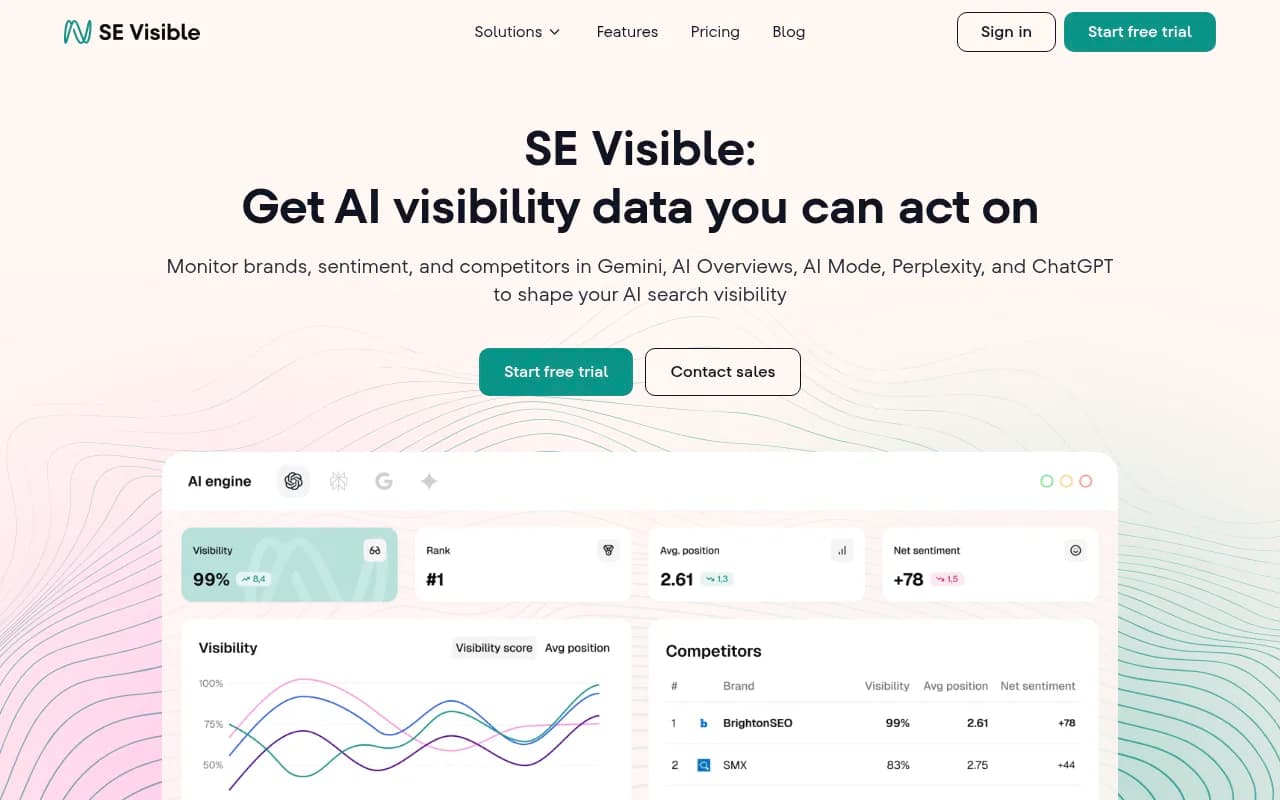
The monitoring data is reasonably solid. SE Ranking's infrastructure means you get reliable tracking across major AI models. But like Peec AI, SE Visible is primarily a monitoring tool. There's no content generation, no crawler log analysis, no traffic attribution built in. If you want to act on the data, you're doing that work elsewhere — either in SE Ranking's SEO tools or in a separate platform.
The case for SE Visible: if you're already a heavy SE Ranking user and want AI visibility data alongside your existing SEO workflow, the integration makes sense. If you're starting fresh and AI visibility is a priority, there are better options.
Feature comparison
| Feature | Peec AI | Promptwatch | Morningscore | Rankability | SE Visible |
|---|---|---|---|---|---|
| AI model coverage | 5+ | 10+ | 3 | 3 | 5+ |
| Prompt-level tracking | Yes | Yes | Limited | Limited | Yes |
| Share of voice | Yes | Yes | Yes | Basic | Yes |
| Citation tracking | Yes | Yes | No | No | Yes |
| Content gap analysis | No | Yes | No | Partial | No |
| AI content generation | No | Yes | No | Yes (Google SEO) | No |
| AI crawler logs | No | Yes | No | No | No |
| Traffic attribution | No | Yes | No | No | No |
| Reddit/YouTube tracking | No | Yes | No | No | No |
| ChatGPT Shopping | No | Yes | No | No | No |
| Traditional SEO tools | No | No | Yes | Yes | Yes (via SE Ranking) |
| Starting price | ~€89/mo | $99/mo | ~€49/mo | ~$99/mo | Included with SE Ranking |
| Free trial | 7 days | Yes | Yes | Yes | Yes |
The core question: monitor or optimize?
This is the real fork in the road. Every tool in this comparison can show you data about your AI visibility. Only two of them — Promptwatch and Rankability — have any built-in content creation capabilities, and Rankability's content tools are built for Google, not AI search.
If you're asking "how visible am I in AI search?", Peec AI, SE Visible, and Morningscore can all answer that question. If you're asking "how do I become more visible?", the answer gets shorter fast.
Promptwatch's Answer Gap Analysis is the clearest example of what "actionable" actually means in this context. Instead of showing you a visibility score and leaving you to figure out why, it shows you the specific prompts where competitors appear and you don't — and then helps you create the content that would make you visible for those prompts. That's a different product category from a monitoring dashboard.
The other thing worth noting: AI crawler logs are genuinely underrated. Most teams focus on whether AI models mention them, but the prior question is whether AI crawlers are even reading their pages correctly. Promptwatch is the only tool here that surfaces that data — which pages are being crawled, how often, and what errors crawlers are hitting.
Who should use which tool
Use Peec AI if...
You want dedicated AI visibility monitoring with realistic UI-scraping results, you don't need content generation or traffic attribution, and you're comfortable doing the optimization work separately. It's a focused tool that does what it says.
Use Promptwatch if...
You want to actually improve your AI visibility, not just measure it. The full loop — gap analysis, content generation, tracking, traffic attribution — is what separates it from everything else here. Best for marketing teams and SEO teams who treat AI search as a real channel, not a side experiment.
Use Morningscore if...
You're a small business owner or solo marketer who wants traditional SEO and basic AI monitoring in one affordable, approachable tool. The gamification genuinely helps if you find SEO dashboards overwhelming. Don't expect deep GEO capabilities.
Use Rankability if...
Your agency's primary work is Google SEO content optimization and you want AI visibility data as a secondary signal. The content brief and optimization tools for Google are strong. The AI visibility layer is thin.
Use SE Visible if...
You're already invested in the SE Ranking ecosystem and want AI visibility data alongside your existing SEO workflow. The integration is the main value proposition. As a standalone AI visibility tool, it's functional but not exceptional.
A note on the broader market
These five tools represent a useful cross-section of how different companies are approaching AI search visibility — but they're not the whole picture. There are dedicated monitoring tools like Otterly.AI and LLM Pulse, enterprise platforms like Profound and Scrunch AI, and newer entrants worth watching.
The market is consolidating around a clear distinction: tools that show you data, and tools that help you act on it. The monitoring-only tools are useful, but the ceiling is low — you'll eventually need to do the optimization work somewhere, and doing it in a separate tool means losing context.
That's the structural advantage Promptwatch has over everything else in this comparison. The data and the action live in the same place.
Bottom line
If you're evaluating these five platforms, the decision usually comes down to one question: are you trying to understand your AI visibility, or improve it?
For understanding: Peec AI and SE Visible are both solid. Peec AI has the edge on realistic results via UI scraping; SE Visible has the edge if you're already using SE Ranking.
For improving: Promptwatch is the only tool here with a complete answer. Gap analysis, AI content generation grounded in real citation data, crawler logs, traffic attribution — it's the difference between a dashboard and a workflow.
Morningscore and Rankability are worth considering if your primary need is traditional SEO and you want AI visibility as a secondary feature. Neither is the right choice if AI search is your main focus.
The AI search channel is real and growing. The tools you use to compete in it should be built for it.