Key takeaways
- All four platforms track brand visibility in AI search engines, but they differ significantly in what they do after showing you the data.
- AthenaHQ and Profound are strong monitoring tools with enterprise credibility, but both leave the "what do I do now?" question largely unanswered.
- Scrunch takes a different angle -- serving AI-optimized content at the CDN edge -- which is interesting but narrow.
- Promptwatch is the only platform in this comparison that closes the full loop: find gaps, generate content, track results, and tie it back to revenue.
The AI search visibility market has exploded in 2026, and with it, a wave of platforms all claiming to help you "rank in ChatGPT" or "optimize for Perplexity." Most of them are dashboards. They show you a score, maybe a chart of which AI models mention your brand, and then... leave you to figure out the rest.
That's fine if you just need a reporting tool. But if you're a marketing team that actually needs to move the needle -- get cited more, generate leads from AI search, outrank competitors in LLM responses -- you need something that goes further.
This guide breaks down four of the most-discussed platforms in the space: AthenaHQ, Promptwatch, Profound, and Scrunch. We'll look at what each one actually does, where they fall short, and which one makes sense depending on what you're trying to accomplish.
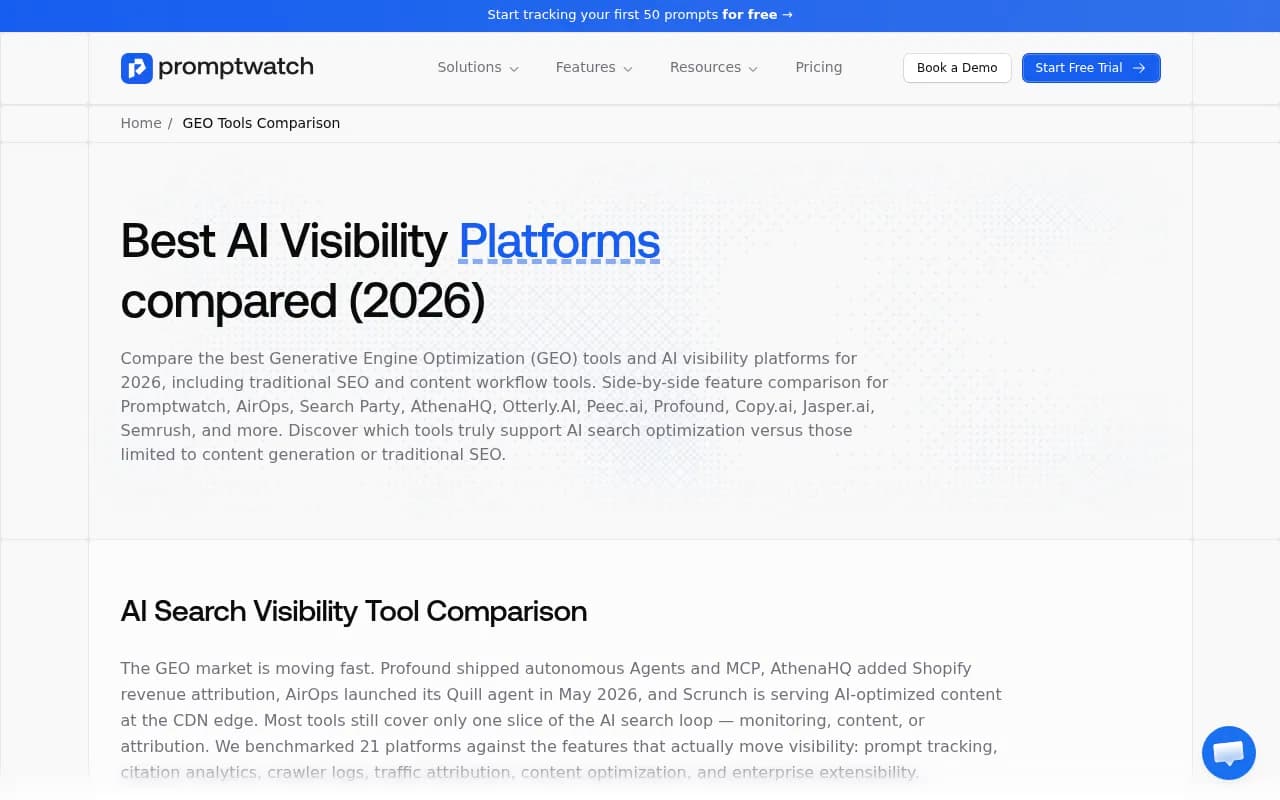
What these platforms are actually competing on
Before diving into each tool, it helps to understand what the real battleground is. There are three things an AI visibility platform can do:
- Monitor: Track how often your brand appears in AI-generated responses across ChatGPT, Perplexity, Gemini, etc.
- Diagnose: Identify why you're not appearing -- which prompts competitors are winning, what content gaps exist, which pages AI crawlers are ignoring.
- Optimize: Help you create content, fix crawl issues, and close the gaps so your visibility actually improves.
Most platforms do #1. Some do #2. Very few do #3. That distinction is what separates a monitoring tool from an optimization platform.
AthenaHQ
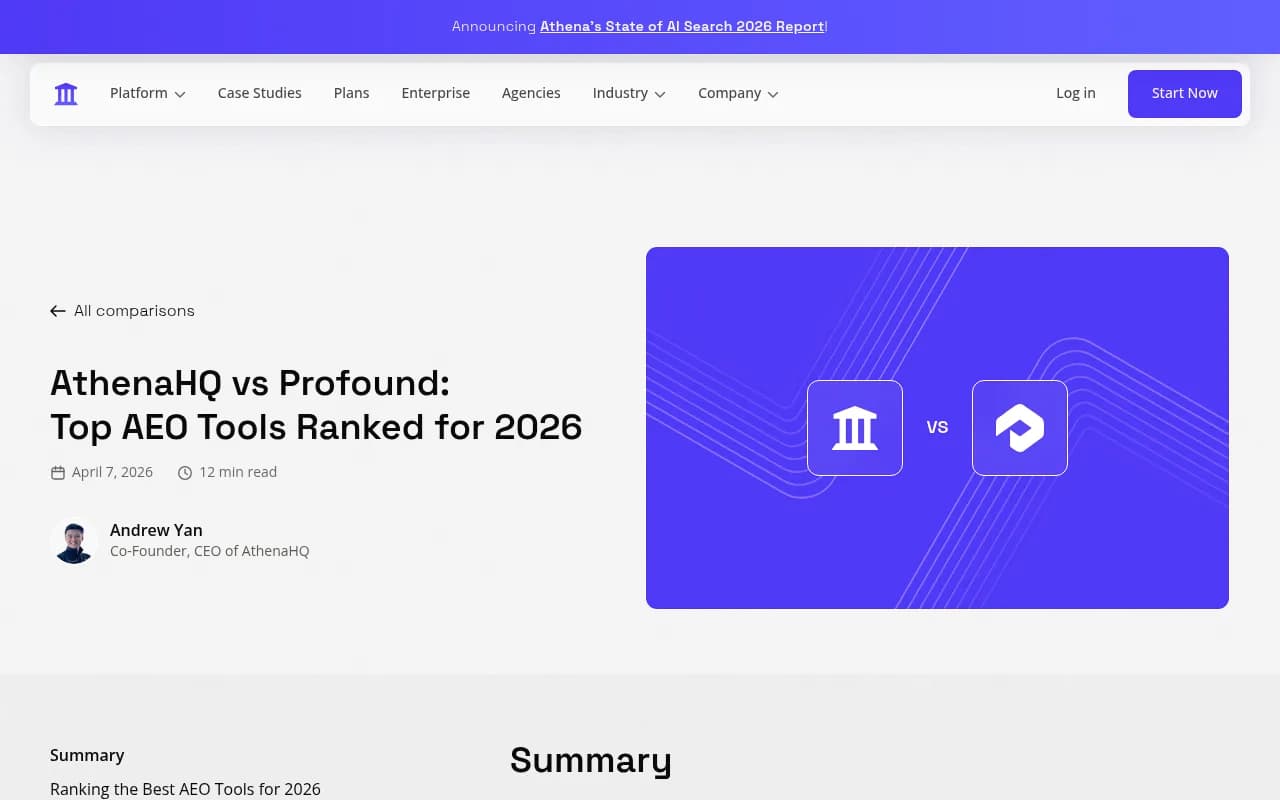
AthenaHQ has built a solid reputation in the AEO (Answer Engine Optimization) space. It holds a 4.9 rating on G2 and counts SoFi, ZoomInfo, and Wix among its customers. The platform focuses on helping brands understand which prompts their customers are using and how they're showing up in AI-generated answers.

What it does well
AthenaHQ covers a good range of AI platforms and provides citation pattern analysis that's genuinely useful for understanding where you stand. The interface is clean, and the onboarding is structured enough that teams can get up and running without a long setup process.
Their "State of AI Search 2026" report shows they're investing in thought leadership and original research, which matters for credibility in a space that moves fast.
Where it falls short
The honest criticism of AthenaHQ -- and you'll find this in reviews from users who've moved on -- is that it's strong on insight but weak on action. You can see that a competitor is getting cited for a prompt you're not. You can see your visibility score. What you can't easily do is generate the content that would fix it, or track exactly which of your pages AI crawlers are actually reading.
There's no content generation built in. No crawler log analysis. No Reddit or YouTube tracking to surface the offsite signals that influence AI recommendations. For a team that wants to understand their position, it works. For a team that wants to improve it systematically, you'll need to bolt on other tools.
Pricing is also on the higher end, which makes the monitoring-only positioning harder to justify when more complete platforms exist at similar or lower price points.
Profound
Profound is another well-funded player in this space, with a clear enterprise focus. They've shipped some genuinely interesting features in 2026 -- autonomous Agents, MCP integration, and a research hub that's worth bookmarking.
Profound

What it does well
Profound's prompt volume data is one of its strongest features. Knowing not just which prompts exist but how often real users are sending them is useful for prioritization. Their Agent Analytics feature tracks how AI crawlers interact with your site, which puts them ahead of pure monitoring tools.
They also offer unlimited prompts on higher-tier plans, which matters for enterprise teams running broad visibility programs across many product lines or markets.
Where it falls short
Profound's content generation capabilities are still catching up to its monitoring depth. The Agents feature is promising, but users have noted that translating insights into concrete content actions requires significant manual work. The platform tells you what's missing; it doesn't reliably help you build it.
There are also reported reliability issues with data consistency -- something that matters a lot when you're using visibility scores to make content investment decisions. If the data fluctuates in ways that aren't explained by actual AI model behavior, it erodes trust in the platform.
Support SLAs are better than AthenaHQ (Profound claims 5-minute response times vs. AthenaHQ's 2-hour SLA), which matters for enterprise teams.
Scrunch
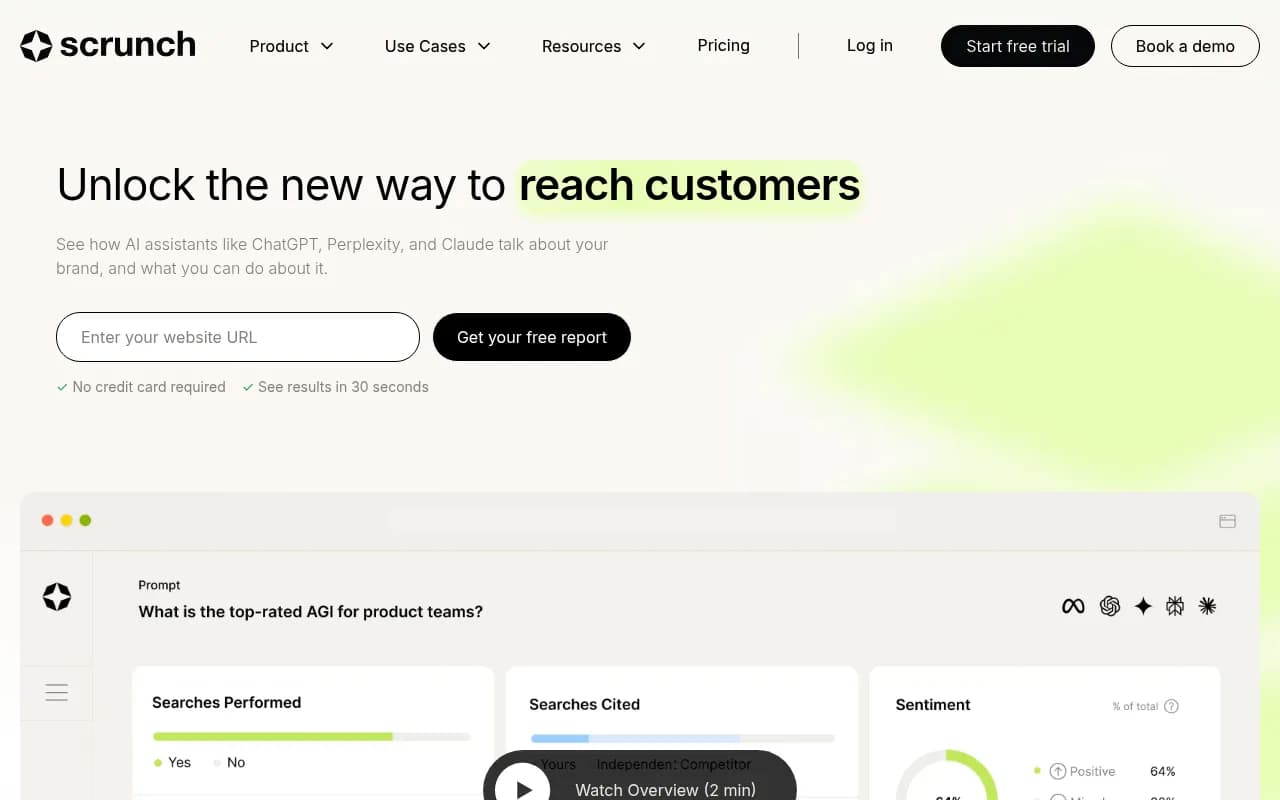
Scrunch takes a different architectural approach. Rather than just monitoring AI responses, it serves AI-optimized content at the CDN edge -- meaning it can intercept requests and deliver content specifically structured for AI crawlers.
What it does well
The CDN-edge approach is genuinely interesting. If AI crawlers are hitting your site and getting JavaScript-heavy pages that they can't parse well, Scrunch's approach can help ensure they see clean, structured content. It's a technical solution to a real problem.
Where it falls short
Scrunch is narrow. It solves one piece of the puzzle -- how your content is served to AI crawlers -- but doesn't help you figure out what content to create, which prompts to target, or how your visibility is trending over time. It's a tool you'd use alongside a monitoring platform, not instead of one.
For most marketing teams, the CDN-edge optimization is also a harder sell internally. It requires technical involvement and doesn't produce the kind of visibility dashboards that stakeholders want to see.
Promptwatch
Promptwatch is the platform that most directly addresses the "monitoring is not enough" problem. It's used by 1,480+ brands and agencies -- including Booking.com, Center Parcs, and Everflow -- and it's the only platform in this comparison built around a complete optimization loop rather than a reporting dashboard.

The core difference
Most platforms show you where you're invisible. Promptwatch shows you where you're invisible and helps you fix it. That sounds simple, but the implementation is what matters.
The Answer Gap Analysis identifies exactly which prompts competitors are winning that you're not -- not as a vague category, but as specific questions with prompt volume data and difficulty scores. You can see "this competitor is cited for 'best project management tool for remote teams' and you're not" and immediately understand whether that's a winnable gap.
From there, Content Agents generate articles, listicles, and comparison pages grounded in that prompt data. This isn't generic AI writing -- it's content engineered around the specific gaps AI models are exposing, with brand guidance, competitor analysis, and citation data baked in.
Then you track results. Page-level tracking shows which of your pages are being cited, by which models, and how often. Agent Analytics shows the timeline from when you publish to when AI crawlers find it to when it starts generating citations. Traffic attribution connects that visibility to actual revenue.
Specific capabilities worth noting
A few things Promptwatch does that the other platforms in this comparison don't:
- AI Crawler Logs: Real-time logs of GPTBot, ClaudeBot, PerplexityBot, and others hitting your site. You can see which pages they read, which ones return errors, and how often they come back. This is how you diagnose crawl issues before they become visibility problems.
- Reddit and YouTube tracking: AI models cite Reddit threads and YouTube videos constantly. Promptwatch surfaces which discussions are influencing AI recommendations in your category, so you can participate or create content that addresses those angles.
- ChatGPT Shopping tracking: If your products appear in ChatGPT's shopping recommendations, Promptwatch tracks it. Most platforms ignore this entirely.
- Offsite citation analysis: Not just your own pages, but which external sites, listicles, and third-party pages are driving AI citations for your brand or competitors.
- Multi-language and multi-region: Monitor AI responses in any language, from any country, with customizable personas that match how your actual customers prompt.
Pricing starts at $99/month for the Essential plan (1 site, 50 prompts, 5 articles), $249/month for Professional (2 sites, 150 prompts, 15 articles, crawler logs), and $579/month for Business (5 sites, 350 prompts, 30 articles). There's a free trial available.
Side-by-side comparison
| Feature | AthenaHQ | Profound | Scrunch | Promptwatch |
|---|---|---|---|---|
| AI model coverage | Good | Good | Limited | 10+ models |
| Prompt volume data | Partial | Yes | No | Yes |
| Content gap analysis | Basic | Partial | No | Yes (Answer Gap Analysis) |
| Content generation | No | Partial (Agents) | No | Yes (Content Agents) |
| AI crawler logs | No | Yes | CDN-level | Yes (real-time) |
| Reddit/YouTube tracking | No | No | No | Yes |
| ChatGPT Shopping tracking | No | No | No | Yes |
| Offsite citation analysis | No | Partial | No | Yes |
| Traffic/revenue attribution | No | Partial | No | Yes |
| Page-level citation tracking | No | No | No | Yes |
| Multi-language/region | Partial | Yes | No | Yes |
| Free trial | No | Demo only | No | Yes |
| Starting price | Enterprise | Enterprise | Custom | $99/mo |
Which platform is right for you?
The honest answer depends on what you're actually trying to do.
If you need a monitoring dashboard for stakeholder reporting, AthenaHQ or Profound both work. They're credible, they have enterprise customers, and they produce the kind of visibility scores that look good in a slide deck. AthenaHQ has a cleaner interface; Profound has better prompt volume data and faster support.
If you have a specific technical problem with how AI crawlers read your site, Scrunch's CDN-edge approach is worth exploring -- but you'll still need a separate monitoring tool alongside it.
If you want to actually improve your AI visibility, not just measure it, Promptwatch is the only platform in this comparison that closes the full loop. The combination of gap analysis, content generation, crawler logs, and attribution data means you're not just watching your score -- you're moving it.
The gap between "we track AI visibility" and "we improve AI visibility" is where most marketing teams get stuck. They buy a monitoring tool, get a dashboard full of data, and then spend weeks trying to figure out what to do with it. Promptwatch's design assumption is that the data is only valuable if it connects directly to action -- and that's what makes it structurally different from the other three platforms here.
For teams that are serious about AI search as a growth channel in 2026, that distinction matters more than any individual feature comparison.
A note on the broader market
These four platforms aren't the only options. Tools like Otterly.AI and Peec.ai offer simpler monitoring at lower price points -- fine for small teams just getting started. Semrush and Ahrefs have added AI visibility features, but they're built on traditional SEO infrastructure and don't go deep on LLM-specific behavior.
Otterly.AI


The market is moving fast. Profound shipped autonomous Agents in early 2026. AthenaHQ added Shopify revenue attribution. AirOps launched its Quill agent. The platforms that will matter in 12 months are the ones that treat AI search as a distinct channel -- not a feature bolted onto traditional SEO -- and that help teams take action, not just take notes.
Right now, Promptwatch is the clearest example of that approach. But the space is competitive enough that it's worth revisiting your stack every quarter as capabilities evolve.