Key takeaways
- AirOps evolved from a workflow builder into a content platform focused on AI search visibility, launching tools like Quill (an AI content agent) and publishing research on the state of content teams.
- Its strengths are real: content generation, brand kit integration, and a clear focus on AEO (Answer Engine Optimization) set it apart from generic AI writers.
- The gaps are also real: AI monitoring coverage is limited, regional data is thin, and the platform leans heavily toward content creation rather than deep visibility analytics.
- Teams with serious AI search tracking needs -- especially those wanting crawler logs, prompt intelligence, or multi-LLM coverage -- often found themselves needing a second tool alongside AirOps.
- Alternatives range from pure monitoring tools to full-stack GEO platforms, depending on what you actually need.
What AirOps set out to do
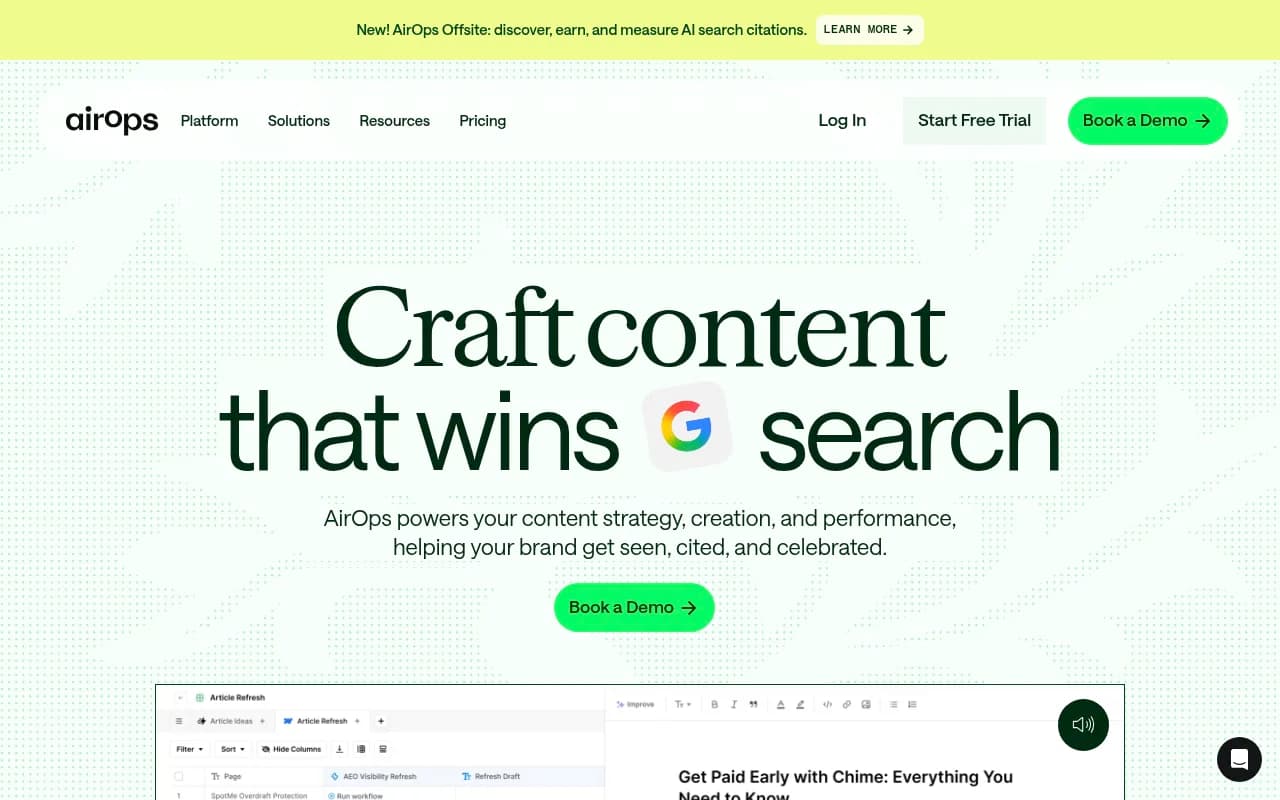
AirOps started as a tool for building AI workflows -- a kind of no-code layer on top of LLMs that let marketing and content teams automate repetitive tasks. By 2025, it had repositioned itself more deliberately as what it calls "the growth platform for AI search."
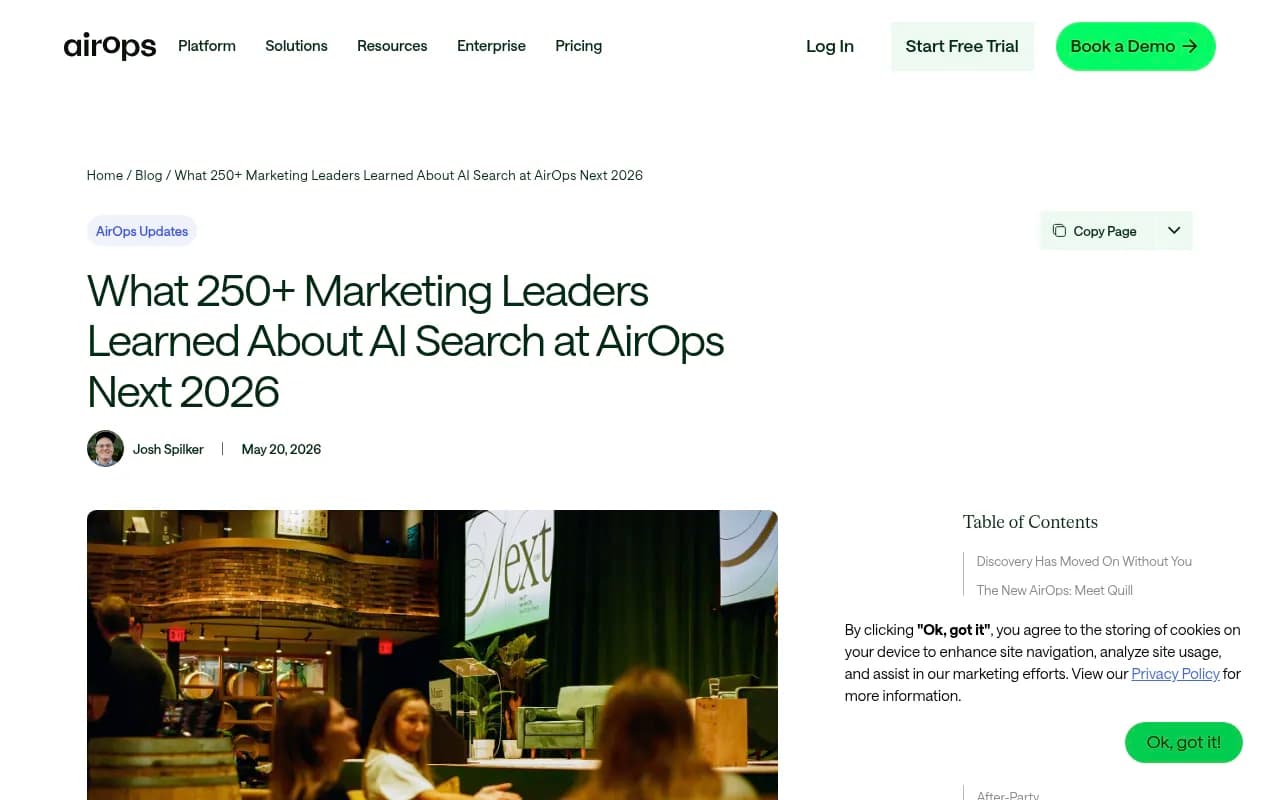
That's a meaningful shift. The pitch is no longer "automate your content ops" but rather "show up in AI answers." The company published a State of Content Teams report in April 2025 surveying around 150 content leaders, ran a conference (AirOps Next) in May 2026 with 250+ marketing leaders, and launched Quill -- an AI agent specifically designed for content campaigns.
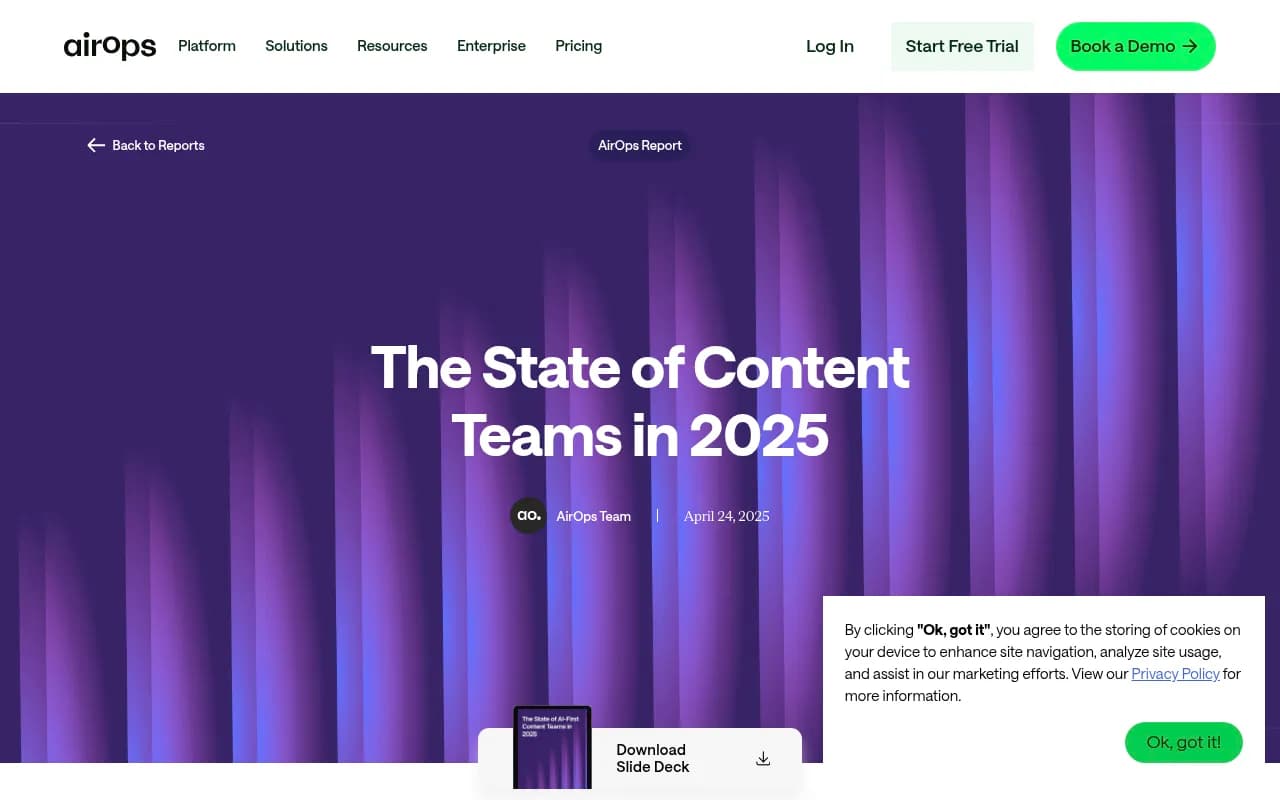
The research from that report is worth noting on its own terms. Nearly 75% of respondents said maintaining quality is their biggest challenge with AI. Research (65%) and content creation (40%) are the biggest time sinks. These aren't surprising numbers, but they do explain why AirOps doubled down on content generation rather than monitoring -- that's where the pain is for most teams.
What AirOps got right in 2025
The shift toward AEO as a first-class concern
Most content tools in 2024 were still optimizing for Google's blue links. AirOps was one of the earlier platforms to frame its product explicitly around Answer Engine Optimization -- the idea that headings, content density, freshness, and off-site authority now matter in a different way when AI models are deciding what to cite.
The Quill launch in mid-2026 made this concrete. Rather than just generating articles, Quill uses citation data and sentiment analysis to identify content gaps, then runs campaigns to close them. The example from Fetch (one of AirOps' early Quill users) is instructive: their data privacy sentiment score was 4.87 out of 100, which became the basis for a full content campaign. That's a real workflow, not a demo.
Quill's "playbooks" approach
One of the more practical improvements in 2025 was moving away from requiring Liquid syntax or JSON to configure workflows. Quill lets teams design and run campaigns in plain language. That matters a lot for content teams where the people who understand the strategy aren't the same people who can write configuration code.
Early customers reported up to 130% increases in citation rate within weeks of using Quill. That's a striking number, and it's worth being skeptical of any single metric like that -- but the directional signal is consistent with what AEO-focused content work tends to produce when done well.
Brand kit integration
AirOps built in brand kit functionality so that AI-generated content stays on-brand. This sounds like table stakes, but it's actually one of the harder problems in AI content at scale. Generic AI writers produce generic output. AirOps' approach of grounding content in brand guidance, competitor analysis, and real prompt data is a meaningful differentiator from tools that just spin up articles from a keyword.
The content operations angle
For teams that were already using AirOps as a workflow tool, the 2025 evolution made sense. The platform connects to WordPress for publishing, tracks prompt performance across answer engines, and integrates citation data into the content strategy process. That end-to-end loop -- from gap identification to publish -- is genuinely useful.
What AirOps missed
AI monitoring depth
This is the most consistent criticism from teams that evaluated AirOps seriously. The platform's AI visibility monitoring is described by at least one competitor review as "surface-level at best, with limited LLM coverage and regional data." That's a fair characterization based on what's publicly known about the product.
AirOps tracks prompt performance across answer engines, but it doesn't offer the kind of deep monitoring infrastructure that dedicated GEO platforms provide. If you want to know exactly which pages are being cited by ChatGPT vs. Perplexity vs. Google AI Overviews, or how your visibility changes by region or persona, AirOps isn't the right tool for that analysis.
For teams that need serious tracking -- crawler logs, page-level citation data, multi-LLM coverage across 10+ models -- they typically end up pairing AirOps with something else, or switching to a platform that does both.

Promptwatch, for instance, covers 10 AI models with real crawler log data, prompt volume estimates, and page-level citation tracking. That's a different category of monitoring than what AirOps currently offers.
Limited regional and persona data
AI answers vary significantly by country, language, and even the way a question is phrased. A brand might be well-cited in US English responses but invisible in German or Spanish. AirOps' regional data coverage has been noted as thin, which matters for any brand operating across markets.
The monitoring-to-action gap (in reverse)
AirOps' strength is action -- generating content, running campaigns, publishing. Its weakness is the monitoring side that should inform those actions. You can't optimize what you can't measure accurately. Teams that tried to use AirOps as their primary visibility tracker found themselves working with incomplete data, which undermines the content strategy built on top of it.
Pricing and fit for smaller teams
AirOps is positioned for content teams with real volume -- agencies, mid-market brands, companies publishing at scale. For smaller teams or solo practitioners, the platform can feel like more infrastructure than they need, and the pricing reflects that positioning.
Why teams switched (or added tools)
The teams that moved away from AirOps in 2025 generally fell into a few categories:
Teams that needed deeper monitoring. If your primary need is understanding where you stand across AI search engines -- which prompts you're winning, which competitors are outranking you, what the citation patterns look like -- AirOps doesn't give you enough. These teams tended to move toward dedicated GEO platforms.
Teams that wanted content + monitoring in one place. Running two tools is expensive and creates friction. Some teams consolidated onto platforms that handle both the tracking and the content optimization loop.
Teams that outgrew the workflow model. AirOps' roots as a workflow builder mean some of its architecture reflects that history. Teams with more sophisticated content operations sometimes found the platform's structure constraining.
How AirOps compares to alternatives
Here's a practical comparison of AirOps against tools that overlap with its positioning:
| Tool | Primary strength | AI monitoring depth | Content generation | Best for |
|---|---|---|---|---|
| AirOps | Content campaigns, AEO content ops | Limited | Strong (Quill) | Content teams running AEO campaigns |
| Promptwatch | Full GEO platform, action loop | Deep (10 models, crawler logs) | Strong (Content Agents) | Brands wanting monitoring + optimization |
| Profound | Enterprise AI visibility tracking | Strong | Limited | Enterprise monitoring-first teams |
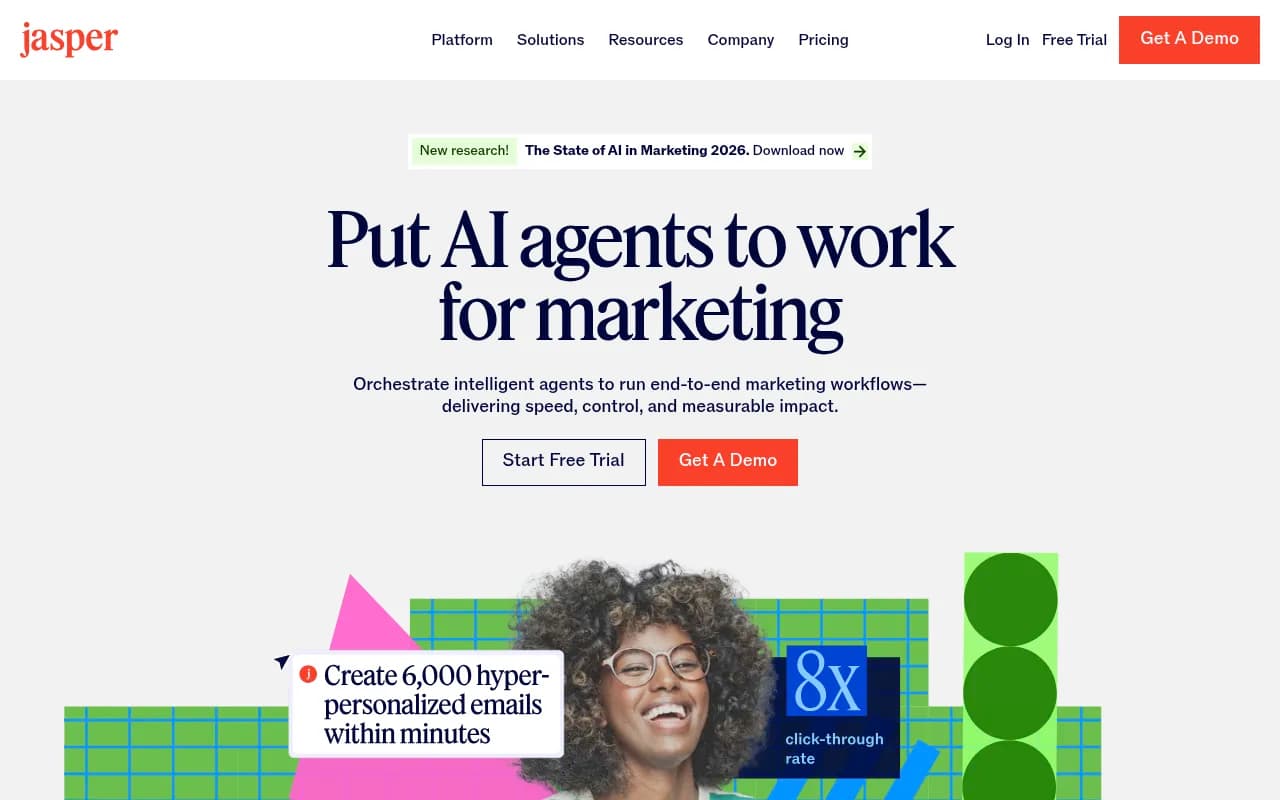
| Jasper | AI writing at scale | None | Very strong | Pure content production |
| MarketMuse | Content intelligence, topic modeling | None | Moderate | SEO content strategy |
| Clearscope | On-page content optimization | None | Limited | Content quality optimization |
| Otterly.AI | Basic AI brand monitoring | Moderate | None | Simple brand tracking |
Profound


Otterly.AI

The honest read: AirOps sits in an interesting middle position. It's more sophisticated than a pure AI writer like Jasper when it comes to AEO strategy, but less capable than a dedicated GEO platform when it comes to monitoring and analytics. Whether that's a problem depends entirely on what you need.
What the 2025 content team data actually tells us
AirOps' own State of Content Teams research is worth taking seriously, not just as marketing but as a signal of where the market is. A few findings stand out:
63% of teams plan to invest more in AI tools, training, or dedicated roles over the next 18 months. That's not a marginal shift -- it suggests content teams are treating AI adoption as a structural change, not an experiment.
44% say upskilling is a major hurdle. This is the quiet problem that most platforms underestimate. You can build the best tool in the world, but if the team using it doesn't understand how AI search works, the output suffers. AirOps' investment in education (the conference, the webinars, the research reports) reflects an awareness of this.
Research and production are still the biggest bottlenecks. This is where AirOps' Quill agent is most directly aimed -- automating the research and brief-generation phase, not just the writing.
Practical recommendations
If you're evaluating AirOps right now, here's how to think about it:
Use AirOps if your primary need is running AEO content campaigns at scale, you already have (or don't need) deep monitoring, and your team is comfortable with a content-operations-first workflow. The Quill agent is genuinely useful for teams that know what gaps they're trying to close.
Look elsewhere if you need serious AI visibility monitoring as your foundation. The monitoring side of AirOps isn't built for teams that need to track citation rates across 10 LLMs, analyze crawler behavior, or understand regional visibility differences. For that, you need a platform built around monitoring first.
Consider pairing tools if your budget allows. Some teams run AirOps for content production and a dedicated GEO tracker for monitoring. It's not elegant, but it works.
For teams that want the full loop -- find gaps, create content, track results -- in one place, platforms like Promptwatch are worth evaluating. The distinction matters: AirOps is strong at the "create content" step but weaker at the "find gaps" and "track results" steps that should surround it.
The bottom line
AirOps made real progress in 2025. The pivot toward AEO, the Quill launch, and the research investment all point to a team that understands where content marketing is going. The product is genuinely useful for content teams that need to produce AEO-optimized content at scale.
The gaps are real too. Limited monitoring depth, thin regional data, and a content-first architecture mean it's not the right fit for teams whose primary need is understanding their AI search visibility. Those teams need a platform built around measurement first, with optimization built on top of that foundation.
The market is still sorting itself out. Tools that were pure AI writers in 2023 are becoming content platforms. Monitoring tools are adding content features. The question for any team is which direction you're coming from -- and which gaps matter most to you right now.