Key takeaways
- Qwairy is a GEO (Generative Engine Optimization) platform that tracks brand visibility across multiple AI search engines and surfaces content gaps
- It covers 10 AI engines including ChatGPT, Perplexity, Gemini, and Google AI Overviews -- solid breadth for a mid-market tool
- The platform is primarily a monitoring tool; content generation and optimization capabilities are limited compared to full-cycle platforms
- Pricing and feature depth make it a reasonable entry point for smaller teams, but agencies and enterprise brands will likely hit its ceiling quickly
- If you need to go beyond tracking and actually fix your AI visibility, you'll want to pair Qwairy with a content optimization layer -- or consider a platform that does both
The GEO tool market has exploded. Eighteen months ago, there were maybe a dozen platforms worth considering. Now there are well over a hundred, ranging from sophisticated enterprise systems to glorified dashboards with a "track AI visibility" label slapped on them.
Qwairy sits somewhere in the middle of that spectrum -- and that's actually where most of the interesting decisions get made. It's not a bare-bones monitor, but it's also not trying to be a full-stack optimization engine. So the real question is: does what it does, it does well enough to justify the investment?
We spent time testing the platform, comparing its outputs against competitors, and talking to teams who use it. Here's what we found.
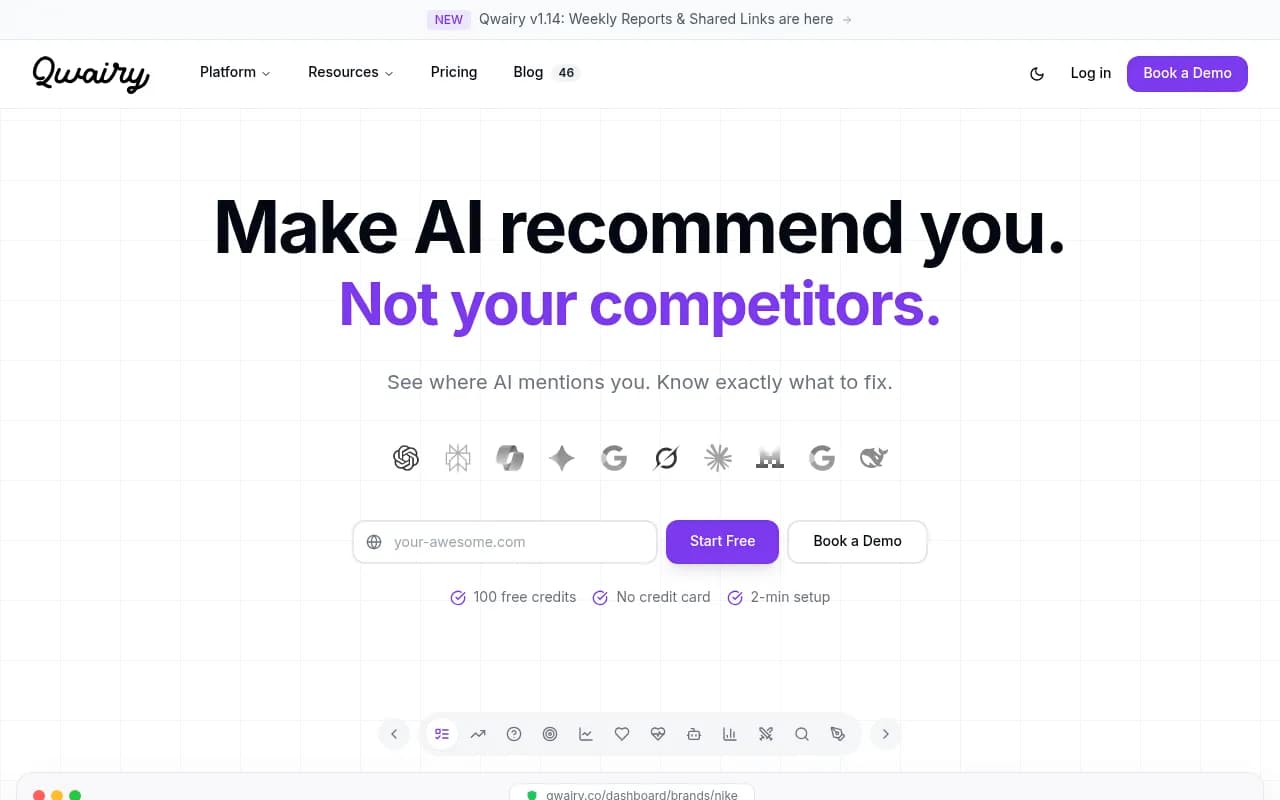
What Qwairy actually is
Qwairy describes itself as a GEO strategy platform. In practice, that means it helps marketing and SEO teams understand where their brand appears (or doesn't appear) in AI-generated answers across search engines like ChatGPT, Perplexity, Gemini, Google AI Overviews, and several others.
The core workflow is straightforward:
- You set up a brand profile and define the prompts you want to track
- Qwairy queries those AI engines on your behalf and logs the responses
- You see visibility scores, citation rates, and competitor comparisons
- The platform surfaces gaps -- prompts where competitors appear but you don't
That's the loop. It's a clean concept, and Qwairy executes the monitoring side reasonably well.
What it doesn't do -- at least not in any meaningful depth -- is help you fix those gaps. There's no content generation engine, no AI crawler log analysis, and no traffic attribution connecting your AI visibility to actual revenue. You get the "what" but not much of the "so what, now what."
What we tested
We ran Qwairy through a structured evaluation across four dimensions:
- Coverage: Which AI engines does it track, and how accurately?
- Prompt intelligence: Does it help you find the right prompts to track, or do you have to guess?
- Gap analysis: How useful is the competitive gap data in practice?
- Actionability: Can you actually use the data to improve your visibility?
Here's what we found in each area.
Coverage: solid but not exceptional
Qwairy covers 10 AI engines, which is genuinely good. Many cheaper tools track only ChatGPT and Perplexity and call it a day. Getting Google AI Overviews, Gemini, Grok, and others in the mix matters because different AI engines pull from different sources and behave differently for the same query.
The tracking methodology appears to use direct API queries for most engines, which is fast and scalable but has a known limitation: user-facing AI responses can differ from API outputs. When ChatGPT serves a response in its actual interface versus through the API, the citations, formatting, and recommendations sometimes diverge. Platforms that monitor real user-interface behavior catch things that API-only tools miss.
For most use cases, this won't be a dealbreaker. But if you're in a category where AI shopping recommendations or entity-specific responses matter (think product comparisons, local services, or anything with a ChatGPT shopping carousel), the API-only approach can give you an incomplete picture.
Prompt intelligence: functional, not sophisticated
Setting up prompts in Qwairy is manual. You define the queries you want to track, and the platform monitors them. There's some guidance on prompt selection, but nothing that algorithmically surfaces high-value, winnable prompts based on volume estimates or difficulty scoring.
This is a meaningful gap. One of the harder problems in GEO right now is knowing which prompts to care about. Not all AI queries are equal -- some drive significant traffic and brand exposure, others are niche edge cases. Without volume data or difficulty scoring, you're essentially guessing at prioritization.
Compare this to platforms that show you prompt volume estimates, query fan-outs (how one prompt branches into sub-queries), and competitive difficulty scores. That kind of intelligence turns prompt selection from a gut-feel exercise into something you can actually defend in a strategy meeting.
Gap analysis: the strongest feature
This is where Qwairy earns its keep. The competitive gap analysis -- showing you which prompts competitors rank for in AI responses that you don't -- is genuinely useful and presented clearly.
You can see, at a glance, which AI engines are citing your competitors for specific queries, what the response looks like, and where your brand is absent. For teams that have been flying blind on AI visibility, this alone can justify the tool.
The gap data is most useful when you already have a content team ready to act on it. The platform will tell you "your competitor appears in ChatGPT responses for 'best project management software for remote teams' and you don't." What it won't do is help you write the content that closes that gap.
Actionability: the ceiling you'll hit
This is the honest limitation of Qwairy, and it's worth being direct about it.
Monitoring-only platforms -- and Qwairy is primarily a monitoring platform -- give you a dashboard full of data and then leave you to figure out what to do with it. For teams with strong content operations already in place, that's fine. You know what to do; you just needed the data to prioritize.
For teams that are newer to GEO, or that want a platform that helps them close the loop from "we have a visibility gap" to "we published content that fixed it," Qwairy will feel incomplete.
There's no content brief generation, no AI-assisted article creation grounded in prompt data, and no mechanism to track whether the content you publish eventually gets cited. You'd need to layer in separate tools for all of that.
How Qwairy compares to the field
The GEO tool market has a clear split right now: monitoring-only platforms and full-cycle optimization platforms. Qwairy sits in the monitoring camp, which puts it in competition with tools like Otterly.AI, Peec AI, and LLMrefs -- all of which do similar things at similar price points.
Otterly.AI


LLMrefs
Here's a quick comparison of where Qwairy lands against the broader field:
| Feature | Qwairy | Otterly.AI | Peec AI | LLMrefs | Promptwatch |
|---|---|---|---|---|---|
| AI engines tracked | 10 | 5-6 | 5 | 9+ | 10+ |
| Prompt gap analysis | Yes | Basic | Basic | Yes | Yes |
| Prompt volume/difficulty | No | No | No | No | Yes |
| Content generation | No | No | No | No | Yes |
| AI crawler logs | No | No | No | No | Yes |
| Traffic attribution | No | No | No | No | Yes |
| Reddit/YouTube tracking | No | No | No | No | Yes |
| ChatGPT Shopping tracking | No | No | No | No | Yes |
| Free trial | Yes | Yes | Yes | Yes | Yes |
The pattern is clear. Qwairy and most of its direct competitors are strong at showing you the problem. The platforms that differentiate themselves are the ones that help you solve it.
Promptwatch is the clearest example of a platform built around the full action loop -- find gaps, create content that addresses them, track whether it works. It's the only platform in the 2026 comparison that rated as a "Leader" across all evaluation categories, largely because it doesn't stop at monitoring.

That said, Promptwatch is also priced accordingly. If your budget is tight and you just need to start tracking AI visibility without committing to a full optimization platform, Qwairy is a reasonable starting point.
Who Qwairy is actually for
After testing, here's our honest read on the right audience for Qwairy:
Good fit:
- Small to mid-size marketing teams that are just starting to take AI visibility seriously
- Teams that already have strong content operations and just need the monitoring data to prioritize
- Brands that want to benchmark AI visibility before committing to a more expensive platform
- Anyone who needs a quick, relatively low-friction way to show stakeholders where they stand in AI search
Not a great fit:
- Agencies managing multiple client brands (the multi-site story gets complicated fast)
- Enterprise brands that need traffic attribution and revenue impact reporting
- Teams that need content generation built into the same workflow
- Anyone who needs to understand AI crawler behavior on their own site
Pricing and value
Qwairy's pricing sits in the mid-range for GEO tools -- accessible enough for individual teams but not the cheapest option in the market. There's a free trial, which is worth using before committing.
The value calculation depends almost entirely on what you're going to do with the data. If you have a content team ready to act on gap analysis, the ROI can be real. If you're going to look at the dashboard, feel vaguely anxious about your AI visibility, and not change anything, you'll get the same result from any monitoring tool.
Alternatives worth considering
If Qwairy's monitoring-only approach isn't quite right for your situation, here are a few alternatives worth evaluating:
For more depth on the monitoring side:
Profound

Profound covers 9+ AI engines with strong enterprise-grade reporting. It's more expensive but more thorough, particularly for brands that need detailed citation analysis.

AthenaHQ is another solid monitoring platform with clean UX and good competitive benchmarking. Still monitoring-only, but well-executed.
For a full-cycle approach:
Promptwatch is the platform to consider if you want to go beyond tracking. The gap analysis feeds directly into content generation, and the AI crawler logs tell you exactly what's happening when AI engines visit your site. It's the only platform that closes the loop from visibility gap to published content to citation tracking.
For budget-conscious teams:
LLMrefs
LLMrefs covers a wide range of AI engines at a lower price point. Less sophisticated than Qwairy on the gap analysis side, but fine for basic monitoring.
Otterly.AI
Otterly.AI is another lean option that gets the job done for simple brand mention tracking without a lot of overhead.
The bottom line
Qwairy is a competent GEO monitoring platform. The gap analysis is genuinely useful, the multi-engine coverage is solid, and the interface is clean enough that you won't spend your first week fighting the tool.
But it's a monitoring platform, and monitoring is only half the job. The GEO teams that are actually moving the needle in 2026 aren't just tracking where they're invisible -- they're systematically closing those gaps with content engineered to answer the exact prompts AI models are already fielding. Qwairy gets you to the problem. What you do next is up to you.
If that's enough for where you are right now, Qwairy is worth a trial. If you need the full picture -- from gap identification through content creation to citation tracking -- you'll want a platform that was built to do all three.