Key takeaways
- Semrush added an AI Toolkit and GEO Audit tool, but it's built on fixed prompts and lacks traffic attribution, content generation, and crawler log access.
- Dedicated GEO platforms like Promptwatch, Profound, and Scrunch go much deeper on AI visibility monitoring and optimization.
- If you're already a Semrush user, the AI Toolkit is a decent starting point -- but it won't replace a purpose-built platform for teams serious about AI search.
- The biggest gap between Semrush and dedicated tools: Semrush shows you data, but doesn't help you act on it.
- Promptwatch is the only platform in this comparison rated as a "Leader" across all GEO categories in 2026.
Semrush has been the default SEO platform for marketing teams for over a decade. When AI search started eating into traditional click traffic, it made sense that Semrush would respond. And it did -- with an AI Toolkit and a GEO Audit feature that plugs into its existing platform.
But "responding" and "leading" are different things. The question worth asking in 2026 isn't whether Semrush has AI visibility features. It's whether those features are good enough for teams that actually need to compete in AI search -- or whether you need a dedicated GEO platform alongside it (or instead of it).
This guide breaks down exactly where Semrush stands, what the dedicated platforms do better, and how to decide what's right for your situation.
What Semrush actually offers for AI visibility
Semrush's AI visibility capabilities live in two places: the AI Toolkit (part of the main platform) and the GEO Audit tool, which integrates AI search visibility analysis directly alongside traditional SEO metrics.
The integration angle is genuinely useful. If you're already running keyword research, backlink audits, and rank tracking inside Semrush, having AI visibility data in the same dashboard reduces context-switching. You can see how a piece of content performs in traditional search and in AI-generated answers without logging into a second tool.
That said, the feature set has real limits:
- Fixed prompts: Semrush uses a predefined set of prompts rather than letting you build custom prompt sets around your actual customers' questions. You're tracking what Semrush decided to track, not what your buyers are actually asking.
- Limited engine coverage: Monitoring covers 3-4 major AI engines. Platforms like Promptwatch cover 10+ (ChatGPT, Perplexity, Claude, Gemini, Google AI Overviews, Google AI Mode, Grok, DeepSeek, Copilot, Meta AI, Mistral).
- No AI traffic attribution: Semrush can't connect AI visibility to actual website traffic or revenue. You see mention rates, but not whether those mentions are driving clicks or conversions.
- No content generation: The platform identifies gaps but doesn't help you fill them. You'd need to export insights and write content elsewhere.
- No crawler logs: You can't see which AI bots are crawling your site, which pages they're reading, or what errors they're hitting.
For a team that just wants a rough sense of AI visibility without adding another subscription, Semrush's AI Toolkit is fine. For teams trying to actually improve their AI search presence, it's a starting point, not a solution.
The dedicated GEO platforms: what they do differently
The platforms built specifically for AI visibility tend to share a few characteristics that Semrush lacks: custom prompt tracking, deeper engine coverage, and some form of optimization capability beyond just monitoring.
Here's how the main players stack up.
Promptwatch
Promptwatch is the most complete platform in this comparison. It covers 10 AI models, supports custom prompts, and -- critically -- goes beyond monitoring into actual optimization.
The core workflow is built around three steps: find gaps (which prompts are competitors visible for that you're not?), create content (a built-in AI writing agent generates articles grounded in citation data from 880M+ analyzed citations), and track results (page-level visibility scores, traffic attribution via code snippet, GSC integration, or server log analysis).
That last part matters. Most platforms stop at "here's your visibility score." Promptwatch connects visibility to traffic and revenue, which is what actually gets budget approved.
Other features worth noting: real-time AI crawler logs (see exactly which AI bots are hitting your site and what they're reading), Reddit and YouTube citation tracking, ChatGPT Shopping monitoring, prompt volume and difficulty scores, and competitor heatmaps across LLMs.
Used by 6,700+ brands and agencies including Booking.com and Center Parcs. Pricing starts at $99/month.

Profound
Profound is the enterprise-grade option. It supports up to 10 LLMs, has strong governance features, and goes deep on the "why did we appear?" question -- useful for large brands that need to understand what's driving their AI visibility, not just measure it.
The tradeoff is price and complexity. Profound is custom-priced at the enterprise tier, and the platform is built for teams with dedicated analysts rather than lean marketing teams who need quick answers.
Profound

Scrunch AI
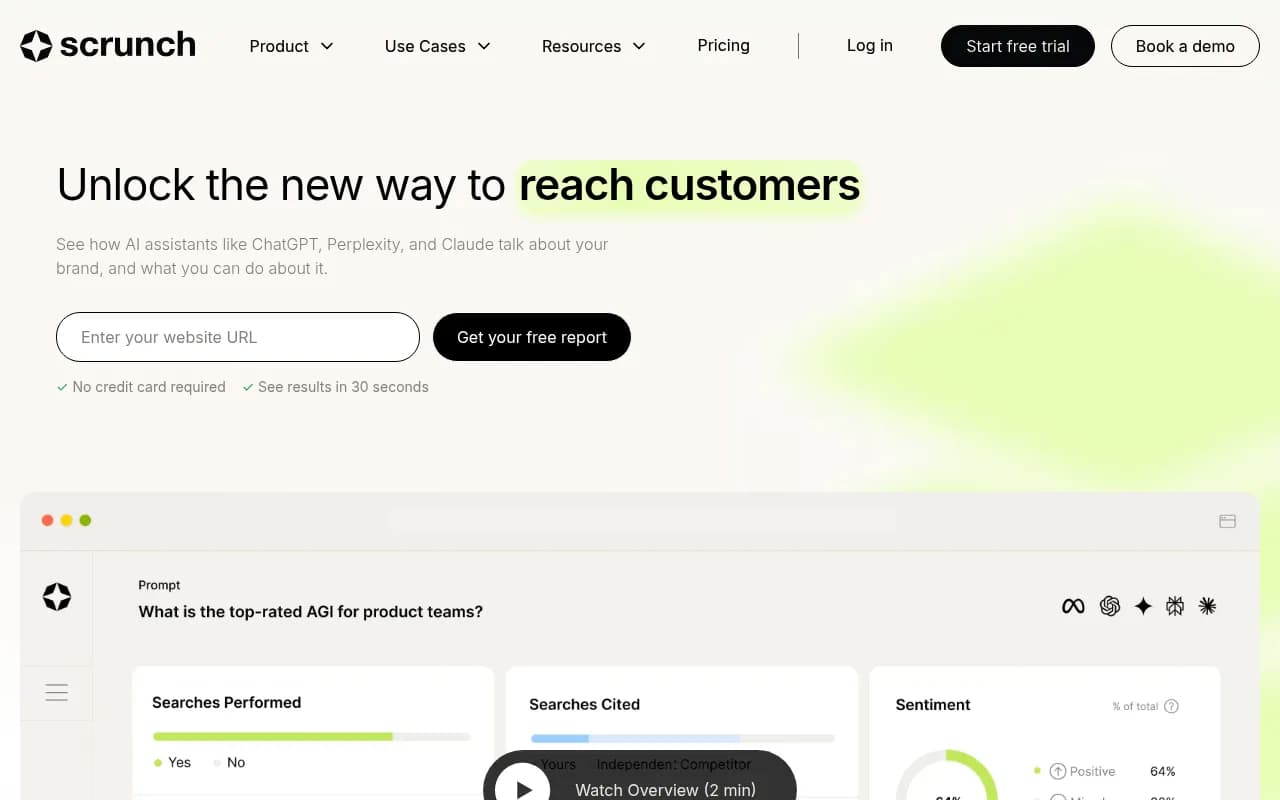
Scrunch positions itself as a "command center" for AI visibility. It has broad engine coverage, solid prompt and competitor tracking, and stakeholder-friendly reporting that makes it easy to show visibility trends week over week.
Where it's weaker: several reviews note it's better at monitoring than prescriptive optimization. It shows you what's happening more clearly than it tells you what to do about it. Starts around $250-300/month.
Otterly.AI
Otterly.AI is the budget-friendly entry point. Starting at $29/month for 15 prompts across 4 engines, it's accessible for small teams or individuals who want basic AI visibility monitoring without a big commitment.
The limitation is that it's monitoring-only. No content generation, no gap analysis, no traffic attribution. Good for awareness, not for optimization.
Otterly.AI

Peec AI
Peec AI covers 3 engines at entry level (€85/month for 50 prompts). Clean interface, straightforward monitoring. Like Otterly, it's primarily a tracking tool rather than an optimization platform.

AthenaHQ
AthenaHQ focuses on monitoring and competitive benchmarking. It's more sophisticated than Otterly but still sits on the monitoring side of the spectrum -- it doesn't have content generation or gap analysis built in.

SE Visible (SE Ranking)
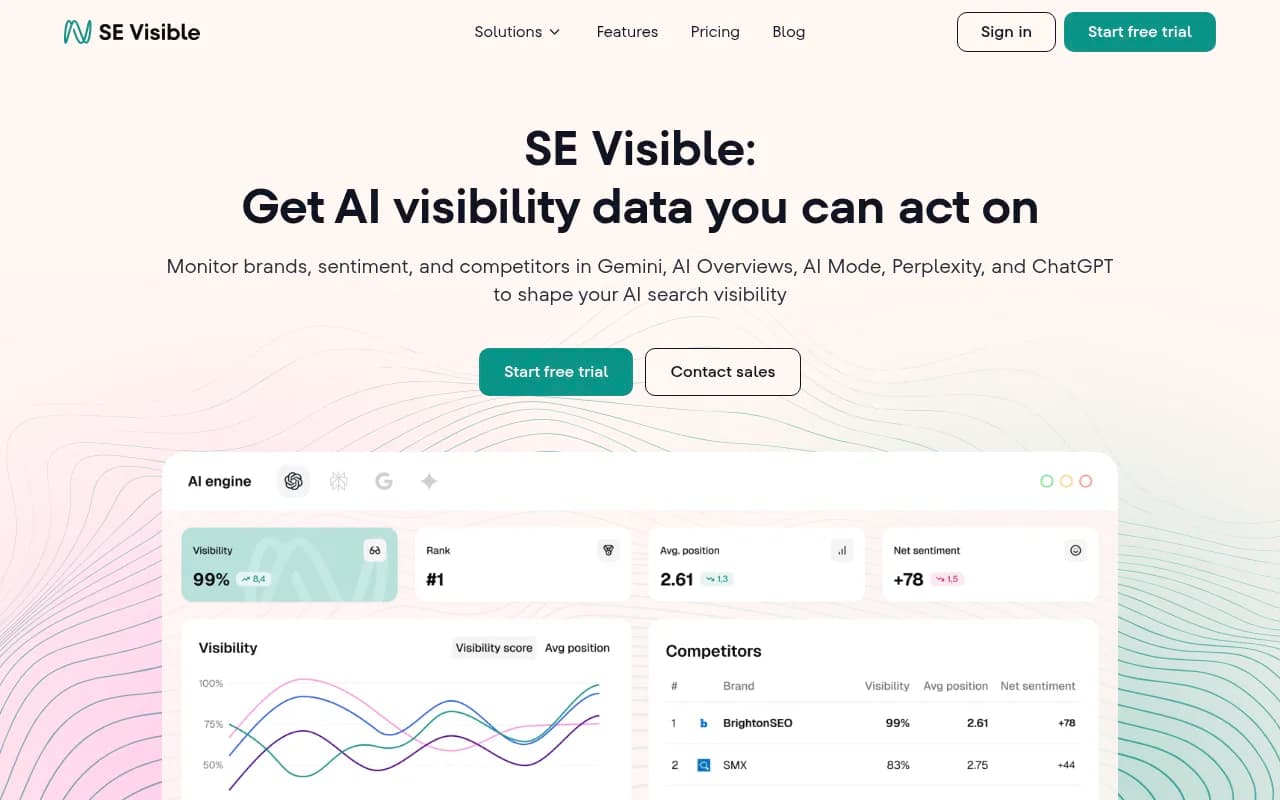
SE Ranking's AI visibility product, SE Visible, tracks brand mentions in AI search engines. It benefits from SE Ranking's existing SEO infrastructure, similar to how Semrush's AI Toolkit benefits from its parent platform. The same tradeoff applies: good integration, limited optimization depth.
Full comparison table
| Platform | AI engines covered | Custom prompts | Content generation | Traffic attribution | Crawler logs | Reddit/YouTube tracking | Starting price |
|---|---|---|---|---|---|---|---|
| Promptwatch | 10+ | Yes | Yes (built-in AI writer) | Yes (GSC, snippet, logs) | Yes | Yes | $99/mo |
| Semrush AI Toolkit | 3-4 | No (fixed) | No | No | No | No | Included in Semrush plans |
| Profound | Up to 10 | Yes | No | Limited | No | No | Custom (enterprise) |
| Scrunch AI | Up to 9 | Yes | No | Limited | No | No | ~$250/mo |
| Otterly.AI | 4 | Yes | No | No | No | No | $29/mo |
| Peec AI | 3 | Yes | No | No | No | No | €85/mo |
| AthenaHQ | 5+ | Yes | No | No | No | No | Custom |
| SE Visible | 4 | Limited | No | No | No | No | Bundled with SE Ranking |
| Ahrefs Brand Radar | Up to 6 | No (fixed) | No | No | No | No | €654/mo |
Ahrefs: the other traditional SEO tool in the mix
Worth mentioning separately: Ahrefs launched Brand Radar as its AI visibility offering. Like Semrush, it uses fixed prompts (no customization), and there's no AI traffic attribution. The "All platforms" tier covering 6 engines runs €654/month -- significantly more expensive than dedicated platforms with better feature sets.
If you're an Ahrefs power user, Brand Radar gives you a baseline. But for the same budget, you'd get considerably more from a dedicated GEO platform.
The monitoring vs. optimization gap
The most important distinction in this market isn't between platforms -- it's between what monitoring-only tools and optimization platforms actually do for you.
Monitoring tools (Semrush AI Toolkit, Otterly.AI, Peec AI, SE Visible, Ahrefs Brand Radar) answer one question: "How visible are we in AI search right now?" That's useful data. But knowing your visibility score is 23% while your competitor's is 41% doesn't tell you what to do next.
Optimization platforms (Promptwatch, and to varying degrees Profound and Scrunch) answer the follow-up questions: "Which prompts are we missing? What content would close those gaps? Is our new content actually getting cited? Is that driving traffic?"
For teams that are just starting to measure AI visibility, monitoring is fine. For teams that have been tracking for a few months and want to actually move the needle, the monitoring-only tools start to feel like a dashboard without a steering wheel.
When Semrush is the right choice
There are real scenarios where sticking with Semrush's AI Toolkit makes sense:
- You're already a Semrush subscriber and want a first look at AI visibility without adding another tool or budget line
- Your team is early in the AI search journey and needs to build a business case before investing in a dedicated platform
- You primarily care about Google AI Overviews (where Semrush's integration with traditional SEO data is actually useful)
- You have limited bandwidth and want everything in one place, even if the AI visibility features are shallower
What Semrush is not the right choice for: teams that need to understand why they're not being cited, teams that want to create content specifically engineered for AI citations, or teams that need to connect AI visibility to revenue.
When you need a dedicated GEO platform
The case for a dedicated platform gets stronger as your requirements get more specific:
- You need to track more than 4-5 AI engines (your customers use ChatGPT, Perplexity, Claude, and Gemini -- not just one)
- You want to build custom prompt sets that reflect how your actual buyers search, not a generic set
- You need to identify content gaps and act on them, not just observe them
- You need to show leadership that AI visibility is driving traffic and revenue, not just impressions
- You're running an agency and need multi-client reporting with white-label options
For most of these scenarios, Promptwatch is the strongest option in 2026 -- it's the only platform that covers the full loop from gap identification to content creation to traffic attribution. Profound is worth evaluating if you're enterprise-scale and need governance features. Scrunch is a solid middle ground for teams that want broad coverage and good reporting without the complexity of an enterprise platform.
Pricing reality check
One thing that surprises people: dedicated GEO platforms aren't necessarily more expensive than Semrush at comparable feature levels.
Semrush's full platform (which includes the AI Toolkit) runs $139-$499/month for standard plans. The AI visibility features are included, but they're limited. Promptwatch's Professional plan at $249/month gives you 150 prompts, 10+ AI engines, crawler logs, content generation, and traffic attribution -- features that don't exist in Semrush at any price point.
The comparison isn't really "Semrush AI Toolkit vs. Promptwatch at $249." It's "what does $249 buy you in terms of actual AI visibility capability?" On that measure, dedicated platforms win clearly.
The bottom line
Semrush is a great SEO platform that added AI visibility features. Those features are useful if you're already in the ecosystem and want a baseline. But "useful baseline" and "competitive advantage" are different things.
The brands that are winning in AI search in 2026 aren't just monitoring their visibility -- they're finding gaps, creating content engineered to get cited, and tracking whether that content is driving revenue. That loop requires a dedicated platform.
If you're evaluating options, start with a free trial of Promptwatch to see what the full optimization workflow looks like. If you're enterprise-scale with governance requirements, add Profound to your shortlist. If budget is the primary constraint, Otterly.AI or Scrunch give you solid monitoring at lower price points.
Semrush is worth keeping for traditional SEO. For AI search, it's a starting point -- not a destination.