Key takeaways
- Evertune is a legitimate enterprise GEO platform with strong prompt volume and source influence analytics, but it's primarily a monitoring and measurement tool — it doesn't help you create content that gets cited.
- Most GEO platforms in 2026 share the same limitation: they show you where you're invisible but leave you to figure out what to do about it.
- Promptwatch is the only platform in this comparison that closes the full loop — from gap analysis to AI content generation to traffic attribution.
- If you're an enterprise brand that just needs executive-level reporting, Evertune is a reasonable choice. If you want to actually improve your AI visibility, you need a platform built around optimization, not just observation.
- Pricing matters: Evertune doesn't publish pricing (a red flag for most teams), while Promptwatch starts at $99/month with a free trial.
The GEO platform market has exploded. Two years ago there were maybe five tools worth considering. Now there are dozens, each claiming to be the definitive way to track and improve your brand's visibility in ChatGPT, Perplexity, Google AI Overviews, and the rest.
Evertune is one of the more prominent names in that crowd. It raised $19M in a Series A in August 2025, has a polished enterprise pitch, and publishes its own "Top 15 GEO Platforms" list (where it conveniently ranks itself #1). That kind of self-promotion deserves some scrutiny.
This guide cuts through the noise. We look at what Evertune actually does, where it genuinely excels, and how it stacks up against the platforms that are actually competing for the same buyers in 2026.
What Evertune actually does
Evertune positions itself as an enterprise GEO platform for Fortune 500 brands. Its core pitch is scale: it claims to process over 1 million prompts per month per brand using base model API access, which gives it a larger data sample than tools that rely on UI scraping or smaller API samples.
The platform's standout feature is source influence analytics — it tries to show you which sources (domains, Reddit threads, specific pages) are influencing AI-generated responses for your category. That's genuinely useful if you want to understand why a competitor keeps getting cited.
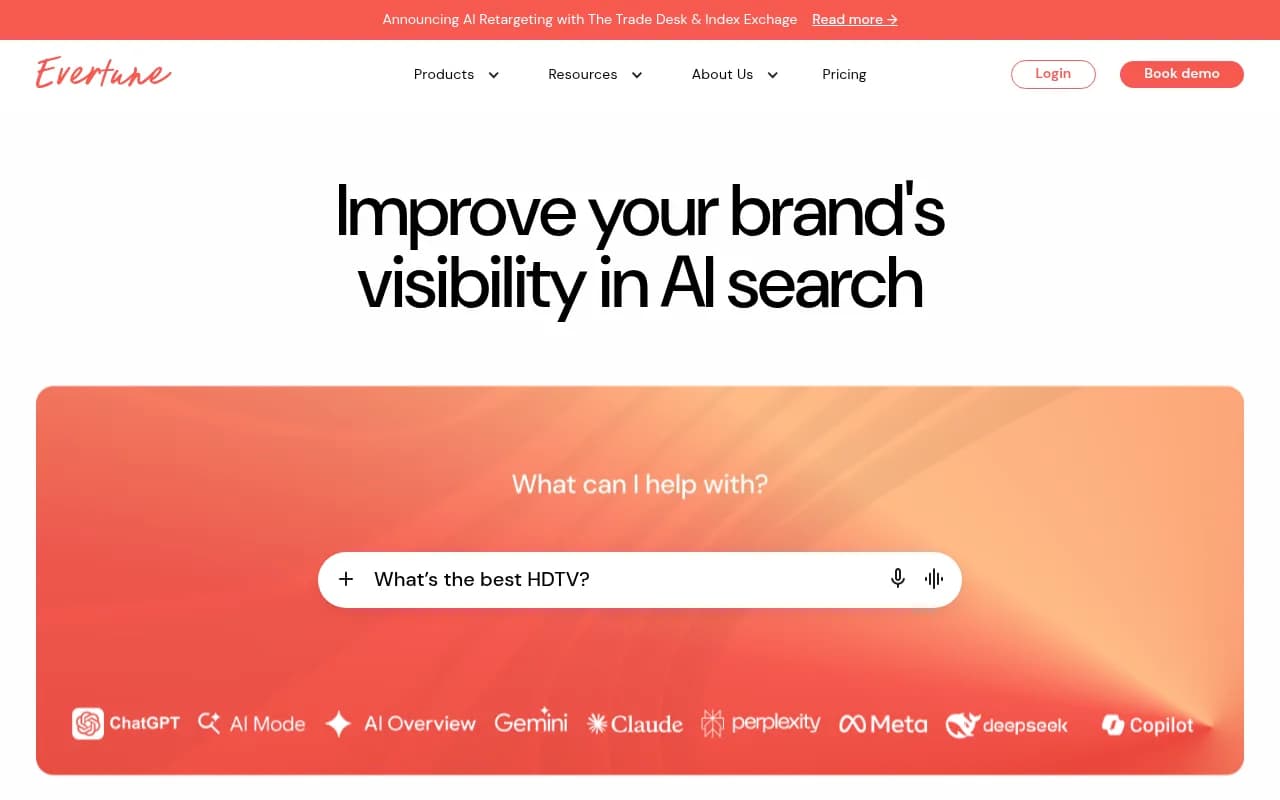
Where Evertune focuses most of its energy is measurement and executive reporting. One analysis from ZipTie.dev described it as "targeting the executive measurement and reporting use case specifically" — which is a polite way of saying it's built for dashboards and quarterly business reviews, not for the marketing team trying to fix their AI visibility this week.
The platform covers 6 AI engines with daily updates, and integrations are limited to basic CSV exports. No GA4 connection, no Slack alerts, no server log analysis. For a $19M-funded enterprise tool, that's a meaningful gap.
Pricing is undisclosed, which almost always means "expensive and negotiated per contract."
The core problem with monitoring-only platforms
Before we get into the full comparison, it's worth naming the structural issue with most GEO tools in 2026, Evertune included.
They tell you what's happening. They don't help you change it.
You can see that ChatGPT mentions your competitor 3x more often than you. You can see which prompts you're invisible for. You can see citation drift month over month. But then what? Most platforms hand you a report and wish you luck.
The platforms that are actually moving the needle for brands are the ones that complete the loop: find the gap, create content that fills it, track whether it worked.
Head-to-head comparison
Here's how Evertune stacks up against the main alternatives across the dimensions that matter most.
| Platform | AI engines monitored | Content generation | Crawler logs | Traffic attribution | Prompt volume data | Pricing (starting) |
|---|---|---|---|---|---|---|
| Evertune | 6 | No | No | No | Yes (1M+ prompts/mo) | Undisclosed |
| Promptwatch | 10+ | Yes (built-in AI writer) | Yes | Yes (GSC, snippet, logs) | Yes (with difficulty scores) | $99/mo |
| Profound | 9+ | No | Yes (server logs) | Limited | Yes | Custom enterprise |
| AthenaHQ | 6+ | No | No | No | Limited | Custom |
| Scrunch | 7+ | No | No | No | Limited | $250-500/mo |
| Otterly.AI | 5 | No | No | No | No | Low entry price |
| Peec AI | 6+ | No | No | No | Basic | Affordable |
A few things jump out from that table. Evertune's prompt volume claim (1M+ per brand per month) is legitimately impressive and differentiates it from lighter tools. But it has no content generation, no crawler logs, and no traffic attribution. You're paying for data, not outcomes.
Promptwatch: the platform built around the full loop
Promptwatch takes a different approach. Instead of just showing you where you rank in AI responses, it's built around a three-step cycle: find the gaps, create content that fills them, and track whether your visibility actually improved.

The Answer Gap Analysis shows you exactly which prompts your competitors are visible for that you're not — not just as a list, but with the specific content angles and topics that AI models are looking for. The built-in AI writing agent then generates articles, listicles, and comparisons grounded in real citation data (880M+ citations analyzed), prompt volumes, and competitor analysis. This isn't generic content — it's engineered to get cited by ChatGPT, Claude, Perplexity, and others.
Then you close the loop with traffic attribution: a code snippet, GSC integration, or server log analysis that connects AI visibility to actual revenue.
Promptwatch also covers more AI engines than Evertune (10+ vs 6), includes real-time AI crawler logs showing which pages ChatGPT and Perplexity are reading on your site, and tracks Reddit and YouTube discussions that directly influence AI recommendations — a channel most competitors ignore entirely.
Pricing starts at $99/month for the Essential plan (1 site, 50 prompts, 5 articles), $249/month for Professional (2 sites, 150 prompts, 15 articles, crawler logs), and $579/month for Business (5 sites, 350 prompts, 30 articles). A free trial is available. Compare that to Evertune's undisclosed enterprise pricing.
Profound: the technical depth option
Profound is the other serious enterprise contender. It uses a combination of front-end scraping and server log analysis, covers 9+ AI engines, and has strong integrations (GA4, Tableau, Slack, Vercel, AWS, Cloudflare). It's SOC 2 Type II certified, which matters for enterprise procurement.
Profound

The honest take: Profound is a more technically rigorous monitoring platform than Evertune. But it's still primarily a monitoring platform. It doesn't generate content or tell you what to write — it shows you the data and expects your team to act on it.
One independent comparison noted that Profound's "real-world data capture provides more actionable insights than API-based sampling alone," which is a fair point. The server log approach gives you a different (and arguably more reliable) signal than pure API sampling.
Profound is best for enterprise teams with dedicated SEO resources who want deep technical data and can act on it themselves. It's not the right fit for teams that need the platform to help them actually create content.
AthenaHQ: monitoring with a LinkedIn twist
AthenaHQ raised $2.7M in a seed round in June 2025 and has carved out a niche with its LinkedIn outreach integration — the idea being that you can use AI visibility data to inform your outreach strategy.

It's an interesting angle, but the platform is fundamentally monitoring-focused. No content generation, no crawler logs, no traffic attribution. The LinkedIn integration is clever but doesn't address the core problem of actually improving your AI visibility.
Scrunch: hallucination detection as a differentiator
Scrunch raised $19M (same as Evertune) and focuses on misinformation and hallucination detection — tracking when AI models say incorrect things about your brand. That's a real problem worth solving, especially for regulated industries.
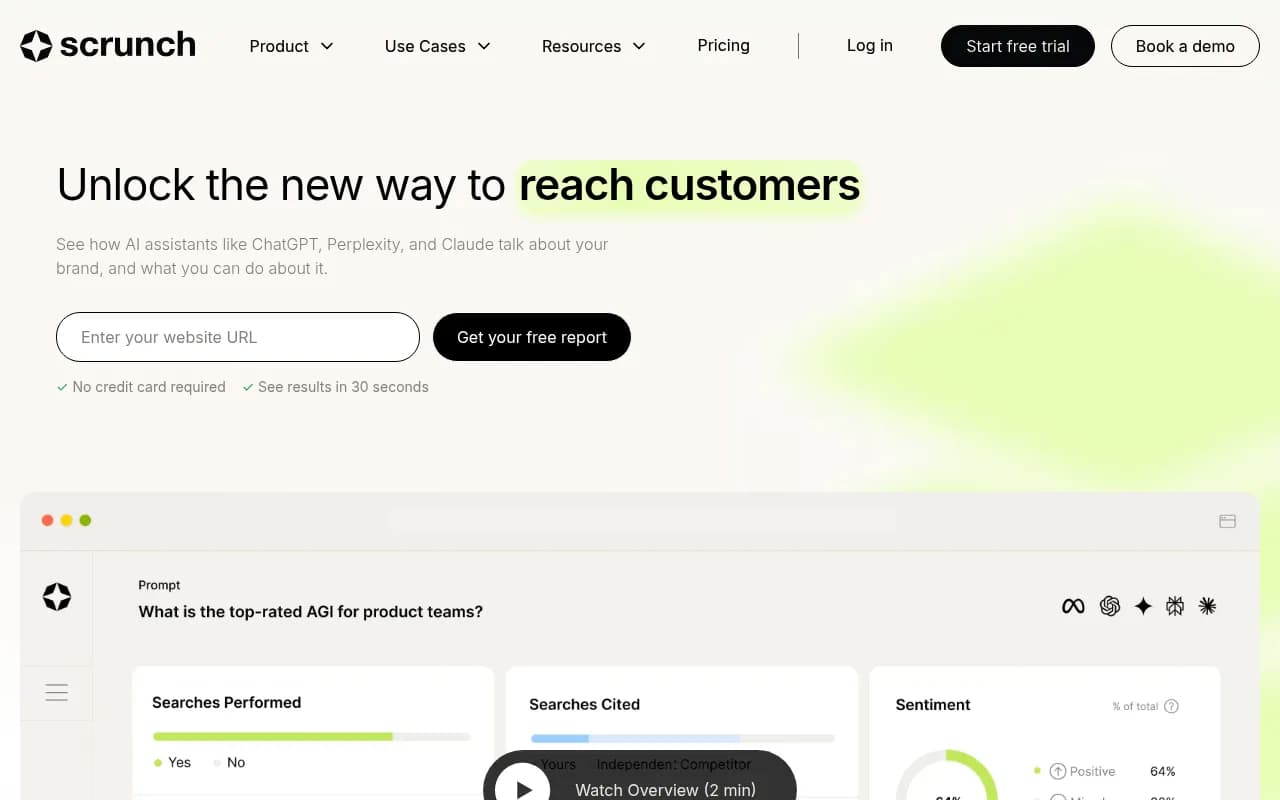
Pricing runs $250-500/month. Coverage is solid at 7+ engines. But like most competitors, it stops at monitoring. If AI is saying something wrong about your brand, Scrunch will tell you — but it won't help you publish the content that corrects the record.
Otterly.AI and Peec AI: the budget end
These two cover the lower end of the market. Otterly.AI is bootstrapped, has a low entry price, and covers around 5 AI engines. Peec AI raised $29.1M (Series A, November 2025) and offers affordable structured reporting across 6+ engines.
Otterly.AI


Both are reasonable starting points for teams that want basic monitoring without a big budget. Neither has content generation, crawler logs, or meaningful traffic attribution. They're dashboards, not optimization platforms.
Who should actually use Evertune?
Evertune makes sense in a specific scenario: you're a Fortune 500 brand, you have a dedicated analytics team, you need executive-level reporting on AI visibility, and you're willing to pay enterprise pricing for a polished dashboard with high prompt volume.
If that's you, Evertune's 1M+ prompts per month per brand and source influence analytics are genuinely differentiated. The scale of data collection is real.
But if you're a marketing team, an SEO team, or a digital agency that needs to actually move the needle on AI visibility — not just report on it — Evertune leaves you with a lot of work still to do. You'll get a clear picture of the problem. You won't get much help solving it.
The broader landscape
A few other platforms worth knowing about:
AirOps ($60M total funding) focuses on content engineering workflows — it's more of a content production platform than a GEO tracker, but it's relevant if you're building content at scale for AI search.
Goodie AI is a lightweight monitoring tool focused on brand alerts. Simple, cheap, limited.
Conductor is an established SEO platform that has added AEO tracking. Solid for teams already using it for traditional SEO, but not purpose-built for GEO.
Semrush and Ahrefs both have AI search features, but they're traditional SEO tools at heart. Semrush uses fixed prompts, Ahrefs Brand Radar has fixed prompts and no AI traffic attribution. Neither is purpose-built for the GEO use case.
How to choose
The right platform depends on what you actually need to accomplish.
If your goal is executive reporting and you have a large budget: Evertune or Profound are worth evaluating. Both offer enterprise-grade data at scale.
If your goal is to actually improve your AI visibility — find gaps, create content, track results: Promptwatch is the only platform in this comparison that does all three. The pricing is transparent, the free trial lets you test before committing, and the built-in content generation means you're not just watching your competitors get cited while you wait for your content team to act.
If you're on a tight budget and just want basic monitoring: Otterly.AI or Peec AI will get you started.
The honest summary: most GEO platforms in 2026 are still monitoring tools with good dashboards. The category is maturing, and the gap between "we show you data" and "we help you act on it" is where the real competition is happening. Evertune is a strong monitoring platform. Promptwatch is an optimization platform. Those are different products solving different problems — and knowing which problem you actually have is the most important decision you'll make when choosing between them.