Key takeaways
- BrightEdge is an enterprise SEO platform built for large-scale organic search management -- it was not designed for AI visibility or GEO, and its AI monitoring capabilities are limited compared to dedicated platforms.
- Dedicated GEO platforms like Promptwatch, Profound, and Conductor track brand citations across 10+ AI engines, while BrightEdge primarily covers Google AI Overviews through its existing organic reporting.
- The biggest gap with BrightEdge isn't monitoring -- it's what happens after. Most enterprise SEO tools show you data but don't help you create content engineered to get cited by ChatGPT, Perplexity, or Claude.
- BrightEdge pricing starts at $1,000+/month (custom enterprise contracts), making it one of the most expensive options in this comparison.
- If your goal is AI search visibility specifically, you'll get more for less with a purpose-built GEO platform.
The SEO world has split into two camps. On one side: legacy enterprise platforms built around Google rankings, keyword tracking, and content audits. On the other: a new generation of GEO (Generative Engine Optimization) tools built specifically for the world where ChatGPT, Perplexity, and Claude are answering your customers' questions before they ever reach your website.
BrightEdge sits firmly in the first camp. It's one of the most established enterprise SEO platforms around, trusted by Fortune 500 marketing teams for organic search performance, content forecasting, and large-scale technical SEO. But "established" doesn't automatically mean "equipped for what's happening right now."
This guide breaks down exactly where BrightEdge stands in 2026, what it does well, where it falls short on AI visibility, and which platforms are better suited if GEO is your priority.
What BrightEdge actually does
BrightEdge is an enterprise SEO platform. Its core strengths are:
- Organic keyword tracking at scale (thousands of keywords across large websites)
- ContentIQ: site auditing that identifies technical SEO issues and content gaps
- Share of Voice reporting across competitors in organic search
- Revenue forecasting tied to SEO initiatives
- Data Cube: a large proprietary dataset for keyword and content research
- Integration with Google Analytics, Adobe Analytics, and other enterprise data sources
It's genuinely good at these things. If you're managing SEO for a 50,000-page enterprise website with multiple stakeholders, BrightEdge has the reporting depth and workflow tools to handle that complexity.
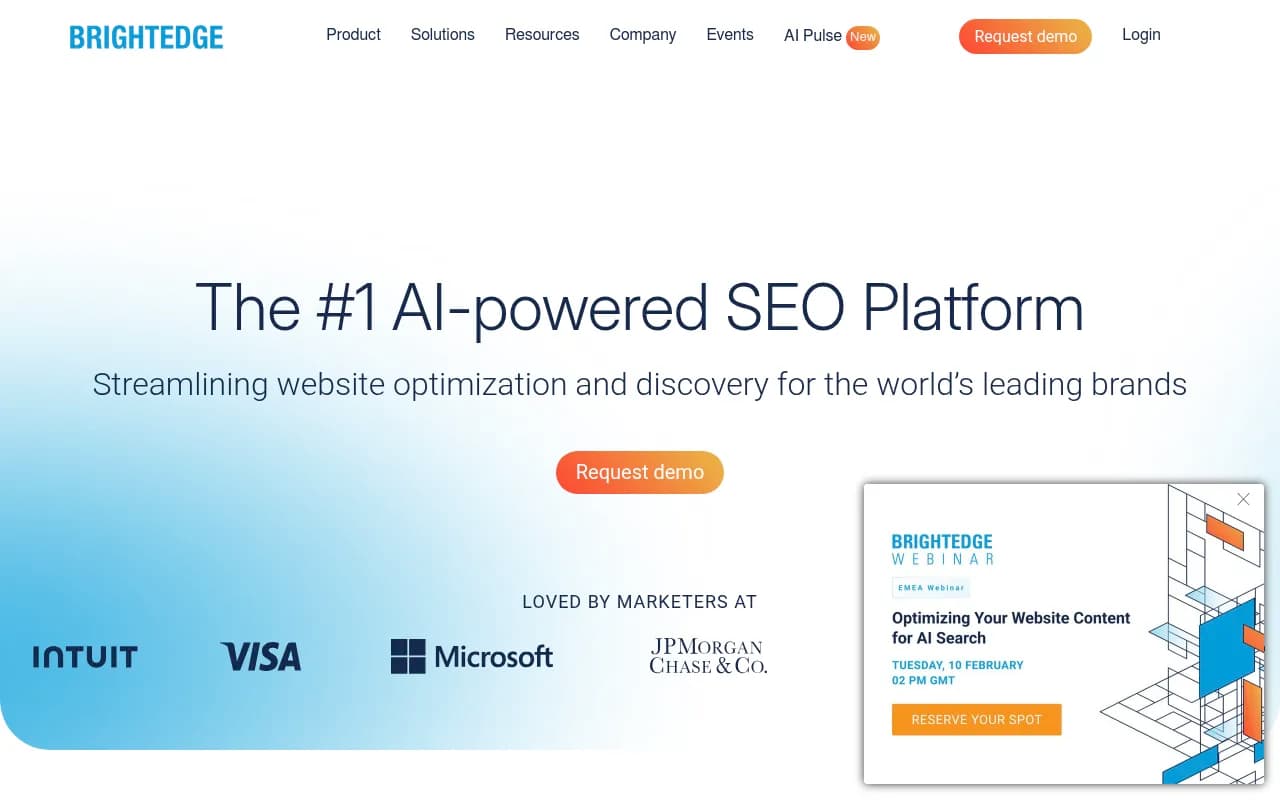
The problem is that BrightEdge was architected for a Google-centric world. Its AI visibility features are largely bolted on -- primarily surfacing Google AI Overview appearances through its existing organic tracking. It doesn't have dedicated monitoring for ChatGPT, Claude, Perplexity, Gemini, Grok, or DeepSeek. It doesn't track which AI models are citing your pages. It doesn't tell you why a competitor is being recommended by AI when you're not.
For a team whose primary concern is "how do we rank in Google?" -- BrightEdge is a reasonable choice. For a team asking "why is our competitor showing up in ChatGPT and we're not?" -- it's the wrong tool.
The AI visibility gap in enterprise SEO platforms
This isn't a BrightEdge-specific problem. Most enterprise SEO platforms -- Conductor, seoClarity, Searchmetrics -- were built before generative AI search became a real channel. They've added AI features, but the underlying architecture wasn't designed for it.
The fundamental difference between traditional SEO tracking and AI visibility monitoring:
- Traditional SEO: you track keyword rankings in Google's index. The signal is a position number.
- AI visibility: you track whether an AI model cites your brand when answering a question. The signal is a citation, a mention, or a recommendation in a conversational response.
These are completely different data problems. Scraping Google's SERPs is well-understood. Querying ChatGPT, Claude, and Perplexity at scale -- with different personas, in different languages, across thousands of prompts -- requires a different infrastructure entirely.
Legacy platforms have tried to adapt. But there's a meaningful difference between "we added an AI Overviews tab" and "we built a platform from scratch to track AI citations."
Platform-by-platform comparison
Here's how BrightEdge stacks up against the leading GEO and AI visibility platforms in 2026.
| Platform | AI engines monitored | Content generation | Crawler logs | Prompt intelligence | Pricing |
|---|---|---|---|---|---|
| Promptwatch | 10+ (ChatGPT, Claude, Perplexity, Gemini, Grok, DeepSeek, Copilot, Meta AI, Google AI Overviews, Google AI Mode) | Yes -- AI writing agent grounded in citation data | Yes | Yes (volume, difficulty, fan-outs) | From $99/mo |
| BrightEdge | Limited (primarily Google AI Overviews) | No (content audits only) | No | No | $1,000+/mo (custom) |
| Profound | 9+ AI engines | No | No | Limited | Custom enterprise |
| Conductor | Multiple AI engines | Limited | No | No | Custom enterprise |
| Semrush | Google AI Overviews + limited LLM tracking | Yes (ContentShake) | No | No | From $139/mo |
| Otterly.AI | ChatGPT, Perplexity, Google AI Overviews | No | No | No | From ~$99/mo |
| seoClarity | Multiple AI engines | Limited | No | No | Custom enterprise |
| Ahrefs | Brand Radar (limited LLM tracking) | No | No | No | From $129/mo |
A few things stand out from this table. First, BrightEdge's AI monitoring is genuinely limited -- primarily Google AI Overviews, with no dedicated tracking across the major LLMs that are actually driving purchase decisions. Second, its price point is the highest in the comparison, which is hard to justify for AI visibility use cases specifically. Third, almost every platform in this list -- BrightEdge included -- stops at monitoring. They show you data. They don't help you fix the problem.
The platforms worth considering in 2026
Promptwatch
Promptwatch is the platform that most directly addresses what's missing from BrightEdge's AI offering. It monitors 10+ AI engines including ChatGPT, Claude, Perplexity, Gemini, Grok, DeepSeek, Copilot, Meta AI, and both Google AI Overviews and Google AI Mode. But the monitoring is only part of it.
The more important distinction: Promptwatch is built around an action loop, not just a dashboard. It identifies which prompts your competitors are visible for that you're not (Answer Gap Analysis), then helps you create content specifically engineered to earn those citations (an AI writing agent trained on 880M+ real citation data points), then tracks whether your visibility scores improve as a result.
That cycle -- find gaps, generate content, track results -- is what separates it from monitoring-only tools. It also includes AI crawler logs (real-time visibility into which AI crawlers are hitting your pages and what errors they're encountering), prompt volume and difficulty scoring, Reddit and YouTube citation tracking, and ChatGPT Shopping monitoring.
Pricing starts at $99/month, which makes it accessible to teams that would never qualify for a BrightEdge contract.

Profound
Profound is a strong enterprise-grade option for teams that need deep AI visibility reporting. It covers 9+ AI engines and has solid competitive analysis features. The trade-off: it's monitoring-focused, with limited content optimization capabilities. It's a good fit for large brands that want detailed AI citation data and have separate content teams to act on it.
Profound

Conductor
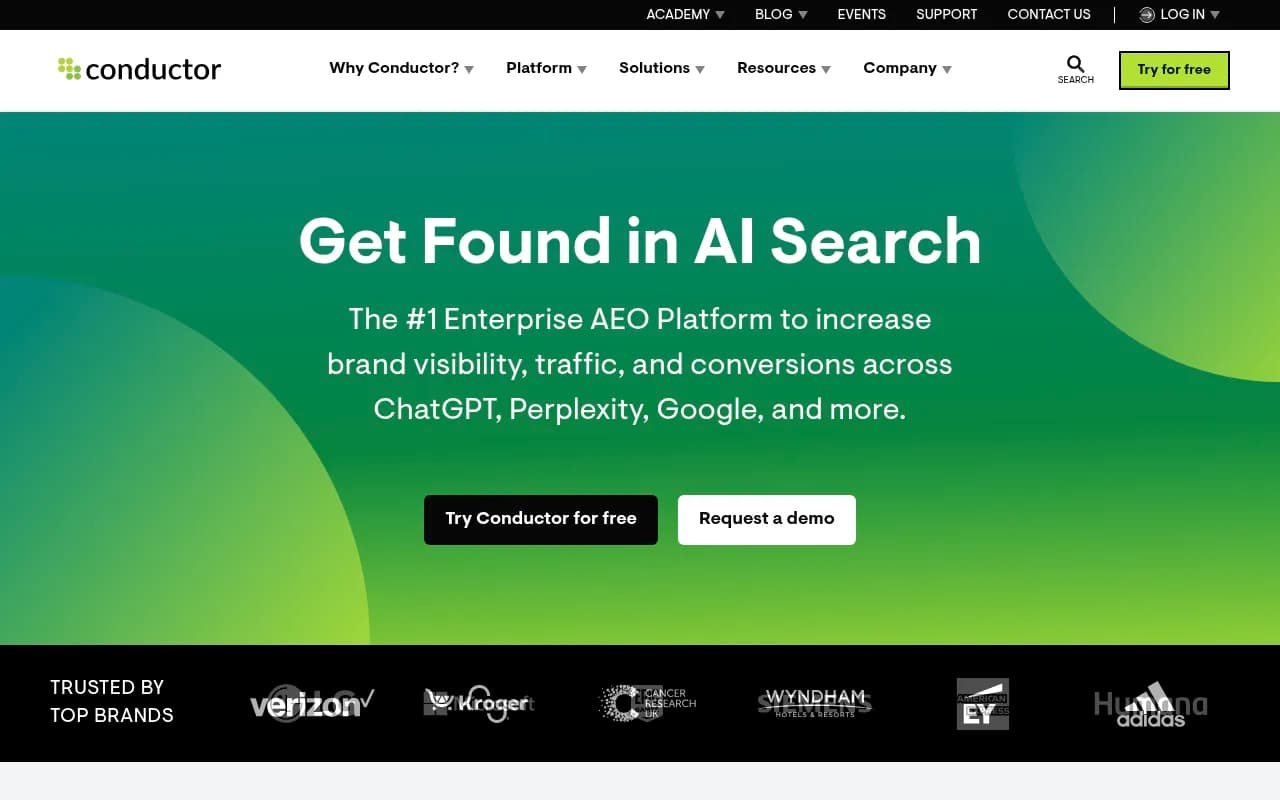
Conductor has been building out its AI search tracking features and now covers multiple AI engines with brand authority and citation monitoring. It's worth evaluating if you're already in the Conductor ecosystem for traditional SEO. Like most enterprise platforms, it's stronger on reporting than on helping you create content that earns citations.
Semrush
Semrush has added AI visibility features to its existing platform, including some LLM tracking and Google AI Overviews monitoring. The advantage: if you're already a Semrush user, you don't need a separate tool for basic AI monitoring. The limitation: Semrush uses fixed prompts rather than custom prompt sets, and there's no AI traffic attribution. It's a reasonable starting point, not a dedicated GEO platform.
Otterly.AI
Otterly.AI covers ChatGPT, Perplexity, and Google AI Overviews with a clean interface and reasonable pricing. It's a solid monitoring tool for teams that are just starting to track AI visibility. The gap: no crawler logs, no content generation, no visitor analytics. You'll see what's happening but not why, and you won't get help fixing it.
Otterly.AI

seoClarity
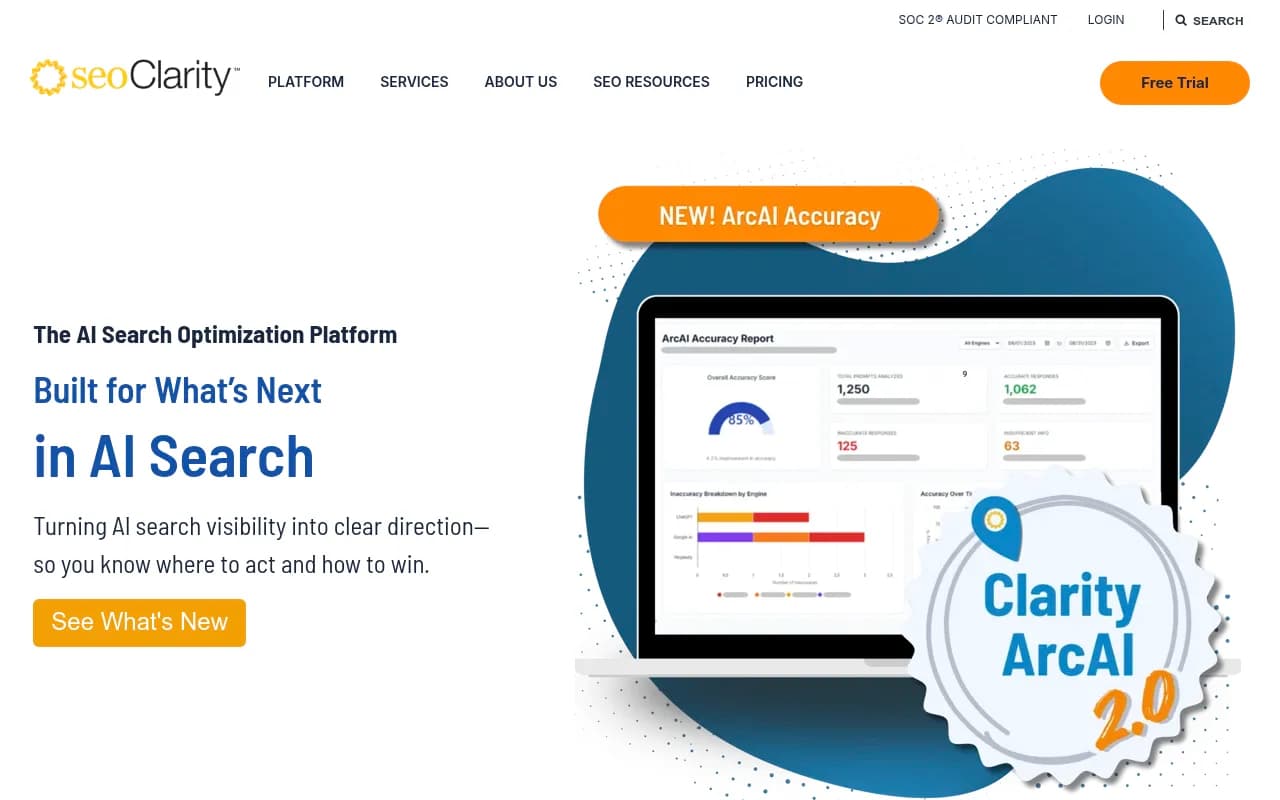
seoClarity is another enterprise SEO platform that has added AI search tracking. Its Clarity Grid feature covers multiple AI engines and it has decent competitive analysis. Like BrightEdge, it's primarily built for enterprise SEO teams and the AI features feel like additions rather than core functionality.
Ahrefs
Ahrefs added Brand Radar for AI visibility tracking, but it's limited -- fixed prompts, no AI traffic attribution, no content generation. Ahrefs remains excellent for traditional SEO research and backlink analysis. For AI visibility specifically, it's not a primary tool.
Where BrightEdge still makes sense
To be fair: BrightEdge isn't the wrong choice for everyone. There are specific scenarios where it's still a reasonable option.
If you're managing SEO for an enterprise website with thousands of pages, complex technical debt, and multiple internal stakeholders who need custom reporting -- BrightEdge's workflow tools, forecasting features, and enterprise integrations are genuinely useful. Its ContentIQ auditing is thorough. Its revenue forecasting tied to organic search is something most pure-play GEO tools don't offer.
The issue is that "enterprise SEO management" and "AI visibility optimization" are increasingly separate problems. A team that needs both will likely end up running BrightEdge for the former and a dedicated GEO platform for the latter.
If your budget forces a choice between them, the answer depends on where your customers are actually searching. For most B2B and consumer categories in 2026, AI search is no longer a future consideration -- it's driving real traffic and purchase decisions now. The Nobori.ai AI Search Visibility Statistics 2025 report found that B2B companies tracking AI search visibility jumped from 8% to 47% in a single year. That's not a trend to wait on.
What to look for in a GEO platform (beyond BrightEdge)
When evaluating any AI visibility platform, these are the questions that actually matter:
Which AI engines does it monitor? Google AI Overviews alone isn't enough. ChatGPT, Perplexity, Claude, and Gemini are all driving meaningful traffic. A platform that only covers one or two of these is leaving you blind to a significant portion of AI-influenced decisions.
Does it help you fix problems or just show them? Most platforms stop at monitoring. They'll tell you that a competitor is being cited more than you. They won't tell you what content to create, or help you create it. The gap between "here's the data" and "here's what to do" is where most teams get stuck.
Does it track AI crawler activity? Knowing that an AI model isn't citing your pages is one thing. Knowing that its crawler is hitting your site but encountering errors -- or not crawling certain pages at all -- is a different and more actionable signal. Very few platforms offer this.
Can it connect AI visibility to actual traffic and revenue? Visibility scores are useful. Revenue attribution is better. Look for platforms that can connect AI citations to actual sessions and conversions, whether through a code snippet, GSC integration, or server log analysis.
What's the prompt coverage? A platform that tracks 10 prompts will give you a very different picture than one tracking 150+ prompts with volume and difficulty data. Make sure the prompt set matches how your actual customers search.
The honest verdict on BrightEdge for AI visibility
BrightEdge is a well-built enterprise SEO platform that wasn't designed for the AI search era. Its AI visibility features are limited to Google AI Overviews, its pricing is among the highest in the market, and it doesn't offer the content generation or optimization capabilities that GEO requires.
For teams whose primary need is AI visibility -- tracking citations across ChatGPT, Claude, Perplexity, and other LLMs, understanding why competitors are being recommended, and creating content that earns those citations -- BrightEdge is not the right tool. A dedicated GEO platform will give you more relevant data, more actionable insights, and almost certainly a lower price tag.
For teams that need enterprise-scale organic search management and are willing to run a separate tool for AI visibility, BrightEdge can still play a role. Just don't expect it to solve the AI visibility problem on its own.
The platforms that are actually built for this problem -- Promptwatch, Profound, Conductor -- approach AI search as a first-class problem, not a feature addition. That architectural difference matters more than any individual feature comparison.