Key takeaways
- Searchmetrics is a mature enterprise SEO platform that has added AEO capabilities, but it was built for traditional search and shows its age when compared to platforms designed from the ground up for AI visibility.
- The GEO/AEO category has exploded in 2025-2026, with purpose-built tools now covering everything from AI crawler logs to content generation grounded in citation data.
- Most monitoring-only tools (Otterly.AI, Peec AI, SE Visible) show you where you're invisible but leave you to figure out the fix yourself.
- The strongest platforms in 2026 close the full loop: find gaps, generate content, track results.
- For teams that need to go beyond tracking and actually improve their AI search presence, Promptwatch is the only platform rated a "Leader" across all GEO categories in a 2026 comparison of 12 platforms.
What Searchmetrics actually does in 2026
Searchmetrics has been around since 2009. For a long time it was one of the go-to enterprise SEO suites, known for its content experience module and competitive benchmarking. Over the past two years it has repositioned itself as an "AEO platform" -- adding AI search visibility tracking on top of its traditional rank tracking and content optimization tools.
What that means in practice: you can monitor brand mentions across some AI engines, track how your content performs in AI-generated answers, and use the existing content suite to optimize pages. The platform is genuinely capable for large enterprise teams that already live inside the Searchmetrics ecosystem.
But there are real limitations worth naming:
- The AI visibility layer feels bolted on rather than native. The core product was built around Google rankings, and the AI tracking features reflect that heritage.
- Pricing is enterprise-only with no self-serve option. You need to book a demo to get a number, which makes it hard to evaluate quickly.
- The platform does not have AI crawler log monitoring, Reddit/YouTube citation tracking, or a built-in content generation engine trained on citation data.
- Coverage of AI engines lags behind dedicated GEO platforms. Most purpose-built tools now track 8-11 models simultaneously.
None of this makes Searchmetrics bad. It makes it a specific kind of tool -- well-suited to large enterprises that want AI visibility layered into an existing SEO workflow, less suited to teams that need to move fast and optimize specifically for AI search.
The GEO/AEO landscape in 2026
The category has matured quickly. In 2024, most tools were basic dashboards showing brand mention rates across ChatGPT and Perplexity. By 2026, the leading platforms have moved well beyond that.
The key dimensions to evaluate now are:
- How many AI engines does it track, and which ones?
- Does it go beyond monitoring to help you actually fix visibility gaps?
- Does it have prompt intelligence (volume, difficulty, query fan-outs)?
- Can it attribute AI-driven traffic back to revenue?
- Does it track AI crawler activity on your site?
Here's how the main players stack up.
Platform-by-platform breakdown
Promptwatch
Promptwatch is the platform that comes closest to a full-cycle GEO solution. Where most tools stop at monitoring, Promptwatch runs the complete loop: it identifies which prompts your competitors rank for that you don't (Answer Gap Analysis), generates content designed to get cited by AI models (using data from 880M+ citations analyzed), and then tracks whether that content actually moves your visibility scores.
It monitors 10 AI models -- ChatGPT, Perplexity, Claude, Gemini, Google AI Overviews, Google AI Mode, Meta/Llama, DeepSeek, Grok, Mistral, and Copilot. The AI Crawler Logs feature shows you exactly which pages ChatGPT, Claude, and Perplexity are crawling on your site, how often, and what errors they're hitting. That's something most competitors don't offer at all.
Other features worth noting: ChatGPT Shopping tracking, Reddit and YouTube citation analysis, competitor heatmaps, prompt volume and difficulty scoring, and query fan-outs that show how a single prompt branches into sub-queries.
Pricing starts at $99/month (Essential: 1 site, 50 prompts, 5 articles), $249/month (Professional: 2 sites, 150 prompts, crawler logs), and $579/month (Business: 5 sites, 350 prompts, 30 articles). A free trial is available.
Promptwatch was rated the only "Leader" across all categories in a 2026 comparison of 12 GEO platforms.

Profound
Profound is a strong enterprise option with up to 10 LLMs tracked and solid share-of-voice analytics. It's particularly good for large brands that need executive-level reporting on AI visibility trends. The weakness: it's primarily a monitoring platform. There's no built-in content generation, no AI crawler logs, and no Reddit tracking. You get excellent data, then you're on your own to act on it.
Profound

Otterly.AI
Otterly is one of the more accessible entry points into AI visibility monitoring, with a Lite plan starting at $29/month. It covers 4 AI engines and gives you brand mention tracking and share of voice. Good for small teams that want to dip their toes in. But it's firmly monitoring-only -- no content tools, no crawler logs, no traffic attribution.
Otterly.AI

Peec AI
Peec AI takes a similar approach to Otterly -- clean interface, focused on brand mention tracking across ChatGPT, Perplexity, and Claude. The Starter plan is €85/month for 50 prompts across 3 engines. Solid for teams that want simple, reliable monitoring without complexity. Like Otterly, it stops at the data layer.

AthenaHQ
AthenaHQ focuses on narrative monitoring -- tracking not just whether your brand appears in AI answers, but how it's described and positioned. That's a genuinely useful angle, especially for brand teams worried about AI hallucinations or negative framing. The gap is the same as most competitors: monitoring without optimization. No content generation, no crawler logs.

SE Visible (SE Ranking)
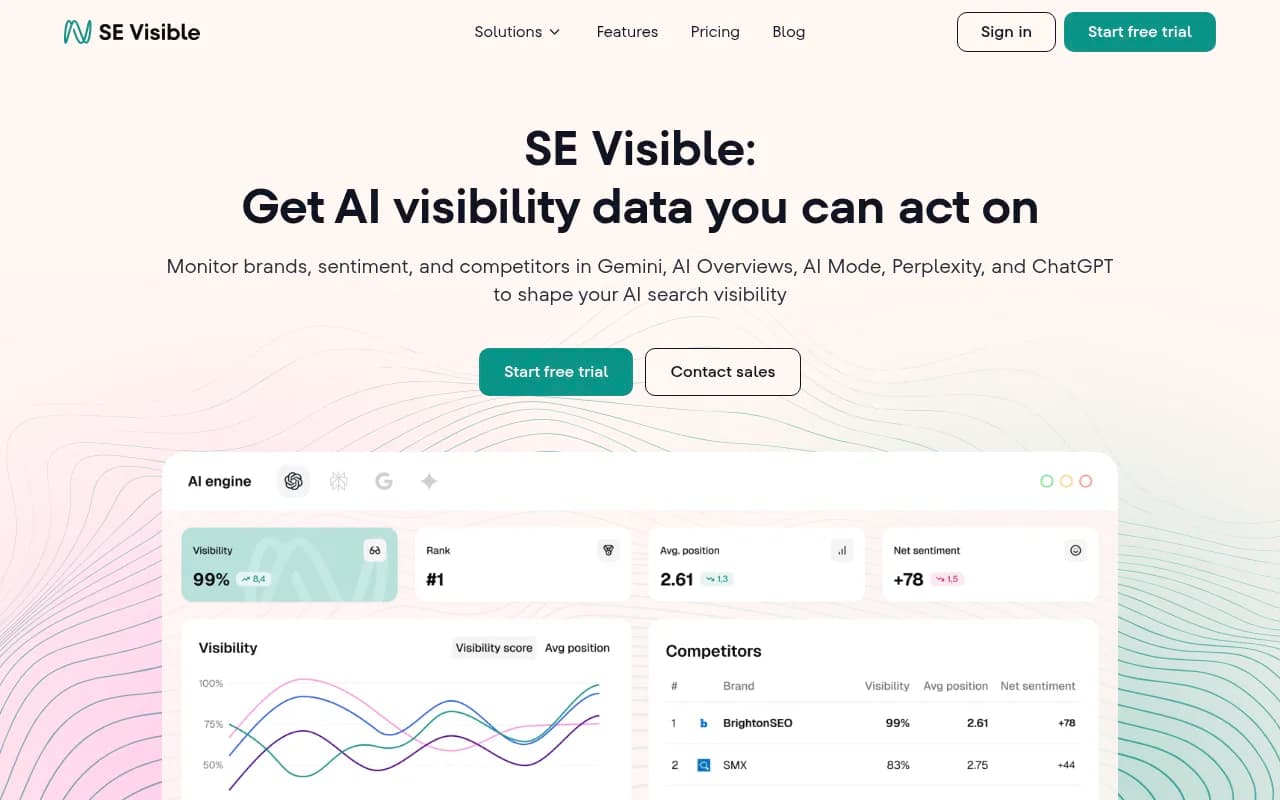
SE Visible is SE Ranking's AI visibility module, which makes it convenient if you're already in the SE Ranking ecosystem. It tracks brand mentions across AI engines and integrates with the broader rank tracking and site audit tools. The limitation is that it inherits SE Ranking's traditional SEO DNA -- AI visibility feels like an add-on rather than a core capability.
Scrunch AI
Scrunch AI covers up to 9 LLMs at the enterprise tier and has a SOC 2 Type II certification, which matters for enterprise procurement. The Core plan at $250/month includes 5 user licenses and 125 prompts. It's a reasonable mid-market option for teams that need multi-user access and compliance credentials. Content optimization features are limited compared to Promptwatch.

Semrush (AI Toolkit)
Semrush has added AI visibility tracking to its existing suite, which is convenient if you're already paying for Semrush. The AI Toolkit covers some prompt monitoring and brand mention tracking. The core issue: Semrush uses fixed prompts rather than letting you define custom prompt sets, and there's no AI traffic attribution. It's a useful addition to an existing Semrush subscription, not a standalone GEO solution.
AirOps
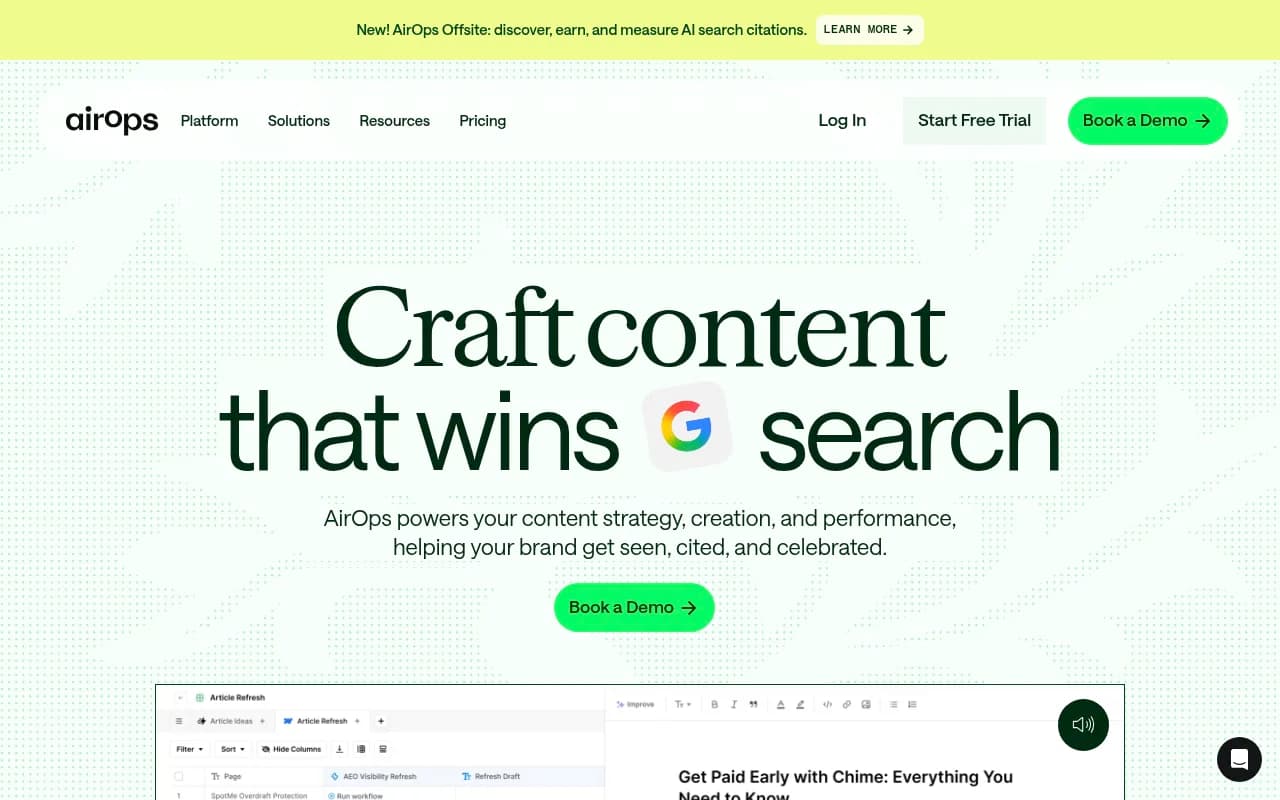
AirOps sits at the content engineering end of the spectrum -- it's built around generating and optimizing content for AI search visibility, with strong workflow automation. Less focused on monitoring and tracking, more focused on content production at scale. Good for teams with a clear content gap they need to fill quickly.
Feature comparison table
| Platform | AI engines tracked | Content generation | AI crawler logs | Reddit/YouTube tracking | Traffic attribution | Prompt intelligence | Starting price |
|---|---|---|---|---|---|---|---|
| Promptwatch | 10+ | Yes (citation-grounded) | Yes | Yes | Yes (GSC, snippet, logs) | Yes (volume, difficulty, fan-outs) | $99/mo |
| Searchmetrics | Limited | Basic content suite | No | No | Limited | No | Enterprise (custom) |
| Profound | Up to 10 | No | No | No | No | Limited | Enterprise (custom) |
| Otterly.AI | 4 | No | No | No | No | No | $29/mo |
| Peec AI | 3-4 | No | No | No | No | No | €85/mo |
| AthenaHQ | Limited | No | No | No | No | No | Custom |
| SE Visible | 4-5 | No | No | No | No | No | Bundled with SE Ranking |
| Scrunch AI | Up to 9 | No | No | No | No | No | $250/mo |
| Semrush AI Toolkit | 4-5 | Basic | No | No | No | No | Bundled with Semrush |
| AirOps | Limited | Yes | No | No | No | No | Custom |
Who should use what
The honest answer is that the right tool depends on what problem you're actually trying to solve.
If you're an enterprise team already using Searchmetrics for SEO and want to add a layer of AI visibility monitoring without switching platforms, Searchmetrics makes sense. You get continuity and integration with your existing workflow. Just go in with realistic expectations about what the AI features can and can't do.
If you want to monitor AI visibility across multiple engines without a big commitment, Otterly.AI or Peec AI are reasonable starting points. They're cheap, simple, and honest about what they are.
If you're at the stage where monitoring isn't enough -- you know you're invisible in AI search and you need to fix it -- the monitoring-only tools will frustrate you quickly. You'll see the gap but have no path to closing it. That's where Promptwatch's full-cycle approach makes a real difference: the Answer Gap Analysis shows you exactly what content you're missing, the AI writing agent generates articles grounded in citation data, and the tracking layer shows you whether it's working.
For enterprise teams that need compliance credentials, multi-user access, and broad LLM coverage, Scrunch AI or Profound are worth evaluating alongside Promptwatch.
The monitoring-only trap
One pattern worth calling out: a lot of teams buy a monitoring tool, watch their visibility scores for a few months, and then don't know what to do with the data. The tool tells them they're getting mentioned in 12% of relevant AI responses while a competitor is at 34%. That's useful information. But the tool doesn't tell them why, what content is driving the competitor's visibility, or what to publish to close the gap.
This is the core limitation of monitoring-only platforms -- and it applies to Searchmetrics' AI layer, Otterly, Peec, AthenaHQ, and most of the field. They're dashboards, not optimization engines.
The distinction matters more in AI search than it did in traditional SEO. In traditional SEO, you could look at a competitor's backlinks and reverse-engineer their strategy relatively easily. In AI search, the signals are more opaque. You need to understand which specific content pieces are being cited, which topics the AI models consider authoritative for your category, and what format and structure gets picked up. That requires more than a mention rate dashboard.
What to look for in 2026
A few capabilities that separate the serious platforms from the dashboards:
Prompt intelligence with volume data. Knowing that a prompt exists isn't enough. You need to know how often users are asking it and how competitive it is to rank for. Promptwatch provides volume estimates and difficulty scores for each prompt, plus query fan-outs that show how one prompt branches into sub-queries.
AI crawler log monitoring. If you don't know which pages the AI crawlers are actually reading, you're optimizing blind. Real-time crawler logs (showing ChatGPT, Claude, Perplexity activity on your site) let you fix indexing issues before they become visibility problems.
Citation source analysis. AI models don't just cite your homepage. They cite specific pages, Reddit threads, YouTube videos, and third-party domains. Knowing which sources are shaping AI recommendations in your category tells you where to publish and what to optimize.
Traffic attribution. Visibility scores are vanity metrics unless you can connect them to actual traffic and revenue. The best platforms offer multiple attribution methods -- Google Search Console integration, a JavaScript snippet, or server log analysis.
Bottom line
Searchmetrics is a capable enterprise SEO platform with AI visibility features added on. For teams deeply embedded in its ecosystem, it's a reasonable option for basic AI monitoring. But it wasn't built for GEO, and that shows in the feature set.
The platforms built specifically for AI search visibility -- particularly those that go beyond monitoring to help you actually create content that gets cited -- are in a different league for this specific use case. If AI search visibility is a priority for your team in 2026, the monitoring-only tools will get you data. The optimization platforms will get you results.