Key takeaways
- Rankscale AI starts at $20/month, making it the cheapest entry point in the GEO category, but its credit-based model can get expensive fast if you track multiple engines or regions
- It's primarily a monitoring tool — you get data on where your brand appears in AI answers, but no built-in way to fix the gaps
- Platforms like Promptwatch, AthenaHQ, and Profound go further by combining visibility tracking with content gap analysis and optimization
- The GEO market has attracted $300M+ in investment across 24+ platforms, so Rankscale faces serious competition at every price tier
- For teams that want to actually improve their AI visibility (not just measure it), monitoring-only tools will leave you stuck
What is Rankscale AI?
Rankscale is a GEO platform that tracks how often your brand gets cited or mentioned in AI-generated answers from ChatGPT, Perplexity, Claude, Gemini, Mistral, and DeepSeek. It launched as one of the most affordable options in the category, with plans starting at $20/month.
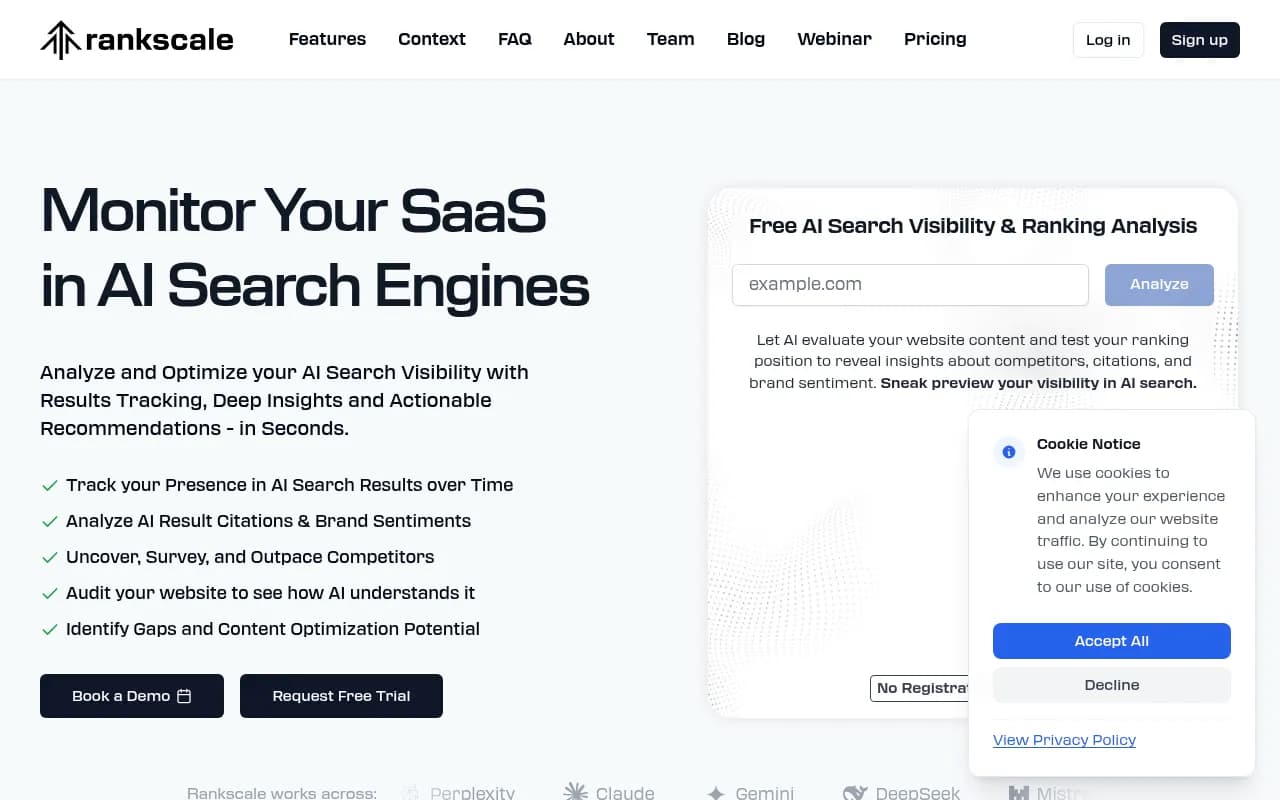
The appeal is obvious. At that price, it's accessible to solo marketers, small agencies, and teams just getting started with AI search visibility. It covers six AI engines, includes citation and sentiment analysis, and has a web audit feature that scores your site's "AI readiness." On SourceForge, it averages 4.8/5 from user reviews.
But there are real limitations worth knowing before you commit:
- The credit system means costs scale up quickly once you add more engines, more prompts, or multiple client sites
- It has a steeper learning curve than some alternatives
- Week-to-week data can be noisy because AI responses vary naturally
- Most importantly: it's a monitoring tool. It shows you where you stand, but doesn't help you change it
That last point is the crux of this comparison. The GEO space has split into two camps: trackers that show you data, and platforms that help you act on it. Rankscale sits firmly in the first camp.
How the GEO market has evolved in 2026
Two years ago, almost every GEO tool was a tracker. You'd set up prompts, run them against ChatGPT or Perplexity, and get a report showing your brand's share of voice. Useful, but passive.
The platforms that have pulled ahead in 2026 are the ones that close the loop. They don't just tell you "your brand appears in 12% of responses for this prompt" — they tell you why competitors are winning, what content is missing from your site, and then help you create it.
This shift matters because AI models cite sources based on what they've indexed. If your website doesn't have a clear, authoritative answer to a question, you won't appear. Knowing you're invisible is step one. Fixing it is the whole game.
Rankscale vs the top GEO platforms: feature comparison
Here's how Rankscale stacks up against the leading platforms across the dimensions that matter most.
| Platform | Starting price | AI engines tracked | Content optimization | Crawler logs | Traffic attribution | Best for |
|---|---|---|---|---|---|---|
| Rankscale | $20/mo | 6 (ChatGPT, Perplexity, Claude, Gemini, Mistral, DeepSeek) | No | No | No | Budget monitoring |
| Promptwatch | $99/mo | 10+ (incl. Grok, Copilot, Google AI Mode) | Yes (built-in AI writer) | Yes | Yes (GSC, snippet, logs) | Full-cycle optimization |
| AthenaHQ | $295/mo | 6 | Yes (automated publishing) | No | No | Content-first teams |
| Profound | Custom | 9+ | Limited | No | No | Enterprise monitoring |
| Peec AI | From €89/mo | 6+ | No | No | No | Marketing dashboards |
| Otterly.AI | $25/mo | 4 (Gemini/AI Mode as add-ons) | No | No | No | Budget monitoring |
| Qwairy | From €59/mo | 10+ (38+ models) | Yes (content studio) | No | No | Broad AI coverage |
Platform-by-platform breakdown
Promptwatch
Promptwatch is the platform that most directly addresses what Rankscale is missing. Where Rankscale shows you your visibility score, Promptwatch shows you the score and then gives you the tools to improve it.

The core difference is the action loop. Answer Gap Analysis identifies the specific prompts where competitors appear but you don't — not just a vague "you're losing" signal, but the exact questions and topics your site is failing to answer. From there, the built-in AI writing agent generates content engineered to get cited by ChatGPT, Claude, Perplexity, and others, grounded in 880M+ citations analyzed. Then page-level tracking shows which new pages are getting cited and by which models.
Beyond that loop, Promptwatch has capabilities Rankscale doesn't touch: real-time AI crawler logs (so you can see when ChatGPT or Claude actually crawls your site and what errors they hit), Reddit and YouTube citation tracking, ChatGPT Shopping monitoring, and traffic attribution that connects AI visibility to actual revenue via GSC integration or server log analysis.
Pricing starts at $99/month for one site and 50 prompts, which is more than Rankscale's entry tier but covers substantially more ground.
AthenaHQ
AthenaHQ is backed by Y Combinator and founded by ex-Google Search and DeepMind engineers. Its standout feature is an automated content workflow that takes you from visibility insight to published content in under four hours, using its QVEM model to estimate prompt demand.

At $295/month, it's 15x more expensive than Rankscale's entry tier. That's a significant jump, and it makes sense mainly for teams where content production speed is the bottleneck. If you're already producing content efficiently and just need better tracking and gap analysis, the price is hard to justify.
Profound
Profound has raised $55M and is the go-to choice for enterprise teams with compliance requirements (SOC 2, HIPAA certified). It tracks 9+ AI engines and has strong monitoring depth, and it's earned G2 Leader status.
Profound

The limitation is that it's still primarily a monitoring platform. You get detailed visibility data, but the content optimization workflow is limited compared to Promptwatch or AthenaHQ. For large organizations that need enterprise-grade data infrastructure and compliance, it's a strong choice. For teams that want to act on the data quickly, it may feel incomplete.
Peec AI
Peec AI has raised $29M and has a polished interface that marketing teams tend to find intuitive. Starting at €89/month, it sits between Rankscale and the enterprise tier.

It's a solid monitoring tool with clean dashboards and good share-of-voice reporting. Like Rankscale, though, it doesn't have built-in content optimization. You'll still need a separate workflow to act on what you learn.
Otterly.AI
Otterly is Rankscale's most direct competitor on price, at $25/month. It tracks ChatGPT, Perplexity, Claude, and Google AI Overviews (with Gemini and Google AI Mode as paid add-ons).
Otterly.AI

For teams that just want basic monitoring and don't need multi-engine coverage or content tools, Otterly is a reasonable alternative. The interface is simpler than Rankscale, which cuts both ways — easier to get started, but less depth for competitive analysis.
Qwairy
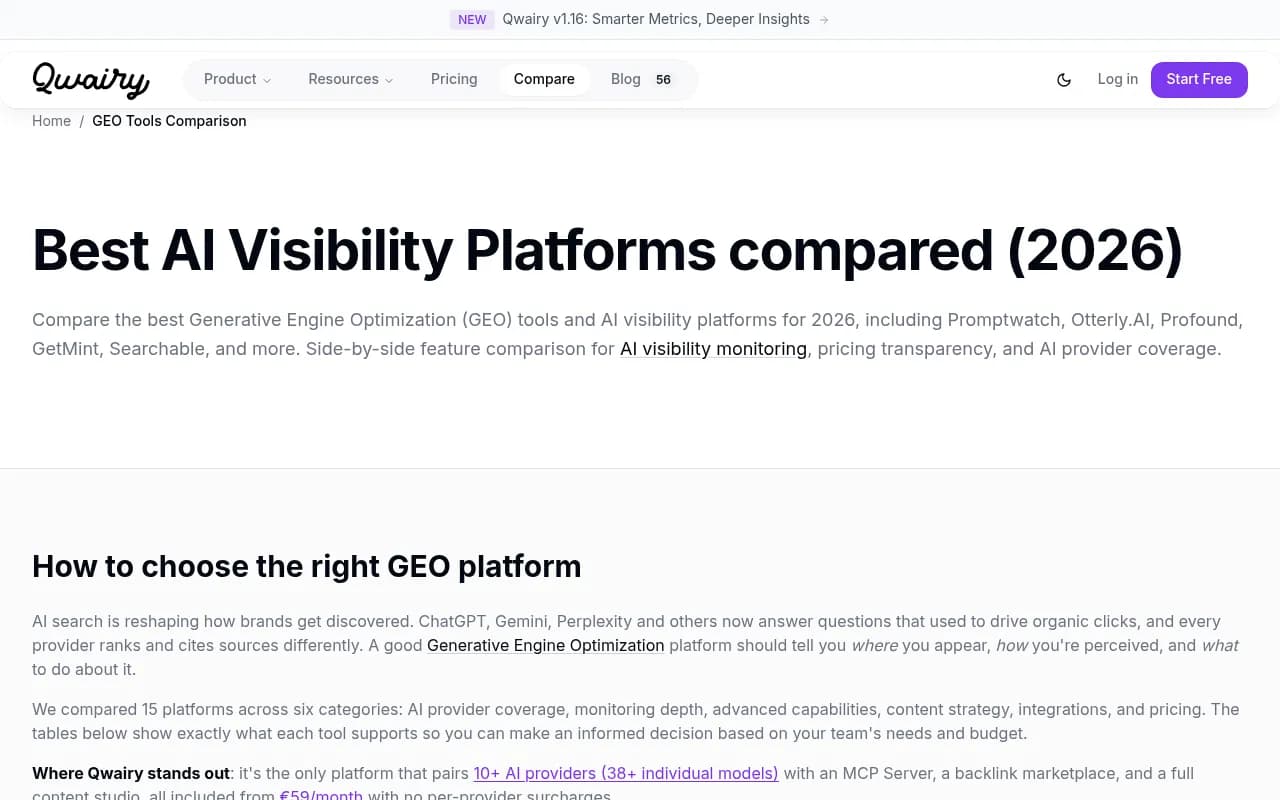
Qwairy tracks 10+ AI providers with 38+ individual models, which is the broadest coverage in the comparison. Starting at €59/month, it includes a content studio and a backlink marketplace. It's a strong option if comprehensive AI engine coverage is your priority.
SE Ranking
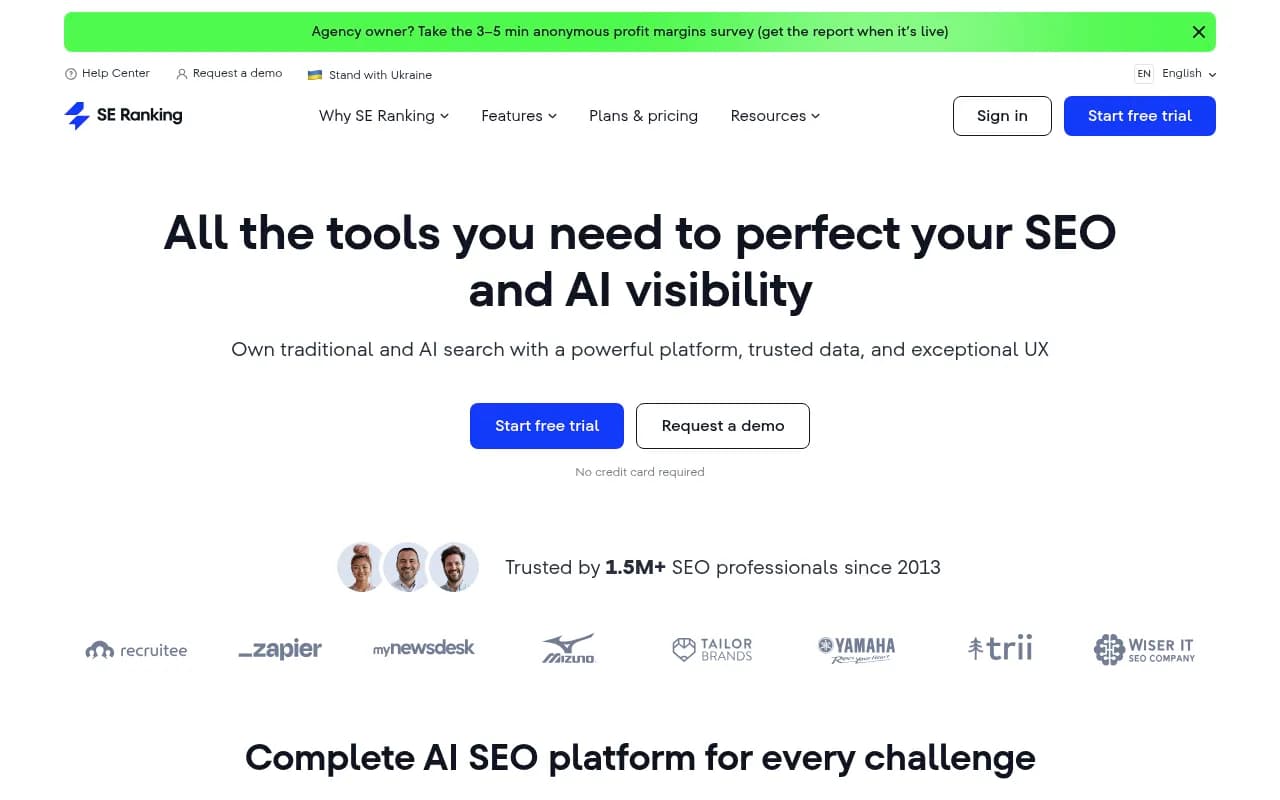
SE Ranking is a traditional SEO platform that has added AI visibility tracking. If your team is already using SE Ranking for rank tracking and site audits, the AI visibility module is a convenient add-on. As a standalone GEO tool, it's less specialized than the dedicated platforms.
The monitoring-only problem
Here's the honest issue with Rankscale and most of its direct competitors: knowing you're invisible in AI search doesn't automatically make you visible.
AI models cite content that clearly answers specific questions. If your website doesn't have that content, no amount of monitoring will change your visibility score. The platforms that are pulling ahead in 2026 are the ones that help you create the right content, not just measure the gap.
This is why the "action loop" distinction matters. Rankscale can tell you that a competitor appears in 60% of responses to a high-value prompt and you appear in 8%. That's useful information. But then what? You need to figure out what content that competitor has that you don't, write something better, publish it, and track whether it moves the needle. Rankscale doesn't help with any of those steps.
Platforms like Promptwatch, AthenaHQ, and (to a lesser extent) Qwairy are built around that full workflow. They're more expensive, but for teams that are serious about improving their AI visibility rather than just measuring it, the extra cost is often justified.
Who should use Rankscale?
Rankscale makes sense in a few specific situations:
- You're just getting started with GEO and want to understand the basics before investing in a more expensive platform
- You have a single site, a limited number of prompts to track, and don't need multi-engine coverage
- You want a quick competitive snapshot without committing to a larger budget
- You're using it alongside other tools that handle content creation and optimization
It's a reasonable starting point. The concern is that teams often outgrow it quickly once they realize monitoring alone doesn't move the needle.
Who should look elsewhere?
If any of the following apply, Rankscale probably isn't the right long-term choice:
- You manage multiple client sites (the credit model gets expensive fast)
- You want to understand why competitors are winning, not just that they are
- You need to create content that ranks in AI search, not just track your current standing
- You want to connect AI visibility to actual traffic and revenue
- You need crawler logs to diagnose indexing issues with AI bots
For those use cases, the platforms with built-in optimization workflows will save you time and produce better results.
Final take
Rankscale is a legitimate entry point into GEO tracking. The $20/month price is genuinely the lowest in the category, the 4.8/5 reviews suggest users find it useful, and the six-engine coverage is reasonable for basic monitoring.
But the GEO category has matured. The question in 2026 isn't just "where do I appear in AI search?" — it's "how do I appear more?" Rankscale answers the first question. Most teams eventually need a platform that answers both.
If you're evaluating options, the clearest upgrade path from Rankscale is to a platform that combines monitoring with content gap analysis and optimization. That's where the real leverage is.