Key takeaways
- All three platforms (Scrunch AI, Profound, AthenaHQ) monitor brand visibility across AI search engines like ChatGPT, Perplexity, and Google AI Overviews -- but their depth and focus differ significantly.
- Profound has the strongest prompt intelligence and agent analytics; AthenaHQ leans into workflow guidance and G2 social proof; Scrunch AI differentiates with its Agent Experience Platform (AXP) for serving AI-optimized content directly to crawlers.
- None of the three are cheap -- all three target enterprise buyers with custom or high-tier pricing.
- If your primary need is moving from monitoring to actually fixing your AI visibility gaps, all three have limitations compared to platforms built around the full optimization loop.
- A fourth option worth knowing: Promptwatch covers monitoring, content gap analysis, and AI content generation in one platform -- and is the only tool in a recent 12-platform comparison rated as a "Leader" across all categories.
The AI search visibility market has gotten crowded fast. Two years ago, there were maybe five tools worth considering. Now there are dozens, and three names keep coming up in enterprise conversations: Scrunch AI, Profound, and AthenaHQ.
Each has raised money, built a customer base, and positioned itself as the serious choice for brands that need to show up in ChatGPT, Perplexity, Claude, and Google AI Overviews. But they're not the same product. They make different bets about what matters most, and those bets have real consequences for how useful they are day-to-day.
This comparison tries to cut through the vendor positioning and give you a clear picture of what each platform actually does, where it struggles, and who it's genuinely built for.
What these platforms are trying to solve
Before getting into the specifics, it's worth naming the problem clearly. When someone types a question into ChatGPT or Perplexity, the AI generates an answer and cites sources. Your brand either appears in that answer or it doesn't. Traditional SEO tools don't track this -- they track Google rankings, not AI-generated responses.
That's the gap all three platforms are trying to fill. They query AI models on your behalf, track whether your brand gets mentioned or cited, and surface data to help you understand your visibility.
Where they diverge is in what happens after the monitoring. Some platforms stop at the dashboard. Others try to help you actually improve.
Scrunch AI

Scrunch AI launched in late 2024 and has raised $19 million in funding. It serves 500+ enterprise customers, which is a meaningful number for a platform that young.
The core product is an AI visibility monitoring and insights platform. You set up prompts, Scrunch queries AI models, and you get back data on where your brand appears, how often, and what the sentiment looks like. There's also site auditing functionality that checks whether your content is structured in ways that AI models can parse effectively.
The most distinctive feature is the Agent Experience Platform (AXP). The idea here is that instead of just hoping AI crawlers find and understand your content, you can serve AI-optimized content directly to AI user agents. It's a more proactive approach than most competitors take -- closer to technical SEO for AI than pure monitoring.
Where Scrunch is less developed: prompt intelligence (volume estimates, difficulty scoring, query fan-outs) and content generation. The platform tells you where you're visible and where you're not, but the path from "I'm not visible for this prompt" to "here's what to publish" requires more manual work than some teams want.
Pricing isn't publicly listed -- you need to request a demo, which is typical for enterprise-focused tools but makes it harder to evaluate fit before committing time to a sales process.
Profound
Profound

Profound is probably the most talked-about platform in this space right now, partly because of its marketing and partly because the product genuinely has some strong capabilities.
The core monitoring is solid. Profound tracks brand visibility across 9+ AI models, with what it describes as 5-minute SLA for prompt refreshes -- meaning when you query a model, you get results fast. That matters when you're trying to track a rapidly changing landscape.
Where Profound stands out is prompt intelligence. The platform surfaces prompt volumes (how often a given query is being asked across AI search), which lets you prioritize which prompts are worth optimizing for. There's also agent analytics -- logs of AI crawlers hitting your site, which pages they read, and how often they return. This is genuinely useful data that most monitoring tools don't provide.
Profound also has content agents: AI-assisted tools for generating articles and briefs grounded in prompt data. The feature exists, though some users have noted that translating monitoring insights into concrete content actions still requires significant manual effort.
The main criticism that surfaces consistently: data reliability and consistency. AthenaHQ's own comparison page (written by AthenaHQ's CEO, so take it with appropriate skepticism) cites customer complaints about this. Independent reviewers have echoed similar concerns about prompt data varying between refreshes in ways that are hard to explain.
Pricing is enterprise-tier and requires a demo. Not a budget tool.
AthenaHQ

AthenaHQ has a 4.9 rating on G2 and counts SoFi, ZoomInfo, and Wix among its customers. The platform focuses on AI citation patterns, broad AI platform coverage, and workflows designed to help teams improve brand visibility.
The workflow angle is where AthenaHQ tries to differentiate. Rather than just showing you a visibility score, the platform attempts to guide you through what to do with the data -- which content to update, which gaps to prioritize, how to structure your optimization efforts. For teams that are new to AEO (Answer Engine Optimization) and want more hand-holding, this framing is appealing.
AthenaHQ also publishes its own research (the "State of AI Search 2026 Report"), which is a smart content strategy that builds credibility in the space.
The limitations are real though. AthenaHQ's monitoring-first orientation means it's stronger at telling you where you stand than at helping you create content to improve that standing. The platform doesn't have the same depth of prompt intelligence as Profound, and content generation capabilities are limited compared to platforms built around the full optimization loop.
There's also a credit-limit model for some features, which Profound has used as a competitive talking point -- claiming unlimited prompts vs. AthenaHQ's credit constraints. Whether that matters depends on how many prompts you're tracking.
Head-to-head comparison
| Feature | Scrunch AI | Profound | AthenaHQ |
|---|---|---|---|
| AI model coverage | Multiple (specifics vary) | 9+ models | Multiple models |
| Prompt intelligence (volume/difficulty) | Limited | Yes | Limited |
| Agent/crawler analytics | No | Yes | No |
| Content generation | No | Partial | No |
| Site auditing | Yes | No | No |
| AI-optimized content delivery (AXP) | Yes (unique) | No | No |
| G2 rating | Not listed | Not listed | 4.9 |
| Funding | $19M raised | Not disclosed | Not disclosed |
| Pricing | Custom/demo | Custom/demo | Custom/demo |
| Best for | Technical AI optimization | Prompt intelligence + monitoring | Workflow guidance + monitoring |
What the buyer's framework says
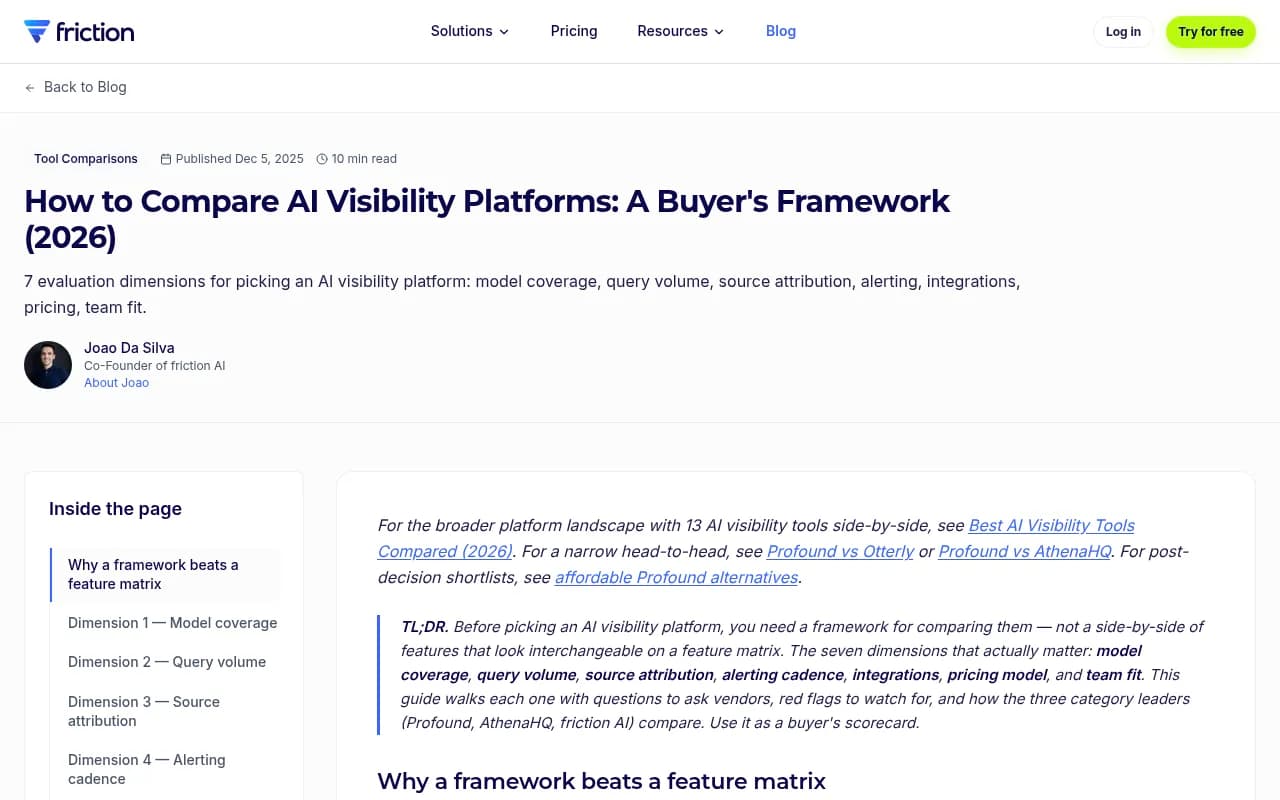
A useful framework for evaluating AI visibility platforms looks at seven dimensions: model coverage, query volume data, source attribution, alerting cadence, integrations, pricing model, and team fit.
Run all three platforms through that lens and a few things become clear:
Model coverage: All three cover the major models (ChatGPT, Perplexity, Google AI Overviews, Claude, Gemini). The differences are in version specificity and query frequency. Profound's 5-minute SLA is a real differentiator if freshness matters to you.
Query volume data: Profound wins here. Prompt volume estimates and difficulty scoring are features the other two don't match. If you want to prioritize which prompts to optimize for based on actual search demand, Profound has more to offer.
Source attribution: All three show you which sources AI models cite. The depth varies -- Profound's agent analytics go further by showing you which pages AI crawlers actually visit, not just which ones get cited in responses.
Actionability: This is where all three have gaps. Monitoring is the easy part. The harder problem is: you know you're not visible for a prompt -- now what? Scrunch's AXP is an interesting technical answer to this question. Profound's content agents are a partial answer. AthenaHQ's workflow guidance is a process answer. None of them have fully solved the gap between "here's your visibility score" and "here's the content that will fix it."
The monitoring-only problem
Here's the honest assessment: all three platforms are primarily monitoring tools. They're very good at showing you data. They're less good at helping you act on it.
This isn't a knock on any of them specifically -- it's a structural limitation of how most AI visibility platforms were built. They started as trackers and have been adding optimization features incrementally.
If your team has the bandwidth to take monitoring data and independently develop a content strategy, run it through your existing content workflow, publish it, and then track whether visibility improves -- these platforms can work well. You're using them as data sources.
If you want a platform that closes the loop -- finds the gaps, generates the content, and tracks the results -- you'll find all three falling short in different ways.
Promptwatch is worth mentioning here because it's built around that full loop. The Answer Gap Analysis shows exactly which prompts competitors are visible for that you're not. Content Agents generate articles grounded in real prompt data, citation data, and competitor analysis. And page-level tracking shows which pages are being cited, by which models, and how often. It's a different architectural bet than what Scrunch, Profound, or AthenaHQ have made.

Who should use each platform
Scrunch AI makes the most sense if you have a technical team that wants to go beyond monitoring into actively shaping how AI crawlers experience your site. The AXP is genuinely differentiated -- no other platform in this comparison offers it. If you're a large brand with engineering resources and want to get proactive about AI content delivery, Scrunch is worth a serious look.
Profound is the better choice if prompt intelligence is your priority. Knowing which prompts have high volume and which are winnable is valuable for prioritization, and Profound's data on this is more developed than the alternatives. The agent analytics (crawler logs) are also a real differentiator for teams that want to understand how AI models discover their content at a technical level.
AthenaHQ fits teams that are newer to AEO and want more structured guidance. The workflow orientation and strong G2 reputation suggest it's easier to get started with and easier to build internal buy-in around. If you're selling AI visibility investment to a skeptical CMO, AthenaHQ's customer logos (SoFi, ZoomInfo, Wix) and research reports help make the case.
A few things to watch out for
Before signing a contract with any of these platforms, a few questions worth asking:
How does the platform handle prompt data consistency? AI models give different answers to the same prompt on different days. How does each platform account for this variance? What does "visibility score" actually mean when the underlying data fluctuates?
What's the actual model coverage? "All major models" is a common claim. Ask specifically: which models, which versions, and how often are they queried? A platform that hits ChatGPT daily but Perplexity weekly is giving you a skewed picture.
What happens after you find a gap? Walk through the actual workflow. If you discover you're not visible for a high-volume prompt, what does the platform give you to fix that? How much of the work is still manual?
What are the contract terms? Enterprise AI visibility tools tend to have annual contracts with limited flexibility. Given how fast this space is moving, a 12-month lock-in on a platform that doesn't keep pace with model changes is a real risk.
The bottom line
Scrunch AI, Profound, and AthenaHQ are all legitimate enterprise tools. None of them are vaporware, and each has real customers using them for real work.
Profound has the deepest prompt intelligence and the most developed agent analytics. Scrunch has the most technically interesting approach to AI content delivery. AthenaHQ has the best G2 reputation and the most structured onboarding experience.
But all three share the same fundamental limitation: they're better at showing you the problem than helping you solve it. If you're evaluating platforms in 2026, that gap is worth taking seriously -- because the teams winning in AI search aren't just monitoring their visibility. They're systematically finding gaps and filling them with content that AI models actually want to cite.