Key takeaways
- Otterly.AI is the most affordable entry point for AI search monitoring, starting at $29/month, but it's a monitoring-only tool with no content generation or crawler logs
- Scrunch AI targets mid-market and enterprise brands with solid tracking features, though it lacks Reddit/YouTube tracking and ChatGPT Shopping monitoring
- Promptwatch is the only one of the three that closes the loop between finding visibility gaps and actually fixing them, with built-in content generation, AI crawler logs, and prompt intelligence
- If your team just wants to know where your brand appears in AI responses, Otterly.AI gets the job done cheaply. If you want to improve those results, you need something more.
- Price alone shouldn't drive this decision -- what matters is whether the tool helps you take action, not just generate reports
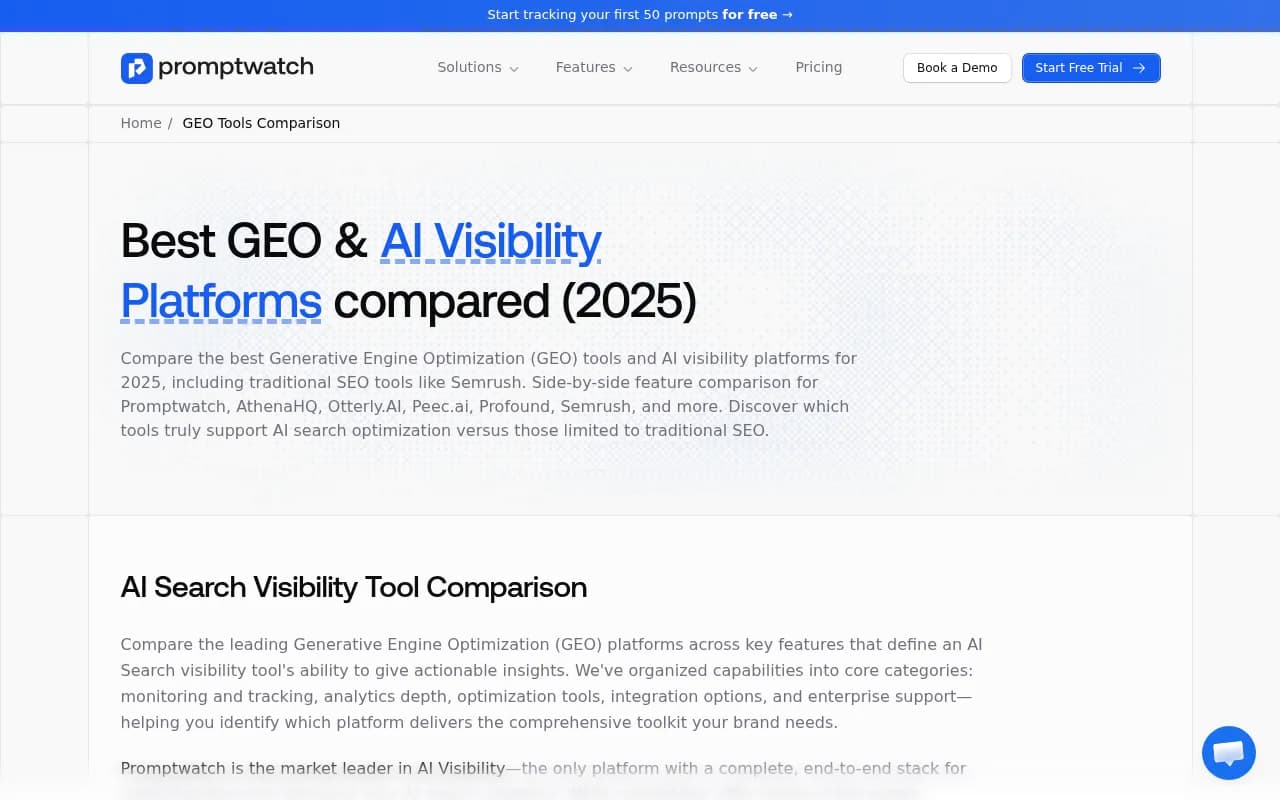
The GEO monitoring space has exploded. Two years ago, tracking your brand in ChatGPT or Perplexity meant running manual queries and keeping a spreadsheet. Now there are dozens of tools promising to do it for you, and three names keep coming up in the same breath: Otterly.AI, Scrunch AI, and Promptwatch.
They're often grouped together because they all track AI search visibility. But they're actually quite different products aimed at different buyers with different goals. This guide breaks down what each one actually does, where each one falls short, and which type of team should use which tool.
What these tools are actually trying to solve
Before comparing features, it's worth being clear about the problem. When someone types a question into ChatGPT, Perplexity, or Google's AI Mode, the AI generates an answer and sometimes cites sources. If your brand or website gets cited, that's visibility. If it doesn't, you're invisible to a growing chunk of search traffic.
GEO monitoring tools track this. They run prompts across AI engines, record the responses, and tell you whether your brand appears, how often, and in what context.
The harder question is: what do you do with that information? Some tools stop at the data. Others try to help you act on it.
Otterly.AI: the budget-friendly starting point
Otterly.AI launched in late 2024 and grew quickly among SEO teams looking for simple, affordable AI search monitoring. It's the most accessible entry point in this comparison, with a Lite plan starting at $29/month.
Otterly.AI

What it does well
Otterly.AI covers the basics competently. You set up prompts, it monitors them across ChatGPT, Perplexity, and Google AI Overviews, and you get visibility data on whether your brand appears. The interface is clean and not overwhelming, which matters for smaller teams that don't want to spend a week learning a new platform.
One standout feature is its GEO audit, which reportedly analyzes 25+ factors. For teams just getting started with AI search optimization, that kind of structured audit can be genuinely useful for identifying quick wins.
Where it falls short
Otterly.AI is a monitoring tool. It shows you data. It doesn't help you fix anything.
There's no content generation, no content gap analysis, no crawler logs showing you which pages AI bots are actually visiting, and no prompt intelligence telling you which queries are worth pursuing. You get a dashboard of visibility scores and that's largely it.
At $29/month, that's a reasonable trade-off for a solo marketer or small team just starting to think about AI search. But the moment you want to move from "we know we're invisible" to "we're doing something about it," Otterly.AI runs out of runway.
Reddit and YouTube tracking are also absent, which matters because AI models frequently cite Reddit discussions and YouTube content in their responses. If you don't know which Reddit threads are influencing recommendations in your category, you're missing a significant piece of the picture.
Who it's for
Otterly.AI makes sense for small teams, freelancers, or anyone who wants a low-cost way to start tracking AI visibility without committing to a full platform. It's a good first step. Just don't mistake it for a complete strategy.
Scrunch AI: mid-market monitoring with enterprise ambitions
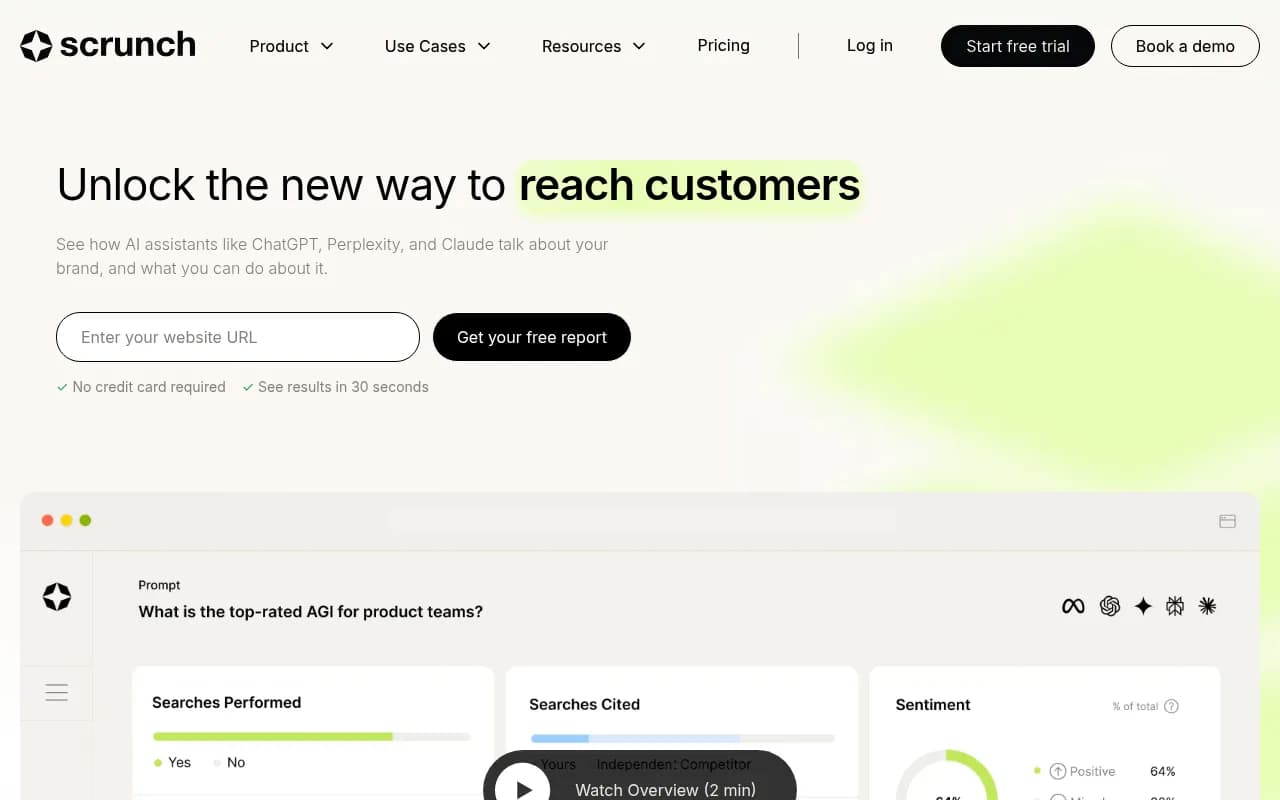
Scrunch AI sits in the middle of this comparison -- more capable than Otterly.AI, positioned at a higher price point, and aimed at brands and agencies that want more comprehensive tracking.
What it does well
Scrunch covers a solid range of AI engines and provides brand mention tracking across LLMs. It's built with a more enterprise-friendly interface and has features that appeal to marketing teams managing multiple brands or clients.
The platform has made a push toward competitive intelligence, letting you see how your brand compares to competitors in AI-generated responses. That's useful context for teams trying to understand their relative position in AI search.
Where it falls short
Scrunch is still primarily a monitoring platform. Like Otterly.AI, it tells you what's happening but doesn't give you the tools to change it. There's no built-in content generation, no AI crawler logs, and no prompt volume data to help you prioritize which gaps to close first.
Reddit tracking and YouTube insights are missing, which is a real gap given how much AI models draw from those sources. ChatGPT Shopping tracking is also absent -- relevant for any brand selling products, since ChatGPT's shopping recommendations are increasingly influential.
Pricing is higher than Otterly.AI, which means you're paying more for monitoring without getting the action layer that would justify the cost increase.
Who it's for
Scrunch works for mid-market brands and agencies that want more robust tracking than Otterly.AI offers and are comfortable with a monitoring-focused workflow. If your team has a separate content operation that can act on the data Scrunch surfaces, the combination can work. But you're paying for two separate tools to do what one platform could handle.
Promptwatch: monitoring plus the action layer
Promptwatch is a different kind of product. It tracks AI visibility across 10+ models -- ChatGPT, Perplexity, Google AI Overviews, Google AI Mode, Claude, Gemini, Meta/Llama, DeepSeek, Grok, Mistral, and Copilot -- but the monitoring is just the starting point.

What it does differently
The core difference is what happens after you see the data. Promptwatch's Answer Gap Analysis shows you the specific prompts where competitors are visible and you're not. Not just "you have a visibility gap" -- it shows you the exact questions AI models are answering from your competitors' content but not yours.
From there, Content Agents generate articles, listicles, comparisons, and briefs built around that gap data. The content is grounded in real prompt volumes, citation data, persona targeting, competitor analysis, and brand guidance. It's not generic AI writing -- it's content engineered to close specific gaps that the monitoring data identified.
Then you track whether it works. Page-level tracking shows which pages are being cited, by which models, and how often. Agent Analytics logs show when AI crawlers visit your pages, which errors they encounter, and when a page moves from "crawled" to "cited." Traffic attribution connects visibility changes to actual revenue.
That cycle -- find gaps, create content, track results -- is what separates Promptwatch from the other two tools in this comparison.
Additional capabilities worth noting
A few things Promptwatch does that neither Otterly.AI nor Scrunch offer:
AI Crawler Logs: Real-time logs of when ChatGPT, Claude, Perplexity, and other AI crawlers visit your site, which pages they read, and what errors they hit. This is genuinely rare in the market and directly useful for diagnosing why certain pages aren't getting cited.
Reddit and YouTube tracking: Surface discussions and videos that AI models are citing in your category. If a Reddit thread is influencing ChatGPT's recommendations about your product category, you need to know that.
ChatGPT Shopping tracking: Monitor when your brand appears in ChatGPT's product recommendations and shopping carousels. For e-commerce brands, this is increasingly important.
Prompt intelligence: Volume estimates and difficulty scores for each prompt, plus query fan-outs showing how one prompt branches into sub-queries. This lets you prioritize high-value, winnable prompts instead of tracking everything equally.
Multi-language and multi-region: Monitor AI responses in any language, from any country, with customizable personas that match how your actual customers search.
Pricing
Promptwatch's Essential plan is $99/month (1 site, 50 prompts, 5 articles). Professional is $249/month (2 sites, 150 prompts, 15 articles, plus crawler logs and state/city tracking). Business is $579/month (5 sites, 350 prompts, 30 articles). Agency and enterprise pricing is available on request. A free trial is available.
Who it's for
Promptwatch is for marketing and SEO teams that want to improve their AI search visibility, not just measure it. If you're tracking data but not acting on it, you're wasting budget. Promptwatch is built for teams that want to close the loop.
Feature comparison
| Feature | Otterly.AI | Scrunch AI | Promptwatch |
|---|---|---|---|
| Starting price | ~$29/mo | Mid-market pricing | $99/mo |
| AI engines covered | ChatGPT, Perplexity, Google AI Overviews | Multiple LLMs | 10+ (ChatGPT, Perplexity, Claude, Gemini, Grok, DeepSeek, Copilot, Meta AI, Google AI Overviews, Google AI Mode) |
| Brand mention tracking | Yes | Yes | Yes |
| Competitor visibility | Basic | Yes | Yes (heatmaps) |
| Content gap analysis | No | No | Yes (Answer Gap Analysis) |
| Content generation | No | No | Yes (Content Agents) |
| AI crawler logs | No | No | Yes |
| Prompt volume/difficulty | No | No | Yes |
| Reddit tracking | No | No | Yes |
| YouTube tracking | No | No | Yes |
| ChatGPT Shopping tracking | No | No | Yes |
| Traffic attribution | No | No | Yes |
| Multi-language/region | Limited | Limited | Yes |
| Page-level citation tracking | No | No | Yes |
| Free trial | Yes | Varies | Yes |
How to choose
The honest answer is that the right tool depends on what you're trying to accomplish.
If you're a small team or individual marketer who wants to start tracking AI visibility without spending much, Otterly.AI is a reasonable starting point. You'll quickly hit its limits, but at $29/month, it's a low-risk way to get familiar with the space.
If you're a mid-market brand or agency that needs more comprehensive monitoring and has a separate content team to act on the data, Scrunch AI can work. Just be clear that you're buying a monitoring tool, not an optimization platform.
If you want to actually improve your AI search visibility -- not just measure it -- Promptwatch is the only one of these three that gives you the full toolkit. The monitoring data is there, but so is the gap analysis, the content generation, the crawler logs, and the attribution. You're not left staring at a dashboard wondering what to do next.
One way to think about it: Otterly.AI and Scrunch AI tell you that your house is on fire. Promptwatch tells you where the fire started and hands you a hose.
A note on what monitoring alone misses
There's a pattern in how teams use monitoring-only tools. They set up prompts, watch the visibility scores, maybe share a report with leadership, and then... not much changes. The data is interesting but not actionable enough to drive a content calendar or justify a budget reallocation.
The teams getting real results from GEO are the ones treating it like an optimization discipline, not a reporting function. That means identifying specific content gaps, creating content designed to fill those gaps, and tracking whether AI models start citing it. That workflow requires more than a monitoring dashboard.
It's worth asking, before choosing any tool: "What will we actually do with this data?" If the answer is "we'll look at it," a cheaper monitoring tool is fine. If the answer is "we'll build a content strategy around it," you need something that supports that workflow end to end.
Bottom line
Otterly.AI, Scrunch AI, and Promptwatch are all legitimate tools for tracking AI search visibility. They're not equally capable, and they're not solving the same problem.
Otterly.AI is cheap and simple. Scrunch AI is more comprehensive but still monitoring-focused. Promptwatch is the only one built around the idea that visibility data is only valuable if you use it to get more visible.
For teams serious about AI search in 2026, the monitoring-only approach is increasingly a half-measure. The brands winning in AI search are the ones closing the gap between insight and action -- and that's exactly what Promptwatch is designed to support.