Key takeaways
- Technical SEO platforms (Botify, Lumar, OnCrawl) and AI visibility platforms (Peec AI, Promptwatch) solve fundamentally different problems -- but the gap between them is closing fast
- If your primary need is crawl health, log file analysis, and site architecture at enterprise scale, Botify or Lumar are the right tools
- If you need to track and improve how your brand appears in ChatGPT, Perplexity, Claude, and other AI engines, Promptwatch is the most complete option -- it goes beyond monitoring to actually help you create content that gets cited
- Peec AI covers AI visibility monitoring well for enterprise teams but lacks the content generation and optimization loop that separates trackers from optimizers
- Most teams in 2026 need both categories -- the question is whether you buy two tools or find one that bridges the gap
The search landscape in 2026 looks nothing like it did three years ago. A meaningful share of informational queries now get answered directly by AI models -- ChatGPT, Perplexity, Google AI Overviews, Gemini -- without the user ever clicking through to a website. That's a real problem if your SEO strategy is built entirely around rankings and organic clicks.
At the same time, technical SEO hasn't gone away. AI crawlers still need to read your pages. Structured data still matters. Crawl budget, page speed, and indexability all affect whether AI models can even discover your content in the first place.
So the question a lot of marketing and SEO teams are wrestling with right now: do I need a technical SEO platform, an AI visibility platform, or something that does both?
This guide breaks down five platforms -- Peec AI, Promptwatch, Botify, Lumar, and OnCrawl -- across both dimensions, so you can make an informed call.
What each platform actually does
Before comparing features, it's worth being clear about what category each tool belongs to. These five platforms are not really direct competitors -- they come from different traditions and solve different core problems.
Botify and Lumar (formerly DeepCrawl) are enterprise technical SEO platforms. Their core job is crawling large websites, analyzing site structure, identifying indexability issues, and helping engineering and SEO teams fix them. Both have been expanding into AI search territory, but technical crawling is their foundation.
OnCrawl is also a technical SEO crawler, with a particular strength in log file analysis. It connects crawl data with server logs to show you how search engine bots (including AI crawlers) actually behave on your site -- not just what your sitemap says.
Peec AI is a dedicated AI search visibility platform. It tracks how brands appear in responses from ChatGPT, Perplexity, Google AI Overviews, and other LLMs. It's positioned at the enterprise end of the market.
Promptwatch is also an AI search visibility platform, but it's built around an optimization loop rather than pure monitoring. It tracks visibility, identifies content gaps, generates content engineered to get cited, and then measures whether that content actually improves your AI search presence.
Promptwatch is the only platform in this comparison rated as a "Leader" across all GEO/AI visibility categories in a 2026 evaluation of 12 platforms.

Feature-by-feature comparison
| Capability | Peec AI | Promptwatch | Botify | Lumar | OnCrawl |
|---|---|---|---|---|---|
| AI search visibility tracking | Yes | Yes | Limited | Limited | No |
| Multi-LLM coverage (10+ models) | Yes | Yes (10 models) | No | No | No |
| Content gap analysis | Limited | Yes | No | No | No |
| AI content generation | No | Yes | No | No | No |
| Answer gap analysis | No | Yes | No | No | No |
| Technical site crawling | No | No | Yes | Yes | Yes |
| Log file / AI crawler analysis | No | Yes (AI crawlers) | Yes | Yes | Yes |
| Prompt volume & difficulty scoring | No | Yes | No | No | No |
| Reddit & YouTube citation tracking | No | Yes | No | No | No |
| ChatGPT Shopping tracking | No | Yes | No | No | No |
| Page-level citation tracking | No | Yes | No | No | No |
| Traffic attribution (GSC / logs) | No | Yes | Yes | Yes | Limited |
| Competitor visibility heatmaps | Yes | Yes | No | No | No |
| Structured data / schema support | No | No | Yes | Yes | Limited |
| Core Web Vitals monitoring | No | No | Yes | Yes | No |
| JavaScript rendering | No | No | Yes | Yes | No |
| Free trial | Yes | Yes | No | No | No |
| Starting price | Enterprise | $99/mo | Enterprise | Enterprise | Enterprise |
Botify: the enterprise crawler with AI ambitions
Botify has been around long enough to earn serious trust from large enterprise SEO teams. Its crawling infrastructure handles sites with millions of pages, and its integrations with CDNs, JavaScript rendering engines, and server log data make it genuinely useful for complex technical audits.
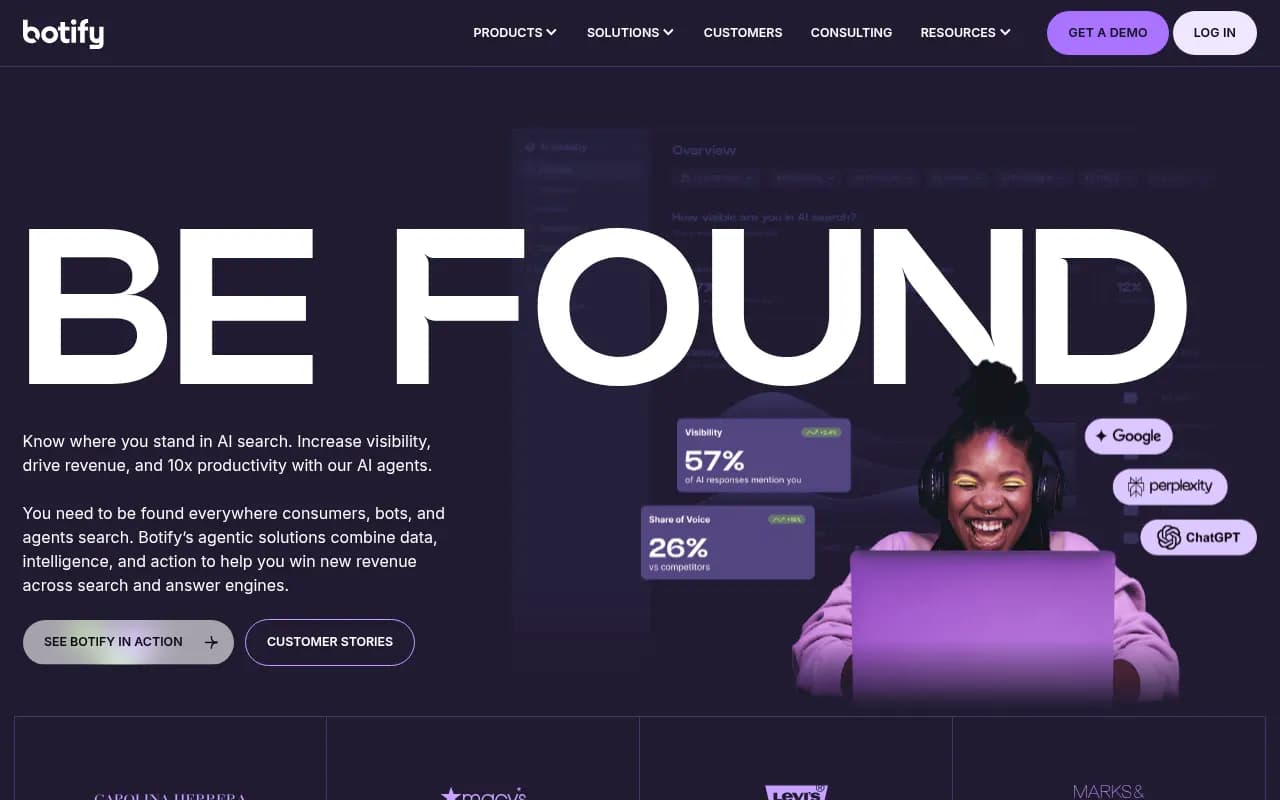
In 2026, Botify has been adding AI search features -- tracking how AI models interact with your content, and surfacing insights about which pages are being referenced in AI-generated answers. But this is still secondary to its core crawling product. If you're a large publisher or e-commerce site trying to fix crawl budget issues, fix canonicalization problems, or understand why Googlebot isn't indexing your pages, Botify is excellent.
Where it falls short for AI visibility work: it doesn't track prompt-level responses across LLMs, it has no content gap analysis, and it can't generate content to fill those gaps. It's a diagnostic tool, not an optimization engine for AI search.
Best for: Enterprise SEO teams at large sites (100k+ pages) where technical health is the bottleneck.
Lumar: technical SEO meets website intelligence
Lumar (rebranded from DeepCrawl a few years back) has positioned itself as a "website intelligence" platform -- broader than just crawling. It covers technical SEO, accessibility, performance, and increasingly, content quality signals.
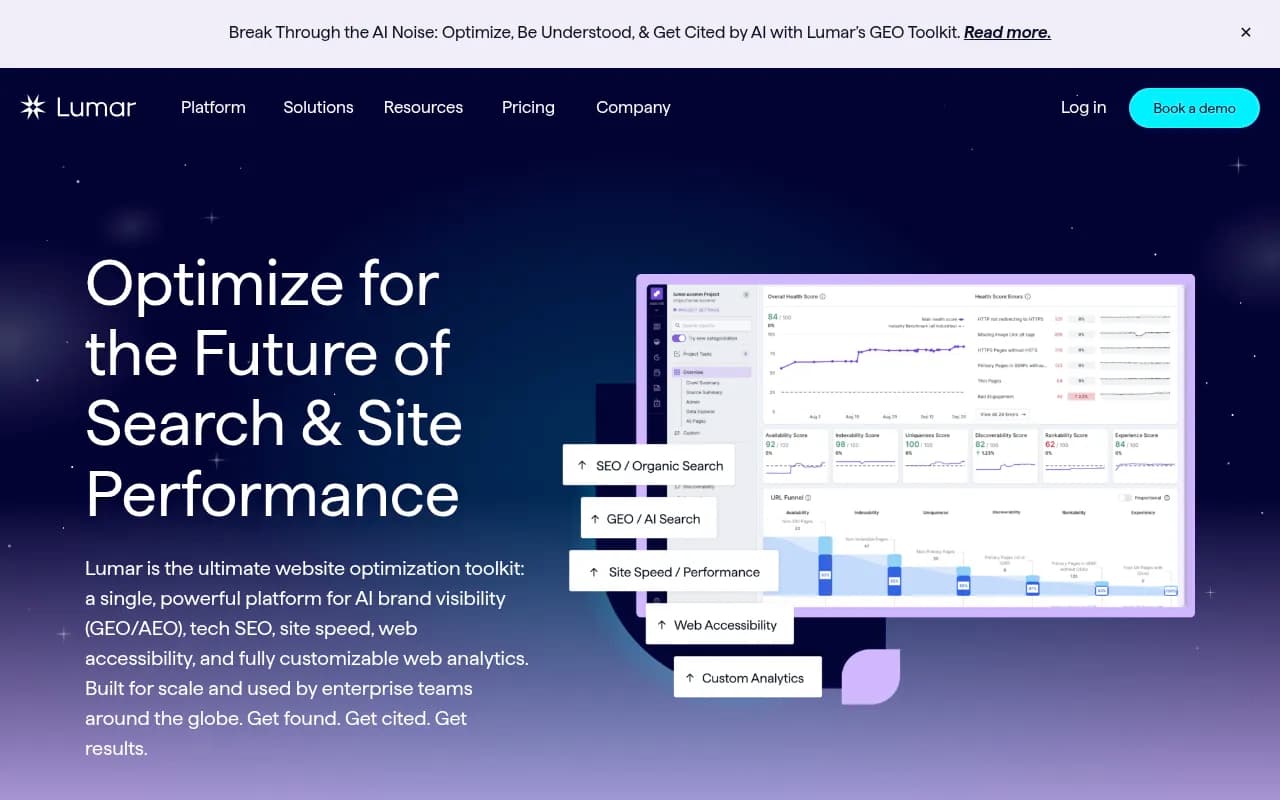
Lumar's strength is its ability to connect technical data with business outcomes. It has solid Core Web Vitals monitoring, JavaScript rendering, and structured data validation. For teams that need to audit and maintain large, complex websites, it's a strong choice.
Like Botify, Lumar has been moving toward AI search -- its GEO features track how AI engines interact with your content. But it's still primarily a technical platform. The AI visibility layer is more of an add-on than a core workflow.
Best for: Enterprise teams that need both technical SEO auditing and some AI search monitoring, and don't mind paying for a platform that does both at a surface level.
OnCrawl: log file analysis done right
OnCrawl has always been the most data-heavy of the three technical platforms. Its log file analysis is genuinely best-in-class -- you can see exactly which bots crawled which pages, how often, and what they found. That includes AI crawlers like GPTBot (OpenAI), ClaudeBot (Anthropic), and PerplexityBot.
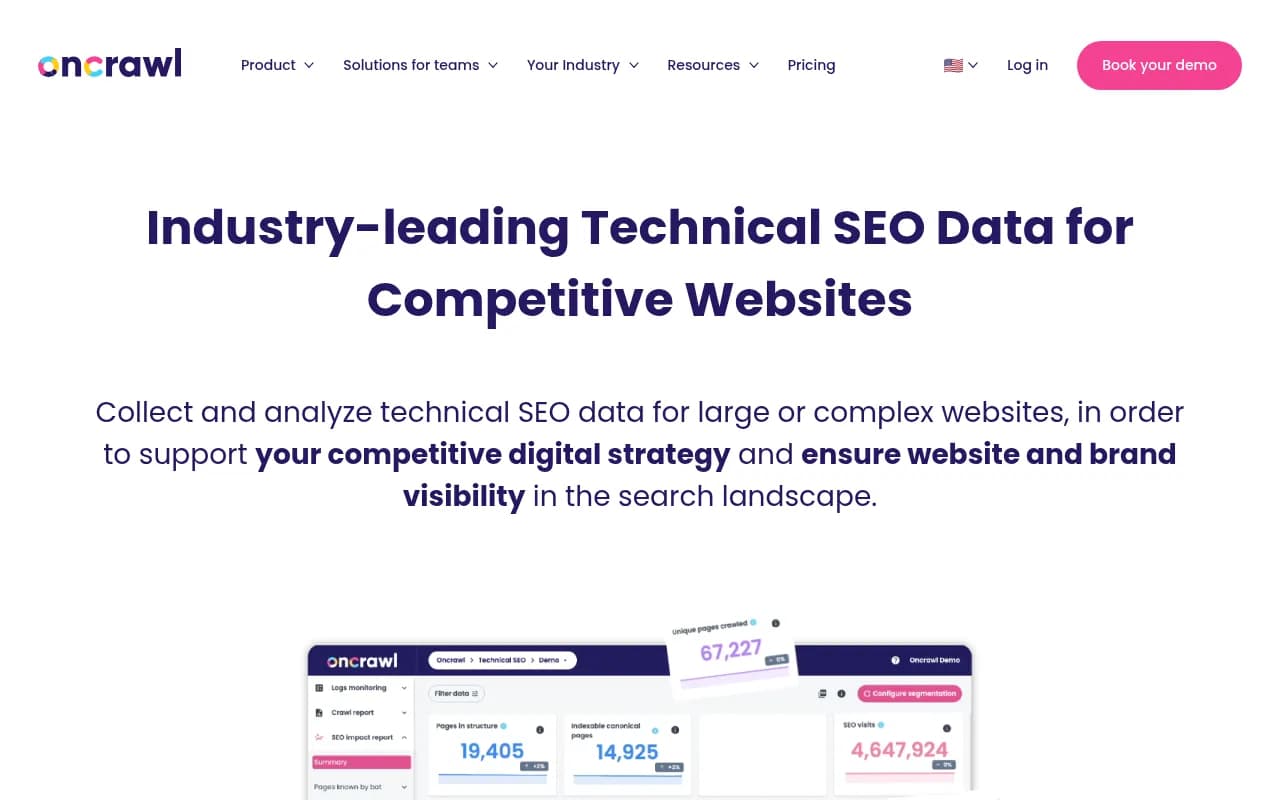
This matters more than people realize. If AI crawlers are hitting your 404 pages, encountering slow load times, or getting blocked by your robots.txt, they can't read your content -- and they can't cite it. OnCrawl helps you find and fix those problems.
What OnCrawl doesn't do is track what AI models actually say about your brand. It can tell you that GPTBot crawled your pricing page 47 times last month, but it can't tell you whether ChatGPT recommends your product when someone asks "what's the best CRM for small teams?" That's a different problem requiring a different tool.
Best for: Technical SEO teams and data engineers who need deep log file analysis and want to understand AI crawler behavior specifically.
Peec AI: solid enterprise monitoring, but monitoring-only
Peec AI has built a reputation as a strong enterprise AI search visibility platform. It tracks brand mentions across major LLMs, provides share-of-voice data, and gives enterprise teams the reporting infrastructure they need to communicate AI visibility metrics to stakeholders.

It covers the monitoring side well. You can track how often your brand appears in AI responses, compare against competitors, and segment by topic or query type. For large enterprises that need to report on AI visibility at scale, it's a credible option.
The gap is on the action side. Peec AI shows you where you're invisible -- but it doesn't help you fix it. There's no content gap analysis that identifies which specific prompts you're losing to competitors, no built-in content generation to create the articles that would fill those gaps, and no way to close the loop between visibility data and actual content output.
That's not a minor limitation. In 2026, knowing you're invisible in AI search is table stakes. The harder problem is doing something about it.
Best for: Enterprise teams with dedicated content teams who need visibility data and can act on it independently.
Promptwatch: the optimization loop, not just a dashboard
Promptwatch takes a different approach to the problem. Rather than just showing you where you rank in AI responses, it's built around a three-step cycle: find the gaps, create content that fills them, and track whether it worked.
The Answer Gap Analysis is the most practically useful feature here. It shows you exactly which prompts your competitors are visible for that you're not -- not just "you're losing to Competitor X" but the specific questions and topics where AI models can't find relevant content on your site. That's actionable in a way that a visibility score isn't.
The built-in content generation agent then creates articles, listicles, and comparisons grounded in actual citation data (over 880 million citations analyzed). This isn't generic AI writing -- it's content engineered around the specific prompts where you need to show up, informed by what AI models actually cite.
Then the tracking layer closes the loop. Page-level citation tracking shows which of your pages are being cited by which models, how often, and whether new content is moving the needle. Traffic attribution via Google Search Console integration or server log analysis connects AI visibility to actual revenue.
Beyond the core loop, Promptwatch covers things the other platforms in this comparison don't touch: Reddit and YouTube citation tracking (both major sources for AI model training and real-time retrieval), ChatGPT Shopping monitoring, prompt volume and difficulty scoring, query fan-outs, and multi-language/multi-region tracking.
The AI crawler logs feature is also worth calling out in the context of this comparison. Promptwatch shows you real-time logs of AI crawlers hitting your site -- which pages they read, errors they encounter, how often they return. This overlaps with what OnCrawl does for traditional crawlers, but focused specifically on AI engines. It's not as deep as OnCrawl's log analysis, but for most teams it's sufficient.
Pricing starts at $99/month (Essential: 1 site, 50 prompts, 5 articles), $249/month (Professional: 2 sites, 150 prompts, 15 articles, crawler logs), and $579/month (Business: 5 sites, 350 prompts, 30 articles). Agency and enterprise pricing is available separately.
Best for: Marketing and SEO teams that need to improve AI search visibility, not just measure it -- especially teams without a separate technical SEO platform.
The technical SEO / AI visibility gap
Here's the honest reality: none of these five platforms fully bridges the gap between deep technical SEO and AI search optimization. They're converging, but they're not there yet.
Botify and Lumar are adding AI visibility features, but their core value is still in crawl analysis and technical health. Promptwatch has AI crawler logs, but it's not a replacement for a full technical crawler on a 500,000-page site.
For most mid-market teams, the practical answer is to pick the tool that solves your biggest current problem:
- If your site has serious technical health issues (crawl budget, JavaScript rendering, indexability), start with Botify, Lumar, or OnCrawl.
- If you're technically healthy but invisible in AI search, Promptwatch is the most complete option because it goes from diagnosis to content creation to measurement.
- If you're at enterprise scale and need both, you're probably running two tools -- a technical crawler and an AI visibility platform.
The one thing to avoid is treating a monitoring-only platform as an optimization strategy. Knowing your AI visibility score is low doesn't help you fix it. The platforms that show you the specific content gaps and give you a path to fill them are worth the premium.
Which platform for which team
| Team type | Best fit | Why |
|---|---|---|
| Enterprise with large technical debt | Botify or Lumar | Deep crawling, JS rendering, Core Web Vitals |
| Data-heavy SEO team | OnCrawl | Best-in-class log file analysis |
| Marketing team focused on AI visibility | Promptwatch | Full optimization loop, not just tracking |
| Enterprise needing AI visibility reporting | Peec AI or Promptwatch | Both cover enterprise monitoring; Promptwatch adds optimization |
| Agency managing multiple clients | Promptwatch | Multi-site plans, white-label reporting, content generation |
| Team with no dedicated technical SEO | Promptwatch | AI crawler logs cover the basics without needing a separate tool |
The bottom line
The platforms in this comparison aren't really competing for the same buyer -- they're solving different parts of the same problem.
If you're choosing between them purely on the basis of AI search visibility (which is where most of the growth pressure is in 2026), Promptwatch is the most complete platform. It's the only one here that takes you from "here's where you're invisible" to "here's the content that will fix it" to "here's proof it worked." Peec AI covers the monitoring side well at enterprise scale, but stops before the optimization step.
If your site has serious technical health issues that are preventing AI crawlers from reading your content in the first place, OnCrawl's log analysis or Botify/Lumar's crawling infrastructure will surface problems that no AI visibility tool can fix for you.
The most sophisticated teams in 2026 are running both -- a technical crawler to keep the foundation solid, and an AI visibility platform to optimize what gets built on top of it.