Key takeaways
- EdTech GEO comes down to three jobs: seeing whether ChatGPT, Gemini, Perplexity and AI Overviews recommend your courses or platform, finding out why they don't, and shipping fixes.
- Entry prices across tools aren't comparable. Engine coverage, billing term and credit models differ, so a $99 plan can cover one engine while a $95 plan covers many.
- Promptwatch's data shows product and landing pages are the most cited content types in ChatGPT (22.4% and 16.8%, Sep 28 to Oct 4, 2026). For EdTech, that means course, program and platform pages matter more than blog volume.
- Budget options like Otterly.AI and Peec AI are good for monitoring. Pick a platform with crawler logs and content tooling if you also want to fix problems.
- No tool has education-specific citation data yet. Expect to build your own prompt set around program names, comparisons and "best X for Y" queries.
Why education brands need to care about AI search
Students and parents ask AI assistants questions that used to go to Google: "best online MBA for working parents," "is Coursera worth it," "which coding bootcamp has job placement." These are high-stakes, high-consideration decisions, and AI answers compress the shortlist to a handful of names. If you aren't in that handful, you never get the click.
EdTech has a few quirks that make GEO different from, say, SaaS:
- Buying cycles are long and emotional. People ask follow-up questions, so one conversation can mention many brands.
- Trust matters a lot. Accreditation, outcomes, and tuition claims get scrutinized, and wrong answers (hallucinated tuition, outdated deadlines) do real damage.
- Content goes stale fast. Application deadlines, program names and pricing change every year.
- Aggregators dominate. Ranking sites, review platforms and marketplaces often get cited ahead of the institution itself.
That last point mirrors what Promptwatch Data found in other verticals. In automotive, marketplaces outrank every car brand in ChatGPT citations, and in travel, booking and search sites earn more than half. I'd expect education to look similar, but I'll be honest: I found no education-specific citation report, so treat that as a hypothesis to test with your own prompts.
What the data says about which pages get cited
The closest relevant research is Promptwatch's ChatGPT citation share by content type (Sep 28 to Oct 4, 2026):
| Content type | Share of ChatGPT citations |
|---|---|
| Product pages | 22.4% |
| Landing pages | 16.8% |
| Listicles | 13.6% |
| How-tos | 8.7% |
| Documentation | 7.5% |
| General articles | 6.1% |
| Comparisons | 5.9% |
| News | 5.7% |
| FAQ pages | 3.3% |
| Reviews | 1.7% |
For commercial prompts like "best X for...", product pages hit 26.0% and landing pages 20.6%. Translated into EdTech terms: your course pages, degree program pages, pricing pages and platform feature pages are the main citation surface. A blog full of thought leadership won't carry you if the program pages are thin or hidden behind JavaScript and login walls.
Two more findings are worth noting:
- Landing pages and docs stay cited longest, while news loses half its pages within 36 days, per Promptwatch's content half-life report. Evergreen program and help-center pages are a better investment than news-style posts.
- ChatGPT has nearly stopped citing social media (0.46% of citations), while Google AI Overviews gets 12.2% from social platforms, with YouTube at 4.28%, per Promptwatch's October 2026 social report. If you run lecture clips or explainer videos, YouTube matters for Google audiences. Don't build a ChatGPT strategy around Reddit.
If you want the wider picture, the Promptwatch Data hub has the full set of reports.
What to look for in a GEO tool as an EdTech team
Before comparing logos, decide what you actually need. Here's the checklist I'd use:
- Engine coverage. Students use ChatGPT, Google AI Overviews and AI Mode, Gemini, Perplexity and Copilot. A tool that tracks one or two engines leaves gaps.
- Geography and language. If you recruit internationally, you need country-level (sometimes city-level) tracking and multiple languages.
- Prompt control. You'll want to track program-specific, comparison and persona-based prompts (prospective student, parent, employer sponsor).
- Citation data. Knowing which domains AI cites in your category tells you whether to work on your own site, rankings sites, or review platforms.
- Crawler visibility. Many university sites are slow, JavaScript-heavy or block bots by accident. Crawler logs show whether AI systems can even read your pages.
- Content execution. Monitoring is the easy part. Someone still has to write and refresh a few hundred program pages.
- Reporting for stakeholders. Provosts and CMOs want a share-of-voice number and a trend line, not a spreadsheet.
A warning on prompt sets: Peec's visibility score is computed over the prompts you choose, so adding prompts you already win inflates the score without changing what engines say. Agree on the set up front, record a baseline, and freeze it.
The best GEO tools for education and EdTech
Promptwatch: best for teams that want to fix visibility, not just watch it
Promptwatch is the option I'd shortlist first for EdTech companies and larger education marketing teams, mainly because it goes past monitoring. It tracks real user interfaces of ChatGPT, Google AI Overviews, AI Mode, Gemini, Perplexity and Copilot by country, and its IP-verified AI crawler logs show whether bots are reading your course pages or hitting errors. For a university with a heavy, JavaScript-rendered program catalog, that's often where the problem is.
On the action side, the Content Agent can plan, write and publish to WordPress, Webflow or Framer, and the Action Board gives a prioritized to-do list. Page-level tracking then shows whether a new page got crawled, cited and clicked. Visitor analytics connect AI traffic to conversions, which matters when you need to justify the spend to a dean or CFO. Agencies get white-label reports and client portals.
Pricing (confirm at promptwatch.com/pricing): Essential $95/mo (1 project, 50 prompts, 6,000 responses), Professional $245/mo (2 projects, 150 prompts, crawler logs, 5 articles), Business $579/mo (5 projects, 350 prompts, city tracking, Content Agent). A 7-day trial is available on monthly plans, and there is a free Explore tier limited to ChatGPT and 10 prompts. One source disagreed on how many models Essential covers per project, so check before buying.

Otterly.AI: best low-cost monitoring
Otterly is the budget pick. Lite is $29/mo for 15 prompts, Standard is $189/mo for 100, and Premium is $489/mo for 400, with daily tracking on ChatGPT, AI Overviews, Perplexity and Copilot and unlimited users. Gemini, AI Mode and Claude are paid add-ons. There is no content generation and no crawler logs, so it answers "are we mentioned?" and stops there. For a small tutoring company or a single-program school, that may be exactly enough.
Otterly.AI

Peec AI: best for European and multilingual teams
Peec starts at $95/mo (50 prompts, 3 engines of your choice, 1 project), with Pro at $245 and Advanced at $495. A fourth engine costs $35/mo. It is popular with European marketing teams, which is useful for institutions recruiting across languages. API and SSO are Enterprise-only, which can bite larger universities with IT requirements.

Profound: best for large enterprises with budget
Profound is the mature enterprise option, with a $96M Series C in February 2026. Starter is $99/mo billed yearly but covers only ChatGPT with 50 prompts. Growth is $399/mo with three engines and 100 prompts. Enterprise contracts are custom, and one third-party estimate puts them at $30k to $100k or more per year. Worth a demo if you run a global university system or a large online program manager, but it's overkill for most EdTech startups.
Profound

Semrush and Ahrefs Brand Radar: best if you already live in those suites
If your SEO team is already inside Semrush, its AI Visibility Toolkit ($99/mo per domain, 25 prompts, +$60/mo per 50 extra) is the path of least resistance. Ahrefs Brand Radar is sold as an add-on, roughly $199 per index or $699 for all platforms. Both are fine for directional reporting. Prompt sets are tighter and AI-specific depth is shallower than dedicated platforms, and neither offers AI crawler logs.

Other tools worth a look
- AthenaHQ from $295/mo, monitoring-focused.
- Scrunch from about $250/mo billed annually.
- Rankshift at $92/mo for 150 prompts across 8 models, a good value for small teams.
- HubSpot AEO at $50/mo for 25 prompts on 3 engines, handy if you already run HubSpot.
- Rankscale from $20/mo, credit-based, for agencies on a leash.



Side-by-side comparison
| Tool | Starting price | Engines on entry plan | Crawler logs | Content creation | Best for |
|---|---|---|---|---|---|
| Promptwatch | $95/mo (free tier available) | Multiple, incl. AI Overviews, AI Mode, Gemini | Yes (Professional and up) | Yes (articles from Professional, Content Agent on Business) | Teams that need to act on findings |
| Otterly.AI | $29/mo | 4 (ChatGPT, AIO, Perplexity, Copilot) | No | No | Small budgets, monitoring only |
| Peec AI | $95/mo | 3 of 6, your pick | No | No | Multilingual European teams |
| Profound | $99/mo yearly | ChatGPT only | Not covered in my sources | Not covered in my sources | Enterprise programs |
| Semrush AI Toolkit | $99/mo per domain | Varies | No | Via wider suite | Existing Semrush users |
| Rankshift | $92/mo | 8 models | Not covered in my sources | No | Value monitoring |
Treat entry prices with suspicion. Profound's $99 is ChatGPT-only and yearly. Otterly's base plans skip Gemini and AI Mode. Several of my pricing sources are vendor-authored, so verify on each vendor's page before you buy.
A practical workflow for an EdTech GEO program
1. Build a prompt set that mirrors how students ask
Split prompts into groups:
- Category: "best online data science master's programs"
- Comparison: "Coursera vs edX for professional certificates"
- Branded: "is [your school] accredited", "[your platform] reviews"
- Persona: "best coding bootcamp for career changers over 35"
- Tactical: "how to apply for [program]", "[program] tuition"
Start with 50 to 150. Record a baseline, then freeze the set.
2. Check which sources AI cites in your category
Look at who gets cited for your category prompts. If rankings sites and review platforms dominate, your job is partly offsite: get included and accurately described there. Promptwatch-style offsite mention tracking and review collection both help. If your own site is rarely cited even when you're mentioned, that points to a content or crawlability problem.
3. Audit crawlability before writing anything
Check robots.txt for accidental AI bot blocks, make sure program pages render without JavaScript, keep admissions FAQs and course docs public, and confirm pages aren't orphaned. Crawler logs make this concrete: you can see GPTBot or ChatGPT-User bounce off a 403.
4. Fix the page types that win
Based on the content-type data, prioritize:
- Program and course pages with clear facts: duration, tuition, format, outcomes, accreditation, start dates.
- Comparison pages ("Our bootcamp vs a CS degree") and honest listicles.
- FAQ pages that answer admissions, financial aid and transfer credit questions.
- Public documentation for platform products, such as LMS integrations and API docs.
- Reviews collected on trusted third-party sites.
5. Keep facts fresh
Stale tuition or deadlines are the quickest way to get misreported. Set a quarterly refresh for program pages, and use diff-style tools or a content refresh feature so edits are targeted rather than full rewrites.
6. Tie it to enrollments
Mentions don't pay tuition. Connect AI referral traffic to applications or trial signups in Google Analytics or your platform's visitor analytics, and report conversions, not just visibility score.
Agencies versus tools
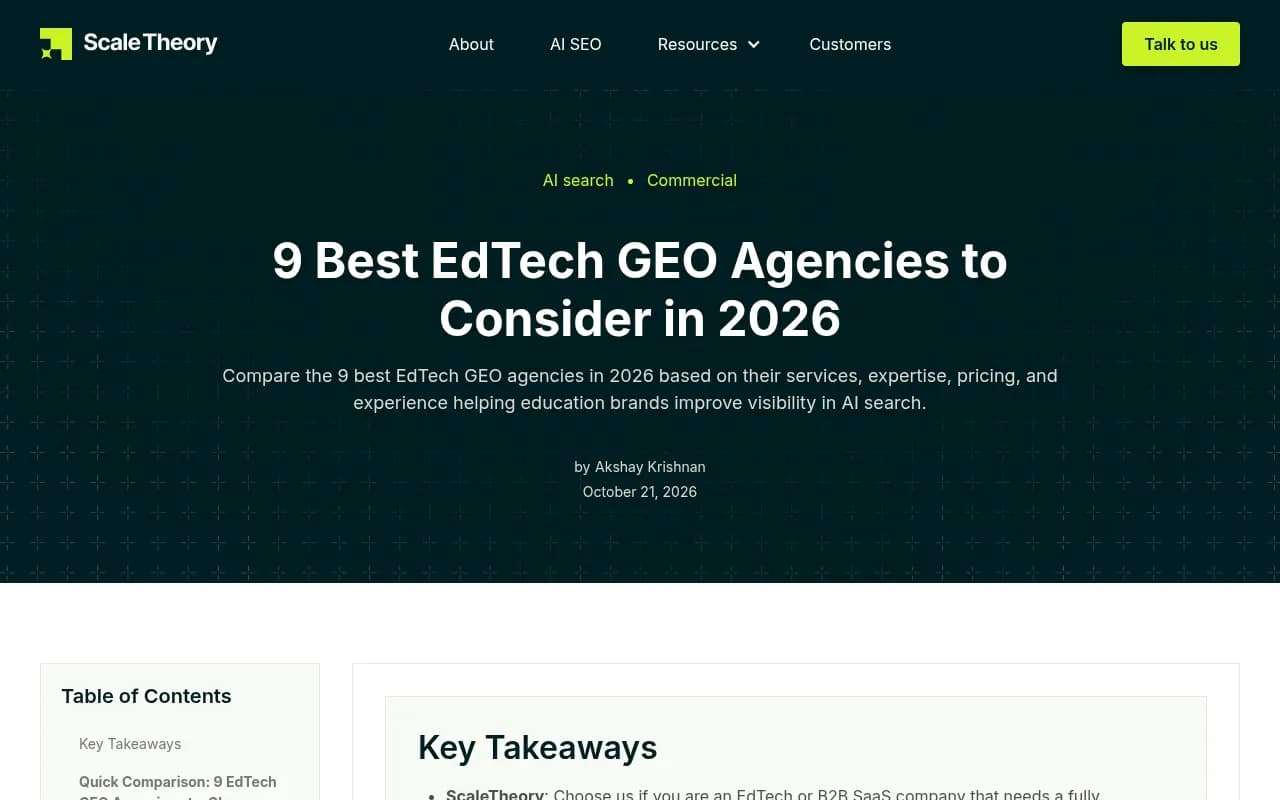
If you lack the bandwidth, an agency can run this for you. ScaleTheory's October 2026 list of EdTech GEO agencies names First Page Sage, Siege Media, Qoulomb, Animalz, Manaferra, Embarque, NoGood and Concurate, with ScaleTheory ranking itself first, so read it as a starting list rather than a neutral ranking.
Some of these also appear in our directory, including First Page Sage, Siege Media and Embarque. A common hybrid works well: pay for a platform for measurement and let an agency or in-house writers handle production. For more tool options, the GEO software directory at bestgeosoftware.com lists dozens of platforms.
Picking by situation
- Solo founder or tiny EdTech startup: Otterly Lite or Promptwatch's free Explore tier to get a baseline, then upgrade.
- Growth-stage EdTech with an SEO team: Promptwatch Essential or Professional, or Peec if multilingual tracking is the priority.
- University marketing team: Promptwatch Professional or Business for crawler logs and city tracking, plus the free site audit-style checks before big content work.
- Large university system or enterprise OPM: demo Profound and Promptwatch Business or Enterprise side by side.
- Agency serving schools: look at Promptwatch's agency plans (Kick-off $199/mo, Growth $399/mo, Scale $799/mo) or Rankscale for light reporting.
Mistakes to avoid
- Comparing sticker prices without comparing engines and billing terms.
- Tracking only ChatGPT. Google AI Overviews and AI Mode cite very differently, and YouTube is far more relevant there.
- Chasing Reddit for ChatGPT visibility after the August 2026 drop (reddit.com's share fell from about 4% to 0.5% on August 14, per Promptwatch Data).
- Publishing hundreds of thin AI-written program pages. The citation data favors substantive product and landing pages.
- Ignoring hallucinations. Check what AI says about your tuition, accreditation and outcomes, and fix the source pages when it's wrong.
The bottom line
The tool matters less than the loop: track a frozen prompt set, find where AI reads and cites you, fix program pages and public docs, then check whether it worked. Monitoring-only tools like Otterly are fine for a baseline. If you want the whole loop in one place, Promptwatch is the strongest fit I found. Whatever you pick, start with 50 well-chosen prompts and a baseline this month.