Key takeaways
- Slate (slatehq.com) starts at $499/mo and its dedicated Agency plan is $2,000/mo. Promptwatch starts at $95/mo, with agency plans from $199/mo.
- Both platforms try to close the loop from insight to published content. Promptwatch adds IP-verified AI crawler logs, visitor analytics, and Reddit, YouTube and LinkedIn citation tracking. Slate leans on credits, workspaces and a hands-on onboarding model.
- Slate meters usage in credits and "AI answers", so tracking daily can burn through a plan fast. Promptwatch plans are sized by prompts and responses, with all engines included.
- Promptwatch is the better default for most agencies, especially those with many small and mid-size clients. Slate makes more sense if you want a high-touch, done-with-you setup for a few larger accounts.
- Slate is young and has no independent reviews that I could verify yet. Check both pricing pages before you commit.
Why this comparison matters for agencies
Running AI visibility for one brand is a dashboard problem. Running it for fifteen clients is a billing, workspace, reporting and prioritization problem. Most tools in this category were designed for the first case and got an "agency" tier bolted on later.
Slate and Promptwatch both claim to go past monitoring. Slate describes itself as a system of action between insight and outcome. Promptwatch describes itself as an optimization platform where agents plan, write and publish. On paper they look close. In practice the pricing models, the data underneath, and the agency packaging differ a lot.
One note before we start: Slate here means slatehq.com, an AI platform for marketing teams. It is unrelated to slate.ai, which is construction analytics.
What each platform is
Slate
Slate is built around the premise that visibility has to be engineered, not just observed. It ties AI answer tracking to page monitoring, keyword tracking, an Opportunities feed, and agent-driven work such as Slate Coworker, workflows and outreach. Its own positioning targets B2B SaaS and content-led teams. Every plan includes a bring-your-own-API-key option.
It is a newer product. I could not find independent reviews beyond a Capterra listing, so most of what is known comes from Slate's own site.
Promptwatch
Promptwatch is an end-to-end AI search visibility and GEO platform used by 1,840+ brands and agencies and rated 4.7/5 on G2. It tracks the real interfaces of ChatGPT, Google AI Overviews, Google AI Mode, Gemini, Perplexity, Copilot, Alexa and others, and then adds crawler logs, visitor analytics, content gap analysis, and a Content Agent that publishes to Webflow, Framer or WordPress.

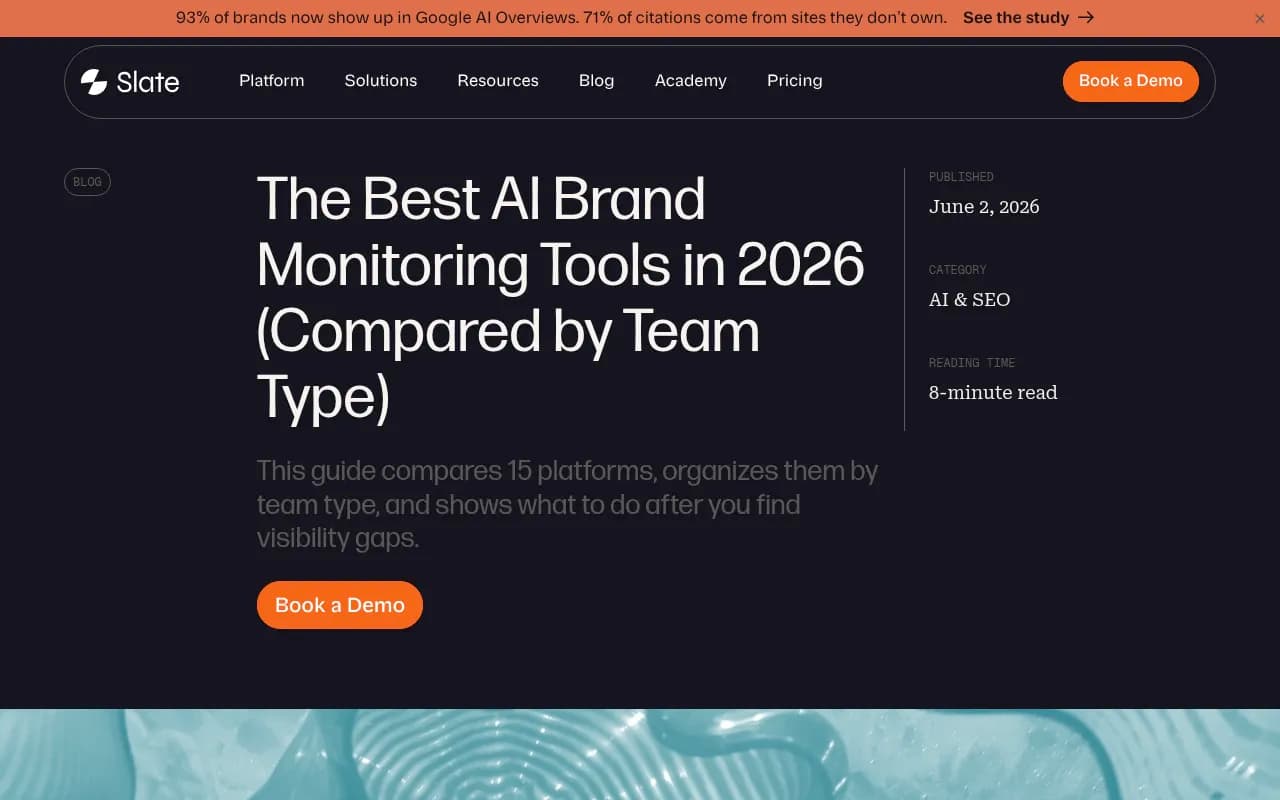
Slate itself lists Promptwatch in its own roundup of AI brand monitoring tools, recommending it for teams that want to connect visibility to crawler activity, traffic and revenue in one platform.
Pricing compared
Pricing is where the two diverge most. Always confirm on slatehq.com/pricing and promptwatch.com/pricing, since both change.
| Plan | Price per month | Prompts | Notes |
|---|---|---|---|
| Slate Growth | $499 | 333 | 15,000 credits, 10,000 AI answers, 1 user, 1 workspace, 1 region |
| Slate Scale | $999 | 667 | 50,000 credits, 20,000 answers, multi-region, account manager |
| Slate Agency | $2,000 | 1,667 | 100,000 credits, 50,000 answers, custom workspaces, GTM Engineer |
| Promptwatch Essential | $95 | 50 | 6,000 responses, all models, API and MCP |
| Promptwatch Business | $579 | 350 | 42,000 responses, Content Agent, state and city tracking |
| Promptwatch Agencies Kick-off | $199 | Unlimited | 10 seats, 10,000 responses, unlimited projects |
| Promptwatch Agencies Growth | $399 | Unlimited | 25,000 responses |
| Promptwatch Agencies Scale | $799 | Unlimited | 65,000 responses, most popular |
Slate bills annually at a 20% discount. Promptwatch annual billing gives 12 months for the price of 10.
The usage math matters
Slate counts one AI answer as one response from one platform, for one prompt, in one location. Its own numbers show that 333 prompts tracked daily on a single platform use about 10,000 answers a month, which is the entire Growth allowance. Running them weekly uses roughly 1,450. So the real question is not the sticker price, it is how many prompts times how many engines times how often you check.
An agency with ten clients, 30 prompts each, across four engines, checked weekly, is looking at roughly 5,000 answers a month. That fits. Daily checks multiply it by about seven and it no longer fits comfortably.
Slate also sells Claude and Gemini as a separate add-on answer pool in packs of 1,000. Every plan covers ChatGPT, Perplexity, AI Overviews and AI Mode. Promptwatch includes all engines at every paid tier.
Engine coverage and data source
| Slate | Promptwatch | |
|---|---|---|
| ChatGPT, Perplexity | Included | Included |
| Google AI Overviews and AI Mode | Included | Included |
| Claude, Gemini | Add-on packs (Enterprise includes all six) | Included on paid plans |
| Copilot, Alexa | Not listed in what I could verify | Included |
| Data collection | Not clearly stated | Real UI scraping, plus API models alongside |
| Country tracking | Region count by plan | All paid plans, state and city from Business |
The real-interface point is not trivia. Answers and citations from the consumer UI can differ from what the API returns, and your clients' buyers use the UI. Promptwatch is explicit that it monitors the interfaces. I could not confirm Slate's method from the material available.
Beyond tracking: what you can diagnose
This is the area where I would push hardest in a demo, because it determines whether you can explain a drop to a client.
Promptwatch includes IP-verified AI crawler logs. You can see when GPTBot, ClaudeBot, PerplexityBot and others hit a page, what errors they got, and whether crawling turned into citations. When a client asks why ChatGPT never mentions them, the first useful check is whether the bot can even read the site. A third-party agency review of Promptwatch calls crawler analytics the thing it does better than anything else on that list.
It also ships visitor analytics for AI referral traffic and conversions, weekly site audits, Citation Trends, and Reddit, YouTube and LinkedIn citation reports. Those channels matter. Promptwatch Data shows that from Sep 28 to Oct 4, 2026, ChatGPT drew only 0.46% of its citations from social platforms while Google AI Overviews drew 12.2%. A tracker that treats all engines the same will mislead you on social strategy.
Slate's published material emphasizes page monitoring, keyword tracking, content performance, and an Opportunities feed. That is useful, but nothing I found describes crawler-level logs. If diagnosing technical access is part of your service, that gap is worth asking about directly.
Content and execution
Both platforms want to be where the fix happens.
Slate's angle is agents: credits pay for Cowork tasks and workflow runs, and it lists custom agent builds, bulk execution, and LinkedIn and email outreach. I could not tell from the pricing scrape which plans include which agent features, and when credits run out, workflows pause. Buy credit packs (5,000, 50,000 or 100,000) if you hit the ceiling.
Promptwatch's loop is: content gap analysis finds missing topics, the Action Board prioritizes work, the Content Agent writes and publishes to Webflow, Framer or WordPress on a schedule, and published pages are then tracked through crawls, citations and clicks. Underperformers return as actions. The Content Agent and full Agentic AI Search Optimization sit on the Business plan and above, and agencies get Ads Radar and state and city tracking on all agency tiers.
If your clients care about content quality, both approaches still need a human editor. Neither removes that step.
Agency-specific packaging
| Need | Slate | Promptwatch |
|---|---|---|
| Multiple client workspaces | Custom workspaces on Scale and Agency | Unlimited projects on every agency plan |
| Seats | Custom | 10 seats on agency plans |
| White-label reporting | Not verified | White-label PDF reports, workspace and client portal |
| Pitch or prospect projects | Not verified | Pitch projects included |
| Onboarding | 1:1 onboarding, GTM Engineer on Agency | Self-serve, live sessions, managed options on higher tiers |
| API and MCP | BYO key, MCP listed | REST API v2 and hosted MCP server with 110+ tools |
Two things stand out. First, Slate's $2,000 Agency tier includes a GTM Engineer and priority Slack, which is real service, and some agencies will value that more than software features. Second, Promptwatch's agency plans have unlimited projects and prompts at a fraction of the price, which changes the economics when your client book is long and your clients are small.
I could not verify white-label or pitch features for Slate. Ask for them in writing.
How the two stack up on cost per client
A rough worked example. Say you run 12 clients with 25 prompts each, 300 prompts total, across four engines, weekly.
- On Slate, that is about 300 x 4 x roughly 4.3 weeks, around 5,200 answers a month. The Growth plan covers the answers but gives you one workspace and one user. Multi-client work pushes you toward Scale at $999 or Agency at $2,000.
- On Promptwatch, agency plans size by responses, so the same load fits inside Growth at $399, or Kick-off at $199 with lighter cadence.
These are estimates, not quotes. Your cadence, engines and regions change the answer.
What the market says about both
Independent agency roundups are mixed, and worth reading with skepticism since many are published by competing vendors. Analyze AI's agency comparison rates Promptwatch for crawler-level visibility but criticizes scaling cost and the maturity of white-labeling. Promptwatch's current agency plans were built to address exactly that, so recheck current pricing rather than relying on older write-ups. Slate's own blog recommends Promptwatch for teams wanting crawl-to-revenue visibility.
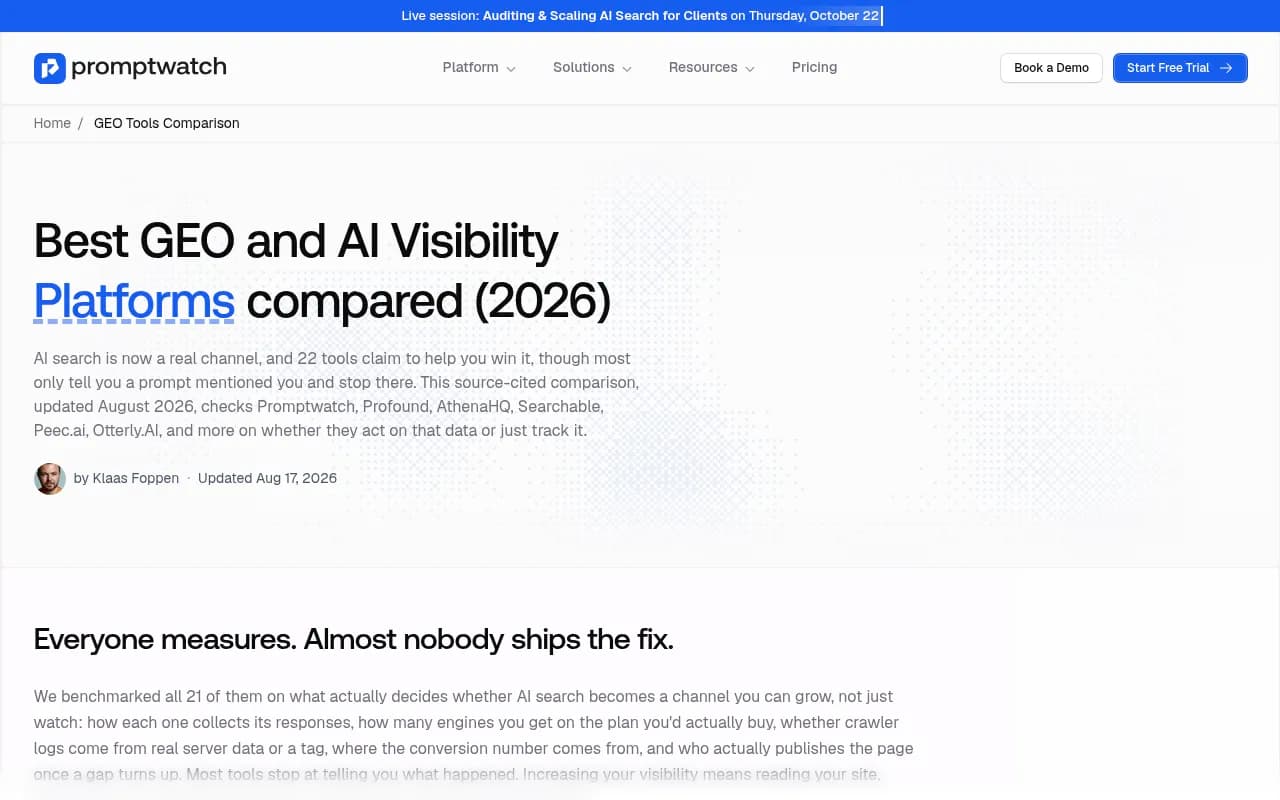
A broader look at the field is in the Promptwatch comparison of 22 GEO platforms, which scores tools on prompt tracking, citation trends, crawler logs, visitor analytics, content gap and offsite mentions.
If you want to widen the shortlist, the GEO software directory at bestgeosoftware.com lists dozens of alternatives. Profound is the other agency-focused name that keeps coming up, with client workspaces and pitch environments, though its workspace add-on is charged on top of the base subscription.
Profound

Why cross-engine tracking matters for agency reporting
Citation behaviour differs by engine, and your client reports should reflect it. In Promptwatch's data on average sources per response, ChatGPT cites about 5 sources per web-search answer, Google AI Overviews about 10, and Perplexity almost exactly 10. Fewer ChatGPT slots means tougher competition per citation, so a single blended score hides where a client is actually losing.
Also keep volatility in mind. Promptwatch Data shows reddit.com's share of ChatGPT citations falling from about 4% to 0.5% on August 14, 2026. An agency with weekly reporting needs to catch shifts like that quickly and explain them, not discover them a month later.
Which should your agency choose
Choose Promptwatch if:
- You manage many clients, especially small and mid-size ones, and need unlimited projects and prompts at a predictable price.
- You need to explain why a client is invisible, using crawler logs, site audits and citation trends.
- You want AI traffic and conversion data on the client's own site, not just mention counts.
- You want every engine included without add-on answer packs.
Choose Slate if:
- You handle a small number of larger, content-led B2B accounts and want a hands-on GTM Engineer and priority Slack.
- Agent-driven workflows and outreach automation are central to how you deliver.
- You are comfortable budgeting around credits and answer allowances.
My honest read: for most agencies, Promptwatch wins on price, coverage, diagnostics and agency packaging. Slate's strength is the done-with-you service layer, and it is a defensible choice if that is what you are buying. Its youth and the lack of independent reviews are reasons to run a paid pilot first.
How to run a fair trial
- Pick two real clients with different profiles, one local or mid-market and one larger.
- Load the same 30 to 50 prompts into both tools and run them on the same cadence for two weeks.
- Compare what each tells you about why a prompt is lost, not just that it is lost.
- Ask each vendor to show white-label output you can send to a client unedited.
- Count the answers or responses used so you can project real monthly cost.
- Publish one fix from each tool and check whether it gets crawled, cited and clicked.
Promptwatch offers a 7-day free trial on monthly Essential and the agency Kick-off and Growth plans, plus a free Explore tier. Confirm current terms on promptwatch.com/pricing.
If you are also weighing whether to build this capability in-house or hire help, an agency like 1001 SEO Media, which uses Promptwatch for its own GEO work, can run the program for you.