Key takeaways
- Gauge is a solid entry-level AI visibility tracker, but most mid-market teams outgrow it quickly -- it monitors mentions but doesn't help you act on what you find
- Promptwatch is the strongest all-around alternative: it tracks 10+ AI models, identifies content gaps, generates AI-optimized content, and attributes traffic back to revenue
- Nightwatch and Orchly are worth considering if your priority is rank tracking or content automation respectively
- Peec AI is the best pick for multilingual and international coverage (115+ languages)
- Budget-conscious teams should look at Promptmonitor or Rankscale before committing to pricier platforms
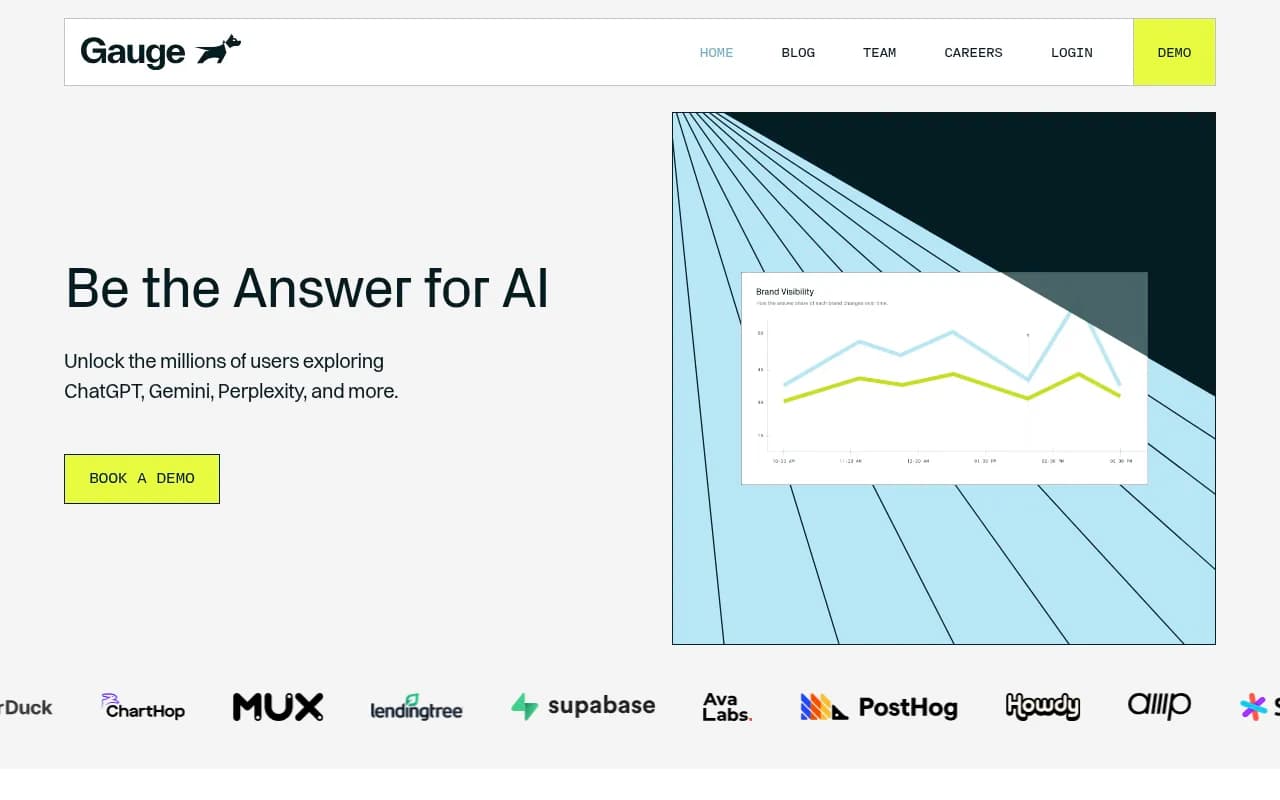
Gauge does one thing reasonably well: it shows you when your brand appears in AI-generated answers. For a lot of teams just getting started with GEO (Generative Engine Optimization), that's enough. You set up some prompts, watch the numbers, feel good about the dashboard.
Then reality sets in. You're invisible for a whole category of prompts your competitors own. You don't know why. You don't know what to do about it. Gauge doesn't tell you.
That gap -- between monitoring and actually fixing your AI visibility -- is where most teams start looking for alternatives. This guide covers the best options in 2026, with honest takes on who each tool is actually for.
Why teams leave Gauge
Gauge is a monitoring tool. It tracks brand mentions across AI engines and gives you visibility scores. That's genuinely useful as a starting point, but the ceiling is low.
The problems that come up most often:
- No content gap analysis -- you can see you're losing, but not why or where
- Limited model coverage compared to newer platforms
- No crawler log access, so you can't see how AI bots are actually reading your site
- No built-in content generation to act on what you find
- Prompt volume data is thin, making prioritization a guessing game
If any of those sound familiar, you're in the right place.
The best Gauge alternatives in 2026
Promptwatch -- best overall for mid-market teams
Promptwatch is the most complete platform in this space right now. It's not just a tracker -- it's built around a full optimization loop: find where you're invisible, generate content to fix it, then track whether that content actually gets cited.

The part that separates it from Gauge and most other alternatives is the Answer Gap Analysis. It shows you the exact prompts your competitors are being cited for that you're not. Not a vague "you're losing in this category" -- the actual prompts, with volume estimates and difficulty scores. That's actionable in a way that most dashboards aren't.
From there, the built-in AI writing agent generates articles, listicles, and comparisons grounded in real citation data (880M+ citations analyzed). The content is engineered to get cited by ChatGPT, Claude, Perplexity, and other models -- not generic SEO filler.
On the tracking side, Promptwatch covers 10 AI models including Google AI Overviews, Google AI Mode, DeepSeek, Grok, and Mistral -- broader than most competitors. The AI Crawler Logs feature is genuinely rare: real-time logs of AI bots hitting your site, which pages they read, errors they hit, how often they return. Most platforms don't offer this at all.
Traffic attribution closes the loop. You can connect AI visibility to actual revenue via a code snippet, GSC integration, or server log analysis.
Pricing starts at $99/month (Essential: 1 site, 50 prompts, 5 articles), with Professional at $249/month and Business at $579/month. A free trial is available.
Nightwatch -- best for traditional rank tracking with AI monitoring added
Nightwatch started as a rank tracker and has added AI search monitoring on top of a solid foundation. If your team already uses it for traditional SEO and wants to layer in AI visibility without switching platforms, it's a reasonable choice.
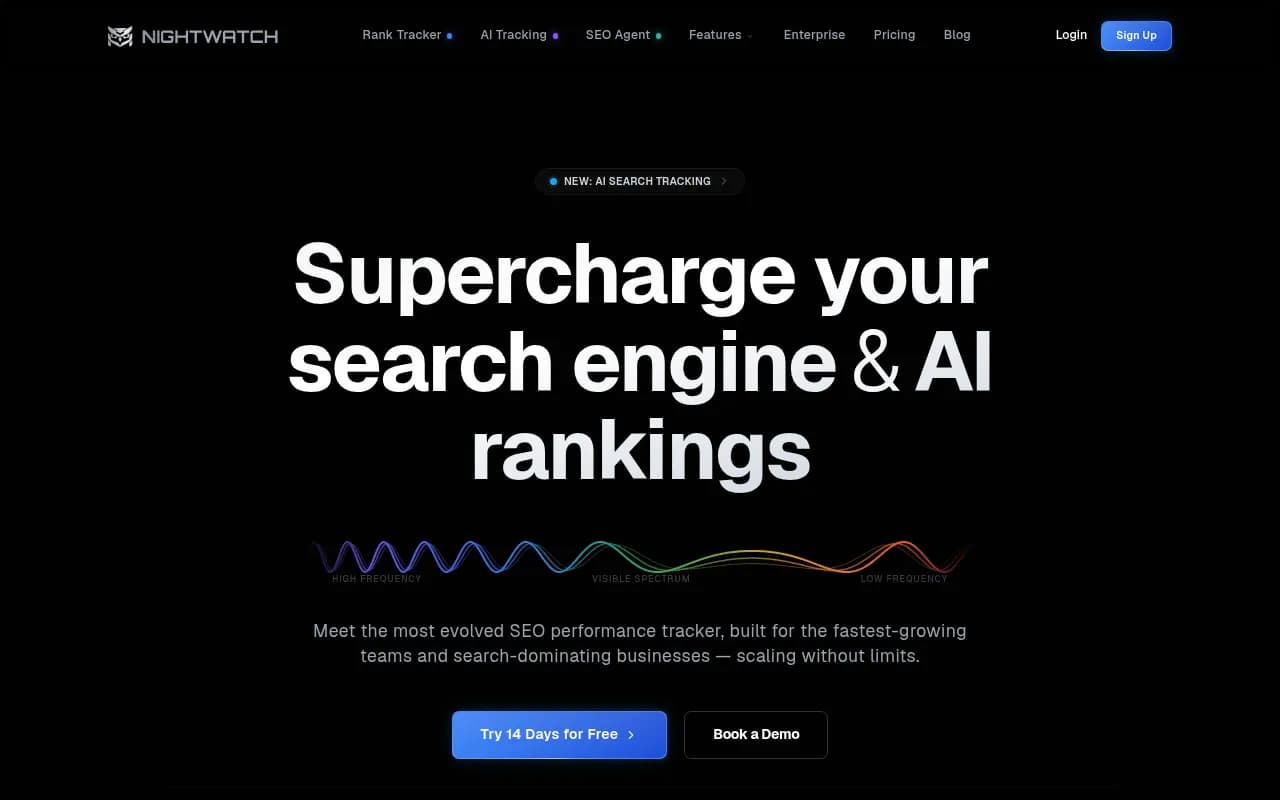
The AI monitoring features are more basic than Promptwatch's -- you get brand mention tracking and some competitor benchmarking, but no content gap analysis or generation tools. Think of it as a "plus AI" version of a rank tracker rather than a purpose-built GEO platform.
Good fit for: SEO teams who want one tool for both traditional and AI search, and don't need deep optimization features.
Orchly -- best for content automation + visibility in one workflow
Orchly combines three things that usually require separate tools: content strategy automation, content creation, and AI visibility tracking. If you're spending too much time stitching together different platforms, that's a real selling point.
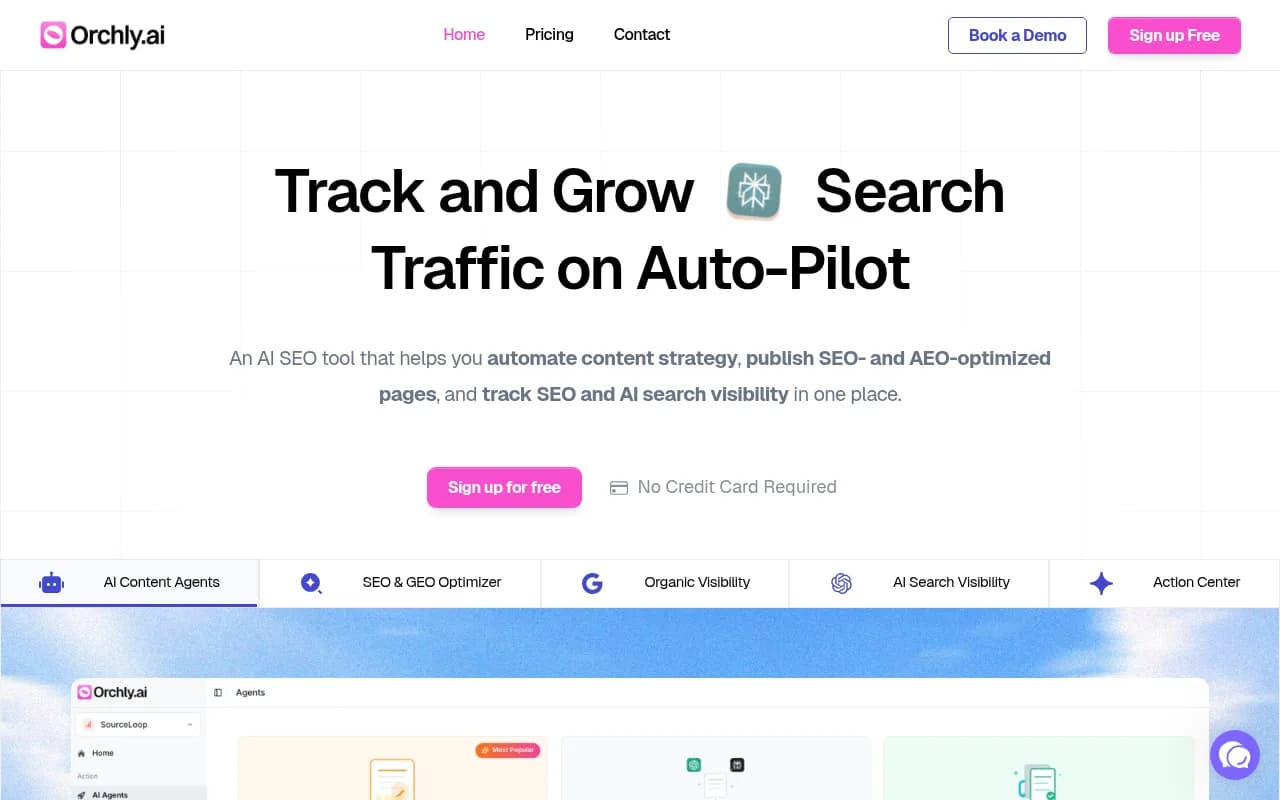
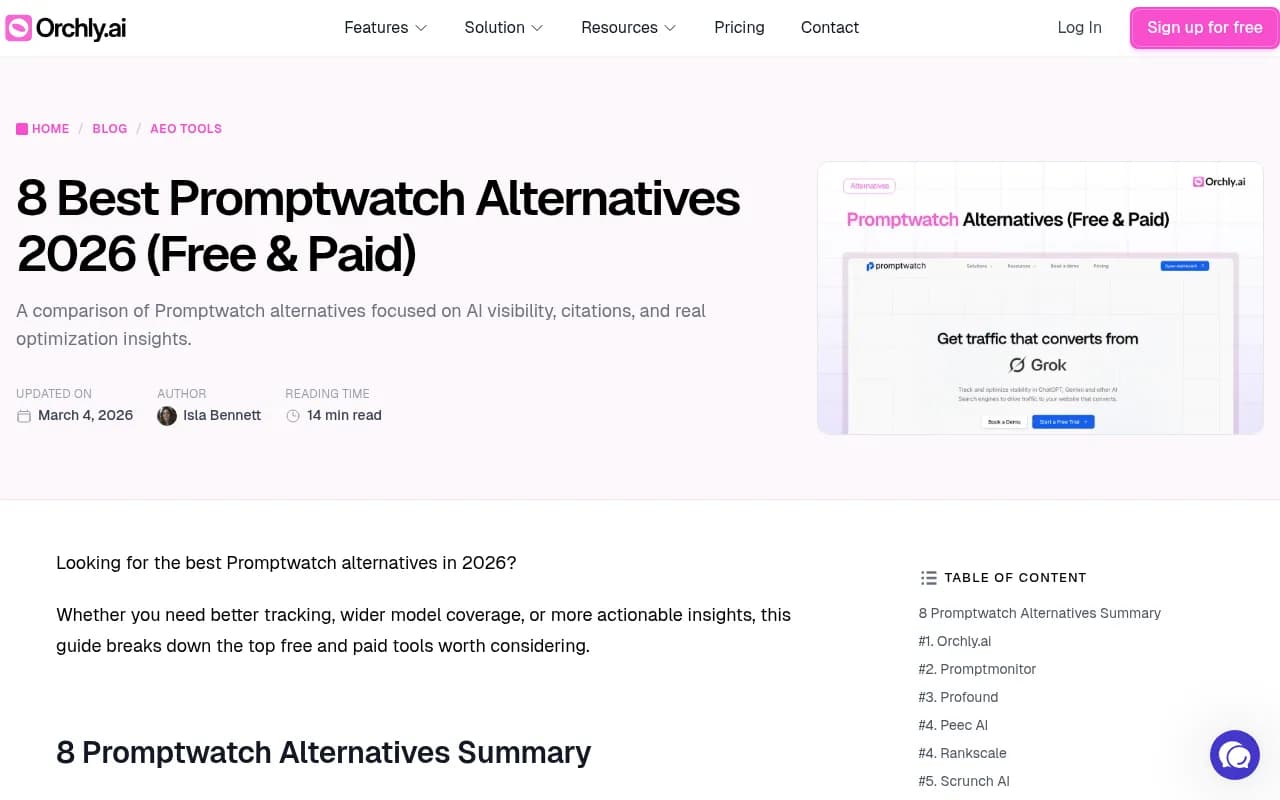
The platform covers ChatGPT, Claude, Perplexity, Gemini, and AI Overviews. Pricing starts at $49/month, which makes it one of the more accessible options for smaller teams. The content automation angle is where it genuinely differentiates -- if your bottleneck is producing enough content to compete, Orchly is worth a look.
The tradeoff: it's not as deep on the tracking and analytics side as Promptwatch. You get visibility data, but the prompt intelligence (volume, difficulty, query fan-outs) is thinner.
Good fit for: content-first teams who want to automate production and track AI visibility without managing multiple tools.
Peec AI -- best for multilingual and international brands
If you're tracking AI visibility across non-English markets, Peec AI is the standout option. It supports 115+ languages, which is more than any other platform in this comparison.

Coverage includes ChatGPT, Perplexity, and AI Overviews, with additional platforms available as add-ons. Pricing starts at €89/month. The core product is monitoring-focused -- you won't get content generation or deep gap analysis here -- but for international teams who need accurate multilingual tracking, it fills a gap that most platforms ignore.
Good fit for: global brands tracking AI visibility in multiple languages, especially in markets where English-first tools fall short.
Scrunch AI -- best for enterprise teams with compliance requirements
Scrunch positions itself as an "AI Customer Experience Platform" and targets mid-market to enterprise customers. It's SOC 2 Type II compliant, which matters for larger organizations with security requirements.
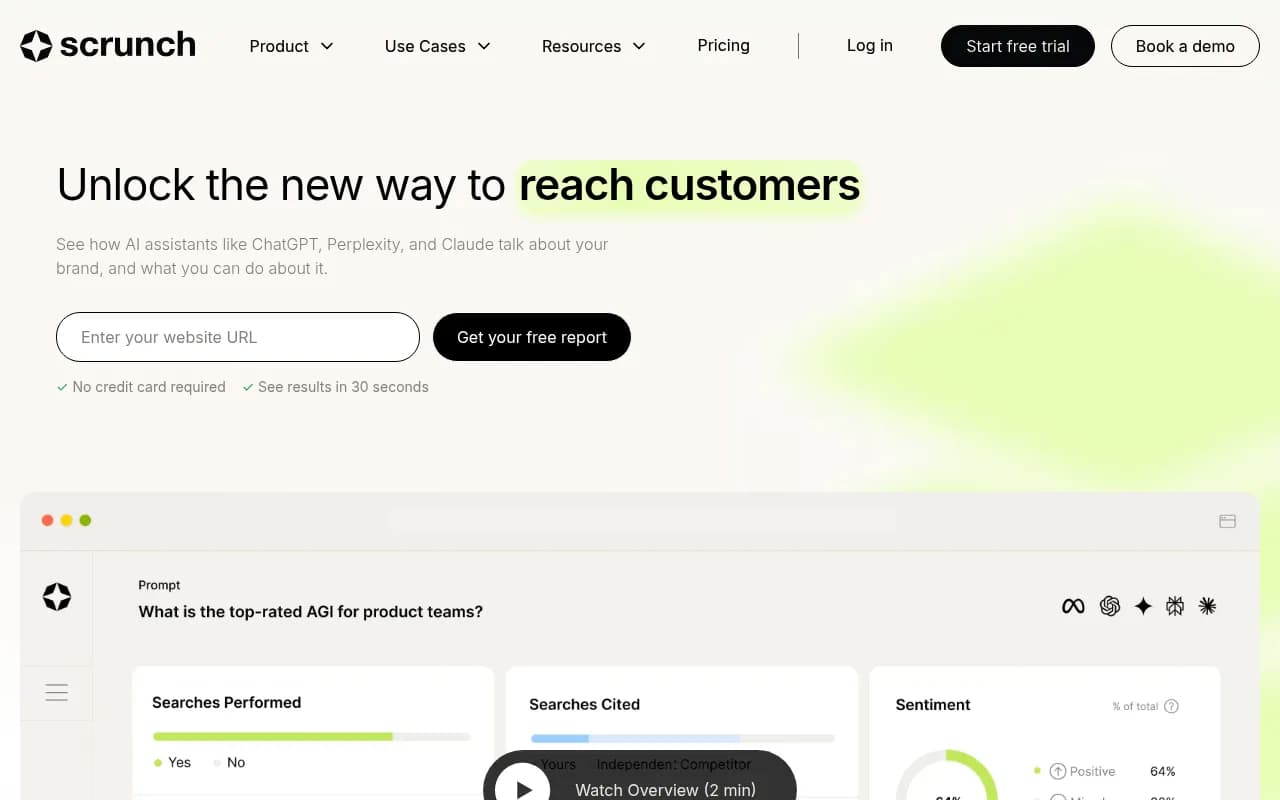
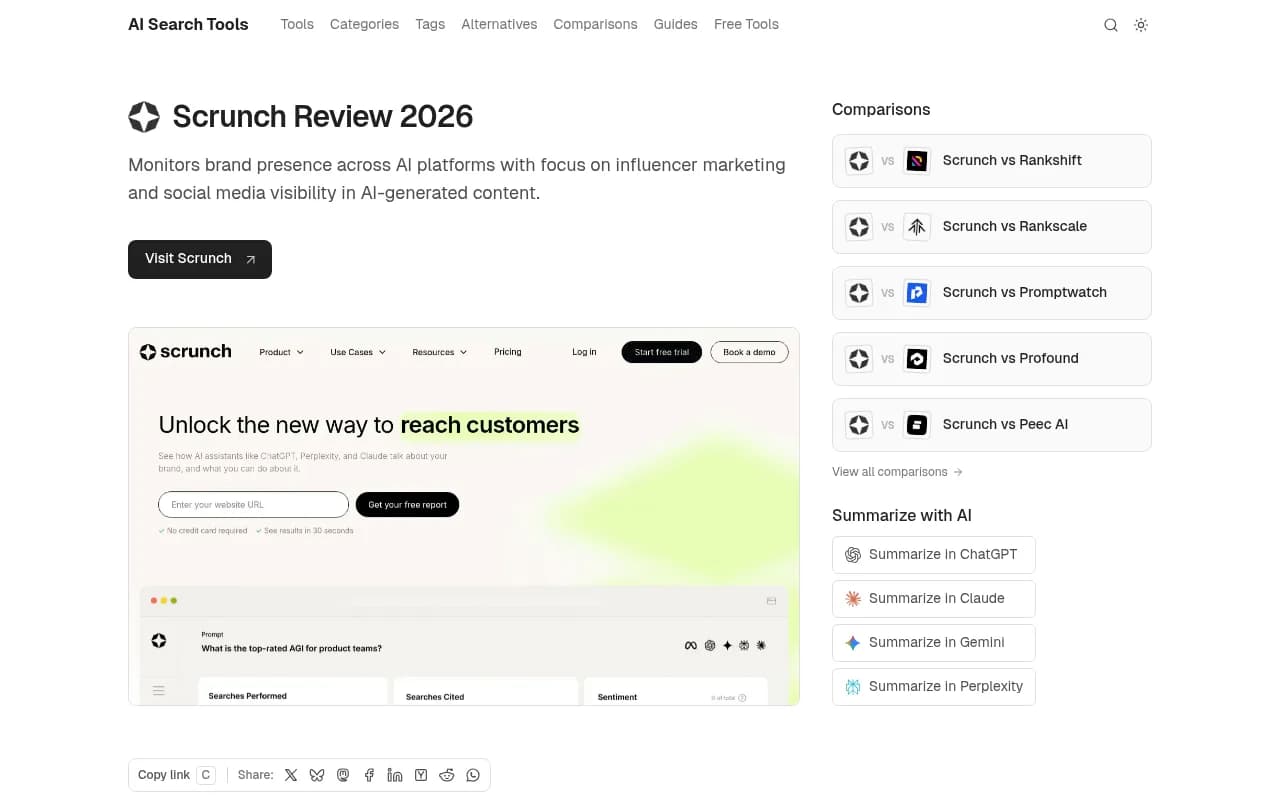
The platform covers ChatGPT, Perplexity, Claude, and Gemini, with a feature called the Agent Experience Platform (AXP) that creates AI-optimized parallel versions of your site to improve how bots interpret your content. That's an interesting technical approach, though it adds complexity.
The main limitation: Scrunch is monitoring-focused. There's no content gap analysis, no Reddit/YouTube tracking, and no built-in content generation. Pricing starts at $300/month (Starter), which is high for what's essentially a monitoring dashboard.
Good fit for: enterprise brands that need SOC 2 compliance and solid monitoring, and have separate resources for content optimization.
Promptmonitor -- best budget option for comprehensive tracking
Promptmonitor covers 8+ platforms including ChatGPT, Claude, DeepSeek, and Grok, and starts at $29/month. It also offers unlimited seats, which is unusual at this price point.
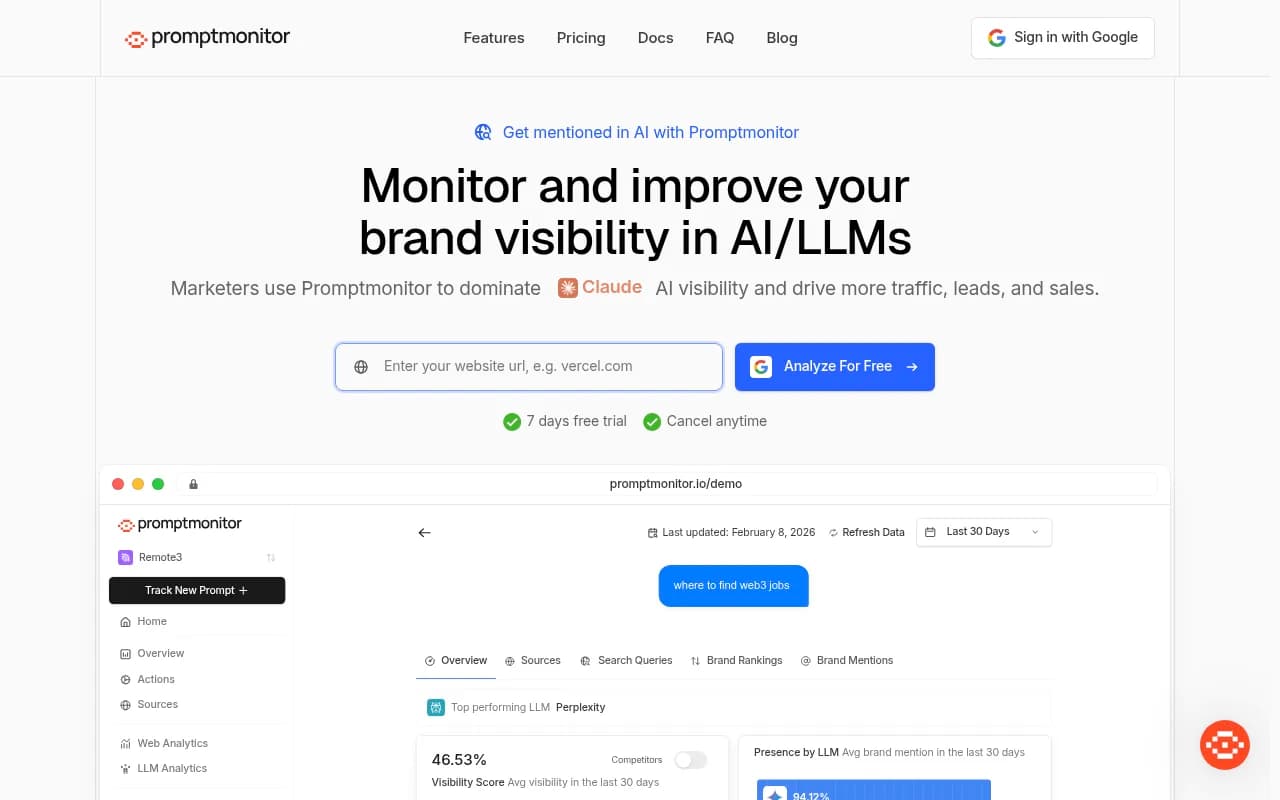
A standout feature is publisher contact extraction -- it surfaces the sources AI models are citing and gives you contact info to pursue link-building or PR opportunities. That's a practical, actionable feature you don't see everywhere.
The tradeoffs are real: no crawler logs, no visitor analytics, no content generation. But if your budget is tight and you need solid multi-platform monitoring, it's hard to beat at this price.
Good fit for: budget-conscious teams who need broad model coverage and don't require optimization features.
Profound -- best for enterprise brands with serious budgets
Profound is the premium option in this space. It covers 10+ platforms and includes a Conversation Explorer feature that lets you dig into how AI models are actually discussing your brand -- not just whether you appear, but what they say and in what context.
Profound

Real-time search volume insights are another differentiator. Most platforms estimate prompt volumes; Profound's data is more current.
The catch: it starts at $499/month, which puts it out of reach for most mid-market teams. If budget isn't a constraint and you need the deepest analytics available, it's worth evaluating. Otherwise, Promptwatch covers most of the same ground at a fraction of the price.
Good fit for: enterprise brands with substantial budgets who need the most detailed AI conversation analytics available.
AthenaHQ -- best for teams that want strategic recommendations
AthenaHQ has an "Action Center" that generates strategic recommendations based on your visibility data. It's a step toward actionability that pure monitoring tools don't offer.

Coverage includes ChatGPT, Perplexity, Claude, and Gemini. Pricing starts at $295/month. The limitation is that AthenaHQ still stops short of actually helping you create content -- it tells you what to do, but the execution is on you.
Good fit for: enterprise teams who want data-driven strategic guidance and have internal resources to act on recommendations.
Rankscale -- best for startups and small businesses
At $20/month, Rankscale is the most affordable entry point with a reasonable feature set. It covers ChatGPT, Claude, Perplexity, and AI Overviews.
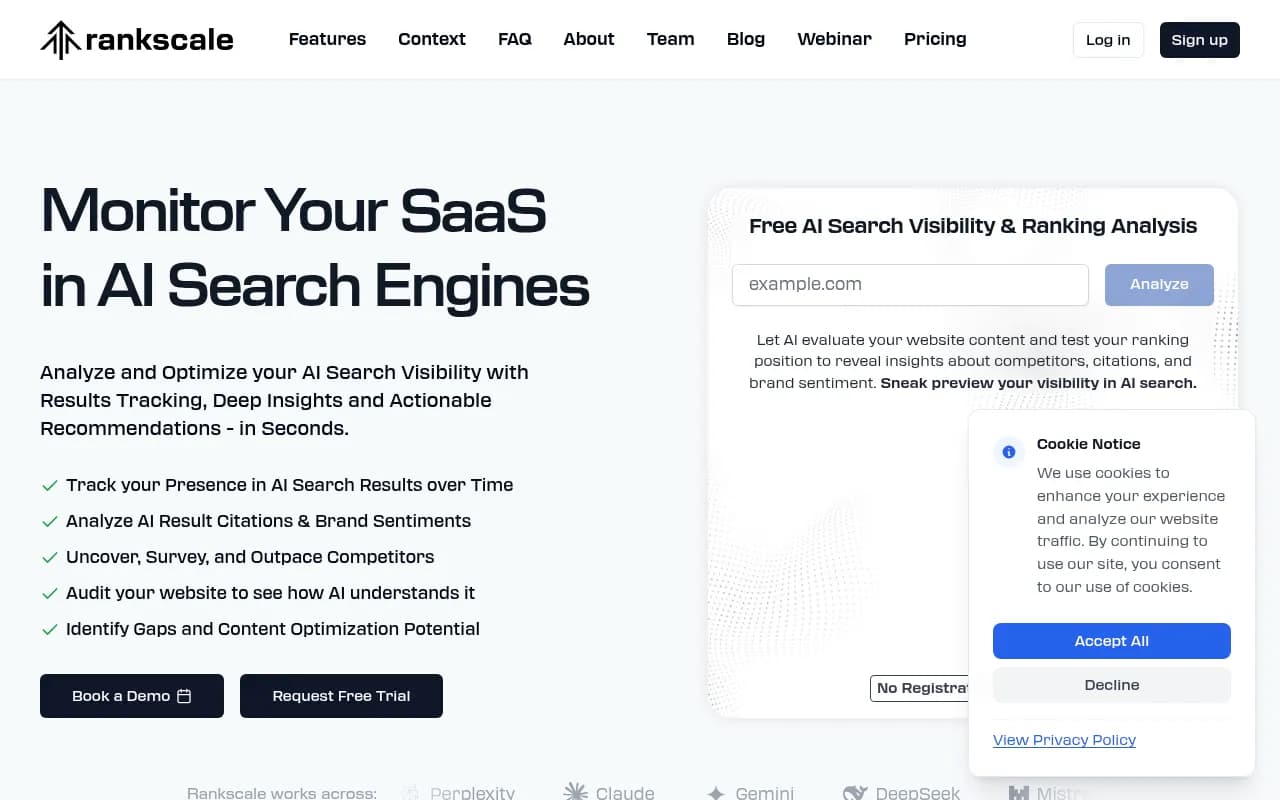
Don't expect deep analytics or content tools -- this is monitoring at its most basic. But for a startup that just wants to know whether they're showing up in AI answers, it's a sensible starting point before investing in a more complete platform.
Good fit for: early-stage companies testing AI visibility tracking before committing to a larger platform.
Side-by-side comparison
| Tool | Starting price | AI models covered | Content generation | Gap analysis | Crawler logs | Best for |
|---|---|---|---|---|---|---|
| Promptwatch | $99/mo | 10+ | Yes | Yes | Yes | Mid-market teams wanting full optimization |
| Nightwatch | Varies | Limited | No | No | No | SEO teams adding AI monitoring |
| Orchly | $49/mo | 5 | Yes | Basic | No | Content-first teams |
| Peec AI | €89/mo | 3+ | No | No | No | Multilingual/international brands |
| Scrunch AI | $300/mo | 4+ | No | No | No | Enterprise with compliance needs |
| Promptmonitor | $29/mo | 8+ | No | No | No | Budget-conscious teams |
| Profound | $499/mo | 10+ | No | Basic | No | Enterprise with large budgets |
| AthenaHQ | $295/mo | 4 | No | Basic | No | Teams wanting strategic guidance |
| Rankscale | $20/mo | 4 | No | No | No | Startups, early-stage testing |
| Gauge | Varies | Limited | No | No | No | Entry-level monitoring |
How to choose
The right tool depends on what's actually blocking you.
If you're invisible in AI search and don't know why, you need gap analysis. That points to Promptwatch (most complete) or AthenaHQ (recommendations without execution).
If you're invisible and also struggling to produce enough content to compete, Orchly's content automation angle is worth exploring. Promptwatch's built-in writing agent is more powerful, but Orchly's workflow automation is designed for teams with high content volume needs.
If you operate in multiple languages, Peec AI is the only real option with serious multilingual coverage.
If budget is the primary constraint, Promptmonitor at $29/month or Rankscale at $20/month give you monitoring without the optimization features. They're good starting points, not long-term solutions.
If you're at enterprise scale with compliance requirements, Scrunch AI or Profound are worth evaluating -- though both come at a significant price premium compared to what Promptwatch offers.
The honest answer for most mid-market teams: Gauge is fine for a few months while you're learning the space. Once you're ready to actually move the needle on AI visibility, you need a platform that helps you act on what you find -- not just watch the numbers.
Promptwatch is the only platform in this comparison that covers the full loop: tracking, gap analysis, content generation, and traffic attribution. For teams serious about AI search visibility in 2026, that's the meaningful difference.