Key takeaways
- Ahrefs Brand Radar covers only ChatGPT and Google AI, uses fixed prompts, and offers no content generation or AI traffic attribution -- making it a weak choice for serious AI visibility work.
- Dedicated GEO platforms like Promptwatch go beyond monitoring: they identify content gaps, generate AI-optimized content, and track whether that content actually gets cited.
- Semrush offers a broader AI toolkit than Ahrefs but still relies on fixed prompts and lacks crawler log access.
- Profound and AthenaHQ are strong monitoring tools but lean enterprise-priced and don't include built-in content creation.
- The right alternative depends on your team size, budget, and whether you need to just track AI visibility or actually improve it.
Ahrefs is a genuinely excellent SEO tool. If you're doing keyword research, backlink analysis, or technical audits, it's hard to beat. But its AI visibility feature, Brand Radar, is a different story. It tracks mentions in ChatGPT and Google AI, uses a fixed set of prompts you can't customize, and gives you no way to act on what you find. There's no content gap analysis, no AI traffic attribution, no crawler logs, and no built-in way to create content that might actually get cited.
For teams who want to understand and improve how they appear in AI search engines in 2026, Ahrefs Brand Radar is more of a checkbox than a solution. This guide covers the best alternatives -- what they do, what they cost, and which one makes sense for your situation.
Why Ahrefs Brand Radar falls short for AI visibility
Before getting into alternatives, it's worth being specific about the limitations.
Ahrefs Brand Radar monitors brand mentions in AI-generated answers, but the prompts are fixed -- you can't add your own questions or track the specific queries your customers actually use. Coverage is limited to ChatGPT and Google AI (no Perplexity, Claude, Gemini, DeepSeek, or Grok). There's no citation-level analysis showing which pages AI models pull from, no Reddit or YouTube tracking, and no way to connect AI visibility to actual website traffic.
Most critically: it's a read-only dashboard. You see that you're not being cited. You don't learn why, and you get no help fixing it.
That's the gap the tools below are designed to fill.
The best Ahrefs alternatives for AI visibility in 2026
1. Promptwatch -- best overall for teams that want to act, not just monitor
Promptwatch is the most complete AI visibility platform available right now. Where most tools stop at showing you a visibility score, Promptwatch is built around a three-step loop: find the gaps, create content that fills them, track the results.
The Answer Gap Analysis feature shows you exactly which prompts your competitors appear in that you don't -- with specific content recommendations for what your site is missing. The built-in AI writing agent then generates articles, listicles, and comparisons grounded in real citation data from over 880 million citations analyzed. This isn't generic content; it's engineered to get cited by ChatGPT, Claude, Perplexity, and other AI models.
On the tracking side, Promptwatch monitors 10 AI platforms (ChatGPT, Perplexity, Google AI Overviews, Google AI Mode, Claude, Gemini, Meta/Llama, DeepSeek, Grok, Mistral, Copilot), with page-level citation tracking, AI crawler logs showing which pages AI bots actually visit, and traffic attribution via code snippet, GSC integration, or server log analysis.
Other features worth noting: prompt volume and difficulty scoring, query fan-outs showing how one prompt branches into sub-queries, Reddit and YouTube insights, ChatGPT Shopping tracking, and competitor heatmaps. It's used by 6,700+ brands and agencies including Booking.com and Center Parcs.
Pricing starts at $99/month (Essential: 1 site, 50 prompts, 5 articles), $249/month (Professional: 2 sites, 150 prompts, 15 articles, crawler logs), and $579/month (Business: 5 sites, 350 prompts, 30 articles). A free trial is available.

2. Semrush -- best for teams already in the Semrush ecosystem
Semrush has added AI visibility tracking to its platform through the AI Toolkit add-on. It covers ChatGPT, Google AI Mode, Google AI Overviews, Gemini, and Perplexity -- broader than Ahrefs Brand Radar. Sentiment analysis is included, and the integration with Semrush's existing SEO data is genuinely useful for teams who want traditional and AI search metrics in one place.
The limitations: prompts are still largely fixed (you can't fully customize the prompt set), there's no AI traffic attribution, and the content generation features are more general-purpose SEO writing than citation-optimized AI content. It's a solid upgrade from Ahrefs Brand Radar if you're already paying for Semrush, but it won't close the loop between visibility and revenue the way a dedicated GEO platform will.
The AI Toolkit is available as an add-on to existing Semrush plans starting at $99/month.
3. Profound -- best for enterprise teams with deep monitoring needs
Profound is one of the earliest purpose-built AI visibility platforms and has earned a strong reputation, including a G2 Winter 2026 Leader badge. It covers 10+ AI platforms on its Growth plan and above, with solid prompt-level tracking and citation analysis.
Where Profound shines is depth of monitoring data -- it's a serious tool for enterprise teams that need comprehensive visibility reporting across multiple AI engines. Where it falls short: it's expensive (pricing starts around $99/month for a limited Starter plan, with meaningful features requiring Growth tier pricing), there's no built-in content generation, and Reddit tracking isn't included. If your primary need is monitoring and reporting rather than optimization, Profound is worth evaluating. If you need to actually improve your AI visibility, you'll need to pair it with other tools.
Profound

4. AthenaHQ -- best for growth-stage teams wanting proven citation improvement
AthenaHQ is a YC-backed platform that has documented 10x citation growth for some customers. It covers 8+ AI platforms including ChatGPT, Perplexity, Google AI Overviews, AI Mode, Gemini, Claude, Copilot, and Grok. The interface is clean and the monitoring data is solid.
The main limitation is that AthenaHQ is primarily a monitoring and analysis tool -- it doesn't include built-in content generation. You'll get good data on where you're visible and where you're not, but the content work to improve visibility happens outside the platform. Pricing starts at $295/month with a discounted first month available.

5. Otterly.AI -- best budget option for SMBs
Otterly.AI covers ChatGPT, AI Overviews, AI Mode, Perplexity, Gemini, and Copilot at a starting price of $29/month. It earned a Gartner Cool Vendor designation and has a 4.9/5 user rating. For small teams or solo marketers who want basic AI visibility monitoring without enterprise pricing, it's a reasonable entry point.
The trade-off is that Otterly.AI is a monitoring-only tool. No content generation, no crawler logs, no traffic attribution. It's good for awareness; it's not a platform you'll use to actually move your visibility scores.
Otterly.AI

6. Peec AI -- best for global brands tracking multiple languages
Peec AI supports 115+ languages and covers ChatGPT, Perplexity, Claude, Gemini, and DeepSeek. It uses UI scraping rather than API calls, which means the responses it captures are closer to what real users see. The dashboards are clean and CSV exports are available.
Starting at around €89/month, it's reasonably priced for what it offers. The gap is on the actionability side -- recommendations are limited, and there's no content generation. For a global brand that needs multilingual AI visibility data, Peec AI is one of the better options in this category.

7. Scrunch AI -- best for enterprises wanting an "Agent Experience Platform"
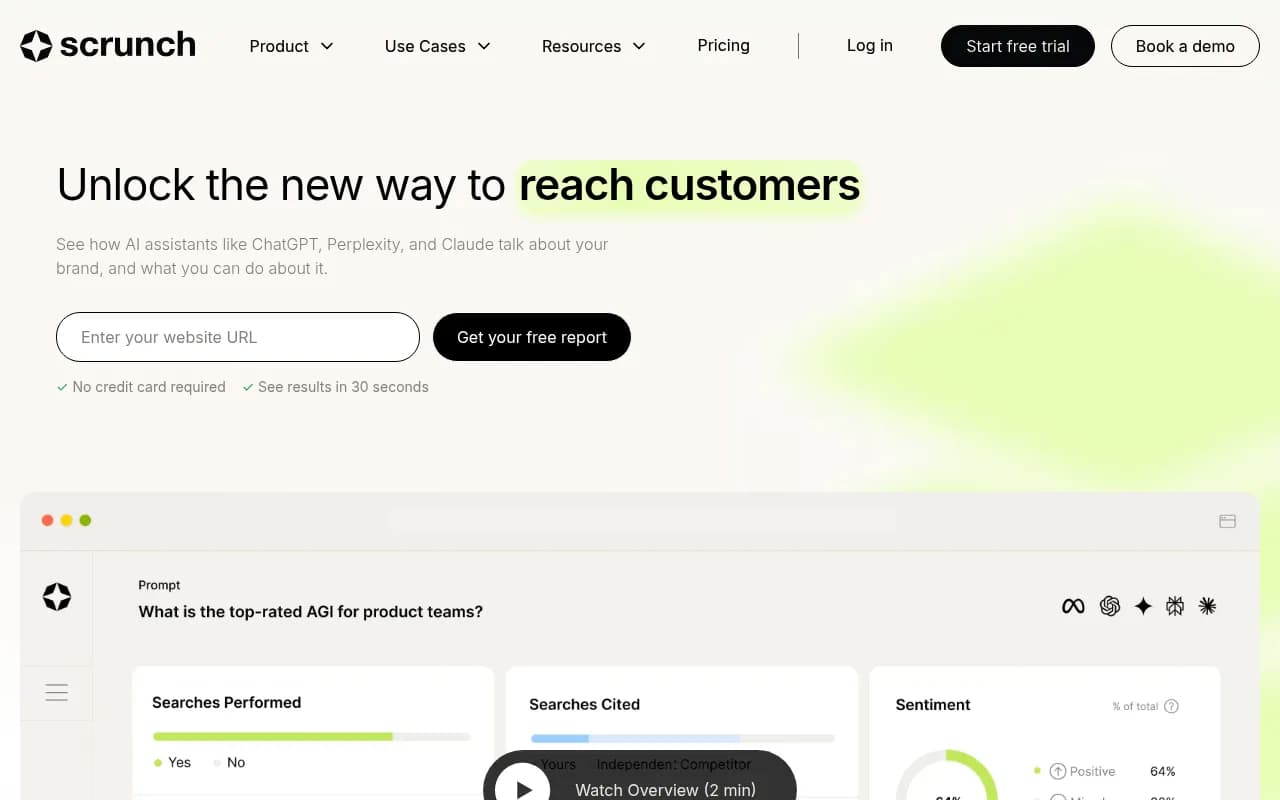
Scrunch AI positions itself as an Agent Experience Platform (AXP) -- the idea being that as AI agents increasingly make purchasing decisions, brands need to optimize for how those agents perceive them. It covers 9+ AI platforms on its Enterprise plan and includes active optimization features beyond basic monitoring.
At $250/month for the Core plan, it's priced for mid-market and enterprise teams. The 7-day trial lets you evaluate it before committing. It's a more ambitious platform than most in this category, though the AXP framing is still relatively new and the feature set is evolving.
8. Airefs -- best for startups wanting Reddit monitoring included
Airefs starts at $24/month, making it the most affordable dedicated AEO tool in this comparison. It includes Reddit monitoring as a core feature (not an add-on), which is genuinely useful since Reddit discussions heavily influence what AI models cite. There's also a done-for-you option for teams that don't want to manage the platform themselves.
Coverage defaults to ChatGPT with other LLMs available on request. For early-stage companies or bootstrapped teams that want to get started with AI visibility tracking without a large budget commitment, Airefs is worth a look.
9. Omnia -- solid mid-market option
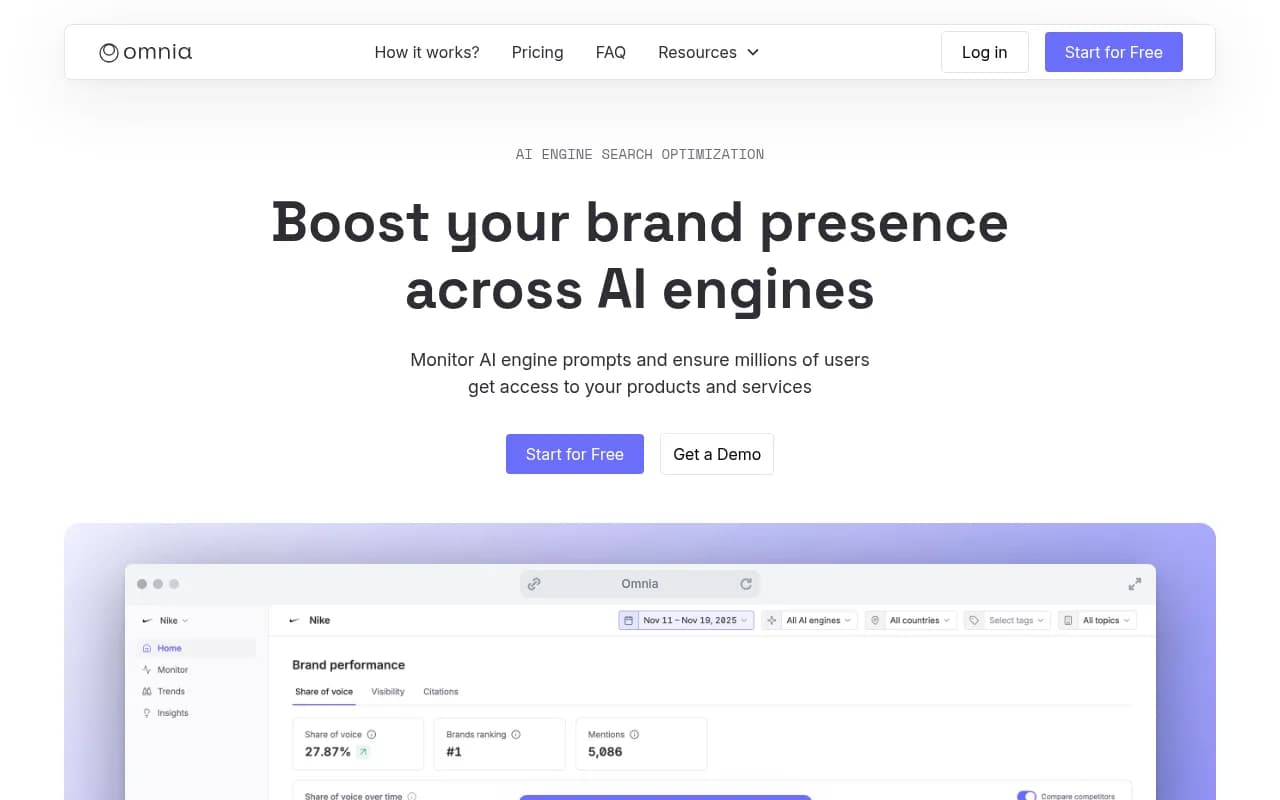
Omnia is a clean AI search monitoring platform that covers brand presence in AI-generated answers. It's a solid choice for mid-market teams that want straightforward monitoring without the complexity of a full GEO platform.
10. LLM Pulse -- lightweight tracking for smaller teams
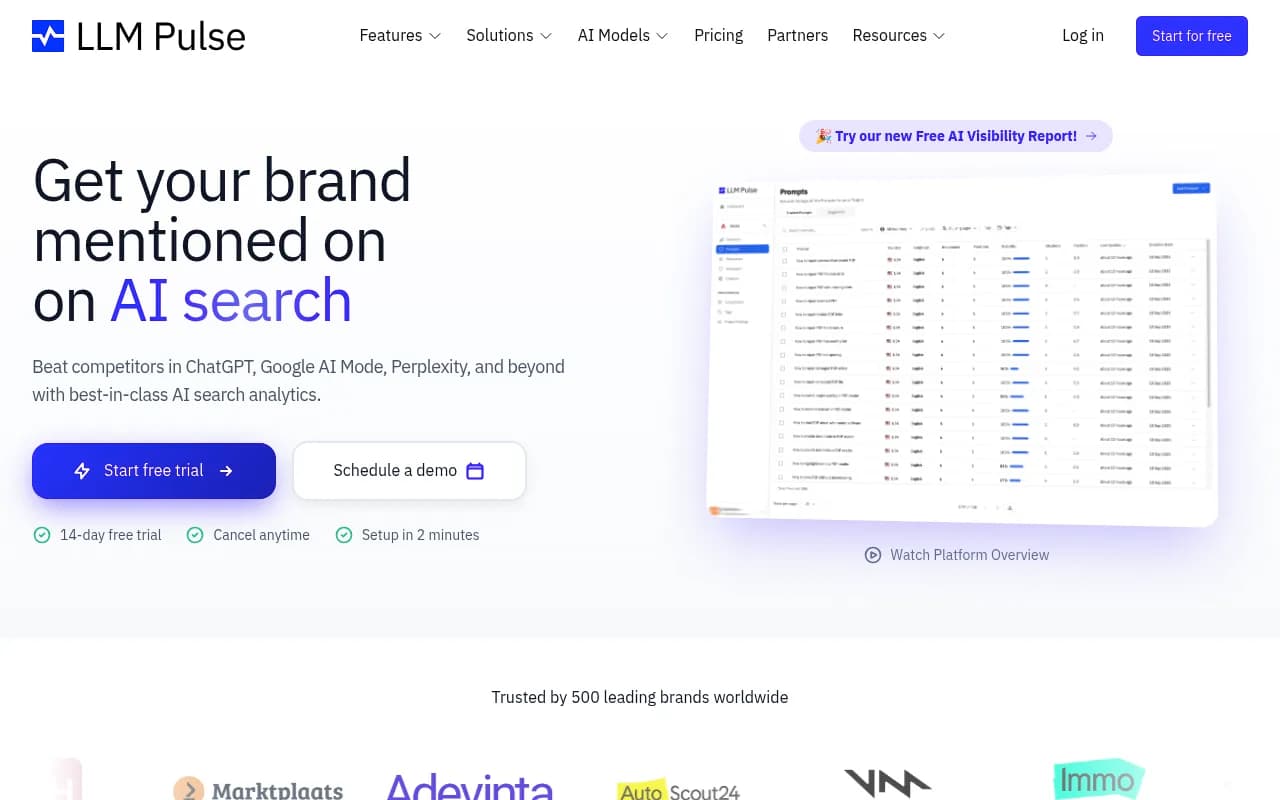
LLM Pulse offers brand visibility tracking across ChatGPT, Perplexity, and other AI search engines. It's a lighter-weight option suited to smaller teams or individuals who want basic monitoring without committing to an enterprise platform.
Feature comparison table
| Tool | Starting price | AI platforms | Custom prompts | Content generation | Crawler logs | Traffic attribution | Reddit tracking |
|---|---|---|---|---|---|---|---|
| Promptwatch | $99/mo | 10 (ChatGPT, Perplexity, Claude, Gemini, Grok, DeepSeek, Copilot, Mistral, Meta AI, Google AIO/AI Mode) | Yes | Yes (built-in AI writer) | Yes | Yes | Yes |
| Semrush AI Toolkit | $99/mo add-on | 5 (ChatGPT, Google AIO, AI Mode, Gemini, Perplexity) | Partial | General SEO writing | No | No | No |
| Profound | ~$99/mo+ | 10+ (Growth+) | Yes | No | No | No | No |
| AthenaHQ | $295/mo | 8+ | Yes | No | No | No | No |
| Otterly.AI | $29/mo | 6 | Yes | No | No | No | No |
| Peec AI | ~€89/mo | 5 | Yes | No | No | No | No |
| Scrunch AI | $250/mo | 9+ (Enterprise) | Yes | Partial | No | No | No |
| Airefs | $24/mo | ChatGPT + others | Yes | No | No | No | Yes |
| Ahrefs Brand Radar | Add-on | 2 (ChatGPT, Google AI) | No | No | No | No | No |
How to choose the right alternative
The decision mostly comes down to what you're trying to accomplish.
If you want to understand your AI visibility and then actually improve it, Promptwatch is the only platform that handles the full loop -- gap analysis, content creation, tracking, and revenue attribution -- in one place. Most other tools in this category are monitoring dashboards that leave the "what do I do about this?" question unanswered.
If you're already a Semrush customer and want a quick upgrade from Ahrefs Brand Radar without switching platforms, the Semrush AI Toolkit is a reasonable step up. You get more platform coverage and sentiment analysis, even if you're still missing the optimization layer.
If your primary need is enterprise-grade monitoring with deep reporting, Profound is worth evaluating -- especially if you have a dedicated team to act on the data separately.
If budget is the main constraint, Otterly.AI at $29/month or Airefs at $24/month give you basic monitoring at a price that's hard to argue with.
For global brands tracking visibility across many languages, Peec AI's 115+ language support is a genuine differentiator that the other tools in this list don't match.
What "AI visibility" actually requires in 2026
One thing worth being direct about: tracking your AI visibility score is not the same as improving it. Most tools in this space -- including Ahrefs Brand Radar -- will tell you that you're not being cited. What they won't tell you is which specific content gaps are causing that, which prompts are worth targeting, or how to create content that AI models will actually pull from.
The platforms that are genuinely useful in 2026 are the ones that connect monitoring to action. That means knowing which prompts your competitors win that you don't, understanding what content those prompts require, and being able to create that content in a way that's grounded in real citation data rather than generic SEO principles.
That's a higher bar than most tools currently meet. But it's also the difference between a dashboard you check occasionally and a platform that actually moves your business.

The AI search monitoring landscape has expanded significantly -- the screenshot above from Omnia's comparison guide illustrates just how many platforms now compete in this space. The challenge isn't finding a tool; it's finding one that goes beyond data collection.
Bottom line
Ahrefs Brand Radar is fine if you're an existing Ahrefs user who wants a quick sense of whether your brand appears in ChatGPT answers. It's not a serious AI visibility platform. The fixed prompts, two-platform coverage, and complete absence of optimization features make it a starting point at best.
For teams that want to actually compete in AI search in 2026, the alternatives above -- particularly Promptwatch for full-cycle optimization, Profound for enterprise monitoring depth, and Otterly.AI for budget-conscious teams -- offer meaningfully more. The question is whether you want to know where you stand or actually change it.