Competitors App Review 2026
Monitors competitor websites, emails, social media, and SEO changes, delivering a daily digest of their marketing activity to help teams respond quickly.
Key takeaways
- Competitors App is a solid, affordable competitor monitoring tool that covers a wide range of marketing channels: website changes, emails, social media, SEO rankings, reviews, and traffic.
- Pricing starts at $19.90/competitor/month, making it accessible for small teams but potentially expensive as you scale to 10+ competitors.
- Best suited for marketing teams at SMBs and digital agencies who want a passive, low-effort way to stay informed about competitor activity.
- The tool is primarily a monitoring and alerting platform -- it tells you what competitors are doing but does not help you act on that intelligence with content creation, gap analysis, or optimization workflows.
- No AI search visibility or LLM monitoring features; if tracking how your brand appears in ChatGPT, Perplexity, or Google AI Overviews matters to you, this tool does not cover that space.
Competitors App is a Romanian-founded SaaS tool built specifically for marketers who want to keep tabs on what their rivals are doing across every major online channel. The premise is simple: instead of manually checking competitor websites, subscribing to their email lists, and scrolling through their social feeds, you set up Competitors App once and it delivers a digest of meaningful changes directly to your inbox. The founder, Razvan Girmacea, has positioned it squarely at marketing teams who are time-poor and need competitive intelligence without hiring a dedicated analyst.
The product has been around for several years and has iterated into a version 2.0 that incorporates AI-assisted summaries and a broader channel set. It has been selected for at least one startup accelerator program, which speaks to some external validation of the concept. The target audience is clear: marketers at growth-stage SaaS companies, digital agencies managing multiple client brands, and product marketers who need to track pricing changes, feature announcements, and campaign shifts from competitors.
What makes Competitors App stand out from pure SEO tools like Semrush or Ahrefs is the breadth of non-SEO channels it monitors. Email tracking, social media post monitoring, and PR mention aggregation are not things traditional SEO platforms do well. That said, it is worth being clear about what this tool is: a monitoring and alerting system. It surfaces data. What you do with that data is entirely up to you.
Key features
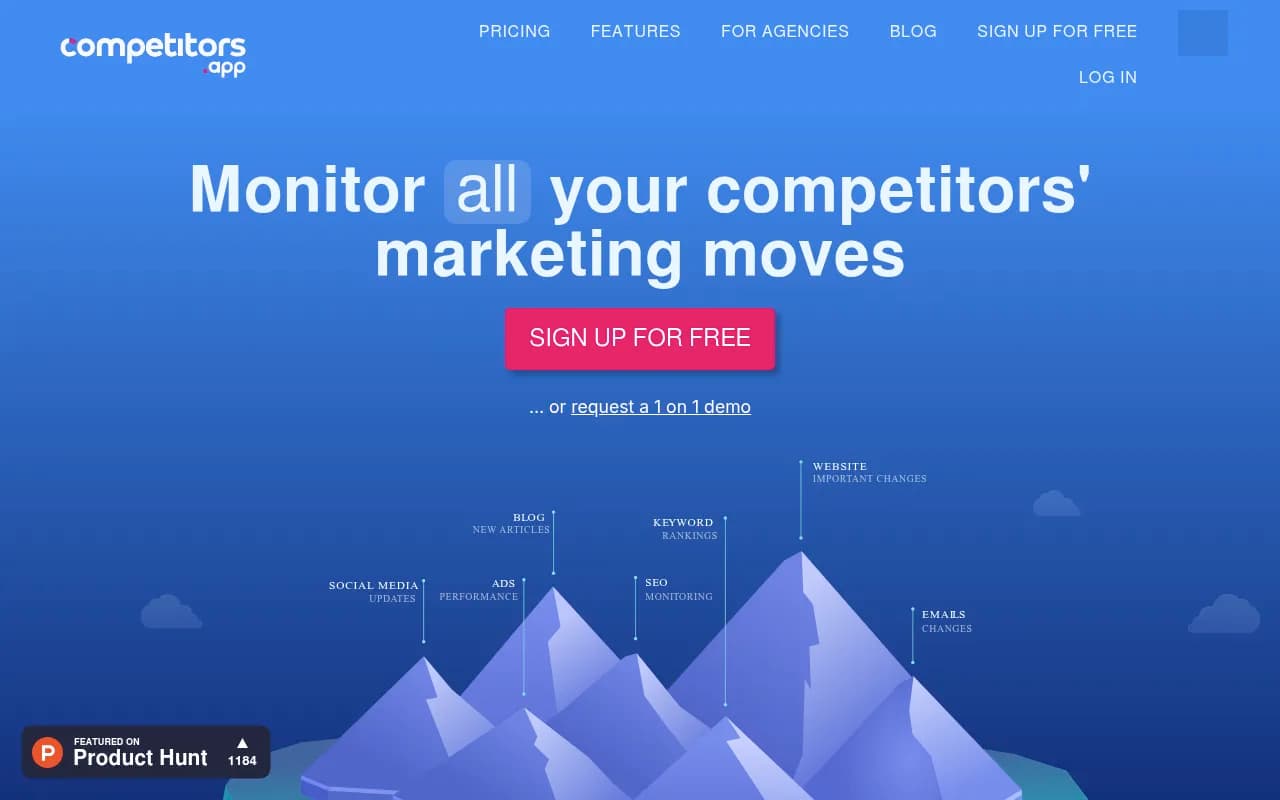
Website change monitoring is the core of the product. Competitors App crawls competitor websites and flags meaningful changes -- updated pricing pages, new feature announcements, new case studies, redesigned landing pages. The AI layer helps filter out noise (minor CSS tweaks, cookie banner updates) and surfaces only changes that are likely strategically significant. In practice, this is genuinely useful for product marketers who want to know the moment a competitor launches a new pricing tier or adds a new integration page.
Trial email and newsletter capture is one of the more distinctive features. The tool signs up for competitor email lists on your behalf and forwards every email they send into your dashboard. You can see onboarding sequences, promotional campaigns, feature announcement emails, and newsletters -- all in one place. This is something most competitor tools completely ignore, and it gives you a real window into how competitors are nurturing and converting leads. The feature works by creating dedicated email addresses that receive competitor communications.
Social media monitoring covers Facebook, Twitter/X, LinkedIn, Instagram, and TikTok. You can see when competitors post, what content they publish, and get a sense of engagement patterns. The tool tracks follower counts and post frequency over time. This is more of a passive feed than a deep analytics layer -- you will not get engagement rate benchmarking or content performance scoring at the level of a dedicated social listening tool like Brandwatch.
Blog and content tracking alerts you when competitors publish new articles, update existing pages, or launch new content formats like webinars or whitepapers. For content marketers, this is useful for identifying topic gaps and understanding what content themes competitors are investing in.
Keyword rankings and SEO monitoring lets you track how competitors rank for specific keywords over time. You can compare your rankings against theirs and spot when they gain or lose ground on important terms. This is a lighter-weight version of what Semrush or Ahrefs provides -- useful for directional awareness but not a replacement for dedicated SEO tooling if you need deep keyword research capabilities.
Reviews and AI insights aggregates competitor reviews from 100+ review platforms. The AI summary feature condenses large volumes of reviews into key themes -- what customers love, what they complain about, where competitors are weak. There is also a battle card generation feature that uses this review data to help sales teams articulate competitive positioning. This is a genuinely practical feature for sales enablement.
Traffic monitoring shows estimated traffic trends for competitor domains, with historical data to identify seasonal patterns. The ability to correlate traffic spikes with specific marketing activities (a new campaign, a product launch, a PR mention) is where this feature gets interesting. The data is estimated rather than exact, which is a limitation shared by every tool in this category that does not have direct access to competitor analytics.
Social and PR mentions monitors what people are saying about competitors on social platforms and in news coverage. This covers Instagram, YouTube, LinkedIn mentions, and press coverage. For brands in industries where PR and word-of-mouth matter, this rounds out the monitoring picture.
Who is it for
The primary user is a marketing manager or CMO at a B2B SaaS company with 10-100 employees who wants to stay informed about 3-10 direct competitors without spending hours on manual research. Think a growth marketer at a project management tool who wants to know the moment Notion or Asana changes their pricing page, launches a new integration, or starts running ads on a new keyword cluster. Competitors App fits neatly into a weekly workflow: you spend five minutes reading the digest, flag anything important, and move on.
Digital agencies managing competitive intelligence for multiple clients are another strong fit. The agency and white-label plans make it possible to deliver branded competitive reports to clients without building the monitoring infrastructure yourself. An agency running competitive analysis for 10-20 SaaS clients could use Competitors App as the data layer and add their own analysis on top.
Product marketers who own battle cards and competitive positioning are also well served, particularly by the reviews feature and AI-generated summaries. If your job involves keeping sales teams updated on how to position against competitors, having a tool that automatically surfaces new competitor weaknesses from review data saves meaningful time.
Who should not use this tool: companies that need deep SEO analysis (Semrush or Ahrefs will serve you better), teams that need social listening with sentiment analysis at scale (Brandwatch or Mention are more appropriate), and anyone whose primary concern is how their brand appears in AI search results like ChatGPT or Perplexity. Competitors App does not monitor LLM outputs, AI citations, or generative search visibility at all.
Integrations and ecosystem
Competitors App delivers its primary output via email digests, which means it works with whatever email client you already use. The dashboard is web-based and accessible from any browser.
The tool does not appear to have a public API, which limits its usefulness for teams that want to pipe competitive intelligence into their own data warehouse or BI tools. There is no native Slack integration listed, which is a notable gap for teams that live in Slack and want real-time alerts rather than email digests.
Export capabilities are present for reports, which allows you to share competitive snapshots with stakeholders who do not have accounts. The white-label feature for agencies allows custom branding on exported reports.
There is no mobile app listed, and no browser extension. The experience is primarily dashboard plus email.
Pricing and value
Competitors App uses a per-competitor pricing model at $19.90 per competitor per month. This is straightforward to understand but can add up quickly. Monitoring 10 competitors costs $199/month. Monitoring 20 competitors costs $398/month.
There is a free signup available, which lets you explore the product before committing. Agency and custom plans are available with multi-user access and white-labeling, though specific pricing for those tiers is not published on the website and requires a conversation with the team.
Some third-party review sources cite a slightly lower price point of $15/competitor/month, which may reflect annual billing discounts or older pricing. The current website lists $19.90/competitor/month as the standard rate.
For a small team monitoring 3-5 competitors, the cost is reasonable -- $60-100/month for a tool that saves several hours of manual research per week is defensible. For larger competitive landscapes, the cost scales linearly and you may find yourself comparing it against broader platforms that offer flat-rate pricing regardless of competitor count.
Compared to Crayon or Klue, which are enterprise-grade competitive intelligence platforms costing thousands per month, Competitors App is significantly more affordable. Compared to free or near-free options like Google Alerts, it offers substantially more depth and automation.
Strengths and limitations
What it does well:
- Email monitoring is genuinely differentiated. Very few tools capture competitor email sequences automatically, and this feature alone can justify the cost for email-heavy industries.
- Channel breadth is impressive for the price point. Covering website changes, social media, SEO, reviews, traffic, and PR mentions in one dashboard reduces the number of tools a small marketing team needs.
- Low time investment is a real selling point. The digest format means you do not need to log in daily -- the tool does the monitoring and surfaces what matters.
- AI review summaries and battle card generation are practical, not gimmicky. Turning hundreds of G2 and Capterra reviews into a structured competitive summary is a real time-saver for product marketers.
- Setup simplicity -- the product is designed to be configured in minutes, not hours, which matters for small teams without dedicated ops resources.
Limitations:
- No action layer. Competitors App tells you what competitors are doing but provides no tools to help you respond. There is no content gap analysis, no suggestions for what to create, no optimization workflow. You get the intelligence; you are on your own for the strategy.
- No AI search visibility monitoring. The tool has no capability to track how competitors appear in ChatGPT, Perplexity, Claude, Google AI Overviews, or any other LLM-powered search surface. As AI search becomes a primary discovery channel, this is a meaningful blind spot.
- Per-competitor pricing scales poorly. Teams monitoring 15+ competitors will find the cost climbing toward enterprise pricing without enterprise-level features or data depth.
- Limited integrations. No API, no Slack, no CRM connectors. The tool exists somewhat in isolation from the rest of a marketing team's stack.
- Traffic data is estimated. Like all third-party traffic tools, the numbers are approximations. For industries with smaller traffic volumes, the estimates can be unreliable.
Bottom line
Competitors App is a well-executed, affordable monitoring tool for marketing teams that want competitive awareness without the overhead of manual research or enterprise-grade platforms. It covers more channels than most tools at its price point, and the email monitoring feature is genuinely hard to find elsewhere. The best use case is a B2B SaaS marketing team tracking 3-8 direct competitors who want a weekly digest of meaningful changes across website, social, SEO, and email channels.
That said, if your competitive intelligence needs extend to understanding how rivals are performing in AI search -- how often ChatGPT recommends them, which prompts they rank for in Perplexity, or what content is getting cited by AI models -- Competitors App does not cover that ground. For that layer of visibility, Promptwatch is built specifically around AI search monitoring and optimization, including content gap analysis and tools to actually improve your AI search presence rather than just observe it.
Tags:
Frequently asked questions
What is Competitors App?
How much does Competitors App cost?
Does Competitors App monitor AI search results like ChatGPT or Perplexity?
Who is Competitors App best suited for?
What makes Competitors App different from tools like Semrush or Ahrefs?
Is there a free trial available?
Similar and alternative tools to Competitors App