Key takeaways
- Google AI Mode leans on Google's own properties first. In June 2026, google.com alone took 7.31% of all AI Mode citations, more than YouTube and Reddit combined, so your Business Profile and Maps data matter more than ever.
- The ranking factors that win the local pack are not the ones that win AI citations. Whitespark's 2026 survey put on-page content at 24% of AI search visibility versus just 12% for GBP signals.
- Hybrid queries like "best dentist for Invisalign in Denver" trigger AI Overviews 97% of the time. Pure "near me" queries still mostly show the local pack. Your content strategy should target the hybrid middle.
- Multi-location brands are evaluated location by location. A strong brand does not transfer visibility to a weak location page or an unclaimed profile.
- Reviews now have a recency problem: 74% of consumers only trust reviews from the last three months, and 31% won't use a business below 4.5 stars.
What changed: AI Mode and Ask Maps rewired local discovery
If you run marketing for a brand with 20, 200, or 2,000 locations, 2026 has probably felt like the ground moving. Google AI Mode, launched in 2025, replaced the single-shot keyword search with conversational, multi-turn exchanges. Then in March 2026 Google shipped Ask Maps, a Gemini-powered conversational layer inside the Maps app. Users tap a button, ask something like "quiet ramen place open late near Capitol Hill," and get a blended answer: local listings, review snippets, and citations linking out to the websites the answer was sourced from.
Two things about this matter for multi-location brands.
First, the funnel is narrower than it used to be. Joy Hawkins at Sterling Sky tracked AI local packs surfacing only 5,943 unique businesses versus 18,330 surfaced by the legacy 3-pack on the same query set. AI local packs typically list one or two businesses instead of three, and they drop the call buttons. That is a category-level reduction in how many businesses get any visibility at all, not a reshuffle.
Second, results are personalized per user, not just per location. Past searches, clicked businesses, and booking history all modulate what AI Mode shows. Two people on the same block can get different pizza recommendations. You cannot audit your way around that variance, but you can make sure the underlying signals are strong enough that the personalization has good material to work with.
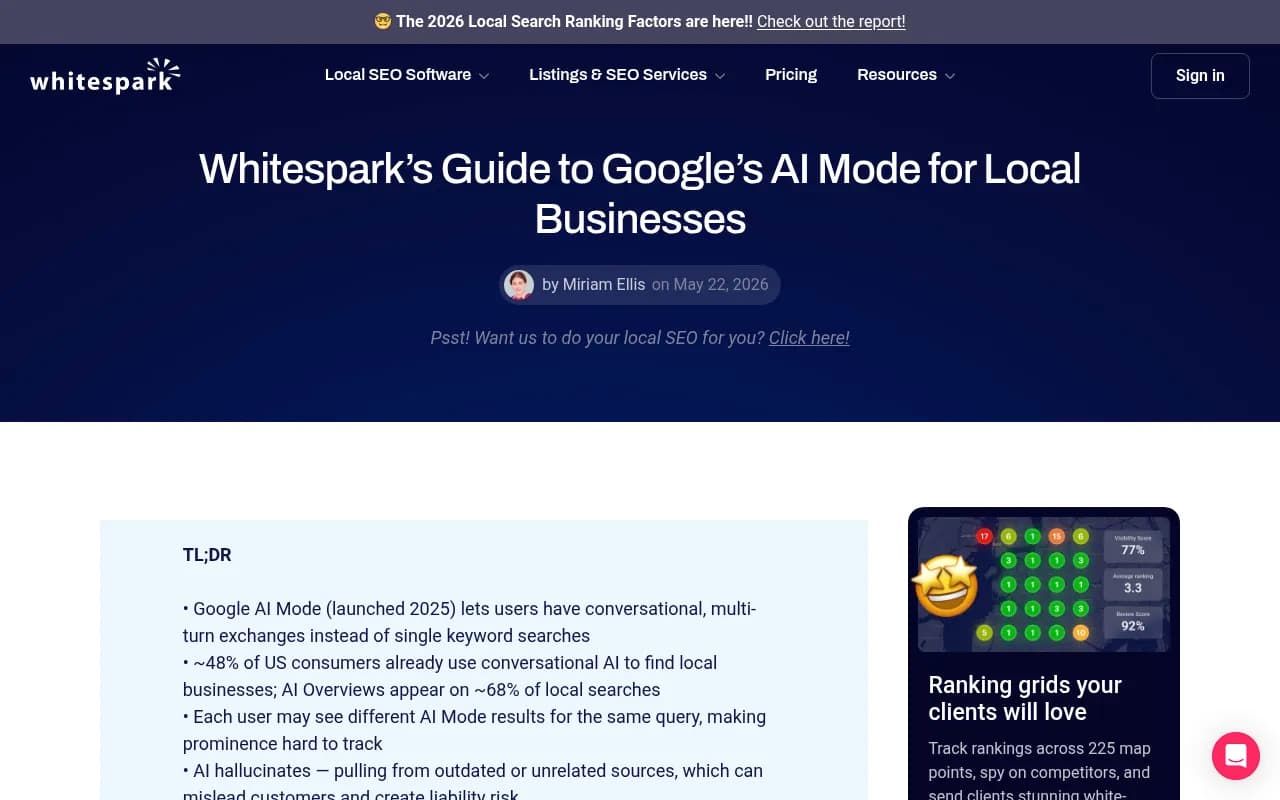
How often does AI actually intercept local queries? It depends on intent, and the split is the single most useful data point for planning. Whitespark's 540-query study across six local verticals found that pure local-intent queries ("pizza delivery near me") trigger AI Overviews only 15% of the time, while the local pack appears 93%. Informational queries flip it: 92% AI Overviews, 6% local pack. And hybrid queries, the informational-plus-transactional kind like "best dentist for Invisalign in Houston," trigger AI Overviews 97% of the time. Local Falcon's larger 60,000-query study put overall AI Overview appearance at 40.2%, but that mix included navigational and Boolean queries that rarely trigger AI. The honest range for commercial local verticals is 40 to 68%.
The practical read: your "near me" visibility still runs through the local pack, but everything with a qualifier, a comparison, a question, or a consideration attached now runs through AI. Most of the buying journey's middle just moved.
Where AI Mode actually gets its local answers
This is where a lot of local SEO advice goes wrong. It assumes AI Mode reads the open web the way classic Google did. It doesn't, at least not primarily.
Promptwatch's citation share data for Google AI Mode in June 2026 shows google.com alone capturing 7.31% of all AI Mode citations, more than YouTube (2.88%) and Reddit (2.52%) combined. Count YouTube and Google-owned properties take over 10% of the citation mix. AI Mode routinely resolves local questions using Google's own Maps listings, Business Profiles, and support content before it reaches anyone's website. And this is accelerating: google.com climbed from 4.24% in May to 7.31% in June, a 72% jump on top of a sixfold rise the month before.
This self-preference is unique to Google. On ChatGPT in the same period, Reddit led citations and google.com was nowhere near the top. So a brand optimizing only for ChatGPT-style AI search, lots of Reddit and forum presence, will underperform in AI Mode, and vice versa. You need both plays.
Below Google's own top three, every other domain drops under 1% of AI Mode citations. The open-web opportunity lives in the long tail, which for local brands means industry directories, local news, "best of" lists, and review platforms. Whitespark's 2026 Local Search Ranking Factors survey, which for the first time scored a dedicated "AI Search visibility impact" dimension across 47 experts, found that three of the top five AI visibility factors are citation-related: presence on expert "best of" lists, prominence on top industry-relevant domains, and the quality of unstructured citations like newspaper articles and government sites.
One more data point worth knowing: Google AI Overviews cite roughly 10 sources per answer on average, about double ChatGPT's 5, and that number has stayed remarkably stable. Ten slots is closer to the classic 10-blue-links SERP than to ChatGPT's tighter answers, which makes AI Overviews the more forgiving surface for mid-authority local sites to break into.
The ranking factor shift nobody budgeted for
Here is the finding from Whitespark's 2026 survey that should change how multi-location teams allocate budget:
| Signal group | Local pack / Maps weighting | AI search visibility weighting |
|---|---|---|
| GBP signals | 32% | 12% |
| On-page content | 15% | 24% |
| Reviews | 20% | 16% |
| Citations | 6% | 13% |
| Links | 8% | 13% |
| Behavioral | 9% | included in other groups |
| Social | 5% | reintroduced in 2026 |
For the local pack, GBP signals dominate at 32%. For AI search visibility, on-page content jumps to the top slot at 24%, GBP collapses to 12%, and citations more than double to 13%. The interpretation is blunt: GBP housekeeping alone no longer covers you once AI surfaces intercept most of your vertical's qualified queries. Content, citations, and links need their own line item, separate from listings maintenance.
The multi-location playbook
Treat every location as its own digital presence
Google evaluates each location separately: the strength of the individual Business Profile, local citations, on-page relevance, proximity signals, and engagement from people in that area. Brands that assume national authority transfers evenly across markets learn this the hard way when Seattle performs and Denver doesn't.
The framework that works:
- A separate GBP per physical location, each with unique NAP, managed through bulk tools at scale.
- A dedicated location page on your website with genuinely unique content: neighborhood landmarks, local case studies, location-specific FAQs, staff, photos. Templated pages with the city name swapped read as thin content to both classic search and AI systems.
- Location-level reviews on each profile. Reviews accumulated at the parent brand do not lift individual locations.
- Topical authority content at the brand level, national guides, original research, case studies, that builds the entity AI systems trust before recommending any specific location.
Fix NAP before anything else
NAP inconsistency is the most commonly broken high-leverage task in multi-location local SEO, and AI makes it worse. A mismatched suite number ("Suite 5" vs "Ste 5" vs "#5") or an outdated phone can suppress an entire region's visibility and confuse AI systems trying to verify which location is being referenced. A single shared toll-free number across every location can trip Google's verification logic and get profiles flagged.
Two rules save most brands from this. First, maintain one authoritative NAP record per location and push updates outward from that single source of truth, never edit listings ad hoc. Second, hunt duplicate listings before building new citations, because directories spawn unauthorized "zombie profiles" over time, and building on top of duplicates just replicates the bad data. Remember that NAP conflicts now propagate differently across engines: Google's AI features check multiple pages simultaneously, ChatGPT Search checks multiple search partners, and Gemini leans heavily on Maps data.
Write for hybrid queries, not just "near me"
Since hybrid queries trigger AI Overviews 97% of the time, they are where multi-location brands win or lose. A query like "brunch restaurant in Denver that's vegetarian-friendly and has really good eggs Benedict" is not a keyword, it's a conversation. Your location pages and brand-level content need to answer in kind.
Whitespark's guide has a tactic I like: empower front-line staff at each location to document the questions they actually get asked every day. That becomes your FAQ backlog, written in natural language, and you can then check whether AI Mode cites your brand for those questions. Prompt AI Mode with your top local-pack competitors' brand names too, and document which publications get cited alongside them. That gives you a target list of sites where your brand needs to be mentioned or listed.
One formatting note from Promptwatch's query fanout research: ChatGPT's searches have compressed from full sentences (~117 characters) down to short keyword phrases (~53 characters) as of April 2026. Content headings should read like short search queries, "emergency plumber Denver open Sunday," rather than full sentences. AI is searching like a keyword machine again, so title accordingly.
Feed the citation sources AI Mode actually uses
Given the citation data above, your offsite priorities for AI Mode specifically:
- Google properties first. Business Profile completeness, Maps accuracy, Merchant Center where relevant, and a maintained YouTube channel. YouTube's citation share in AI Overviews has nearly doubled since January, from about 2.7% to 6.3%, and video is now a top-five cited content type.
- Reddit, carefully. Reddit is a top-three AI Mode citation source and dominant on ChatGPT. Build genuine presence in relevant local subreddits. Note that ChatGPT's reliance on Reddit has been volatile, its citation share dropped sharply in August 2026, so treat Reddit as one channel, not the whole strategy.
- "Best of" lists and industry directories. These are direct AI Mode citation fodder for hybrid queries. Pitch local publications, industry roundups, and regional "best" lists systematically.
- Unstructured citations. Local news coverage, government pages, industry association mentions. Quality over volume.
- Product and service pages over listicles. In July 2026, product pages overtook listicles as the most-cited content type in AI Overviews for the first time. Your actual location and service pages, not just blog content, are citation targets.
Get serious about review recency
BrightLocal's 2026 Local Consumer Review Survey found that 31% of consumers will only use businesses with 4.5+ stars, up from 17% in 2025, and 74% want reviews from the last three months. Recency has overtaken volume as the operative signal. The working cadence is at least four new reviews per location per month, sustained, not a one-time push. Owner responses within 48 hours now get tracked as a separate behavioral signal in Whitespark's survey, so respond to everything.
Monitoring: you cannot manage what you cannot see
AI Mode personalization means a single manual check tells you almost nothing. You need systematic tracking, per location, across the prompts your customers actually use. A few realities from the tooling landscape:
- Prompt shape changes measured visibility dramatically. Cheers' production data across 119 home-services organizations showed price/cost prompts produced a 37.9% brand-appearance rate versus 22.8% for "best near me" prompts. Geo-grid-only tools will under-report your visibility.
- Ask Maps impressions currently roll into standard GBP analytics rather than being broken out separately, so audit your listing appearance in the Ask Maps surface manually for now.
- For local teams, the tool should show which prompts were tested, which engines answered, where each location appeared, which competitors appeared, which sources were cited, and what to do next, by market.
For AI visibility tracking across locations, Promptwatch is the platform we use and recommend, it tracks Google AI Mode and AI Overviews alongside ChatGPT, Perplexity, and the rest, with country, state, and city-level tracking that multi-location brands need, plus crawler logs showing when Google's AI agents actually visit your location pages.

For the local-stack side of the house, these are the tools doing real work in 2026:
| Tool | Starting price | Strength for multi-location | Best for |
|---|---|---|---|
| BrightLocal | $39/mo | Listings, citations, local rank tracking, Local AI Visibility per location | SMBs and mid-market, agencies |
| Whitespark | $10/mo (grids) | Geo-grid rank tracking, citation finder, 2026 ranking factors research | Citation building and local rank grids |
| Local Falcon | from $10/mo | Geo-grid scanning tied to specific locations | Location-level rank visibility |
| Yext | quote-based | Enterprise listings and knowledge graph at scale | Large enterprises |
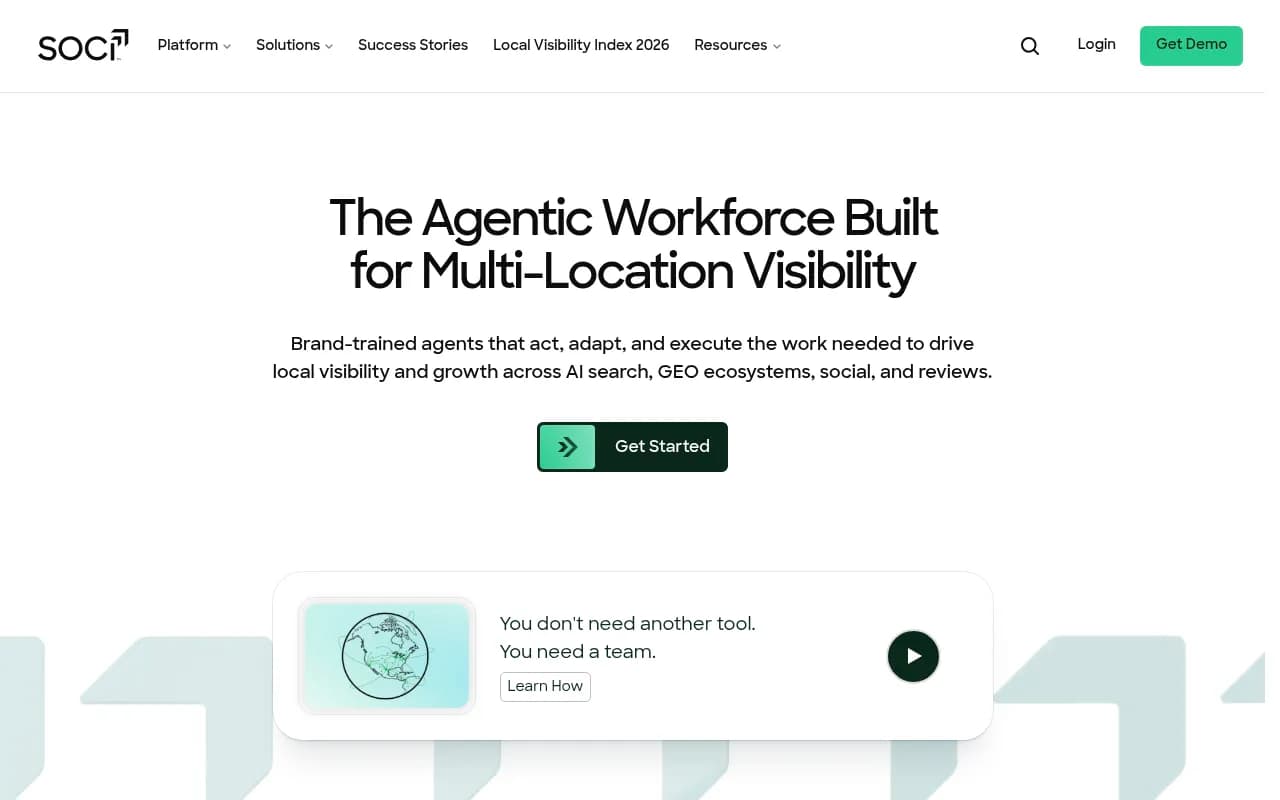
| SOCi | ~$15k+/yr | Agentic AI across listings, reviews, social for 1,000+ location brands | Enterprise multi-location |
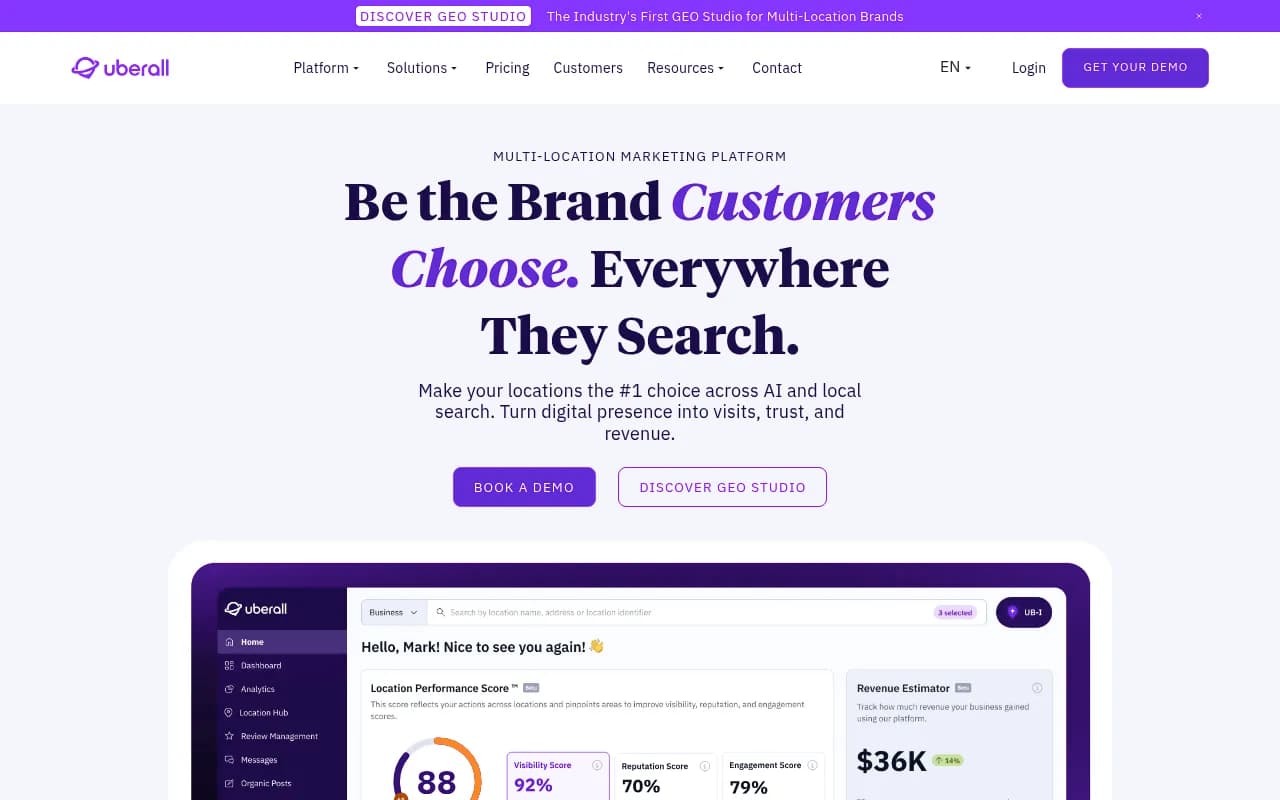
| Uberall | quote-based | Listings plus AI search visibility for foot-traffic businesses | Retail, restaurants, banks |
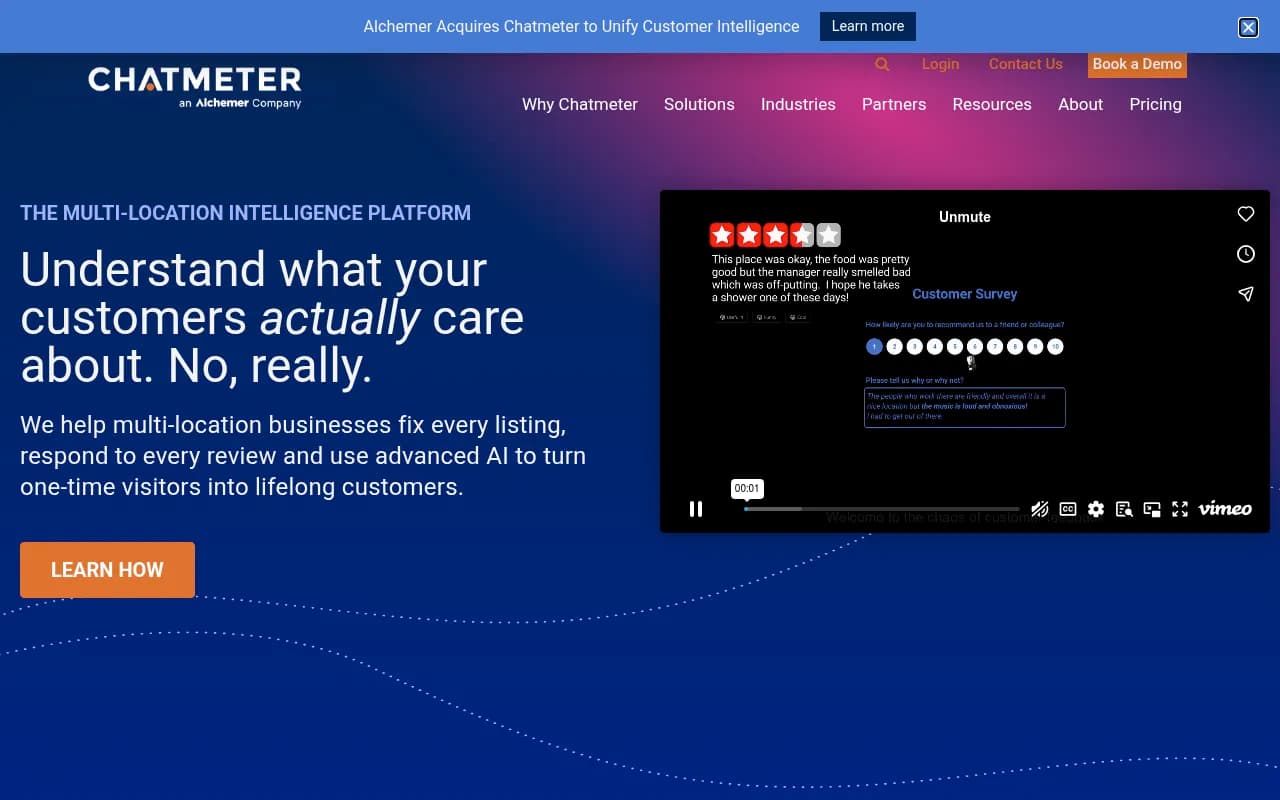
| Chatmeter | quote-based | Reputation and search visibility for multi-location | Franchise and multi-location brands |
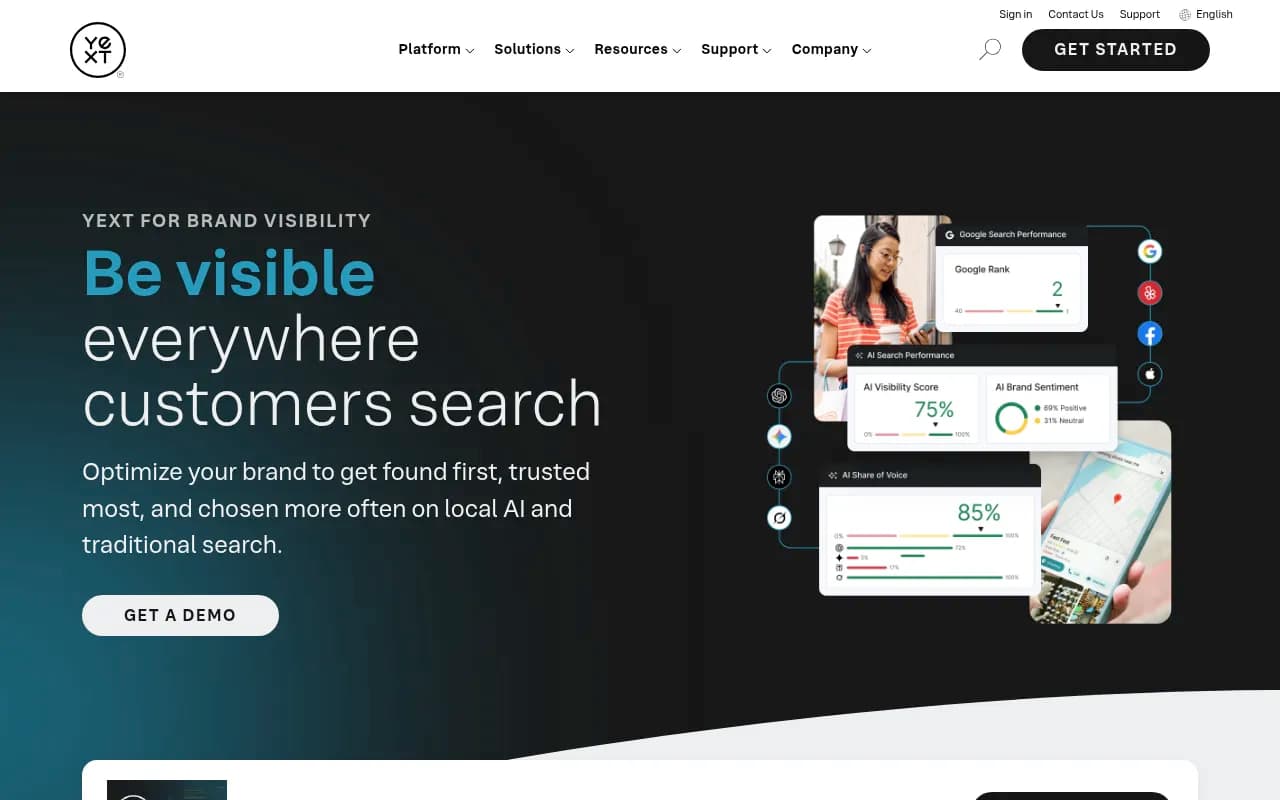
A note on cost structure: Yext's model gets criticized as a rental, listings can revert to old data if you stop paying, while BrightLocal charges one-time fees for citation building. Over five years across 30 locations, BrightLocal claims roughly $250/location versus Yext's $499, a difference of about $43,500. Worth reading the fine print before signing anything multi-year. If you want a broader view of the AI visibility category, the GEO software directory at bestgeosoftware.com and the AI rank tracking tools directory at ai-rank-tools.com both maintain current listings.
Common mistakes that keep brands invisible
The SOCi 2026 Local Visibility Index analyzed 350,000+ locations across 2,751 brands and found that 98.8% of local businesses are invisible to AI search. Out of every 100 businesses in a category, AI picks one. Most multi-location brands are losing to fixable problems:
- Templated location pages with the city name swapped and nothing else.
- NAP drift between website, GBP, and directories, especially suite numbers and phone formats.
- Reviews concentrated at the brand level instead of the location level, or stale review profiles with nothing in the last quarter.
- No presence on the "best of" lists and industry publications AI Mode cites for hybrid queries.
- Ignoring YouTube entirely, despite it being a top AI Mode and AI Overviews citation source.
- Treating AI visibility as a GBP feature instead of a content and citation program.
When to bring in help
If your team is stretched across hundreds of locations, the honest answer is that AI Mode visibility is a program, not a task. It needs per-location content production, citation and PR outreach, review operations, and measurement across engines. That is exactly the kind of work 1001 SEO Media does, combining technical SEO, content production, and generative engine optimization so brands rank in Google and get cited in AI answers, with transparent monthly reporting and no long-term contracts. For teams that want to run it in-house, start with the Promptwatch free AI Brand Visibility Report to see where you stand today.
The brands getting cited in AI Mode in 2026 are not the ones with the biggest ad budgets. They are the ones with clean location data, fresh reviews, genuinely useful location pages, and mentions on the publications AI already trusts. All of that is work you can start this quarter.