Key takeaways
- Google AI Mode surpassed 1 billion monthly users at I/O 2026, and Google has merged AI Overviews and AI Mode into one continuous flow. Traditional rank trackers cannot measure visibility inside AI answers, so you need a purpose-built tracker.
- AI answers are probabilistic. SparkToro's research found AI brand recommendations are so randomized that "it's more like 1 in 1,000 runs before you'd see two lists in the same order." Any tool that reports a single run per prompt is giving you noise.
- API-based tracking shows only about 24% brand overlap with what real users see in the live interface. Prefer tools that scrape the actual UI, logged out, with explicit location and language settings.
- Google cites itself heavily in AI Mode: google.com was the #1 cited domain at 7.31% of citations in June 2026, and Google-owned properties (including YouTube) captured over 10% of the citation mix. Your Google Business Profile, Maps, and YouTube presence matter as much as your website.
- Top picks: Promptwatch for teams that want tracking plus execution, LLM Pulse for affordable multi-model monitoring, SE Ranking for combined SEO + AI tracking, and Profound or Scrunch AI for enterprise.
Why AI Mode tracking is its own problem
Google AI Mode stopped being an experiment a while ago. At I/O 2026, Google reported more than 1 billion monthly users, with queries more than doubling every quarter since launch. Google also unified AI Overviews and AI Mode into a single continuous experience: a question flows into an AI Overview, then into a follow-up conversation in AI Mode. The line between the two products is blurry now, which is exactly why so many tracking tools quietly conflate them.
Here's the core problem. AI Mode doesn't return a stable list of ten blue links. It runs query fan-out (Google's own term), breaking your question into subtopics, issuing many parallel searches, and synthesizing a cited answer. Analysts typically observe 8 to 12 parallel sub-queries per question, and complex queries can expand to 50 or more variations. The answer you get varies by prompt phrasing, location, language, personalization, and plain randomness.
So your classic rank tracker, built to check position 3 for "best crm software" every morning, is useless here. You need tools that execute prompts against AI Mode, parse the generated answers, detect brand mentions and citations, and aggregate enough runs for the numbers to mean something.
What actually matters when evaluating a tracker
Before comparing tools, it helps to know what separates a useful AI Mode tracker from a dashboard that generates pretty but meaningless charts.
UI simulation, not just APIs
Research from ZipTie found that API-based tracking shows only about 24% brand overlap with what real users actually see in the front-end interface. APIs miss real-time web retrieval, personalization, and post-processing that the live UI applies. UI-simulation tracking is slower and costlier to run, but it's the only approach that reflects reality. Promptwatch, for instance, monitors the actual user interfaces of AI Mode, AI Overviews, ChatGPT, and other engines rather than relying on API outputs alone.
Repeated runs per prompt
SparkToro's research on AI brand recommendations found the outputs so inconsistent that, in their words, it's "more like 1 in 1,000 runs before you'd see two lists in the same order." Practitioners report cross-model brand agreement around 41% on repeated identical prompts, and recommend 5 to 7 repeated runs per prompt before treating data as stable. A single response is one sample, not a ranking.
AI Mode tracked separately from AI Overviews
Some tools label AI Overviews data as "AI Mode" because it's easier to scrape. Omnia published a 10-point validation checklist for this exact problem. A few practical checks: the tool should return different citations per country (proving geo-localization), it should run logged-out queries to avoid personalization contamination, and it should show per-prompt, per-country detail rather than only domain aggregates like "competitor.com cited 5 times." If a tool fails more than half those checks, it's probably tracking the wrong surface.
Controlled conditions, recorded
AI Mode results vary by location, language, device, and session history. A good tracker controls and records these per prompt. Aleyda Solis's prompt library guidance is blunt on this: treat a single output as one sample, and track location, language, and personalization state as metadata rather than letting them vary silently.
A path from insight to action
Monitoring is table stakes. The harder question is what you do with the data. Tools that also show why you're invisible (which pages get cited, which don't, what content gaps exist) and help you fix it are worth a premium. Kevin Indig has framed the core mistake as running AI visibility tracking like a rank tracker instead of accounting for its probabilistic nature; the same logic applies to acting on it.
The best Google AI Mode tracking tools in 2026
Promptwatch — best for tracking plus execution
Promptwatch tracks AI Mode alongside Google AI Overviews, ChatGPT, Claude, Gemini, Perplexity, Grok, and others, using real UI data rather than API outputs. What sets it apart from most trackers is that it doesn't stop at monitoring. Its AI crawler logs (Agent Analytics) show when AI systems visit your pages, what they read, and whether they hit errors, which explains the "why" behind your visibility scores. Citation analytics reveal which of your pages get cited, plus Reddit and YouTube mentions. Visitor analytics connect AI visibility to actual traffic and conversions.
Then it closes the loop: content gap analysis, automated content generation with CMS publishing to Webflow, Framer, and WordPress, and Unified Actions, a prioritized GEO to-do list. Most competitors stop at the dashboard.

Pricing runs from a free Explore plan (10 prompts, ChatGPT only) through Essential at $95/mo to Professional at $245/mo, with agency plans from $199/mo. It's used by 1,840+ brands and agencies including Duolingo, Yelp, and Shutterstock, and rated 4.7/5 on G2.
LLM Pulse — best budget multi-model tracker
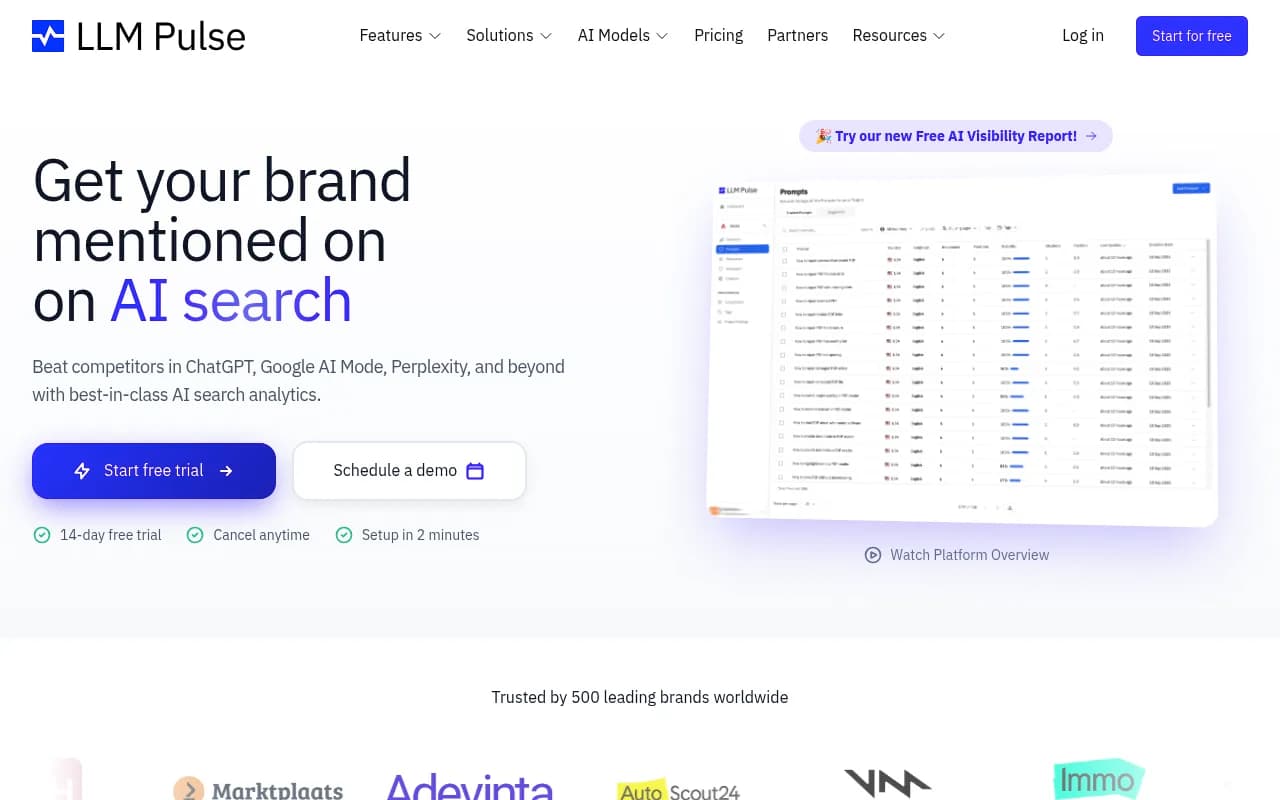
LLM Pulse was built specifically for AI visibility tracking rather than bolted onto an SEO suite. It monitors AI Mode, ChatGPT, Perplexity, Gemini, and AI Overviews as its five standard models on every plan, with brand mention detection, sentiment analysis, citation tracking, and competitive share-of-voice benchmarking. Higher tiers add Reddit intelligence, AI traffic analytics, GEO testing (measure visibility lift from content changes before rolling them out), and a Chrome extension that captures web-search queries exposed in ChatGPT responses.
Pricing starts at €49/mo with unlimited team seats on all plans, which makes it one of the most affordable serious options. A 14-day free trial is available on Starter, Growth, and Scale tiers.
SE Ranking / SE Visible — best all-in-one SEO + AI stack
SE Ranking's AI Search add-on tracks AI Mode, AI Overviews, ChatGPT, Gemini, and Perplexity alongside its traditional rank tracking, site audit, and backlink tools. It uses a pay-per-check model (one check = one prompt + one platform), sold in packages on top of a base subscription. Daily updates and cached answer snapshots let you verify what the AI actually said.
If you don't need the full SEO platform, SE Visible is the team's purpose-built AI visibility product: unlimited user seats on all plans, real-time scraping with cached verification, and multi-country coverage across seven markets. That combination makes it popular with agencies managing multiple client brands.
Semrush AI Toolkit — best if you already use Semrush
Semrush's AI Visibility Toolkit adds prompt tracking, citation analysis, share-of-voice reporting, sentiment analysis, and competitor benchmarking to its existing SEO stack. The standalone toolkit costs $99/mo per domain with 25 tracked prompts, or you can bundle it into Semrush One plans starting at $199/mo. The advantage is obvious if you already live in Semrush: one vendor, unified reporting, keyword research and AI visibility side by side. The downside, flagged by several agencies, is that the AI-specific data is shallower than dedicated platforms, and the per-domain add-on pricing adds up fast for multi-brand teams.
Profound — best for enterprise
Profound

Profound is the enterprise choice, with SOC 2 compliance, SSO, API access, and dedicated analyst support. Its AI Mode-specific suite includes a Visibility Dashboard that scores brand presence and a Conversation Explorer that surfaces trending questions where competitors appear. The Profound Index refreshes weekly while dashboards update continuously. Pricing starts at $99/mo for ChatGPT-only tracking and scales to custom enterprise quotes; Profound Agents are priced on a credit model. It's a serious platform for Fortune 500-scale operations, and priced accordingly.
Scrunch AI — best for compliance-heavy organizations
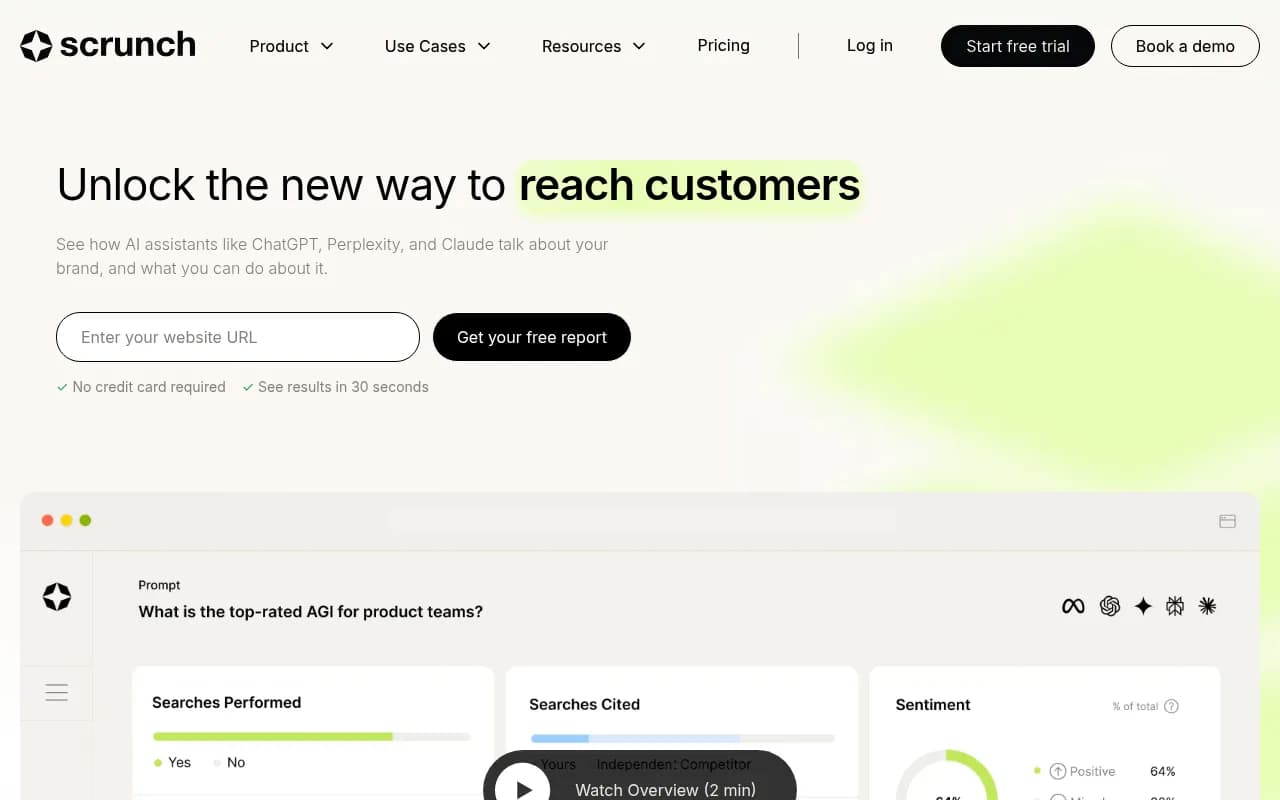
Scrunch AI is enterprise-only with sales-led pricing, and its differentiator is SOC 2 Type II compliance confirmed by independent audit. It supports RBAC, multi-brand management, API access, and monitoring across millions of prompts. If you're in a regulated industry where vendor security reviews decide your tooling, Scrunch AI shortens that conversation.
Nightwatch — best for combining precision rank tracking with AI Mode
Nightwatch pairs accurate traditional rank tracking with AI Mode, AI Overviews, ChatGPT, Claude, Gemini, and Perplexity monitoring. Plans start at €79/mo with 50 AI prompts and 1,500 AI answers collected monthly, scaling to an Agency tier at €399/mo with 500 prompts. No per-seat fees, unlimited users, SOC 2 compliant. Good fit if you want one tool where classic rankings and AI visibility live in the same dashboards.
Also worth a look
- Keyword.com ([tool:keyword-com]) — known for its 96.86% "Spyglass Verification" accuracy claim for AI visibility data. Pricing is tiered and ranges widely depending on bundle, so verify current numbers directly.
- Rankscale AI ([tool:rankscale]) — tracks 17+ engines from €20/mo, positioned by reviewers as the cheapest entry point into AI visibility tracking.
- seoClarity ([tool:seoclarity]) — enterprise SEO platform with ArcAI, an add-on for on-demand AI Mode tracking down to topic and URL level, plus hallucination detection. Custom quote pricing.
- Ahrefs Brand Radar ([tool:ahrefs-brand-radar]) — AI visibility across AI Mode, AI Overviews, ChatGPT, Perplexity, Copilot, and Gemini. The add-on costs $398/mo (select platforms) to $699/mo (all platforms) on top of an Ahrefs subscription, a substantial premium.
- Omnia ([tool:omnia]) — built for startups and scaleups, with citation intelligence that goes deeper than domain-level tracking and content briefs built from winning citation patterns.
Quick comparison
| Tool | AI Mode tracked | Starting price | Standout strength | Best for |
|---|---|---|---|---|
| Promptwatch | Yes, real UI data | Free plan; $95/mo | Crawler logs + automated content execution | Teams that want to fix visibility, not just watch it |
| LLM Pulse | Yes | €49/mo | 5 models on every plan, unlimited seats | Budget-conscious multi-model monitoring |
| SE Ranking | Yes (add-on) | Pay-per-check on top of base plan | SEO + AI in one platform | Agencies wanting one stack |
| Semrush AI Toolkit | Yes | $99/mo per domain | Prompt research database + site audit | Existing Semrush users |
| Profound | Yes | $99/mo (ChatGPT only); custom for full | Enterprise governance, Conversation Explorer | Fortune 500-scale brands |
| Scrunch AI | Yes | Custom (sales-led) | SOC 2 Type II, millions of prompts | Regulated industries |
| Nightwatch | Yes | €79/mo | Precision rank tracking + AI in one place | SEO teams bridging both worlds |
What AI Mode actually cites (and why it changes your strategy)
Tracking tells you where you stand. Knowing what AI Mode rewards tells you what to do about it.
Promptwatch's citation share data for June 2026 shows something unusual about AI Mode compared to every other engine: Google cites itself. google.com was the #1 cited domain at 7.31% of all citations, more than YouTube (2.88%) and Reddit (2.52%) combined. Counting YouTube and other Google properties, over 10% of AI Mode's citation mix goes to Google-owned surfaces.
That share is climbing fast. google.com went from 4.24% in May to 7.31% in June, a 72% jump on top of a sixfold increase the month before. In ChatGPT's data over the same period, Reddit leads and google.com barely registers. This self-preference is unique to AI Mode.
The practical implications:
- Treat Google Business Profile, Maps, Merchant Center, and YouTube as direct GEO channels, not side projects. They feed AI Mode's favorite sources.
- Reddit is the biggest external citation lever. It's the top non-Google source in AI Mode, though note that ChatGPT's reliance on Reddit has dropped sharply since August 2026, per Promptwatch's Reddit citation data.
- Independent sites compete via tightly-scoped, single-question pages. Below the top three domains in AI Mode, nothing clears 1% share individually. The open-web opportunity is almost entirely long-tail.
Content format matters too. In Google AI Overviews, Promptwatch's citation type data shows product pages overtook listicles as the most-cited format in late July 2026, the first time that's happened. Listicles fell from roughly 26% of citations in Q1 2026 to 18% by July, while product pages roughly doubled from about 9% in January. If your AI Mode strategy is "publish more listicles," it's built on last year's data.
How to set up tracking that survives scrutiny
A tool is only as good as the setup around it. Here's a workflow that holds up:
-
Build a prompt library with intent stages. Track generic category prompts ("best [category] for [use case]"), branded prompts, and comparison prompts. Aleyda Solis's guidance is to avoid tracking only one type: generic-only misses nuance, branded-only misses discovery-stage visibility. Different personas ask different questions, so segment accordingly.
-
Control and record your conditions. Set explicit location and language per prompt. Run logged-out. Tag every result by country. If your tool doesn't let you do this, that's a red flag.
-
Establish baselines. Run your first cycles and document starting metrics: mention rate, citation rate, share of voice, sentiment. Expect noise in the first weeks.
-
Validate the tool before trusting it. Run the same 20 prompts across two or three countries on two tools. If Tool A shows 15 of 20 prompts citing you and Tool B shows 8 of 20, one of them is missing genuine AI Mode responses.
-
Set alerts, not just dashboards. Configure notifications for large mention-rate drops, new competitors appearing, or negative sentiment spikes.
-
Review monthly, act weekly. AI visibility data is most useful when reviewed alongside content and SEO performance. And if you'd rather outsource the whole discipline, GEO specialists like 1001 SEO Media run AI visibility programs end to end, from tracking setup to content execution.
Common mistakes to avoid
Treating one run as a ranking. This is the single most common error. AI answers are probabilistic; a single response captures maybe a quarter of the real signal. Repeated runs under consistent conditions are the only reliable read.
Conflating AI Overviews with AI Mode. They're different surfaces with different citation behavior, and Google's merge into a continuous flow makes the confusion easier. Ask vendors directly which surface their "AI Mode" data comes from.
Tracking only branded prompts. Of course AI Mode mentions you when users type your brand name. The value is in discovery-stage prompts where your category, not your name, is the subject.
Ignoring platform-side shifts. On August 8, 2026, ChatGPT Search started using the site: operator at scale, jumping from about 0.4% to 17% of fanout queries overnight, with searches per response nearly doubling the same day. Changes like this rewrite the citation game overnight, which is exactly why continuous monitoring beats quarterly audits.
Buying the longest feature list. Match the tool to your stage, to how many engines your plan actually includes, and to your willingness to act on the data. A monitoring-only tool in the hands of a team that ships content weekly is worth less than a simpler tool paired with actual execution.
The bottom line
For most teams, the decision comes down to one question: do you want to watch your AI Mode visibility or improve it? If watching is enough, LLM Pulse offers the best price-to-coverage ratio, and SE Ranking fits if you want SEO and AI tracking under one roof. If you want the full loop, Promptwatch is the only platform in this list that combines real-UI tracking, crawler logs, traffic attribution, and automated content execution. And if procurement and compliance drive your choices, Profound and Scrunch AI are the enterprise answers.
Whatever you pick, start with a validated prompt library and repeated runs. The teams getting real value from AI Mode tracking in 2026 aren't the ones with the fanciest dashboard; they're the ones treating it like the probabilistic, fast-moving channel it actually is.