Owler Review 2026
Business intelligence platform providing company profiles, revenue estimates, news alerts, and competitive tracking. Crowdsourced data on over 15 million companies.
Key takeaways
- Owler covers 20M+ company profiles with crowdsourced revenue estimates, employee counts, funding history, and competitive relationships -- one of the largest databases of its kind for private company data
- The free Community tier lets you follow up to 5 companies and receive daily news digests, making it genuinely useful for occasional research without paying anything
- Pro pricing sits around $39/month, which is competitive against similar tools like Crunchbase Pro or ZoomInfo's entry tiers
- The competitor graph is the standout differentiator -- it maps direct and indirect competitive relationships across 45M+ relationships, something most company databases don't attempt
- Data accuracy on smaller private companies can be inconsistent; revenue estimates are crowdsourced and should be treated as directional, not authoritative
- Best suited for B2B sales reps, account executives, and market researchers -- less useful for deep financial due diligence or enterprise procurement workflows
Owler is a competitive intelligence platform built around a simple idea: business professionals need a fast, affordable way to understand the companies they sell to, compete with, or want to acquire. Founded in 2012 and headquartered in San Francisco, it grew out of the older Jigsaw/Data.com lineage of crowdsourced business data and has since built one of the more accessible company intelligence databases available. The platform now claims 20M+ company profiles, 150M+ verified contacts, and 45M+ mapped competitive relationships -- numbers that put it in the same conversation as Crunchbase and Owler's more expensive rivals.
The target audience is squarely B2B. Account executives use it to prep for sales calls. Market researchers use it to map competitive landscapes. Business development teams use it to identify acquisition targets or partnership candidates. It's not trying to be Bloomberg Terminal or a full data warehouse -- it's trying to be the tool you open before a meeting to get up to speed quickly.
Owler has gone through a few ownership changes over the years. It was acquired by Meltwater in 2021, which gave it access to a broader media monitoring infrastructure. That acquisition explains some of the news aggregation capabilities that feel more polished than you'd expect from a standalone startup.
Key features
Company profiles with crowdsourced data
Each company profile pulls together revenue estimates, employee headcount, founding year, headquarters location, funding history, and recent acquisitions. The data is partly crowdsourced from Owler's community of 5M+ business professionals who contribute and verify information, and partly aggregated from public sources. For large public companies, the data is reliable and well-maintained. For smaller private companies -- say, a 50-person SaaS startup -- the revenue estimates can be rough approximations. Owler is transparent about this: they label estimates as estimates. That honesty is appreciated, but users doing financial due diligence should cross-reference with other sources.
Competitor graph
This is genuinely the most interesting thing Owler does. Rather than just listing companies in the same industry, Owler maps competitive relationships based on community input and algorithmic inference. You can see direct competitors (companies that users have explicitly flagged as competing with a given company) and indirect competitors (companies that share overlapping competitive relationships). With 45M+ relationships in the database, the graph is dense enough to surface non-obvious competitors -- useful for market mapping exercises and for sales reps trying to understand a prospect's competitive context before a call.
News alerts and daily digests
Owler aggregates news from across the web and sends personalized daily email digests based on the companies you follow. You can configure alerts for specific trigger events: funding rounds, acquisitions, leadership changes, product launches. The news feed is genuinely useful for sales reps who want conversation starters -- knowing that a prospect just closed a Series B or announced a new product line gives you a reason to reach out. The alert quality is decent, though it occasionally surfaces older or less relevant articles alongside breaking news.
Contact database (150M+ verified contacts)
Owler Pro includes access to a contact database with 150M+ verified contacts, including names, titles, email addresses, and LinkedIn profiles. This is a significant addition that pushes Owler into sales intelligence territory alongside tools like Apollo.io or Hunter.io. Contact data quality varies -- it's better for senior roles at larger companies and thinner for smaller organizations. The verification process relies on a combination of automated checks and community contributions.
Advanced search and filtering
Pro users can filter Owler's entire database by revenue range, employee count, industry/sector, geography, and public vs. private status. This makes it practical for building targeted prospect lists. You can, for example, filter for private SaaS companies with 50-200 employees and $10M-$50M in estimated revenue in a specific metro area. The filters aren't as granular as dedicated sales intelligence platforms like ZoomInfo or Cognism, but they're sufficient for most prospecting workflows.
Funding and acquisition tracking
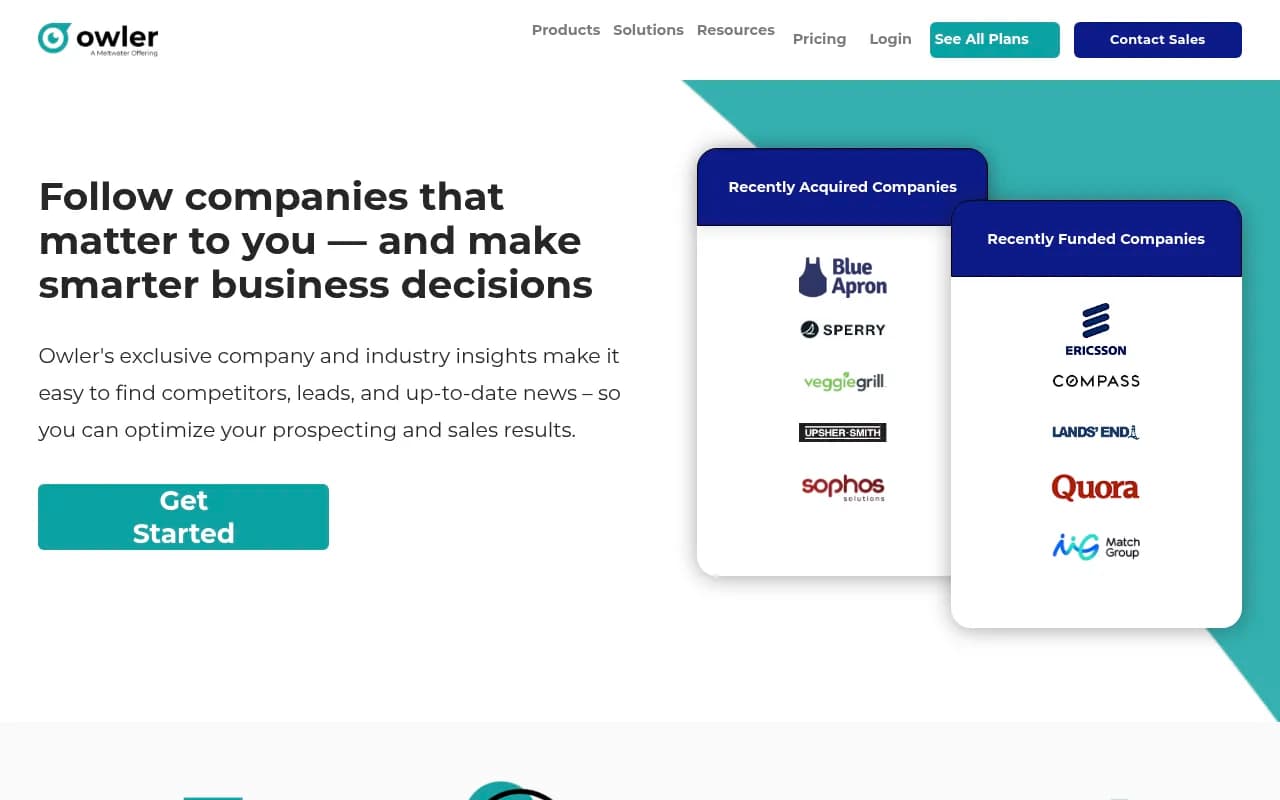
Owler tracks funding rounds and acquisitions in near real-time, which is useful for both sales triggers (a newly funded company is likely hiring and buying software) and competitive monitoring (a competitor getting acquired changes the landscape). The coverage of major funding events is solid; smaller seed rounds at obscure companies are sometimes missed or delayed.
Owler Community (free tier)
The free tier lets you follow up to 5 companies and receive daily news digests. It's a real product, not a crippled demo -- you get actual company profiles, competitor lists, and news alerts. For a freelancer or small business owner who just wants to keep tabs on a handful of competitors, the free tier is genuinely sufficient. This is a smart acquisition strategy that has helped Owler build its 5M+ user community.
Industry lists and sector views
Owler maintains curated industry lists across dozens of verticals -- SaaS, fintech, pharma, logistics, and more. These lists are useful for market research and for identifying companies in a specific space without having to build searches from scratch.
Who is it for
The clearest use case is B2B sales. Account executives at software companies, staffing firms, or professional services businesses use Owler to prep for prospect calls, identify trigger events (funding, acquisitions, leadership changes) that signal buying intent, and build targeted outreach lists. A rep covering the mid-market SaaS space, for example, can follow 50 target accounts and get a daily digest of relevant news -- a workflow that takes minutes to set up and delivers consistent value.
Market researchers and competitive intelligence analysts are another strong fit. The competitor graph makes it easy to map a competitive landscape quickly, and the combination of company profiles, funding data, and news aggregation covers most of what you need for a basic competitive analysis. It's not a replacement for a full CI platform like Crayon or Klue, but for teams that don't have budget for those tools, Owler fills a real gap.
Business development and corporate strategy teams use it for M&A research and partnership identification. The ability to filter by revenue, employee count, and geography makes it practical for building target lists of acquisition candidates or potential partners.
Who should probably look elsewhere: enterprise procurement teams doing financial due diligence (the revenue estimates aren't precise enough), data engineers who need clean, structured data via API (the API is limited), and anyone who needs real-time social media monitoring or brand sentiment analysis (that's not what Owler does).
Integrations and ecosystem
Owler's integration story is functional but not extensive. The platform connects with Salesforce, which is the most important integration for sales teams -- you can surface Owler data directly within Salesforce records, reducing the need to context-switch between tools. There's also a Chrome extension that lets you pull up Owler data while browsing LinkedIn or company websites, which is useful for quick lookups during prospecting.
Beyond Salesforce, Owler supports CSV export for contact and company data, which covers most basic workflow needs. There's no native HubSpot integration, which is a gap for teams on that CRM. Zapier connectivity exists for some automation use cases, though it's not as deep as you'd get with a dedicated sales intelligence platform.
The API is available but limited in scope and documentation -- it's not designed for developers building complex data pipelines. Teams that need programmatic access to large volumes of company data will find it restrictive compared to alternatives like Clearbit or Crunchbase's API.
Mobile support is basic. There's no dedicated mobile app; the web experience is responsive but not optimized for mobile workflows.
Pricing and value
Owler runs three main tiers:
- Community (Free): Follow up to 5 companies, access basic company profiles, receive daily news digests. No credit card required. Genuinely useful for light research.
- Pro (~$39/month): Unlimited company follows, full access to 20M+ company profiles, contact database access, advanced search filters, competitor graph, funding/acquisition alerts. Billed annually, which works out to roughly $468/year.
- Max (~$50/month): Adds additional contact export credits and some enhanced features. Targets heavier prospecting use cases.
- Enterprise: Custom pricing for teams, with Salesforce integration, team management, and higher data export limits.
The pricing is reasonable for what you get. At $39/month, Owler Pro is cheaper than Crunchbase Pro (around $49/month) and significantly cheaper than ZoomInfo or Cognism, which run into hundreds or thousands per month. The contact database inclusion at the Pro tier is good value -- you're essentially getting company intelligence and basic sales prospecting in one subscription.
The main caveat is that if you need high-volume contact exports or deep CRM integration, you'll hit limits quickly and need to move to Enterprise pricing, which requires a sales conversation.
Strengths and limitations
What Owler does well:
- The competitor graph is genuinely differentiated -- mapping 45M+ competitive relationships is something few tools attempt at this scale and price point
- The free tier is real and useful, not a bait-and-switch
- Coverage of private company data is broader than most alternatives at this price; getting revenue estimates and employee counts for a 30-person startup is hard to do elsewhere without paying significantly more
- News aggregation and alert quality is solid for sales trigger use cases
- The combination of company intelligence and contact data in one subscription at ~$39/month is good value
Honest limitations:
- Revenue estimates for private companies are crowdsourced approximations. They're useful for ballpark sizing but not for financial analysis. A company listed as "$10M-$50M revenue" could be anywhere in that range, or outside it.
- The API is thin. Teams that want to build data pipelines or enrich their own databases programmatically will find Owler frustrating compared to Clearbit, Crunchbase, or Apollo.
- No native HubSpot integration is a real gap given HubSpot's market share among SMBs and mid-market companies.
- Contact data quality drops off significantly for smaller companies and non-English-speaking markets. If your prospecting is focused on APAC or LATAM, expect more gaps.
- The platform hasn't changed dramatically in recent years. The UI feels dated in places, and there's no AI-assisted analysis, summarization, or recommendation layer that competitors are starting to add.
Bottom line
Owler is a solid, affordable competitive intelligence tool that earns its place in a B2B sales or market research workflow. The competitor graph and private company coverage are genuinely useful, the free tier is honest, and the Pro pricing is fair. It's not the deepest data source and it won't replace a dedicated CI platform for enterprise teams, but for account executives, market researchers, and small business owners who need fast, accessible company intelligence without a five-figure contract, it delivers.
Best use case in one sentence: a B2B sales rep who wants to follow 50 target accounts, get daily news alerts on funding and acquisitions, and quickly map a prospect's competitive landscape before a call.
Tags:
Frequently asked questions
What is Owler?
Is Owler free to use?
How much does Owler Pro cost?
How accurate is Owler's data for private companies?
What CRM integrations does Owler support?
How does Owler compare to Crunchbase?
Similar and alternative tools to Owler