Arize AI Review 2026
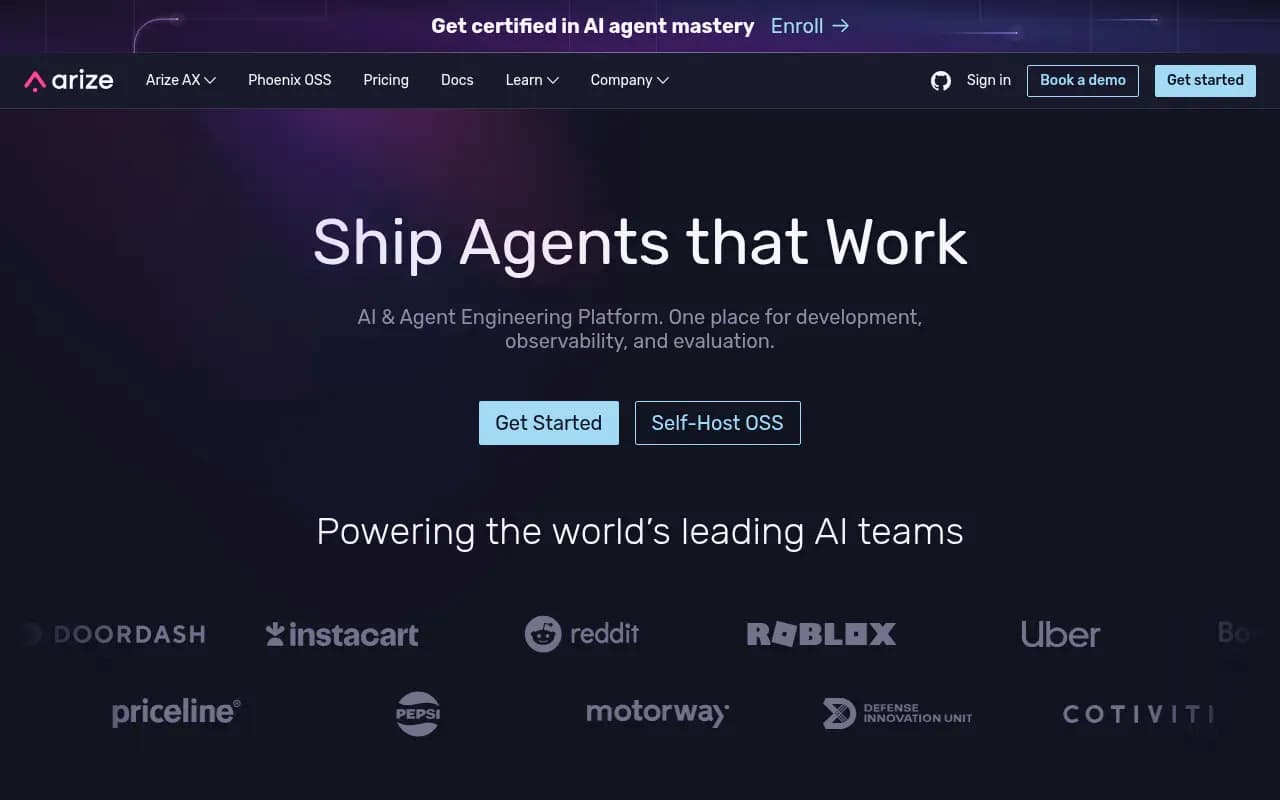
Arize AI is an enterprise-grade observability and evaluation platform for LLM applications and AI agents. Used by DoorDash, Uber, Reddit, and 6,700+ teams, it provides tracing, automated evaluations, prompt optimization, and real-time monitoring to help AI engineers ship reliable agents faster—from
Key Takeaways:
- Unified platform for LLM observability, agent evaluation, and prompt optimization—closes the loop between development and production
- Built on open standards (OpenTelemetry) with open-source evals library and Phoenix OSS—no vendor lock-in
- Enterprise-proven by DoorDash, Uber, Reddit, Booking.com, PepsiCo, Siemens—processes 1 trillion spans and 50M evals/month
- Best for ML/AI teams at scale (10+ engineers), enterprises deploying production agents, and teams needing eval-driven CI/CD
- Pricing starts at $99/mo for Essential tier; free trial available, open-source self-hosted option
Arize AI is an end-to-end observability and evaluation platform built specifically for teams shipping LLM applications and AI agents at scale. Founded by AI engineers who previously built ML infrastructure at Uber and TubiTV, Arize addresses the core challenge of modern AI development: how do you know if your agents actually work in production, and how do you systematically improve them? The platform is trusted by over 6,700 brands and agencies including DoorDash, Uber, Reddit, Roblox, Booking.com, PepsiCo, and Siemens. It processes 1 trillion spans and runs 50 million evaluations per month, making it one of the most battle-tested platforms in the LLM observability space. Arize was selected by the U.S. Navy's Defense Innovation Unit for Project AMMO (Automatic Target Recognition using MLOps for Maritime Operations), demonstrating its capability to handle mission-critical AI workloads.
The platform's core value proposition is closing the loop between AI development and production. Most LLM observability tools are monitoring-only dashboards that show you data but leave you stuck. Arize goes further by connecting real production data back into your development workflow—so you can find gaps, generate optimized content, and track results in a continuous improvement cycle. This makes it an optimization platform, not just a tracker.
OpenTelemetry-Based Tracing
Arize's tracing is built on OpenTelemetry (OTEL), the industry-standard observability framework. This means you get vendor-agnostic, framework-agnostic instrumentation that works with any LLM stack—LangChain, LlamaIndex, Haystack, custom agents, or raw OpenAI/Anthropic calls. The platform automatically captures spans (individual steps in your agent's execution), logs, and metadata without requiring proprietary SDKs. You can trace multi-step agent workflows, see exactly which tools were called, inspect latency at each step, and debug failures with full context. The OTEL foundation also means you can export data to other systems (Looker Studio, custom dashboards) or ingest traces from existing OTEL pipelines. This is a major differentiator vs competitors like Langfuse or Helicone that use proprietary tracing formats.
Automated Evaluations (LLM-as-a-Judge)
Arize runs automated evaluations on every trace using LLM-as-a-Judge—AI models that assess the quality of your agent's outputs against criteria like relevance, hallucination, toxicity, instruction-following, and custom rubrics. The evals library is fully open-source (available on GitHub), so you can inspect, modify, or extend evaluators to fit your domain. Evaluations run in real-time (online evals) or in batch during experiments. This is critical for catching regressions before they hit production. For example, if you change a prompt and hallucination rates spike from 2% to 8%, Arize flags it immediately. The platform supports both pre-built evaluators (20+ out of the box) and custom evaluators you define in Python. Unlike competitors that use black-box eval models, Arize's open-source approach gives you full transparency and control.
Prompt Optimization and Management
Arize includes a prompt playground where you can replay production traces, tweak prompts, and test variations side-by-side. The platform can automatically optimize prompts using evaluations and human annotations—it analyzes which prompt variations perform best on your golden dataset and suggests improvements. Once you've optimized a prompt, you can version it, deploy it via Arize's prompt serving API, and track its performance in production. This creates a self-improving loop: production data → evaluation → optimization → deployment → monitoring. The prompt hub acts as a central repository for all your prompts, making it easy for non-technical stakeholders (product managers, domain experts) to review and approve changes without touching code. This is a major workflow improvement over hardcoding prompts in your codebase.
CI/CD Experiments and Regression Testing
Arize supports eval-driven CI/CD by running experiments on every code or prompt change. You define a golden dataset (curated examples with expected outputs), set evaluation criteria, and Arize automatically runs your agent against the dataset whenever you push a change. If any eval metric drops below a threshold (e.g., accuracy falls from 92% to 85%), the pipeline fails and you're alerted before merging. This prevents prompt regressions from reaching production. The experiments view shows side-by-side comparisons of different prompt versions, model providers (GPT-4 vs Claude vs Gemini), or agent architectures. You can drill into individual traces to see exactly why a particular variant failed. This level of rigor is essential for teams shipping agents to customers—it's the difference between "we think this prompt is better" and "we have data proving this prompt is 8% more accurate."
Human Annotation and Labeling Queues
Arize includes built-in annotation tools for human-in-the-loop evaluation. You can create labeling queues, assign traces to reviewers, and collect thumbs-up/thumbs-down feedback or detailed rubric scores. Annotations feed back into your golden datasets and are used to fine-tune evaluators or retrain models. The platform supports multi-user workflows with role-based access control, so you can have domain experts label data without giving them full platform access. This is particularly useful for regulated industries (healthcare, finance) where human oversight is required. The annotation interface is embedded directly in the trace view, so reviewers see full context (user input, agent reasoning, tool calls, final output) when labeling.
Real-Time Monitoring and Dashboards
Arize provides real-time dashboards for monitoring LLM applications in production. You can track metrics like latency (p50, p95, p99), token usage, cost per request, error rates, and custom business metrics (e.g., conversion rate, user satisfaction). Dashboards are fully customizable—you can slice data by model provider, user segment, prompt version, or any metadata you log. The platform includes anomaly detection that alerts you when metrics deviate from baseline (e.g., latency suddenly spikes or hallucination rate doubles). This is critical for catching production issues before they impact users. Unlike traditional APM tools (Datadog, New Relic) that weren't built for LLMs, Arize understands LLM-specific metrics like token counts, embedding drift, and retrieval quality.
adb: Purpose-Built Datastore
Under the hood, Arize runs on adb, a proprietary datastore optimized for generative AI workloads. adb is designed for real-time ingestion (millions of spans per second), sub-second queries (even on petabyte-scale datasets), and elastic compute that scales up/down based on load. This is why Arize can handle 1 trillion spans—most competitors hit performance walls at much smaller scale. The datastore supports complex queries like "show me all traces where the agent called tool X, the user was in segment Y, and the response contained keyword Z" in under a second. This query speed is essential for debugging production issues in real time.
Alyx: AI Copilot for Agent Development
Arize recently introduced Alyx, an AI agent that helps you build agents. Alyx is context-aware—it understands your traces, evaluations, and production data—and can suggest prompt improvements, debug failures, or generate test cases. For example, if you're seeing high hallucination rates on a specific user segment, you can ask Alyx "why are we hallucinating for enterprise users?" and it will analyze traces, surface patterns, and suggest fixes. This is a major productivity boost for teams that don't have dedicated prompt engineers. Alyx is still in early access but represents Arize's vision of making AI development more accessible.
Machine Learning and Computer Vision Support
While Arize is best known for LLM observability, it also supports traditional ML models and computer vision. You can monitor model drift (feature drift, prediction drift), track embedding quality, and debug underperforming slices. The platform includes heatmaps for identifying failure modes, cluster analysis for finding edge cases, and embedding drift detection for NLP and CV models. This makes Arize a unified platform for all AI workloads, not just LLMs. Teams running both traditional ML and generative AI can consolidate on a single observability stack.
Integrations and Ecosystem
Arize integrates with the entire LLM stack: LangChain, LlamaIndex, Haystack, AutoGen, CrewAI, and custom frameworks. It supports all major model providers (OpenAI, Anthropic, Google, Cohere, AWS Bedrock, Azure OpenAI). The platform has native integrations with Looker Studio for custom reporting, Slack for alerts, and GitHub Actions for CI/CD. There's a full REST API and Python SDK for programmatic access. The open-source Phoenix project (5M+ downloads/month) can be self-hosted for teams that need on-prem deployment or want to try Arize without signing up.
Who Is Arize For?
Arize is built for ML/AI engineering teams at companies deploying production LLM applications and agents. The typical customer is a team of 10-50+ engineers at a mid-market or enterprise company (Series B+, 100-10,000 employees) shipping customer-facing AI features. Specific personas include ML engineers building RAG pipelines, AI product teams deploying chatbots or copilots, data scientists fine-tuning models, and MLOps engineers responsible for production reliability. Industries include e-commerce (DoorDash, Instacart), travel (Booking.com, Priceline, TripAdvisor), fintech, healthcare, and SaaS. Arize is also used by AI-first startups (Cohere, Radiant Security) and government/defense (U.S. Navy, Defense Innovation Unit).
Arize is not ideal for solo developers or very early-stage startups (pre-seed, <5 engineers) who are still experimenting with prompts and don't have production traffic yet. For those teams, the open-source Phoenix project is a better starting point. Arize is also overkill if you're only running simple single-prompt workflows with no agents or multi-step reasoning—tools like Langfuse or Helicone may be simpler. The platform shines when you have complex agent architectures, multiple models, high production volume, and a need for rigorous evaluation and monitoring.
Pricing and Value
Arize offers three paid tiers: Essential ($99/mo for 1 site, 50 prompts, 5 articles), Professional ($249/mo for 2 sites, 150 prompts, 15 articles, crawler logs, state/city tracking), and Business ($579/mo for 5 sites, 350 prompts, 30 articles). Agency and Enterprise pricing is custom. There's a free trial available, and annual billing includes discounts. Startup pricing is available for early-stage companies. The open-source Phoenix project is free and can be self-hosted indefinitely. Compared to competitors, Arize is mid-to-premium priced—more expensive than Langfuse or Helicone (which start free/low-cost) but comparable to enterprise platforms like Weights & Biases or Datadog. The value proposition is the unified platform: you're paying for tracing + evals + prompt optimization + monitoring in one place, rather than stitching together 3-4 tools.
Strengths
- Open standards and open source: Built on OpenTelemetry, open-source evals library, and Phoenix OSS—no vendor lock-in
- Enterprise-proven scale: Processes 1 trillion spans, used by Uber, DoorDash, Reddit, PepsiCo—this is production-grade infrastructure
- Unified platform: Tracing, evals, prompt optimization, and monitoring in one place—no need to integrate multiple tools
- Eval-driven CI/CD: Automated regression testing prevents bad prompts from reaching production
- Prompt optimization: Self-improving agents via automatic prompt tuning based on evals and annotations
Limitations
- Pricing: At $99-$579/mo, Arize is more expensive than free/freemium competitors like Langfuse or Helicone—may be cost-prohibitive for bootstrapped startups
- Learning curve: The platform is feature-rich, which means there's a steeper learning curve than simpler tools—expect 1-2 weeks to fully onboard
- Overkill for simple use cases: If you're only running single-prompt workflows with no agents, Arize's advanced features (multi-step tracing, agent optimization) may be unnecessary
Bottom Line
Arize AI is the go-to platform for ML/AI teams at scale who need end-to-end observability and evaluation for production LLM applications and agents. If you're shipping agents to customers, need rigorous eval-driven CI/CD, and want a unified platform that closes the loop between development and production, Arize is worth the investment. Best use case in one sentence: enterprises deploying multi-agent systems that require real-time monitoring, automated evaluations, and continuous prompt optimization at petabyte scale.
Tags:
Frequently asked questions
What is Arize AI?
How much does Arize AI cost?
Who is Arize AI best for?
What companies use Arize AI?
Does Arize AI have a free version?
What makes Arize AI different from other LLM observability tools?
What are the key features of Arize AI?
Similar and alternative tools to Arize AI