Key Takeaways
- Completely different use cases: Promptwatch tracks brand visibility in AI search engines (ChatGPT, Claude, Perplexity), while Amplitude tracks user behavior within your product. They solve different problems.
- Pricing: Amplitude offers a generous free tier (10K monthly tracked users), while Promptwatch starts at $75-99/mo with a 7-day trial. Amplitude scales to $2K-50K+/year for enterprise; Promptwatch ranges $75-579/mo for standard plans.
- Data sources: Promptwatch monitors AI model responses and crawler logs. Amplitude tracks events from your web/mobile app via SDK integration.
- Best for AI visibility: Promptwatch is purpose-built for tracking how ChatGPT, Claude, and other LLMs mention your brand -- Amplitude doesn't cover this at all.
- Best for product analytics: Amplitude is the industry standard for understanding user journeys, conversion funnels, and retention. Promptwatch doesn't track in-app user behavior.
- You might need both: If you're driving traffic from AI search AND want to understand what users do after they land, these tools complement each other rather than compete.
Overview
Promptwatch

Promptwatch is an AI Search Visibility platform that helps brands monitor and optimize how they appear in AI-generated responses. It tracks mentions across ChatGPT, Claude, Perplexity, Gemini, Google AI Overviews, and other large language models. The platform shows you which prompts trigger mentions of your brand, analyzes citation sources, logs AI crawler activity on your site, and generates content recommendations to improve visibility. It's used by 7,000+ brands and agencies who want to treat AI search as a traffic channel.
The core workflow: track specific prompts, see when AI models mention (or don't mention) your brand, identify content gaps vs competitors, generate optimized content, and measure the impact on AI visibility scores.
Amplitude
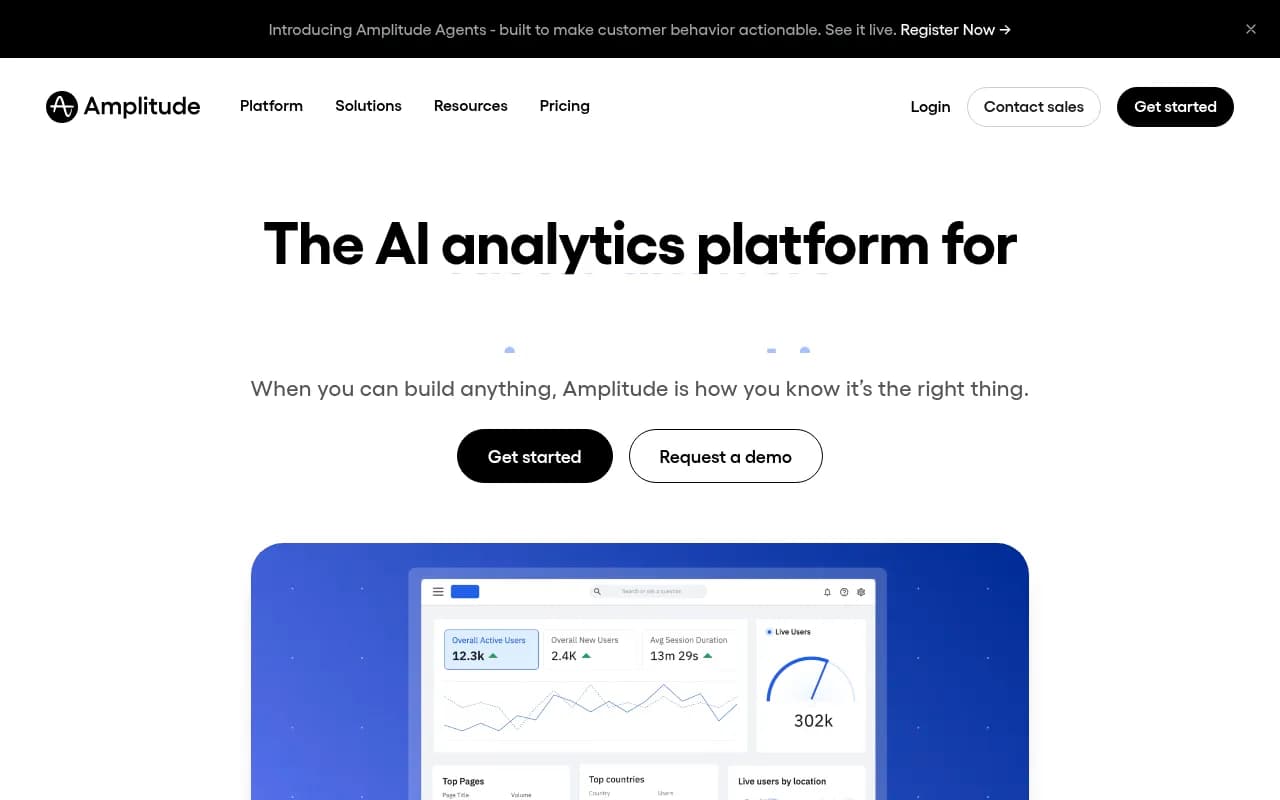
Amplitude is a product analytics platform that tracks user behavior within digital products -- web apps, mobile apps, SaaS platforms. It captures events (clicks, page views, feature usage) and turns them into insights about user journeys, conversion funnels, retention cohorts, and feature adoption. Amplitude is used by 11,000+ digital products including Square, Walmart, NBC, and Atlassian to understand what users do, why they churn, and which features drive growth.
The core workflow: instrument your app with Amplitude's SDK, define events and user properties, build charts and dashboards to analyze behavior, run experiments, and optimize the product based on what the data shows.
Side-by-Side Comparison
| Feature | Promptwatch | Amplitude |
|---|---|---|
| Primary use case | AI search visibility tracking | Product analytics & user behavior |
| Data source | AI model responses, crawler logs | In-app events via SDK |
| Free tier | 7-day trial | Yes, up to 10K MTUs |
| Starting price | $75-99/mo | $49/mo (Plus plan, 300K MTUs) |
| AI models tracked | 10+ (ChatGPT, Claude, Perplexity, Gemini, etc.) | None |
| User behavior tracking | No | Yes (core feature) |
| Content generation | Yes (AI writing agent) | No |
| Funnel analysis | No | Yes |
| Crawler logs | Yes (AI crawlers) | No |
| Citation analysis | Yes (880M+ citations) | No |
| Cohort analysis | No | Yes |
| Experimentation | No | Yes (A/B testing) |
| API access | Yes | Yes |
| Target audience | Marketing/SEO teams, agencies | Product managers, growth teams |
What problem are you solving?
This comparison only makes sense if you understand what each tool is built for.
Promptwatch: AI search visibility
Promptwatch answers questions like:
- Does ChatGPT recommend my brand when users ask for product suggestions?
- Which competitors are getting cited instead of me?
- What content am I missing that would get me mentioned in AI responses?
- Are AI crawlers successfully indexing my site?
- How often does my brand appear in Perplexity search results?
If you're not thinking about AI search as a traffic channel, Promptwatch isn't relevant. But if you've noticed traffic from ChatGPT or want to rank in AI-generated recommendations, it's the only platform that tracks this systematically.
Amplitude: Product analytics
Amplitude answers questions like:
- Where do users drop off in my signup flow?
- Which features correlate with long-term retention?
- How do power users behave differently from casual users?
- Did the new onboarding flow improve activation rates?
- What's the conversion rate from free trial to paid?
If you don't have a digital product with users taking actions, Amplitude isn't relevant. But if you're building software and need to understand user behavior, it's an industry-standard choice.
Head-to-head feature comparison
Tracking capabilities
Promptwatch tracks external AI model responses. You define prompts ("best CRM for startups", "top project management tools"), and Promptwatch monitors whether ChatGPT, Claude, Perplexity, and other models mention your brand in their answers. It also logs when AI crawlers (GPTBot, ClaudeBot, PerplexityBot) visit your website -- which pages they read, how often they return, any errors they encounter.
This is outward-facing monitoring. You're tracking how the outside world (AI models) talks about you.
Amplitude tracks internal user behavior. You instrument your app with their SDK, define events ("button_clicked", "page_viewed", "purchase_completed"), and Amplitude captures every action users take. You can then slice this data by user properties, build funnels, analyze cohorts, and see exactly how people use your product.
This is inward-facing monitoring. You're tracking what users do inside your product.
They're measuring completely different things.
Analytics and insights
Promptwatch shows:
- Visibility scores across AI models
- Citation sources (which URLs AI models reference)
- Prompt volumes and difficulty scores
- Competitor heatmaps (who's winning for each prompt)
- Reddit and YouTube discussions that influence AI recommendations
- Query fan-outs (how one prompt branches into sub-queries)
- Page-level tracking (which of your pages get cited)
Amplitude shows:
- User journey maps
- Conversion funnels with drop-off rates
- Retention curves and cohort analysis
- Feature adoption rates
- User segmentation (power users vs casual users)
- Behavioral cohorts (users who did X are Y% more likely to do Z)
- Predictive analytics (likelihood to convert, churn risk)
Again, different domains. Promptwatch tells you about AI visibility. Amplitude tells you about user behavior.
Content and optimization
Promptwatch includes an AI writing agent that generates articles, listicles, and comparison pages based on citation data, prompt volumes, and competitor analysis. The idea: if you're invisible for certain prompts, Promptwatch shows you what content to create to get cited. It also provides Answer Gap Analysis -- which prompts competitors rank for but you don't, with specific content recommendations.
This is content-driven optimization. You're creating pages that AI models will cite.
Amplitude doesn't generate content. Instead, it helps you optimize the product experience through experimentation. You can run A/B tests on features, flows, and UI changes, then measure impact on conversion, retention, and engagement. Amplitude also has AI-powered insights that surface anomalies and suggest areas to investigate.
This is product-driven optimization. You're improving the user experience based on behavioral data.
Integrations and data flow
Promptwatch integrates with:
- Google Search Console (to connect AI visibility with organic search)
- Looker Studio (for custom reporting)
- API for custom workflows
- Website analytics via code snippet or server logs (to attribute traffic from AI sources)
Data flows one way: Promptwatch monitors AI models and your site, then surfaces insights.
Amplitude integrates with:
- 100+ tools via native integrations (Segment, mParticle, Braze, Salesforce, etc.)
- Data warehouses (Snowflake, BigQuery, Redshift) for two-way sync
- CDPs for unified customer profiles
- Experimentation platforms
- Marketing automation tools
Data flows both ways: you send events to Amplitude, and you can export cohorts/segments to other tools for activation.
Amplitude is built for a data ecosystem. Promptwatch is more standalone.
AI capabilities
Promptwatch is fundamentally about AI -- tracking AI models, analyzing AI-generated responses, using AI to generate content. The entire platform is oriented around the question "how do AI search engines see my brand?"
Recent additions include AI Agents that monitor data-driven issues 24/7 and surface optimization opportunities automatically.
Amplitude added AI features in 2024-2025:
- AI Agents that sense, analyze, and optimize issues automatically
- Natural language query interface (ask questions in plain English)
- Automated insight detection (anomalies, trends, opportunities)
- Predictive models for conversion and churn
But Amplitude's AI is about analyzing user behavior data, not about tracking AI search engines. The word "AI" means different things in each context.
Pricing comparison
| Plan | Promptwatch | Amplitude |
|---|---|---|
| Free tier | 7-day trial | Up to 10K MTUs (monthly tracked users) |
| Starter | Essential: $75-99/mo (1 site, 50 prompts, 5 articles/mo) | Plus: $49/mo (300K MTUs, limited features) |
| Mid-tier | Professional: $249/mo (2 sites, 150 prompts, 15 articles, crawler logs) | Growth: Custom (typically $2K-10K/year, more MTUs + advanced features) |
| High-tier | Business: $579/mo (5 sites, 350 prompts, 30 articles) | Enterprise: Custom (typically $20K-50K+/year, unlimited MTUs, full platform) |
| Agency/Enterprise | Custom pricing | Custom pricing |
Amplitude's free tier is genuinely useful for small products. 10K monthly tracked users covers many early-stage startups. Promptwatch doesn't have a free tier, but the 7-day trial lets you test before committing.
For mid-market and enterprise, both platforms move to custom pricing. Amplitude tends to be more expensive at scale because you're paying per tracked user. Promptwatch pricing is based on sites, prompts, and content generation volume.
Pros and cons
Promptwatch pros
- Only platform that systematically tracks AI search visibility across 10+ models
- Crawler logs show exactly how AI bots interact with your site
- Content generation tied directly to citation data and prompt volumes
- Answer Gap Analysis pinpoints exactly what content you're missing
- Reddit and YouTube tracking (channels most competitors ignore)
- ChatGPT Shopping monitoring for e-commerce brands
- Multi-language and multi-region support
Promptwatch cons
- Doesn't track user behavior within your product
- No funnel analysis or cohort tracking
- Pricing can add up if you need to track many sites or prompts
- Relatively new category -- some companies still don't see AI search as a priority
- No mobile app for monitoring on the go
Amplitude pros
- Industry-standard product analytics with proven ROI (217% over 3 years per Forrester)
- Generous free tier for small products
- Deep funnel and cohort analysis
- Strong experimentation capabilities
- 100+ integrations with marketing and product tools
- Predictive analytics for conversion and churn
- Trusted by 11,000+ digital products
Amplitude cons
- Doesn't track AI search visibility at all
- Steep learning curve -- takes time to instrument properly and build useful dashboards
- Can get expensive at scale (per-MTU pricing)
- Requires engineering resources to implement SDK and maintain event tracking
- Overkill if you just need basic web analytics
Who should pick which tool?
Pick Promptwatch if:
- You're focused on AI search as a traffic channel (ChatGPT, Perplexity, Claude)
- You want to know when and how AI models mention your brand
- You're competing for visibility in AI-generated recommendations
- You need content recommendations based on what AI models are looking for
- You're an agency managing AI visibility for multiple clients
- You want to track AI crawler activity on your website
- You're in e-commerce and care about ChatGPT Shopping recommendations
Pick Amplitude if:
- You have a digital product (web app, mobile app, SaaS) with active users
- You need to understand user journeys, conversion funnels, and retention
- You're optimizing product features based on behavioral data
- You want to run A/B tests and measure impact on engagement
- You need cohort analysis to understand different user segments
- You're a product manager or growth team making data-driven decisions
- You want predictive analytics for conversion and churn
Pick both if:
- You're driving traffic from AI search AND want to understand what users do after they land
- You're optimizing the full funnel: AI visibility → website visit → product signup → activation → retention
- You have budget for complementary tools that solve different problems
For example: use Promptwatch to get your brand cited in ChatGPT responses, then use Amplitude to track what those AI-referred users do once they reach your product. The tools don't overlap -- they cover different stages of the user journey.
The complementary angle
Here's where it gets interesting: these tools can work together.
Say you're a SaaS company. You use Promptwatch to optimize for prompts like "best project management tool for remote teams". You create content, improve your AI visibility, and start getting cited in ChatGPT responses. Traffic from AI sources increases.
Now what? You need to know if that AI-referred traffic converts. That's where Amplitude comes in. You can tag AI traffic sources, track them through your signup funnel, and see if they have better or worse activation rates than other channels. Maybe AI-referred users are more qualified because ChatGPT pre-filtered them. Or maybe they're just browsing. Amplitude tells you.
Conversely, if Amplitude shows that users from a certain persona convert really well, you can use that insight in Promptwatch to target prompts that persona would ask. The data flows both ways.
If you're also looking to track how your brand shows up in AI search results more broadly, Promptwatch covers that angle with detailed prompt tracking and citation analysis.
Final verdict
This isn't a fair fight because Promptwatch and Amplitude solve different problems. Promptwatch is for AI search visibility. Amplitude is for product analytics. Asking "which is better?" is like asking "which is better, a hammer or a screwdriver?"
If you're trying to rank in ChatGPT and other AI search engines, Promptwatch is the only platform built for that. Amplitude won't help you.
If you're trying to understand user behavior within your product, Amplitude is an industry-standard choice. Promptwatch won't help you.
If you're optimizing the full funnel from AI visibility to product activation, you probably need both.
The real question: where is your bottleneck? If you're invisible in AI search, fix that first with Promptwatch. If you're getting traffic but users aren't converting, fix that with Amplitude. Different tools, different jobs.