Key Takeaways
- Ceyo costs $49/mo to start vs AthenaHQ's $295/mo ($95 first month) -- Ceyo is 6x cheaper for small teams
- AthenaHQ tracks 8+ LLMs including Google AI Overviews; Ceyo covers ChatGPT, Gemini, Claude, and Perplexity (4 models)
- AthenaHQ uses a credit-based model (1 credit per query) which can get expensive at scale; Ceyo offers fixed monthly pricing
- Ceyo focuses on prompt analytics and sentiment tracking; AthenaHQ positions itself as an "end-to-end AEO/GEO platform" with content optimization recommendations
- AthenaHQ has bigger-name customers (Coinbase, ZoomInfo, SoFi) and more enterprise features; Ceyo targets agencies and mid-market brands
- Neither platform offers content generation -- both are monitoring-focused dashboards that show you data but leave optimization work to you
Overview
Both Ceyo and AthenaHQ solve the same core problem: helping brands understand how they appear in AI search results. As ChatGPT, Perplexity, and other LLMs replace traditional search for millions of users, companies need visibility into which prompts mention their brand, how they're positioned vs competitors, and whether sentiment is positive or negative.
Ceyo
Ceyo
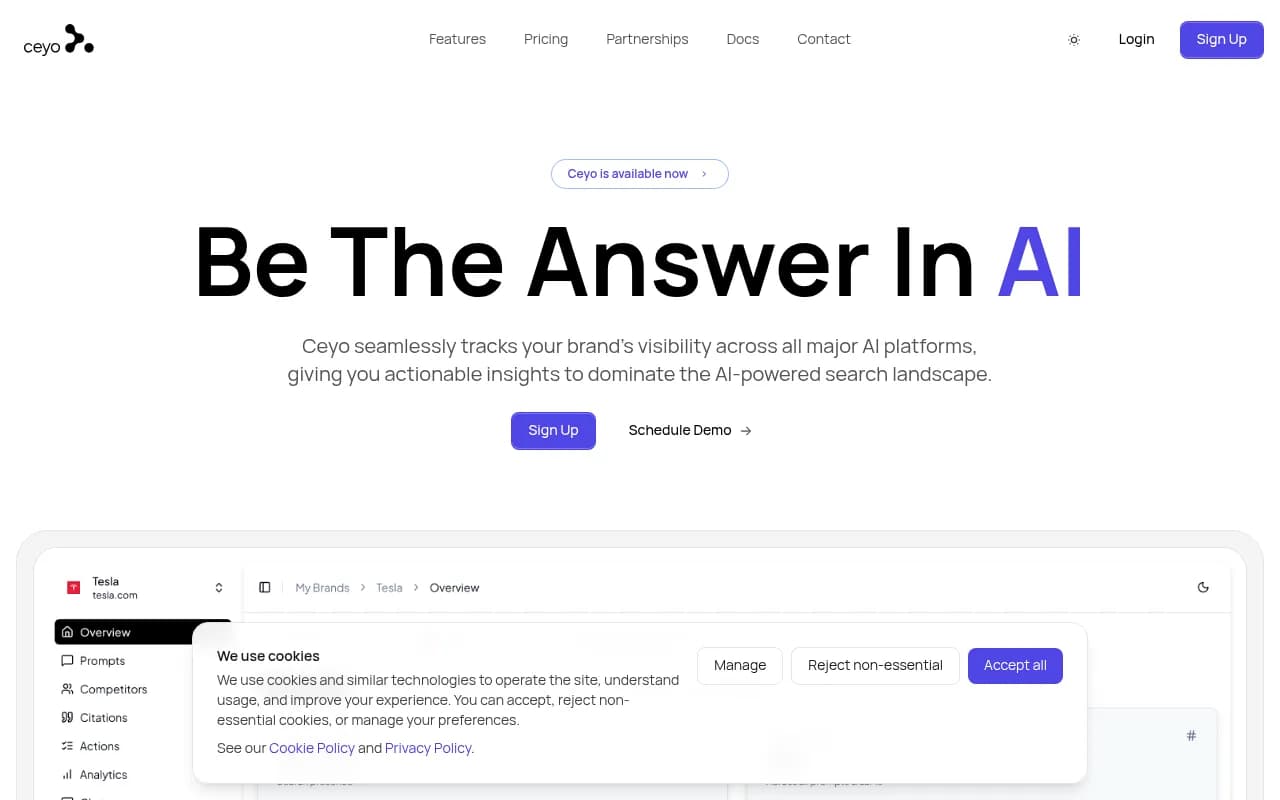
Ceyo is a GEO platform built for agencies and marketing teams who want straightforward AI visibility tracking without enterprise complexity. It monitors four major LLMs (ChatGPT, Gemini, Claude, Perplexity) and organizes data around prompt performance, sentiment analysis, and competitor mentions. The interface emphasizes prompt-level analytics -- you see exactly which queries drive your brand's presence, average position, impact scores, and which other brands appear alongside yours. Pricing starts at $49/mo for the Core plan, making it one of the most affordable options in the space.
AthenaHQ

AthenaHQ markets itself as an "end-to-end AEO & GEO platform" used by enterprise brands like Coinbase, ZoomInfo, and SoFi. It tracks 8+ LLMs (including Google AI Overviews, which Ceyo doesn't cover) and provides citation source analysis, ROI tracking, and content optimization recommendations. The platform uses a credit-based pricing model -- each AI query costs one credit, and the Self-Serve plan starts at $295/mo ($95 for the first month). AthenaHQ positions itself as a strategic command center for GEO specialists rather than just a monitoring dashboard.
Side-by-Side Comparison
| Feature | Ceyo | AthenaHQ |
|---|---|---|
| Starting price | $49/mo (Core) | $295/mo ($95 first month) |
| Pricing model | Fixed monthly tiers | Credit-based (1 credit = 1 query) |
| LLMs tracked | 4 (ChatGPT, Gemini, Claude, Perplexity) | 8+ (includes Google AI Overviews, Copilot) |
| Free trial | Not specified | 14-day trial mentioned in research |
| Prompt analytics | Yes (visibility, sentiment, avg position, impact) | Yes (citation tracking, ROI metrics) |
| Competitor tracking | Yes (shows brands mentioned alongside yours) | Yes (competitive benchmarking) |
| Content optimization | No | Recommendations only (no generation) |
| Citation source analysis | Not mentioned | Yes |
| Target audience | Agencies, mid-market brands | Enterprise teams, GEO specialists |
| Annual billing discount | Yes | 17% discount |
| Notable customers | Brandfirm, Zigt, Enreach | Coinbase, ZoomInfo, SoFi, Volkswagen |
| API access | Not specified | Not specified |
Pricing breakdown
The pricing difference is the most immediate decision factor.
Ceyo pricing
| Plan | Price | Details |
|---|---|---|
| Core | $49/mo | Entry-level monitoring |
| Standard | Not disclosed | Mid-tier features |
| Enterprise | Custom | Volume pricing, dedicated support |
Ceyo uses traditional SaaS pricing -- you pay a fixed monthly fee and get access to features based on your tier. The $49/mo Core plan is accessible for small agencies and individual brands testing AI visibility for the first time. Standard and Enterprise pricing isn't public, but the structure suggests predictable costs as you scale.
AthenaHQ pricing
| Plan | Price | Details |
|---|---|---|
| Self-Serve | $295/mo ($95 first month) | Credit-based model |
| Enterprise | Custom | Volume discounts, dedicated support |
| Annual discount | 17% off | Applies to both plans |
AthenaHQ's credit system means costs scale with usage. If you're running 500 queries per month and each costs one credit, you need to budget accordingly. The $95 first-month discount softens the entry barrier, but ongoing costs are 6x higher than Ceyo's starting price. For enterprise teams running thousands of queries across multiple brands, this can add up fast -- or it can be worth it if the additional LLM coverage and citation analysis deliver ROI.
LLM coverage and tracking depth
Ceyo tracks four LLMs: ChatGPT, Gemini, Claude, and Perplexity. That covers the most popular conversational AI search engines, but it misses Google AI Overviews (the AI summaries that appear in traditional Google search results) and Microsoft Copilot. For most brands, those four models represent the bulk of AI search traffic, but if you need comprehensive coverage, the gap matters.
AthenaHQ tracks 8+ LLMs, including Google AI Overviews and Copilot. This is a bigger deal than it sounds -- Google AI Overviews appear in billions of traditional search results, and missing that data means you're blind to a huge chunk of AI-influenced traffic. If your SEO strategy depends on understanding how Google's AI summaries cite (or don't cite) your content, AthenaHQ is the only option here.
Both platforms track the same core metrics: visibility scores, sentiment, competitor mentions, and prompt-level performance. The difference is breadth vs depth. Ceyo gives you deep analytics on four models. AthenaHQ gives you broader coverage with citation source analysis (which URLs and domains LLMs are pulling from) that Ceyo doesn't mention.
Prompt analytics and sentiment tracking
Ceyo's interface (based on the website screenshot) organizes everything around individual prompts. You see a table with columns for visibility percentage, sentiment (positive/neutral/negative), average position, impact score, competing brands, category, and geography. This is useful if your workflow is "which prompts are we winning or losing, and what's the sentiment?"
The sentiment tracking is a standout feature. Knowing that your brand appears in 85% of responses to "best laptop for developers" is good; knowing that the sentiment is positive vs neutral vs negative is better. Ceyo surfaces this at a glance.
AthenaHQ also tracks sentiment and visibility, but the website emphasizes citation source analysis and ROI tracking more heavily. The pitch is less about individual prompt performance and more about strategic oversight -- executive dashboards, cross-platform benchmarking, and tying AI visibility to business outcomes. If you're a GEO specialist managing multiple brands, AthenaHQ's framing fits that role. If you're an agency account manager who needs to show clients "here's how you're doing on these 50 prompts," Ceyo's table view is more direct.
Content optimization and recommendations
Neither platform generates content for you. This is a critical limitation if you're comparing them to tools like Promptwatch, which includes an AI writing agent that creates articles grounded in citation data and prompt volumes.

Ceyo doesn't mention content optimization at all. It's purely a monitoring dashboard -- you get the data, you figure out what to do with it.
AthenaHQ claims to provide "automated content optimization recommendations," but the website doesn't specify what that means. Based on the positioning ("recommendations" not "generation"), it likely surfaces suggestions like "your competitors are cited more often because they cover X topic" or "this source is frequently cited, consider getting a backlink." Useful, but you still have to write the content yourself.
If your goal is to close the loop from "we're not visible" to "we published content that ranks in AI search," both platforms leave a gap. You'll need a separate content team or tool to act on the insights.
Target audience and customer base
Ceyo's customer logos (Brandfirm, Zigt, Enreach) are agencies and mid-market European companies. The $49/mo entry price and focus on prompt-level analytics suggest it's built for teams that need clear, actionable data without enterprise overhead.
AthenaHQ's customer list (Coinbase, ZoomInfo, SoFi, Volkswagen) is enterprise-heavy. The messaging ("empowering next-gen marketing teams," "executive AI visibility dashboard") targets CMOs and GEO specialists at large organizations. The credit-based pricing model makes sense for enterprise buyers who want to scale usage across departments and justify costs with ROI metrics.
If you're a 5-person marketing team at a SaaS startup, Ceyo's pricing and interface are more approachable. If you're managing AI visibility for a Fortune 500 brand with multiple product lines, AthenaHQ's enterprise features and broader LLM coverage justify the cost.
Ease of use and onboarding
Ceyo's website shows a clean, table-based interface. The learning curve looks low -- if you understand what a prompt is and why visibility matters, you can start using it immediately. The prompt analytics table is self-explanatory: green percentages are good, red percentages are bad, sentiment tells you the tone.
AthenaHQ's website emphasizes "workflows" and "command centers," which suggests more complexity. The feature list (citation source analysis, ROI tracking, cross-platform benchmarking) implies a steeper learning curve. Enterprise tools often trade simplicity for power, and AthenaHQ seems to follow that pattern.
Neither platform mentions onboarding support or training in the public materials, but AthenaHQ's enterprise positioning suggests dedicated account management is available at higher tiers.
What's missing from both platforms
Both Ceyo and AthenaHQ are monitoring tools. They tell you where you stand but don't help you improve. Specifically:
- No content generation: You get insights, not articles. If you discover you're invisible for 200 high-value prompts, you still need to write 200 pieces of content.
- No crawler log analysis: You can't see which AI models are actually crawling your website, how often, or what errors they encounter.
- No traffic attribution: You can track visibility, but connecting that to actual traffic and revenue requires separate analytics.
- No Reddit or YouTube tracking: Both platforms focus on LLM responses but miss the sources (Reddit threads, YouTube videos) that heavily influence those responses.
If you want a platform that closes the loop from visibility tracking to content creation to traffic attribution, you're looking at tools like Promptwatch, which combines monitoring with an AI writing agent, crawler logs, and visitor analytics.
Pros and cons
Ceyo pros
- 6x cheaper than AthenaHQ for entry-level plans ($49 vs $295)
- Clean, table-based interface that's easy to scan
- Strong sentiment tracking at the prompt level
- Fixed monthly pricing (no surprise costs from credit overages)
- Good fit for agencies managing multiple clients
Ceyo cons
- Only tracks 4 LLMs (misses Google AI Overviews and Copilot)
- No content optimization or recommendations mentioned
- Smaller customer base and less enterprise credibility
- Limited public information about Standard and Enterprise tiers
- No citation source analysis
AthenaHQ pros
- Tracks 8+ LLMs including Google AI Overviews (critical for SEO teams)
- Citation source analysis shows which URLs and domains LLMs cite
- Strong enterprise customer base (Coinbase, ZoomInfo, SoFi)
- Content optimization recommendations (though not generation)
- ROI tracking and executive dashboards for strategic oversight
AthenaHQ cons
- 6x more expensive than Ceyo ($295/mo vs $49/mo)
- Credit-based pricing can get expensive at scale
- More complex interface (steeper learning curve)
- Still doesn't generate content -- recommendations only
- Overkill for small teams or individual brands
Who should pick Ceyo
Pick Ceyo if you're an agency managing AI visibility for multiple clients and need a cost-effective tool with straightforward prompt analytics. The $49/mo entry price makes it easy to justify, and the table-based interface is simple enough to show clients in monthly reports. If your clients care about ChatGPT, Gemini, Claude, and Perplexity (but not Google AI Overviews), the four-LLM coverage is sufficient.
Ceyo also makes sense for mid-market brands testing AI visibility for the first time. You can start with the Core plan, see which prompts drive mentions, and decide whether to invest more heavily in GEO before committing to enterprise pricing.
Who should pick AthenaHQ
Pick AthenaHQ if you're an enterprise marketing team that needs comprehensive LLM coverage (especially Google AI Overviews) and can justify $295/mo with ROI metrics. The citation source analysis is valuable if you're doing link building or trying to understand why competitors outrank you. The executive dashboards and strategic framing fit larger organizations where GEO is a dedicated function, not a side project.
AthenaHQ is also the better choice if you're already invested in traditional SEO and need to track how Google's AI summaries cite your content. Missing Google AI Overviews means missing a huge chunk of AI-influenced search traffic.
Final verdict
Ceyo wins on price and simplicity. AthenaHQ wins on LLM coverage and enterprise features. The decision comes down to budget and scope.
If you're a small team or agency with a tight budget, Ceyo gives you 80% of the value at 15% of the cost. If you're an enterprise team managing AI visibility across multiple brands and need Google AI Overviews tracking, AthenaHQ's higher price is justified.
Both platforms share the same fundamental limitation: they're monitoring dashboards, not optimization platforms. You get data, not solutions. If you want a tool that actually helps you create content that ranks in AI search (not just tells you where you're failing), you're looking at a different category of product entirely.